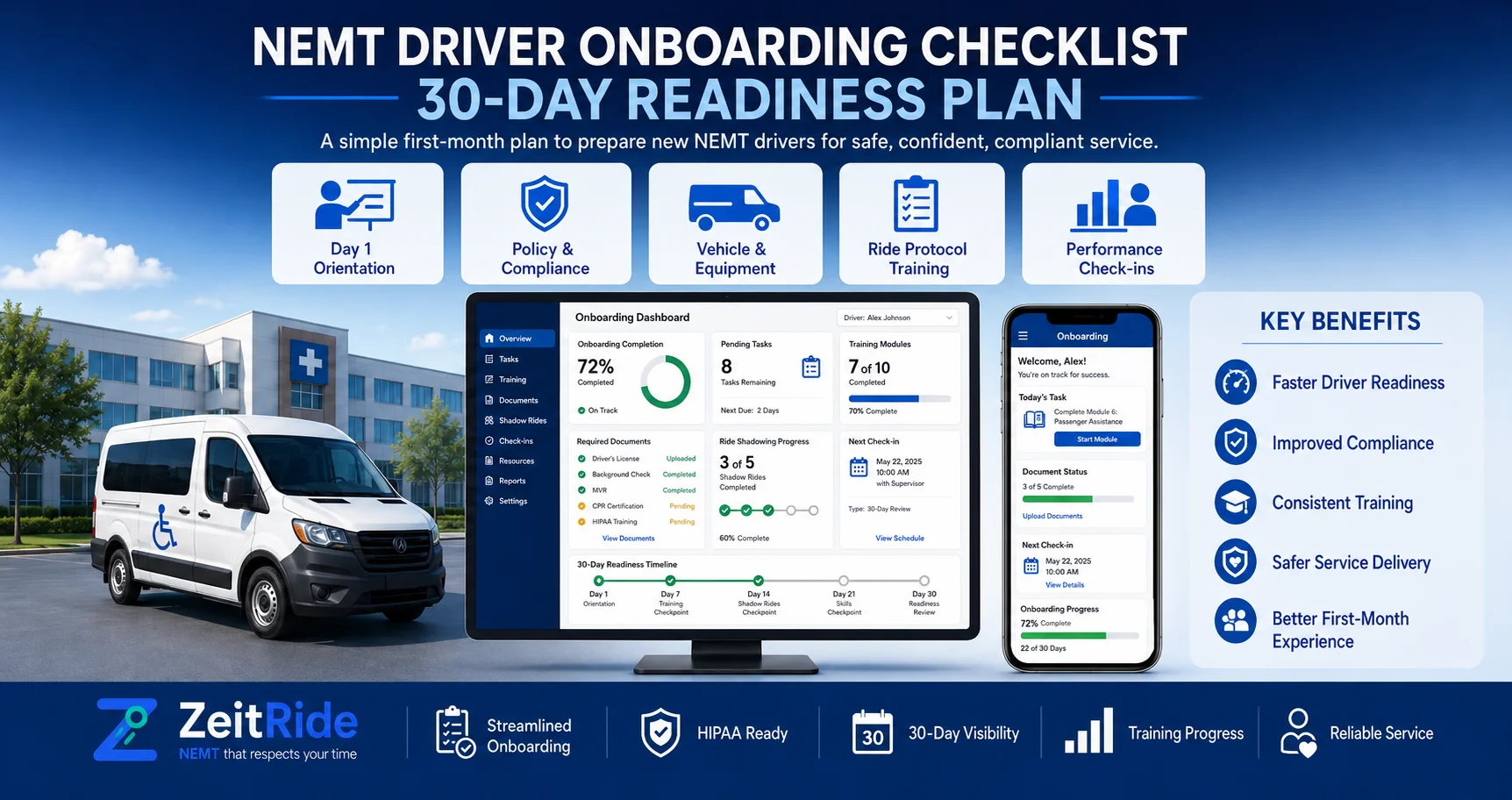
NEMT Driver Onboarding Checklist: 30-Day Readiness Plan
A practical 30-day NEMT driver onboarding checklist for training, first-trip readiness, documentation, and consistent new-driver workflows.
Quick answer
A strong NEMT driver onboarding process verifies qualifications, trains drivers on passenger care, vehicle checks, dispatch, documentation, and exception handling, then confirms practical competency before solo trips with a structured 30-day plan and supervisor sign-off.
ZeitRide Team
NEMT Operations Expert
Hiring an NEMT driver does not automatically mean that person is ready to run a passenger trip independently. A driver may have the required documents and still need practical training on vehicle procedures, passenger assistance, dispatch communication, trip statuses, documentation, no-shows, delays, and incident escalation.
A useful NEMT driver onboarding checklist closes that gap. Instead of treating onboarding as a single orientation session, it gives operators a repeatable path from qualified new hire to first-solo-trip readiness and creates a record of the skills and workflows the driver has demonstrated.
Quick Answer: What Should NEMT Driver Onboarding Include?
NEMT driver onboarding should verify required qualifications, explain company and passenger-service expectations, train the driver on the actual vehicle and field workflow, include supervised practice, document competency, and require a clear readiness sign-off before independent trips. State, broker, payer, insurer, and service-specific requirements should always be verified separately.
NEMT Driver Onboarding vs. Driver Requirements vs. Recredentialing
These three processes are related, but they solve different problems. Driver requirements determine whether a person is qualified for the work. Onboarding prepares that qualified driver to perform your company's workflow. Recredentialing keeps time-sensitive qualifications and approvals current after the driver becomes active.
| Process | Main Question | Typical Timing |
|---|---|---|
| Driver requirements | Is this person qualified for the work? | Before assignment or approval |
| Driver onboarding | Can this person complete our workflow correctly without constant coaching? | Before and during the first 30 days |
| Recredentialing | Are required credentials and approvals still current? | Ongoing after activation |
Use ZeitRide's NEMT driver requirements guide for licensing, screening, training, certification, and broker qualification details. This guide focuses on the next stage: turning a qualified new hire into an operationally ready NEMT driver without duplicating the requirements topic.
The 5 NEMT Driver Readiness Gates
Instead of asking whether orientation is simply finished, evaluate whether the driver has passed five practical readiness gates. This gives trainers a clearer standard and reduces the risk of treating paperwork completion as proof that someone is ready for independent passenger trips.
| Readiness Gate | What the Driver Should Demonstrate |
|---|---|
| Credential-ready | Required company, driver, broker, and service qualifications have been verified |
| Vehicle-ready | Can complete required checks and safely use the assigned vehicle and equipment |
| Passenger-ready | Understands passenger care, privacy, assistance, professionalism, and escalation procedures |
| Workflow-ready | Can use dispatch, navigation, trip statuses, documentation, and exception procedures |
| Solo-route-ready | Can complete the full workflow under supervision and receive documented manager approval |
Before Day 1: Complete the Qualification Handoff
Before operational training begins, the onboarding team should answer one question: what is this driver actually approved to do? Federal Medicaid transportation rules establish baseline safeguards, while additional requirements can vary by state and program. Review current CMS Medicaid transportation guidance alongside your applicable state, broker, payer, insurer, and contract requirements.
- Confirm the driver's qualification and approval status
- Identify approved vehicle and service types
- Confirm applicable broker or network approvals
- Check required training or competency records
- Document restrictions that affect trip assignments
- Identify qualifications or documents still requiring follow-up
- Assign the manager or trainer responsible for onboarding sign-off
Avoid creating a separate onboarding spreadsheet if the same information already exists elsewhere. If qualifications are maintained through NEMT driver management software, use that driver profile as the starting point for operational onboarding.
Day 1: Use an NEMT Driver Orientation Checklist
Day 1 should explain how your company expects transportation to be performed, not simply introduce company policies. The driver should leave orientation understanding the decisions they will need to make on a real shift.
- Attendance and shift expectations
- Passenger dignity and professional communication
- Privacy and appropriate handling of passenger information
- Driver-dispatch communication rules
- Vehicle assignment and inspection procedures
- Pickup and drop-off expectations
- Delays, cancellations, and no-shows
- Required trip statuses and documentation
- Incident and emergency escalation
- Who to contact when the driver is unsure
Keep orientation practical. A long policy presentation has limited value if the new driver still does not know what to do when a rider is absent, an appointment runs late, dispatch changes the route, or the assigned vehicle develops a problem.
Days 2-7: Train the Driver on the Real NEMT Workflow
Start With the Vehicle
Have the driver perform the same pre-trip process expected on a live shift. This may include locating the assigned vehicle, completing required inspections, confirming equipment, checking cleanliness and readiness, and reporting a problem through the correct process. The trainer should observe the task rather than simply ask whether the driver understands it.
Train the Driver App and Trip Workflow
Set up the driver's mobile access and walk through a realistic trip from assignment to completion. The ZeitRide Driver App brings trip assignments, navigation, vehicle inspections, e-signatures, and trip-status actions into the driver's field workflow.
The new driver should practice opening an assigned trip, reviewing pickup and passenger information, navigating, updating trip status, completing required documentation, and understanding what information becomes visible to dispatch after each action.
Practice Dispatch Exceptions
Normal trips are usually easy to teach. Exceptions reveal whether a driver actually understands the operating process. Practice realistic situations such as a rider who is not present, an appointment that runs late, an incorrect address, a vehicle problem, a schedule change, or an instruction from dispatch.
- Rider not present at pickup
- Appointment running late
- Incorrect or incomplete address
- Vehicle issue during the shift
- Same-day schedule change
- Additional instructions from dispatch
- Passenger incident or injury
Drivers should know which situations they can handle themselves, which require dispatch approval, and which require immediate escalation. Train them on your NEMT incident reporting workflow before they begin independent routes.
Complete a Supervised NEMT Route
Classroom knowledge does not prove first-trip readiness. Before solo work, have the new driver complete a supervised route or realistic workflow assessment. The trainer should observe whether the driver can complete the sequence without being coached through every step.
- Start the shift correctly
- Identify assigned vehicle and trips
- Complete the required vehicle check
- Review passenger and service information
- Follow the planned route
- Communicate appropriately with dispatch
- Use trip statuses correctly
- Handle an exception according to procedure
- Complete required signatures or documentation
- Close the shift with required records complete
NEMT Driver Onboarding Process: 30-Day Plan
A 30-day NEMT driver onboarding process gives managers time to verify initial competency and real-world consistency. It does not mean every driver must wait 30 days before taking a trip. The actual activation point should follow your company's policies and all applicable program requirements.
| Period | Main Goal | Manager Actions |
|---|---|---|
| Before Day 1 | Verify eligibility | Confirm qualifications, approved services, documents, restrictions, and trainer ownership |
| Days 1-7 | Build competency | Complete orientation, app training, vehicle workflow, exception practice, and supervised route |
| Days 8-14 | Verify consistency | Review documentation, attendance, communication, trip statuses, and coaching needs |
| Days 15-30 | Confirm independence | Review performance, close training gaps, and document onboarding sign-off |
Once the driver becomes active, connect onboarding with your normal driver scheduling workflow so dispatch can work from current availability, qualifications, vehicle fit, and trip coverage instead of maintaining a separate new-driver schedule.
NEMT Driver Training Checklist: First-Solo-Trip Sign-Off
A useful NEMT driver training checklist should end with a decision, not simply a list of completed videos or signed forms. Before approving independent work, the supervisor should be able to answer yes to the core readiness questions.
- Are required driver qualifications verified?
- Can the driver complete the vehicle workflow independently?
- Can the driver use the dispatch and mobile workflow correctly?
- Can the driver explain what to do during a no-show, delay, or cancellation?
- Can the driver complete required trip documentation?
- Does the driver know when and how to escalate an incident?
- Has the driver demonstrated appropriate passenger communication?
- Has a supervisor documented first-solo-trip approval?
If a critical item is still incomplete, document the gap, assign additional training, and repeat the applicable readiness check. Completion dates are useful, but demonstrated competency should drive the final readiness decision.
How Should NEMT Providers Document Driver Training?
Training documentation should make it easy to determine what was taught, when it was completed, who verified it, and whether the driver demonstrated the required competency.
- Driver name or ID
- Training topic
- Date completed
- Trainer or reviewer
- Supporting certificate where applicable
- Practical competency result
- Restrictions or follow-up required
- Supervisor sign-off
- Renewal date if the training expires
ZeitRide's NEMT documentation requirements guide explains how driver qualification and operational records fit into a broader audit trail. Once a credential or training requirement has an expiration date, move it into the normal NEMT recredentialing process rather than continuing to manage it as an onboarding task.
Common NEMT Driver Onboarding Mistakes
- Treating document submission as proof of operational readiness
- Giving drivers policies without practicing actual workflows
- Training only on normal trips and ignoring exceptions
- Allowing different supervisors to teach conflicting procedures
- Failing to document practical competency
- Activating drivers before service or broker restrictions are clear
- Teaching the driver app without explaining the dispatch workflow
- Ending onboarding without a defined readiness decision
The best onboarding program is not necessarily the longest. It is the one that gives every new driver the same essential expectations, tests the skills that matter on real trips, and provides a clear method for identifying where additional coaching is required.
How NEMT Software Can Support New-Driver Onboarding
Software cannot determine whether a driver satisfies every legal, state, broker, payer, insurer, or company requirement. It can make an approved onboarding process easier to execute consistently.
ZeitRide connects driver profiles, qualifications, scheduling, dispatch, vehicle workflows, and the driver app in one NEMT platform. The same driver information used during onboarding can therefore continue into daily operations instead of being abandoned in a spreadsheet after the first month.
- Maintain driver information and qualifications in one profile
- Give drivers the same mobile workflow they will use on live trips
- Connect driver availability with scheduling
- Keep vehicle and trip assignments visible to dispatch
- Capture field statuses and trip documentation
- Maintain operational history after onboarding is complete
The Bottom Line
Knowing how to onboard NEMT drivers means separating qualification, practical training, and operational readiness. A driver may satisfy the required qualifications but still need coaching before completing passenger trips independently.
Use your NEMT driver onboarding checklist to move each new hire through consistent readiness gates, observe real-world performance, document training gaps, and finish with an explicit first-solo-trip decision instead of assuming that orientation automatically equals readiness.
See Your New-Driver Workflow in One Place
Bring your current new-driver checklist and one example driver. We'll show you how ZeitRide connects driver records, app setup, vehicle workflows, scheduling, dispatch, and live trip execution in one system.
Ready to standardize your new-driver workflow? Book a 15-minute demo and bring your current onboarding process.
Frequently Asked Questions
Q: What should an NEMT driver onboarding checklist include?
An NEMT driver onboarding checklist should cover qualification verification, company orientation, passenger-service expectations, vehicle procedures, driver-app and dispatch training, trip documentation, exception handling, supervised practice, and a documented readiness decision before independent work.
Q: How long should NEMT driver onboarding take?
There is no universal onboarding period for every NEMT driver. A 30-day framework is useful for organizing orientation, practical training, early performance review, and follow-up, while independent activation should follow applicable company and program requirements.
Q: What is the difference between NEMT driver onboarding and credentialing?
Credentialing verifies whether a driver meets applicable qualifications and approval requirements. Onboarding teaches the driver how to perform the company's actual operational workflow. A credentialed driver may still require practical training before independent trips.
Q: What training should an NEMT driver complete before a solo trip?
Operational onboarding commonly covers vehicle checks, passenger interaction, dispatch communication, mobile workflow, trip statuses, documentation, no-shows, delays, cancellations, and incident escalation in addition to any formally required training.
Q: How do you know when a new NEMT driver is ready?
A driver is operationally ready when required qualifications have been verified and the driver can independently demonstrate the vehicle, passenger, dispatch, documentation, and exception-handling workflows required for assigned trips. The supervisor should document the readiness decision.
Q: Can NEMT software help onboard new drivers?
Yes. NEMT software can support onboarding by centralizing driver records, mobile workflows, scheduling, dispatch, vehicle assignments, and trip documentation. Software helps teams execute their onboarding process but does not replace applicable qualification or compliance requirements.
Rather see it than read about it?
Bring a real route, a couple of drivers, and your current process. 15 minutes, zero pitch.