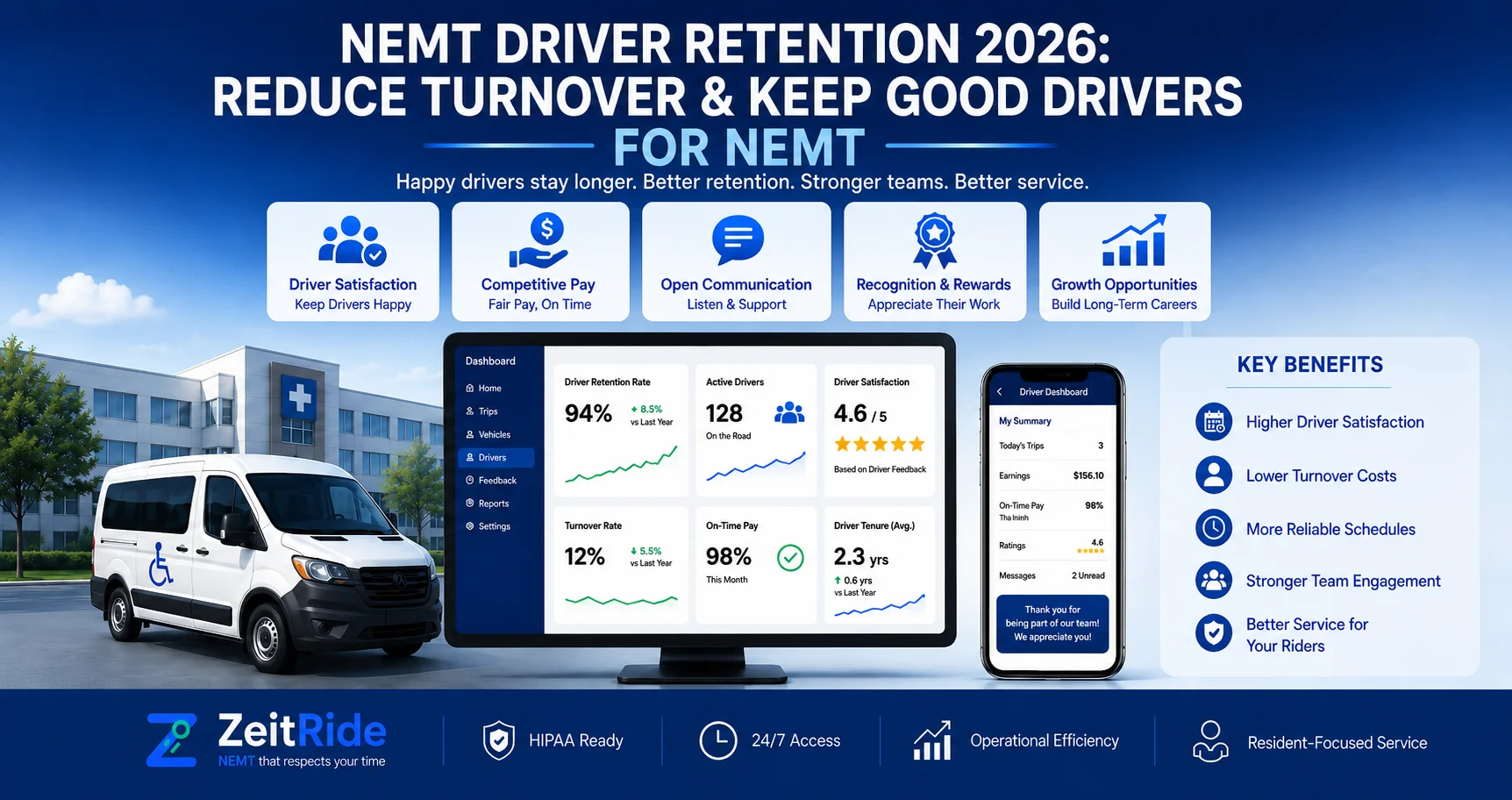
NEMT Driver Retention 2026: Reduce Turnover & Keep Good Drivers
Learn why NEMT drivers leave and how to reduce turnover with better scheduling, communication, onboarding, and daily operations.
Quick answer
NEMT companies can reduce driver turnover by making schedules more predictable, communication clearer, pay rules easier to understand, vehicles more reliable, and onboarding more consistent. Track retention data and fix the recurring operational friction that makes good drivers leave.
ZeitRide Team
NEMT Operations Expert
Keeping a reliable NEMT driver is not only an HR issue. When an experienced driver leaves, the impact can spread across scheduling, dispatch, vehicle assignments, trip coverage, overtime, and service consistency.
That is why NEMT driver retention should be treated as an operations problem. Compensation matters, but drivers also experience your company through the schedule they receive, the vehicle they use, the clarity of dispatch instructions, the way changes are handled, and whether their daily workflow is easy to follow.
Quick Answer: What Improves NEMT Driver Retention?
NEMT companies can improve driver retention by making work more predictable, clear, fair, and supportable. Publish schedules earlier, standardize same-day changes, explain compensation rules, maintain reliable vehicles, simplify driver workflows, onboard consistently, and track the problems that appear before drivers leave.
Why NEMT Drivers Quit
There is no single reason every NEMT driver leaves. The better approach is to look for repeated friction inside your own operation. Common warning signs include last-minute schedule changes, conflicting instructions, unclear pay records, vehicle problems, weak onboarding, excessive manual work, and no dependable way for drivers to raise concerns.
A useful way to think about these issues is retention friction: repeated parts of the workday that make the job harder, less predictable, or more frustrating than it needs to be.
For example, a schedule may technically cover every trip but still create a poor driver experience if availability, qualifications, vehicle assignments, and call-outs are managed separately. A connected driver scheduling workflow helps operators see those pieces together before the day starts.
| Retention Friction | Driver Experience | What to Improve |
|---|---|---|
| Unpredictable schedules | Personal plans are repeatedly disrupted | Earlier schedules and clear change rules |
| Communication gaps | Drivers chase instructions across calls and texts | One dependable dispatch workflow |
| Pay uncertainty | Drivers question hours, trips, or mileage | Written rules and cleaner records |
| Vehicle problems | Drivers lose time or switch vehicles unexpectedly | Faster inspection and maintenance follow-up |
| Weak onboarding | New drivers feel unsure about daily procedures | Structured first-30-day training |
NEMT Driver Retention Strategies That Matter Most
The strongest NEMT driver retention strategies fix recurring operating problems rather than relying on one-time incentives. Start with the friction drivers experience most often, then build consistent processes around it.
1. Make Schedules More Predictable
NEMT schedules naturally change. Members cancel, appointments run late, drivers call out, and vehicles become unavailable. The goal is not to eliminate change; it is to make the stable part of the workday as predictable as possible. Publish schedules as early as practical, record availability before assignments are finalized, and give drivers a clear process for same-day changes.
2. Use One Process for Dispatch Changes
A driver should not have to check a text thread, voicemail, and separate app to understand the next assignment. Improving communication between dispatchers and drivers means creating one dependable source for trip details, reassignments, delays, cancellations, and status updates.
3. Make Compensation Easy to Understand
Drivers should understand how their compensation works and which records support it. Questions about hours, mileage, waiting time, per-trip pay, incentives, or other pay components should be answered through a clear written policy rather than a different explanation each pay period. ZeitRide's guide to NEMT driver pay structures compares common approaches operators can evaluate.
4. Standardize the First 30 Days
New drivers should not spend their first month guessing. Onboarding should cover the actual workday: reviewing assignments, passenger requirements, vehicle inspections, status updates, delays, no-shows, incident reporting, documentation, and end-of-shift procedures. Schedule a short check-in after the first week and another near the end of the first month so uncertainty can be corrected early.
5. Reduce Repetitive Driver Admin
Drivers spend most of their shift in the field, so technology should remove steps rather than add them. A purpose-built NEMT driver app can bring trip assignments, navigation, status actions, inspections, signatures, and other field tools into one workflow. The retention benefit is less time spent on unnecessary calls, repeated data entry, and end-of-day reconstruction.
6. Treat Vehicle Reliability as a Retention Issue
Vehicle problems are also driver problems. Drivers directly experience warning lights, failed equipment, cleanliness issues, delayed maintenance, and last-minute vehicle swaps. A connected NEMT fleet management workflow helps operators keep inspections, maintenance, readiness, and vehicle assignments visible so recurring fleet problems can be addressed earlier.
7. Define and Recognize Good Performance
Drivers should know what management values. Set clear expectations around attendance, safe driving, on-time service, passenger care, documentation, vehicle condition, and communication. Then recognize reliable performance using those same standards so drivers understand what they are doing well and what continued strong performance can lead to.
How to Reduce NEMT Driver Turnover With a 30/60/90-Day Plan
A simple 30/60/90-day retention process creates specific moments to catch problems before they become permanent frustrations. The value is consistency: every new driver receives the same core support while managers get structured opportunities to identify problems when they are still fixable.
| Period | Goal | What to Do |
|---|---|---|
| Days 1–30 | Build confidence | Complete workflow training, app setup, route shadowing, vehicle procedures, and a first-week check-in |
| Days 31–60 | Build consistency | Review schedule stability, communication issues, vehicle concerns, and recurring mistakes |
| Days 61–90 | Build commitment | Review performance, discuss schedule preferences, clarify expectations, and ask what would make the job easier to sustain |
What a Better NEMT Driver Workday Looks Like
Retention becomes easier to understand when you look at the driver's day from start to finish. Before the shift, the driver should be able to see the expected schedule, assigned vehicle, and required trip information. During the route, changes should arrive through a consistent dispatch process instead of scattered messages. If a member cancels or a vehicle issue appears, the driver should know exactly how to report it and what happens next.
At the end of the shift, completed trips, statuses, time records, inspections, and other required information should already be captured as part of the normal workflow. The less often drivers have to reconstruct their day from memory, call dispatch for missing details, or correct records later, the more predictable the job becomes.
How to Measure NEMT Driver Retention
Do not wait for someone to quit before deciding retention is getting worse. Track a small number of metrics consistently and compare them against your own historical baseline. Your own trend data is usually more useful than an unsupported industry-wide turnover benchmark.
| Metric | Simple Formula | What It Shows |
|---|---|---|
| Voluntary turnover rate | Voluntary departures ÷ average active drivers × 100 | How often drivers choose to leave |
| 90-day retention rate | New drivers reaching 90 days ÷ eligible new hires × 100 | Whether onboarding is working |
| Driver call-out rate | Driver call-outs ÷ scheduled shifts × 100 | Whether attendance pressure is increasing |
| Unplanned schedule-change rate | Driver-impacting changes ÷ scheduled shifts × 100 | How predictable the workday is |
| Vehicle disruption rate | Shifts affected by vehicle issues ÷ scheduled shifts × 100 | How often fleet readiness affects drivers |
Use the same definitions every month. The goal is not to create more reporting work; it is to recognize patterns early enough to act.
What Does NEMT Driver Turnover Cost?
There is no universal replacement-cost number that fits every NEMT company. Recruiting conditions, credentialing, training, overtime, service mix, and lost capacity vary too much from one fleet to another.
Instead, calculate the cost for your own operation: recruiting + screening and credentialing + paid onboarding + manager or trainer time + overtime or replacement coverage + lost productive capacity = estimated replacement cost. Apply the same framework to several actual departures so retention decisions are based on your fleet's own numbers.
How NEMT Software Can Support Driver Retention
Software cannot fix poor management, unsafe vehicles, unfair policies, or a weak workplace culture. It can, however, reduce operational friction. NEMT driver management software can keep availability, qualifications, credentials, and driver records closer to dispatch, while real-time NEMT dispatch software can help teams manage same-day trip changes and reassignments without rebuilding the plan across phone calls and spreadsheets.
- Give drivers clearer trip and route information.
- Keep schedule changes and field updates in one place.
- Match available drivers with appropriate trips and vehicles.
- Keep inspection and vehicle-status information visible.
- Maintain cleaner operational records.
- Reduce repetitive calls and manual updates.
The practical goal is simple: drivers should spend less time chasing information and more time completing safe, reliable transportation.
NEMT Driver Retention Checklist
- Publish stable schedules as early as practical.
- Record driver availability before assigning work.
- Define one same-day change process.
- Keep dispatch instructions in one dependable workflow.
- Explain compensation rules clearly.
- Standardize first-30-day onboarding.
- Schedule regular driver check-ins.
- Track vehicle issues through resolution.
- Define measurable performance expectations.
- Recognize reliable performance consistently.
- Monitor turnover, call-outs, and schedule-change trends.
- Use exit conversations to identify recurring causes.
The Bottom Line
Good NEMT driver retention is built through repeatable daily operations. Pay matters, but so do predictable schedules, dependable vehicles, clear communication, useful tools, consistent onboarding, and confidence that problems will be addressed.
If good drivers keep leaving, do not ask only how to recruit replacements. Ask where the daily driver experience becomes harder than it needs to be. Measure those friction points, fix the ones that repeat, and give reliable drivers clearer reasons to stay.
See Your Driver Workflow in One Place
ZeitRide connects scheduling, dispatch, driver operations, vehicle workflows, and the driver app in one NEMT platform. Bring next week's driver schedule and one recent call-out or reassignment example, then book a 15-minute demo to see how the workflow can be managed in one place.
Ready to reduce the daily friction that makes good drivers harder to keep? Book a demo and bring a real driver workflow.
Frequently Asked Questions
Q: What is NEMT driver retention?
NEMT driver retention is a provider's ability to keep qualified, reliable drivers over time. It is influenced by scheduling, compensation, communication, onboarding, vehicle conditions, management practices, and the daily workflow drivers experience.
Q: Why do NEMT drivers quit?
Common causes include unpredictable schedules, communication problems, unclear compensation, weak onboarding, recurring vehicle issues, unnecessary administrative work, unclear expectations, and limited recognition or feedback.
Q: How do you retain NEMT drivers?
Make schedules more predictable, communicate changes consistently, explain pay rules clearly, maintain reliable vehicles, improve onboarding, reduce unnecessary administrative work, recognize strong performance, and give drivers an easy way to raise concerns.
Q: How can an NEMT company reduce driver turnover?
Measure why drivers leave, identify recurring operational friction, and improve the systems drivers interact with every day, including scheduling, dispatch communication, compensation records, onboarding, and vehicle readiness.
Q: Can NEMT software help reduce driver turnover?
NEMT software can support retention by improving schedule visibility, dispatch communication, driver assignments, field workflows, and vehicle information. It should support good management rather than replace it.
Rather see it than read about it?
Bring a real route, a couple of drivers, and your current process. 15 minutes, zero pitch.