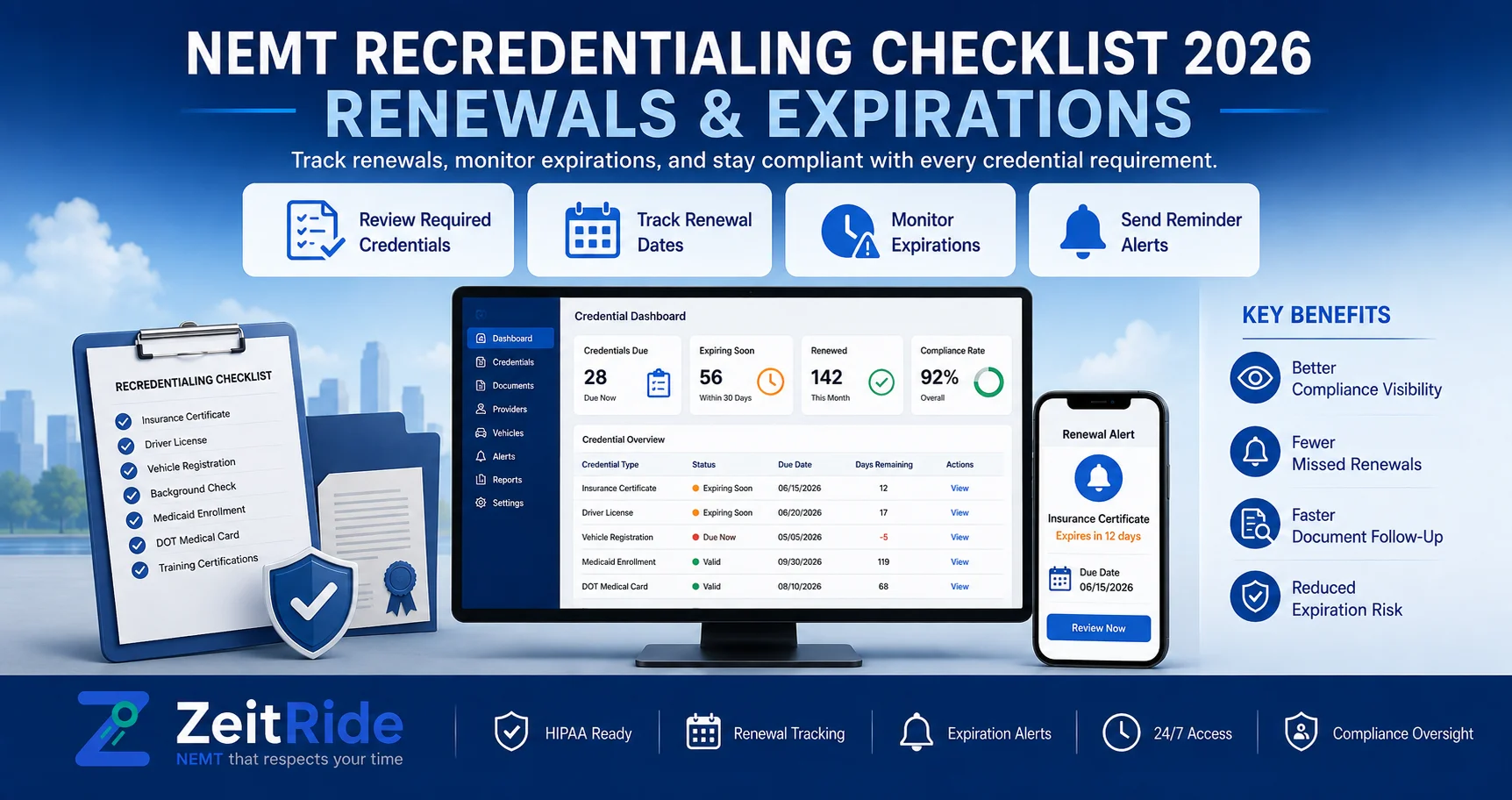
NEMT Recredentialing Checklist 2026: Renewals & Expirations
Use this 2026 NEMT recredentialing checklist to track driver, vehicle, insurance, and broker renewals before expirations disrupt operations.
Quick answer
NEMT recredentialing is the ongoing process of keeping provider, driver, vehicle, insurance, and broker credentials current after initial approval. Providers should track expiration dates, start renewals early, verify acceptance, and prevent expired resources from being assigned.
ZeitRide Team
NEMT Operations Expert
Getting approved to provide non-emergency medical transportation is not the end of credentialing. Licenses expire, insurance policies renew, training certificates need updating, vehicles require new inspections, and transportation networks may periodically review provider records. NEMT recredentialing is the ongoing process of keeping those approvals current so drivers, vehicles, and the company remain eligible for the work they perform.
A reliable renewal process should answer three questions at any time: what is expiring, who owns the renewal, and whether the renewed credential has actually been accepted. Providers managing this through spreadsheets should connect that process with NEMT compliance document tracking before an overlooked expiration becomes an operational problem.
What Is NEMT Recredentialing?
NEMT recredentialing is the process of reviewing and updating the records used to prove that a transportation provider, driver, or vehicle still meets applicable requirements after initial approval.
It may involve business records, insurance, driver licenses, screening records, training certificates, vehicle registrations, inspections, broker approvals, or Medicaid enrollment information. The exact requirements and timing vary by state, payer, broker, insurer, contract, and service type.
The simplest distinction is this: credentialing gets you approved; recredentialing helps keep you approved.
Credentialing vs. Renewal vs. Recredentialing
| Term | What It Means | Example |
|---|---|---|
| Initial credentialing | First approval process | Joining a transportation broker network |
| Credential renewal | Replacing one expiring item | Renewing a driver's license |
| Recredentialing | Broader periodic review of eligibility | A broker reviews provider, driver, and vehicle records |
| Medicaid revalidation | Renewal of Medicaid provider enrollment | State Medicaid re-screens an enrolled provider |
These terms are often used interchangeably, but they do not always describe the same process. A driver may renew a license on the state's licensing cycle while a broker conducts a broader NEMT provider recredentialing review on a different schedule.
Providers should therefore maintain one master renewal calendar without assuming every credential follows the same deadline.
What Should an NEMT Recredentialing Checklist Track?
A useful NEMT recredentialing checklist separates records by company, driver, and vehicle. This makes it easier to identify which expiration could affect a specific driver, vehicle, broker relationship, or trip.
- Business licenses and applicable operating permits
- Commercial auto and general liability insurance
- Medicaid or payer enrollment information where applicable
- Broker or transportation-network approvals
- Driver's licenses
- Motor vehicle record reviews
- Background or exclusion screenings where required
- CPR, First Aid, PASS, defensive-driving, or other required training
- Broker-specific driver approvals
- Vehicle registrations
- Commercial vehicle insurance
- Required vehicle safety inspections
- Wheelchair-lift or accessibility-equipment inspection records
- Other state, payer, broker, insurer, or contract-specific documents
Do not treat a general checklist as a universal compliance rule. Requirements can differ between programs and contracts. ZeitRide's NEMT broker requirements guide can help you understand the categories providers should verify before checking the current requirements of the specific network they serve.
Use a 90-60-30 Day Credential Renewal Workflow
For internal planning, a 90-60-30 day workflow gives your team time to identify upcoming expirations, complete renewals, and escalate unresolved items. This is an operational planning framework, not a universal broker deadline.
| Timing | Recommended Action |
|---|---|
| 90 days before expiration | Identify the renewal, confirm current requirements, and assign an owner |
| 60 days before expiration | Begin applications, training, inspections, or document collection |
| 30 days before expiration | Escalate missing items and confirm submission status |
| Before expiration | Verify that the renewed credential has been accepted and is active |
| After renewal | Record the new effective and expiration dates and retain prior history |
The word verify is important. Uploading or emailing a renewed document does not always mean the reviewing organization has accepted it. Your workflow should distinguish between submitted, pending, approved, and expired status wherever those stages apply.
NEMT Driver Credential Renewal
Driver files often contain several credentials with different expiration or review cycles. An effective NEMT driver credential renewal process should therefore track each requirement independently instead of assigning one generic expiration date to the entire driver profile.
Before an item expires, verify the driver's current license, required screening records, training or certifications, broker approval, and any service-specific qualification needed for the trips that driver performs. For a broader qualification framework, review the NEMT driver requirements guide.
The operational goal is simple: dispatch should be able to tell whether a driver is eligible before assigning the trip. A renewed document sitting in someone's email inbox does not help if scheduling still sees outdated information.
Vehicle and Insurance Renewals Need the Same Discipline
Driver records are only half of the recredentialing problem. Vehicle registrations, commercial insurance, safety inspections, and accessibility-related records may also expire.
A vehicle should not appear operationally available simply because it is physically available. Its required documentation and inspection status also need to support assignment. Providers can connect this process with NEMT fleet inspection tracking so inspection records and vehicle readiness remain easier to verify.
How Often Do NEMT Providers Recredential?
There is no single recredentialing interval that applies to every NEMT provider, broker, driver, and vehicle. Timing depends on the credential involved and the organization requiring it.
Driver licenses, insurance policies, inspections, training records, broker approvals, and state requirements may all operate on different cycles. Medicaid provider revalidation is also a separate enrollment process and should not be treated as the renewal schedule for every NEMT credential.
The practical answer to how often do NEMT providers recredential is to track the actual expiration, revalidation, or review date attached to each requirement rather than relying on one company-wide renewal date.
What Happens If an NEMT Credential Expires?
The consequence depends on what expired and which requirement applies. A lapse may affect a driver's eligibility, a vehicle's availability, broker participation, Medicaid enrollment, reimbursement, audit results, or the provider's ability to support a completed trip.
The safest operational rule is to make unresolved expiration status visible to scheduling and dispatch instead of discovering it later during billing or an audit. Your NEMT documentation process should also make it easier to retrieve evidence showing that assigned resources were appropriately documented on the date of service.
Spreadsheet vs. Automated Credential Tracking
| Requirement | Spreadsheet | Connected Compliance Tracking |
|---|---|---|
| Expiration dates | Manual | Centralized |
| Renewal reminders | Manual calendar or follow-up | Automated alerts |
| Driver documents | Multiple folders or files | Connected to driver records |
| Vehicle records | Often tracked separately | Connected to vehicle records |
| Status visibility | Requires manual review | Current status visible centrally |
| Scheduling control | Separate from dispatch | Compliance status can affect assignment |
| Historical records | Easy to overwrite or lose | Searchable operational history |
A spreadsheet can track dates, but it usually cannot control what happens when a date passes. As the fleet grows, the more important question becomes: can an expired driver or vehicle still reach the schedule?
How ZeitRide Supports NEMT Recredentialing
ZeitRide connects compliance records with the same operating environment used for drivers, vehicles, scheduling, and dispatch. Driver licenses, training documentation, vehicle records, insurance, inspections, and expiration dates can be organized centrally instead of being distributed across spreadsheets and folders.
Renewal alerts help surface upcoming deadlines, while compliance status can be visible before new work is assigned. ZeitRide also maintains searchable operational history so important changes and records are easier to retrieve later. Providers preparing for reviews can use NEMT audit history software to preserve visibility into important operational changes.
Software does not decide which credential your state, broker, insurer, payer, or contract requires. It helps your team consistently execute the renewal process you are already responsible for following.
Final NEMT Recredentialing Checklist
- List every company, driver, and vehicle credential
- Record current effective and expiration dates
- Identify which organization requires each credential
- Assign one person responsible for every renewal
- Begin time-consuming renewals before the expiration date approaches
- Track submitted, pending, approved, and expired status separately
- Confirm that renewed documents have actually been accepted
- Record the new effective and expiration dates immediately
- Retain historical records where required
- Make expired compliance status visible to scheduling and dispatch
- Review the credential calendar regularly
- Recheck requirements whenever a broker, payer, state program, or contract changes
Keep Renewals From Becoming Dispatch Problems
NEMT recredentialing becomes difficult when documents live in one spreadsheet, drivers in another system, vehicle inspections in paper folders, and dispatch somewhere else. ZeitRide brings driver and vehicle compliance tracking into the same platform used to run daily NEMT operations.
Bring your current credential spreadsheet or renewal checklist to a demo and see how your existing workflow could be organized inside ZeitRide.
Ready to keep renewals from becoming scheduling problems? See ZeitRide compliance tracking and request a demo.
Frequently Asked Questions
Q: What is NEMT recredentialing?
NEMT recredentialing is the ongoing process of reviewing and updating provider, driver, vehicle, insurance, and network credentials after initial approval so applicable requirements remain current.
Q: Is recredentialing different from initial NEMT credentialing?
Yes. Initial credentialing establishes eligibility for the first time, while recredentialing confirms that required qualifications, documents, and approvals remain current later.
Q: How often do NEMT providers recredential?
There is no universal NEMT recredentialing interval. Timing varies by state, broker, payer, insurer, contract, driver credential, vehicle requirement, and other applicable program rules.
Q: Which NEMT driver credentials need to be renewed?
Depending on applicable requirements, renewals may include driver's licenses, screening records, training certificates, service-specific qualifications, and broker approvals.
Q: What happens if an NEMT driver's credential expires?
An expired credential may affect the driver's eligibility for certain assignments and can create compliance, broker, billing, or audit issues depending on the requirement involved.
Q: How should an NEMT company track credential expirations?
Track each credential's owner, effective date, expiration date, renewal status, approval status, and supporting documentation in a centralized system with reminders before deadlines.
Rather see it than read about it?
Bring a real route, a couple of drivers, and your current process. 15 minutes, zero pitch.