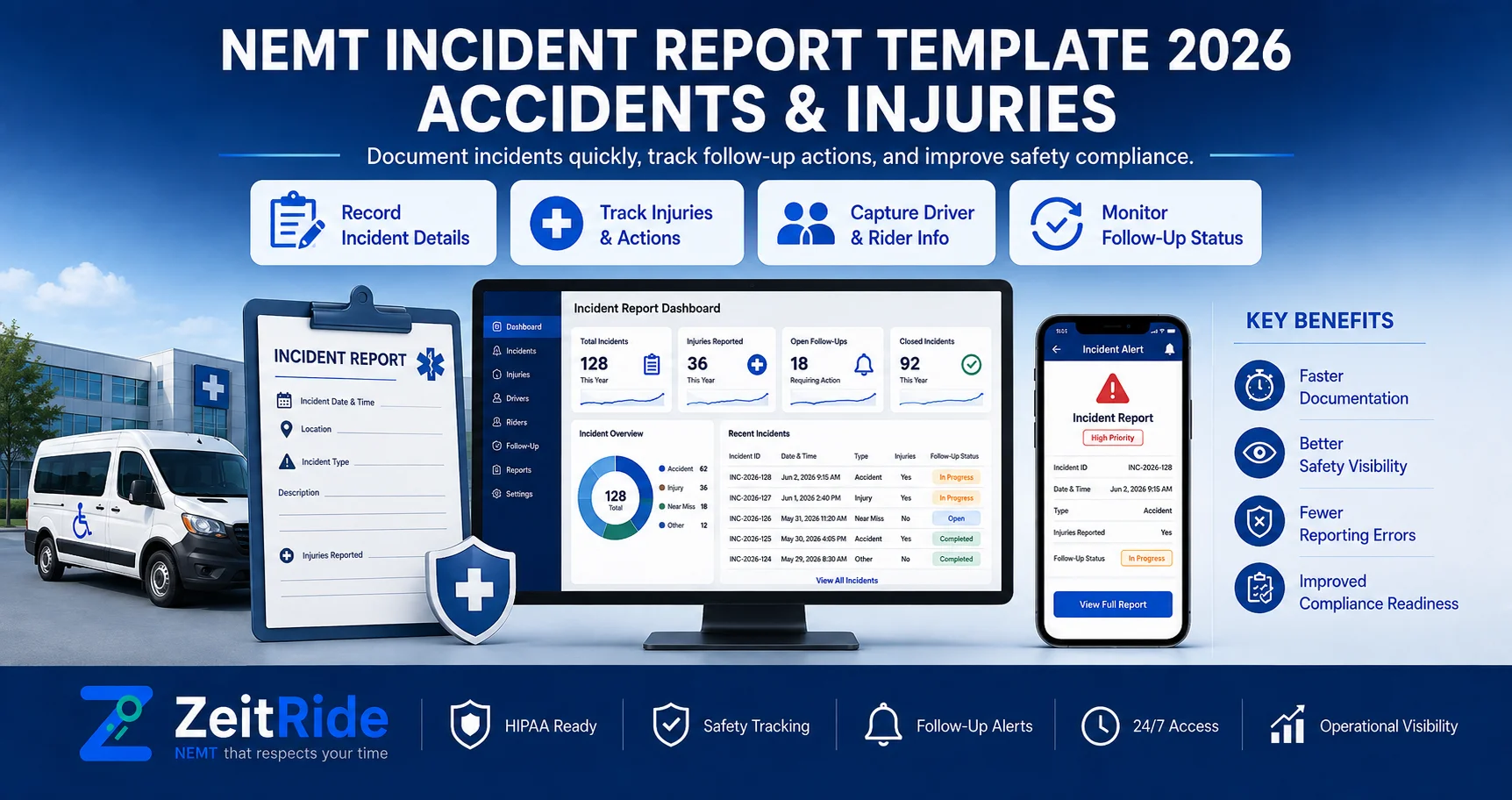
NEMT Incident Report Template 2026: Accidents & Injuries
Use this NEMT incident report template to document accidents, passenger injuries, evidence, notifications, and follow-up with a clear driver workflow.
Quick answer
An NEMT incident report records what happened, who was involved, the trip, driver and vehicle, injuries, emergency response, witnesses, evidence, notifications, and follow-up. Exact reporting deadlines vary by state, payer, broker, insurer, and contract.
ZeitRide Team
NEMT Operations Expert
An accident or passenger injury is the wrong time to discover that nobody knows what belongs in the incident report. A useful NEMT incident report should document the event while the facts are still fresh, connect it to the correct trip, driver and vehicle, preserve available evidence, record required notifications, and create a clear path for investigation and follow-up.
The form itself is only one part of that process. Strong incident documentation follows an evidence chain: Respond → Notify → Capture → Link → Review → Correct → Close.
Exact reporting requirements and deadlines are not the same across every Medicaid program, transportation broker, managed-care organization, insurer, or state. Your internal procedure should therefore tell drivers what to do immediately while also directing supervisors to the requirements that apply to the specific trip.
What Is an NEMT Incident Report?
An NEMT incident report is a written or digital record of an accident, injury, safety event, service interruption, or other reportable occurrence connected to a non-emergency medical transportation trip. It records the facts of the event, people and vehicles involved, immediate response, supporting evidence, notifications, and follow-up.
The purpose is not simply to prove that a form was completed. The report should allow someone who was not present to understand what happened, when it happened, which trip was involved, what the driver did, and what happened next.
That principle aligns with broader NEMT documentation requirements: records are most useful when the complete operating history can be reconstructed without relying on memory, texts, or scattered paperwork.
What Events Should an NEMT Provider Document?
Your company policy should define which events require an internal report and which must also be reported externally. Depending on the applicable rules, examples may include:
- Vehicle collision or roadway accident
- Passenger fall while entering or exiting the vehicle
- Passenger or driver injury
- Wheelchair lift or securement incident
- Medical emergency during transport
- Driver injury while assisting a rider
- Property damage
- Passenger behavior that interrupts or stops the trip
- Safety event involving another vehicle or person
- Allegation of abuse, neglect, or inappropriate conduct
- Incident that significantly changes the member's trip
- Other events identified by a payer, broker, insurer, or state program
Do not assume every internal incident has the same external reporting rule. Your NEMT policies and procedures manual should identify who decides whether an event must be escalated, who receives the report, and which contractual or regulatory deadline applies.
What Should a Driver Do Immediately After an Accident or Injury?
The first priority is people, not paperwork. Drivers should follow company emergency procedures and the requirements that apply to the situation. A practical sequence is: Safety → Emergency assistance → Dispatch → Preserve evidence → Document.
1. Protect Immediate Safety
Stop in a safe location when possible, secure the vehicle, and assess whether passengers, the driver, or anyone else may be injured.
Do not instruct drivers to diagnose medical conditions. If emergency assistance is needed, follow the company's emergency-response procedure and contact the appropriate emergency service.
2. Notify Dispatch or the Designated Supervisor
The driver should notify the person identified in company policy as soon as the immediate situation permits.
Dispatch needs enough information to manage the passenger, any remaining trip obligations, vehicle availability, replacement transportation, and required escalation.
3. Preserve the Facts
Drivers should record what they directly observed rather than guessing why an event happened. Where permitted and appropriate, preserve:
- Exact date and time
- Location
- Vehicle position
- Visible damage
- Relevant photos
- Witness contact information
- Emergency-services information
- Police or case number when available
- Trip and passenger identifiers required by the workflow
4. Avoid Reconstructing the Event From Memory Later
A report written shortly after an event is generally more useful than one rebuilt at the end of a long shift from texts, phone calls, and memory.
The driver's job is to document facts. Supervisors can investigate cause and corrective action separately.
What Should an NEMT Incident Report Include?
If you are asking what should an NEMT incident report include, the form should connect the event to the transportation record and capture enough information for internal review and any required external reporting.
| Incident Report Field | What to Record |
|---|---|
| Incident date and time | When the event occurred |
| Exact location | Address, intersection, facility, parking area, or other location |
| Trip ID or broker reference | The transportation record connected to the incident |
| Passenger/member | Required member identifier under your approved workflow |
| Driver | Driver involved in the trip |
| Vehicle | Unit, plate, or vehicle identifier |
| Service level | Ambulatory, wheelchair, stretcher, or other applicable mode |
| Incident type | Accident, injury, fall, medical event, property damage, or other category |
| Event description | Objective description of what happened |
| Injuries | Known or reported injuries without unsupported diagnosis |
| Emergency response | Police, EMS, fire, tow, or other response |
| Report/case number | Police or other official reference when available |
| Witnesses | Names and contact information where appropriate |
| Evidence | Photos, video, GPS context, or supporting records |
| Immediate action | What the driver or company did immediately |
| Notifications | Who was notified and when |
| Driver attestation | Driver confirmation or signature where required |
| Supervisor review | Reviewer and review date |
| Corrective action | Follow-up required after investigation |
| Closure status | Open, under review, corrective action pending, or closed |
Collect only information your organization is authorized and required to maintain. Incident documentation may contain sensitive member information, so access, sharing, and retention should follow applicable privacy, contractual, and company requirements.
NEMT Incident Report Template
The following NEMT incident report template can be adapted to your state's, broker's, payer's, or insurer's requirements.
| Section | Fields |
|---|---|
| Provider | Company name, contact person, provider ID if required |
| Trip | Trip ID, broker reference, service level, pickup and destination |
| Event | Date, time, exact location, incident category |
| Driver | Name, driver ID, contact details where applicable |
| Vehicle | Vehicle or unit ID, plate, vehicle type |
| Passenger | Approved member identifier |
| Description | Objective account of what occurred |
| Injury | Whether injury was reported or observed; affected party |
| Emergency response | Police, EMS, fire, tow, emergency facility |
| Official report | Agency, case or report number |
| Witnesses | Names and contact information |
| Evidence | Photos, video, GPS, other supporting files |
| Notifications | Dispatch, supervisor, broker, payer, insurer, or others as applicable |
| Attestation | Driver or reporter name, signature, date |
| Review | Supervisor, findings, follow-up |
| Corrective action | Training, maintenance, policy review, or other action where appropriate |
| Status | Open, pending, resolved, closed |
If your company uses a broker-specific or state-required NEMT accident and incident report form, use that required form rather than substituting this framework. The template is best used to build an internal process that ensures the required information is available when an official report must be completed.
NEMT Accident Reporting Requirements Are Not the Same Everywhere
There is no single national deadline that every NEMT provider can apply to every accident or incident.
Reporting timing can depend on:
- State Medicaid requirements
- Managed-care plan rules
- Transportation broker contract
- Severity of the incident
- Injury or fatality
- Insurance requirements
- Law-enforcement reporting rules
- Provider agreement
- Whether the event occurred during loading, transport, or unloading
Some programs distinguish serious injury or fatality from a non-injury incident and assign different notification timelines. Others require a written report within a defined number of hours or business days.
That is why NEMT accident reporting requirements should be mapped before an incident occurs—not searched for while the driver is standing at the scene.
Your incident SOP should clearly identify: who to call → who submits the report → which form is required → what deadline applies → what supporting evidence must follow.
What Evidence Should Be Preserved After an NEMT Incident?
A written narrative becomes more useful when it is supported by the operational record. Depending on the incident and applicable requirements, preserve relevant evidence such as:
- Driver incident statement
- Photos
- Dash-cam footage
- GPS trip context
- Pickup and drop-off activity
- Trip assignment
- Route or manifest information
- Passenger signature where relevant
- Witness information
- Police or EMS documentation
- Vehicle inspection history
- Maintenance information where relevant
- Dispatch communications
- Notification timestamps
If your fleet uses video, preserve relevant footage before normal storage cycles overwrite it. ZeitRide's guide on choosing an NEMT dash cam explains why video retention and incident retrieval should be considered before a collision or complaint happens.
Link the Incident to the Trip, Driver and Vehicle
One of the biggest weaknesses of a standalone NEMT accident report form is what happens after it is completed.
If the form sits in a folder while the trip is in dispatch software, driver information is somewhere else, photos live on a phone, and vehicle records are in another spreadsheet, the investigation begins with reconstruction rather than review.
A stronger incident record connects: Incident → Trip → Passenger → Driver → Vehicle → Evidence → Notifications → Follow-up.
The ZeitRide Driver App supports custom forms with text, select, date, photo, and signature fields, allowing providers to build state- or broker-specific forms into the mobile workflow drivers already use.
The purpose is not for software to decide whether an incident is reportable. It is to help the company capture required information consistently when its approved policy says a report is needed.
What Happens After the Initial Incident Report?
An incident should not automatically be considered complete when the driver presses submit. A practical review workflow is: Review → Investigate → Follow Up → Correct → Close.
Supervisor Review
Check whether the report is complete, facts are written objectively, required notifications occurred, and supporting evidence has been preserved.
Investigation
Review the trip, driver, vehicle, GPS activity, available video, statements, and other relevant information. Keep facts separate from conclusions.
Corrective Action
If the investigation identifies a preventable operational problem, record what the company changed.
Corrective action could involve training, maintenance, securement procedures, dispatch workflow, documentation practices, or another appropriate response.
Closure
The record should show when the matter was reviewed, what follow-up was completed, and who closed it.
ZeitRide's NEMT audit history helps preserve who changed important operational information and when, which can make later review easier to reconstruct.
Common NEMT Incident Reporting Mistakes
- Waiting until the end of the shift to document the event
- Writing conclusions instead of observable facts
- Forgetting the trip or broker reference
- Failing to identify the vehicle involved
- Keeping photos only on a driver's personal phone
- Allowing relevant video to be overwritten
- Recording that someone was notified without documenting when
- Assuming every contract uses the same reporting deadline
- Treating a recurring passenger's information as a substitute for the actual trip record
- Completing the form but never documenting follow-up
- Closing a case without recording corrective action when corrective action was required
Paper Incident Forms vs. Digital Driver Forms
| Workflow | Paper / Standalone Form | Digital Driver Workflow |
|---|---|---|
| Completion | Written after or during shift | Completed on driver's device |
| Photos | Stored separately | Can be attached to the workflow |
| Signature | Paper signature | Electronic signature where appropriate |
| Trip connection | Manually referenced | Can remain associated with operating records |
| Retrieval | File or folder search | Searchable digital record |
| Follow-up | Separate notes or documents | Can be connected to review workflow |
| Change history | Limited visibility | Digital history can improve traceability |
Paper is not automatically noncompliant, and digital software is not automatically compliant. The deciding factor is whether the provider's approved process captures, protects, retains, and reports the information required by the applicable rules.
How ZeitRide Supports NEMT Incident Documentation
ZeitRide gives NEMT operators several tools that can support an approved incident workflow without pretending that software replaces state, broker, insurer, or legal requirements.
Drivers can use custom forms in the ZeitRide Driver App, including photo and signature fields. Trip and driver activity stay connected to the operating system, while audit history helps teams review changes later.
For fleets that use video evidence, the ZeitRide NEMT dash cam adds accident and ride-complaint video with GPS trip context.
The operational advantage is simple: the incident form, trip context, driver activity, supporting evidence, and follow-up do not have to begin as five disconnected records.
That makes internal review easier and reduces the amount of information staff have to reconstruct after the fact.
Build the Incident Workflow Before the Incident Happens
A good NEMT incident report is not created by adding more blank fields after something goes wrong.
It starts with a clear company process: respond safely → notify the right people → capture objective facts → preserve evidence → connect the event to the trip → meet applicable deadlines → investigate → document corrective action → close the record.
Review your state, payer, broker, insurer, and provider-agreement requirements before turning any template into company policy.
If your current incident process starts with a paper form, text messages, photos on a driver's phone, and someone manually trying to connect everything later, bring that workflow to ZeitRide.
Ready to digitize your incident workflow? See how ZeitRide connects driver forms and NEMT operations.
Frequently Asked Questions
Q: What is an NEMT incident report?
An NEMT incident report documents an accident, injury, safety event, service interruption, or other reportable occurrence connected to a transportation trip, including the people, vehicle, response, evidence, notifications, and follow-up.
Q: What should an NEMT incident report include?
It should generally include the date, time, location, trip, driver, vehicle, incident type, objective description, injuries, emergency response, witnesses, evidence, notifications, reporter, and required follow-up.
Q: Who should complete an NEMT incident report?
The driver or staff member with direct knowledge commonly provides the initial report. A supervisor or compliance manager may then review the event, complete required external reporting, investigate, and document follow-up.
Q: How quickly must an NEMT accident be reported?
There is no single national deadline. Reporting timelines vary by state, Medicaid program, MCO, transportation broker, insurer, incident severity, and provider agreement.
Q: Should NEMT drivers take photos after an accident?
Photos may be useful when they can be taken safely, legally, and in accordance with company privacy and incident procedures. Immediate safety and emergency response come first.
Q: Should dash-cam footage be preserved after an NEMT incident?
Relevant footage should be preserved when required or useful under the provider's approved incident, insurance, investigation, or record-retention procedures.
Q: What is the difference between an NEMT accident and an incident?
An accident commonly involves a vehicle collision or similar physical event, while an incident can include broader events such as passenger injury, illness, behavior, equipment problems, or other trip interruptions. Definitions vary by program.
Rather see it than read about it?
Bring a real route, a couple of drivers, and your current process. 15 minutes, zero pitch.