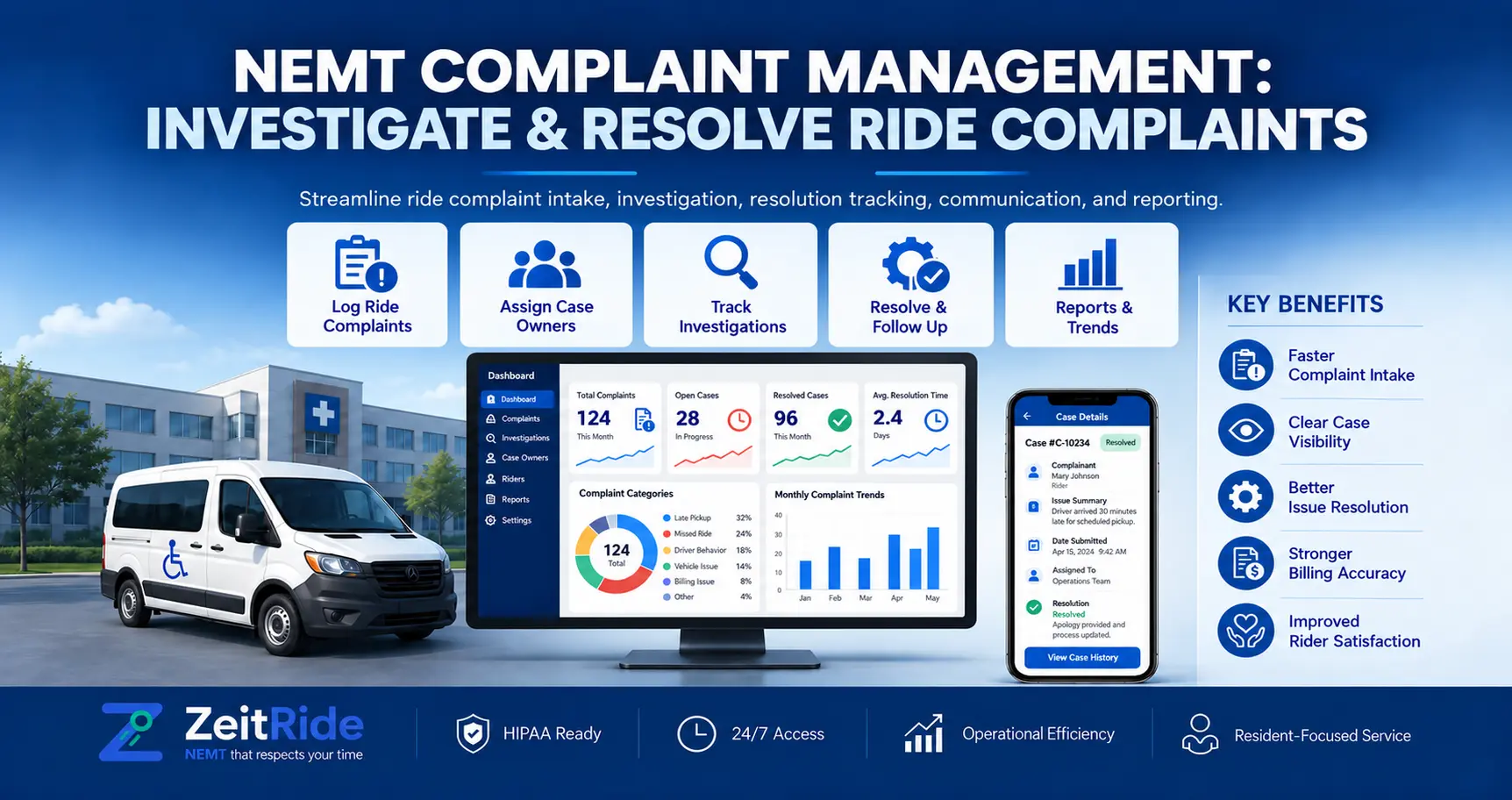
NEMT Complaint Management: Investigate & Resolve Ride Complaints
A practical guide to investigating NEMT ride complaints, documenting evidence, resolving issues, and reducing repeat service problems.
Quick answer
NEMT complaint management is the process providers use to record, investigate, resolve, and analyze ride complaints. A strong workflow links each complaint to the trip record, reviews evidence, documents findings, assigns corrective action, and tracks repeat problems.
ZeitRide Team
NEMT Operations Expert
A passenger says the driver never arrived. The driver says they waited at the pickup location. Dispatch remembers receiving a call, but the details may be spread across trip records, GPS history, notes, and messages. This is where NEMT complaint management matters. A reliable process helps your team identify the correct trip, preserve relevant evidence, reconstruct what happened, document the finding, resolve the issue, and identify patterns that could cause the same problem again.
What Is NEMT Complaint Management?
NEMT complaint management is the structured process a transportation provider uses to receive, classify, investigate, resolve, document, and analyze complaints related to non-emergency medical transportation services. A strong process should allow someone who was not involved in the original ride to understand what was reported, which trip was involved, what evidence was reviewed, what the investigation found, and what corrective action followed.
Industry guidance such as the NEMTAC provider-standard public-comment draft treats complaint intake, investigation, resolution, and reporting as distinct operational responsibilities. Exact requirements can vary by Medicaid program, transportation broker, managed-care organization, payer, or contract, so providers should follow the requirements that apply to their operation.
Common NEMT Ride Complaints
Providers should classify NEMT ride complaints consistently. Good categorization makes individual cases easier to review and allows recurring service problems to become visible over time.
| Complaint Type | Example | Evidence to Review |
|---|---|---|
| Late pickup | Vehicle arrived outside the expected pickup window | Scheduled time, GPS history, arrival timestamp |
| Provider no-show | Passenger says the driver never arrived | GPS history, driver status, wait time, contact attempts |
| Excessive wait | Rider waited much longer than expected | Schedule, dispatch activity, ETA or trip progress |
| Driver conduct | Complaint about communication or behavior | Complaint statement, driver notes, dispatch records |
| Mobility or service-level issue | Wrong vehicle or assistance level | Trip request, mobility details, vehicle assignment |
| Pickup-location dispute | Driver and passenger report different locations | Pickup address, GPS history, call records |
| Excessive ride time | Passenger reports an unnecessarily long ride | Route history, stops, dispatch changes |
| Communication issue | Passenger was not informed about a delay or change | Call, SMS, notification, and dispatch records |
A serious accident, injury, abuse allegation, unsafe securement concern, or other major safety event may require a separate incident procedure rather than ordinary complaint handling.
How Should an NEMT Complaint Investigation Work?
A practical NEMT complaint investigation can follow seven stages: Receive → Identify → Preserve → Reconstruct → Evaluate → Resolve → Improve. The purpose is to review the available evidence consistently rather than beginning with an assumption that either the passenger or driver must be correct.
1. Record and Classify the Complaint
Record the complaint clearly when it is received. Capture the complaint date, trip or reservation ID, passenger or facility, complaint category, description of the issue, person responsible for the review, and any applicable response deadline. Keep the original allegation separate from the provider's eventual finding.
2. Identify the Correct Trip
Confirm the exact ride before beginning the investigation. Check the date of service, pickup and destination, scheduled time, assigned driver, assigned vehicle, mobility or service level, and broker or payer reference where applicable.
3. Preserve Relevant Evidence
Gather records that can help establish what happened before useful information is lost or overwritten. ZeitRide's NEMT documentation requirements guide explains why operational records are more useful when captured during service rather than recreated later from memory.
What Evidence Should Be Reviewed?
An investigation does not need every possible record. It needs the records relevant to the complaint. Bringing the important evidence together creates a clearer and more defensible trip timeline.
| Evidence | What It Can Help Establish |
|---|---|
| Original trip request | What transportation was requested |
| Scheduled pickup time | When service was expected |
| Driver and vehicle assignment | Who and what was assigned to the trip |
| Driver status history | En route, arrived, picked up, dropped off, or no-show activity |
| GPS history | Where the vehicle was at relevant times |
| Trip timestamps | When important trip events occurred |
| Dispatch changes | Reassignments, timing changes, or exceptions |
| Call or SMS history | Communication attempts and notifications |
| No-show documentation | Whether the required service attempt was recorded |
| Driver notes and audit history | Contemporaneous observations and changes to the trip record |
Location data becomes more useful when it is connected to the rest of the trip. NEMT GPS tracking software can help connect vehicle location with driver activity, trip status, timestamps, and stop history rather than relying on a location point alone.
4. Reconstruct the Trip Timeline
Before reaching a conclusion, place the relevant events in chronological order. A disputed 8:00 AM pickup might show the driver marked en route at 7:35 AM, entered the pickup area at 7:55 AM, marked arrived at 7:57 AM, attempted contact at 8:04 AM and 8:10 AM, contacted dispatch at 8:15 AM, and recorded a no-show at 8:20 AM.
A timeline turns separate records into a sequence that is easier to evaluate. When the complaint involves lateness, compare actual service times with the applicable broker or contract definition. The NEMT on-time performance guide explains why providers should not assume one universal pickup-time standard.
5. Compare the Complaint With the Evidence
Do not reduce the investigation to a single question such as whether the complaint is true or false. Determine what exactly was alleged, which parts can be independently verified, what evidence supports or conflicts with the allegation, whether required procedures were followed, and whether important evidence is missing.
- What exactly does the complaint allege?
- Which parts of the allegation can be verified?
- What evidence supports the complaint?
- What evidence conflicts with it?
- Was the applicable provider or broker process followed?
- Did another operational problem contribute to the event?
- Is the available evidence sufficient to reach a finding?
Sometimes the available records do not support a definite conclusion. An insufficient-evidence finding is different from automatically deciding that the complaint did not happen.
6. Document the NEMT Complaint Resolution
A useful NEMT complaint resolution should document more than a status of "closed." Record the finding, evidence reviewed, communication made to the appropriate party, corrective action if required, responsible owner, completion date, and whether follow-up monitoring is needed.
- Complaint substantiated
- Complaint not substantiated by available evidence
- Unable to determine from available evidence
- Driver coaching or retraining
- Scheduling or routing correction
- Vehicle or process review
- Documentation correction
- Safety or incident escalation
Use the classification and resolution terminology required by your applicable Medicaid program, broker, payer, contract, or internal policy rather than assuming one national definition applies everywhere.
7. Track the Root Cause
Closing an individual case should not end the process. Repeated complaints involving the same driver, route, facility, dispatcher, pickup location, service level, time of day, or complaint category may indicate a broader operational issue.
Example: The Passenger Says the Driver Never Arrived
Consider a passenger who reports that the vehicle never arrived for a 9:00 AM pickup. The trip record shows the driver marked en route at 8:32 AM, GPS entered the pickup area at 8:53 AM, the driver marked arrived at 8:55 AM, contact attempts were recorded at 8:59 AM and 9:06 AM, dispatch was contacted at 9:10 AM, and the vehicle departed at 9:18 AM.
GPS alone does not automatically settle the complaint. The reviewer should still determine whether the driver reached the correct entrance, followed the required waiting period, used the correct phone number or pickup instructions, and complied with the broker's no-show procedure. Evidence is most useful when interpreted in the context of the required service workflow.
How Is NEMT Complaint Rate Calculated?
One useful internal NEMT complaint rate measure is: substantiated complaints ÷ completed trips × 1,000. For example, 4 substantiated complaints across 2,000 completed trips equals 2 complaints per 1,000 completed trips.
This should not be treated as a universal industry formula or benchmark. Some brokers or transportation programs use percentages, raw complaint counts, different denominators, or specific categories. Follow the reporting methodology required by the applicable contract. The NEMT KPI and broker scorecard guide covers complaint rate alongside on-time performance, fulfillment, cancellations, utilization, and other operating metrics.
NEMT Complaints and Grievances
The terms NEMT complaints and grievances are sometimes used together, but providers should not assume they have one universal legal or contractual meaning. A Medicaid program or broker may define who can submit each type, required acknowledgment or response times, escalation procedures, appeal rights, reporting obligations, and retention requirements differently.
Use the terminology and procedures contained in the Medicaid program, managed-care plan, transportation broker agreement, payer requirements, or company policy that applies to the specific trip.
When Should a Complaint Become an Incident?
Not every service complaint is a safety incident. A late pickup or communication issue may remain within the normal complaint-management process. An allegation involving a collision, passenger injury, abuse, neglect, unsafe securement, or another serious safety event may require escalation into a separate incident or safety workflow.
The NEMT incident report guide covers accident, injury, evidence, notification, investigation, and follow-up workflows in more detail.
How Can Providers Reduce Repeat NEMT Complaints?
The real operational value appears when complaints are analyzed as a pattern rather than only as individual customer-service cases. Review complaint trends by driver, dispatcher, vehicle, facility, route, service area, time of day, mobility level, broker, and complaint category.
Repeated late pickups may reveal unrealistic scheduling assumptions. Repeated pickup-location disputes may indicate poor facility instructions. Repeated communication complaints may expose weaknesses in passenger notifications or dispatch procedures. The goal is not only to close cases but to remove the process problem causing them.
How NEMT Software Helps With Complaint Management
Software cannot decide whether every complaint is valid, and it does not replace contract requirements or human review. Its value is making the operational record easier to reconstruct. A connected NEMT software platform can keep scheduling information, dispatch activity, driver assignments, trip statuses, GPS-aware records, documentation, reporting, and audit history closer to the same ride.
Instead of rebuilding the story from spreadsheets, phone notes, driver texts, and memory, investigators can start with the recorded trip activity. Where video is part of an approved fleet workflow, the ZeitRide NEMT dash cam can provide additional video and GPS context for complaint review. Video should remain one source of evidence rather than replacing the complete trip record.
NEMT Complaint Management Checklist
- Record the original complaint clearly.
- Identify the correct trip, driver, and vehicle.
- Confirm applicable broker, payer, or contract requirements.
- Preserve relevant trip records and evidence.
- Reconstruct the trip timeline.
- Review GPS, timestamps, dispatch activity, communication, and notes.
- Separate the original allegation from the provider's finding.
- Document the resolution and corrective action.
- Escalate serious safety events through the appropriate incident workflow.
- Categorize the root cause.
- Monitor repeated complaint patterns.
Strong NEMT complaint management starts before a complaint is received. The better the trip record, the easier it becomes to understand what actually happened later. If your team regularly has to reconstruct disputed rides manually, book a ZeitRide demo to see how dispatch activity, GPS-aware trip data, driver records, reporting, audit history, and optional video context can stay connected.
Frequently Asked Questions
Q: What is NEMT complaint management?
NEMT complaint management is the process transportation providers use to record, investigate, resolve, document, and analyze complaints related to non-emergency medical transportation service.
Q: How should an NEMT provider investigate a ride complaint?
Identify the correct trip, preserve relevant evidence, reconstruct the timeline, compare the complaint with available records, document the finding, record the resolution, and track any corrective action or repeat pattern.
Q: What evidence is useful in an NEMT complaint investigation?
Useful evidence can include the original trip request, scheduled pickup time, driver and vehicle assignments, GPS history, trip timestamps, driver statuses, dispatch changes, communication attempts, no-show documentation, driver notes, and audit history.
Q: How is NEMT complaint rate calculated?
One useful internal measure is substantiated complaints divided by completed trips, multiplied by 1,000. Brokers, payers, and Medicaid programs may define complaint metrics differently, so providers should follow the methodology required by the applicable contract or program.
Q: Are NEMT complaints and grievances the same?
Not necessarily. Definitions, deadlines, escalation procedures, reporting requirements, and appeal rights can vary by Medicaid program, managed-care organization, transportation broker, payer, or contract.
Q: How can NEMT providers reduce repeat complaints?
Providers can categorize complaint root causes, analyze patterns across drivers, vehicles, routes, facilities, service areas, and complaint types, correct the recurring workflow problem, and monitor whether the issue improves.
Rather see it than read about it?
Bring a real route, a couple of drivers, and your current process. 15 minutes, zero pitch.