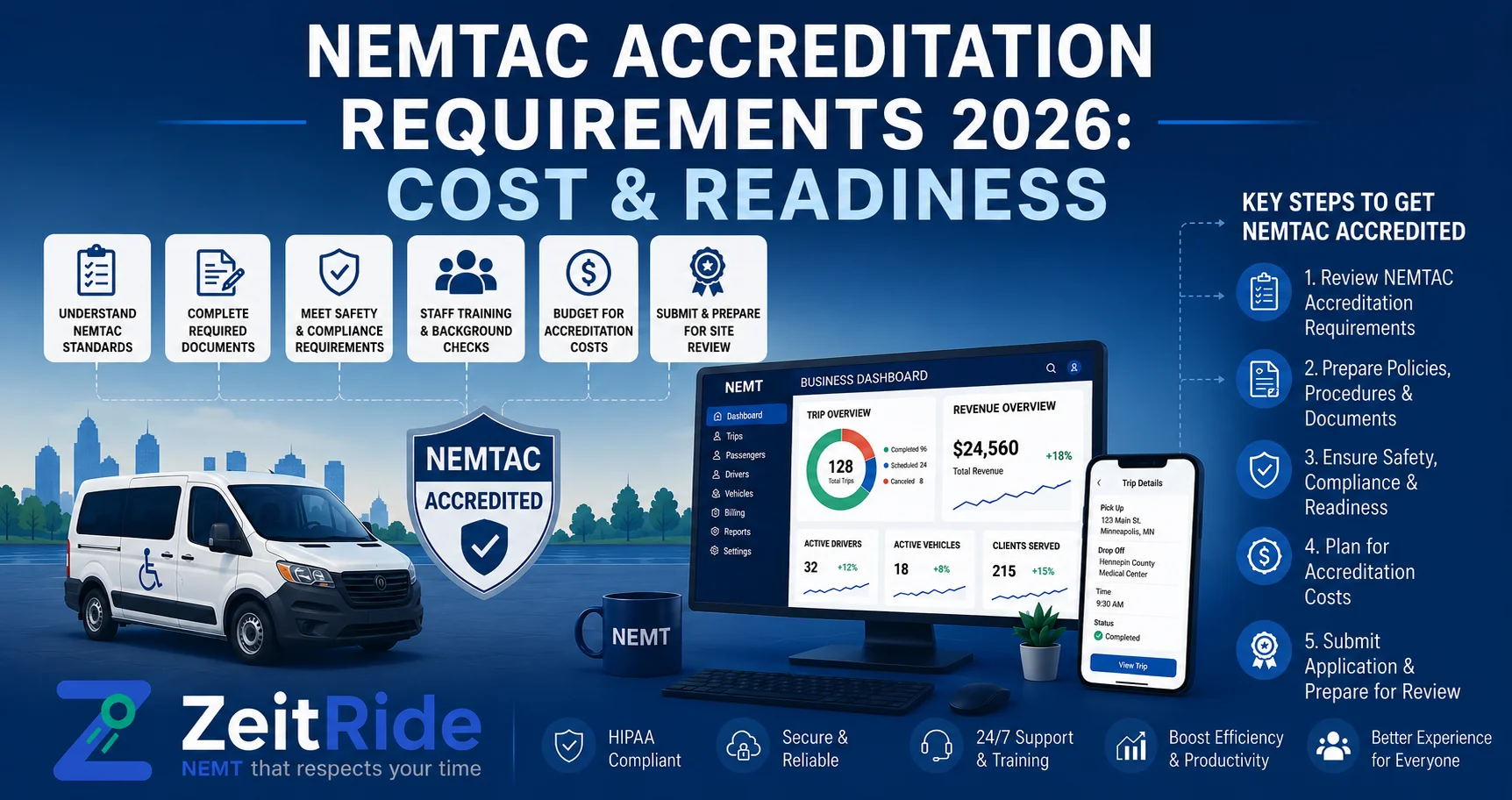
NEMTAC Accreditation Requirements 2026: Cost & Readiness
Learn NEMTAC accreditation requirements for 2026, including eligibility, cost, process, review areas, and a practical readiness checklist for NEMT providers.
Quick answer
NEMTAC applicants need applicable business licenses, an EIN, an NPI, at least 12 months in service, and eligible NEMT services. Providers should also be ready to demonstrate policies, driver credentialing, vehicle maintenance, compliance, fleet operations, HR, and communications.
ZeitRide Team
NEMT Operations Expert
For an established non-emergency medical transportation company, the NEMTAC accreditation requirements in 2026 involve much more than filling out an application. NEMTAC evaluates whether an organization has the required business credentials, operating history, policies, driver controls, vehicle processes, compliance practices, and operational systems to demonstrate consistent service. If your records are still spread across spreadsheets, paper files, email, and driver messages, strengthening your NEMT compliance document tracking before the review can make accreditation preparation much more manageable.
This guide explains the current NEMTAC accreditation requirements, cost, application process, review areas, and a practical readiness framework for NEMT providers. It also explains what accreditation is not, because NEMTAC organizational accreditation is different from Medicaid enrollment, broker credentialing, and individual driver or staff certification.
What Are the NEMTAC Accreditation Requirements in 2026?
According to the official NEMTAC accreditation information, an organization seeking accreditation must have applicable city and state business licenses, an Employer Identification Number (EIN), a National Provider Identifier (NPI), at least 12 months in service, and eligible NEMT services. NEMTAC also expects established providers to have developed operational policies, procedures, handbooks, or guidelines that are actively practiced throughout the organization.
| Requirement | What It Means for an NEMT Provider |
|---|---|
| Applicable business licenses | Maintain required city and state business licenses for the locations where the organization operates |
| Employer Identification Number (EIN) | Maintain an EIN associated with the operating business |
| National Provider Identifier (NPI) | Maintain the NPI required by NEMTAC for organizational accreditation |
| At least 12 months in service | The organization must have an established operating history before seeking accreditation |
| Eligible NEMT services | Provide qualifying transportation services such as NEMT, wheelchair transportation, or stretcher van service |
| Established operating processes | Have documented policies and procedures that are actually followed in day-to-day operations |
These are baseline eligibility conditions, not the complete accreditation standard. Before applying, providers should review NEMTAC's current handbook and standards rather than assuming that state licensing, Medicaid approval, or broker credentialing automatically satisfies accreditation requirements.
Is NEMTAC Accreditation Required to Operate an NEMT Business?
NEMTAC accreditation is not a universal federal license required for every NEMT company in the United States. Providers still need to comply with the licensing, Medicaid, payer, broker, insurance, driver, and vehicle requirements that apply in their state and contracts. A provider may therefore be properly licensed or credentialed for Medicaid and broker work without being NEMTAC accredited.
This distinction matters when planning compliance. If your primary goal is obtaining approval to perform Medicaid trips, review the process for becoming a Medicaid transportation provider. NEMTAC accreditation is a separate organizational evaluation focused on safety, quality, accountability, and operational standards.
NEMTAC Accreditation vs. CTS Certification vs. Medicaid Enrollment
One of the most common sources of confusion is the difference between organizational NEMTAC accreditation and individual certification. Searches for NEMT certification or broader NEMT accreditation information can mix several different concepts together, even though they serve different purposes.
| Term | Applies To | Primary Purpose |
|---|---|---|
| NEMTAC Accreditation | NEMT organization | Third-party evaluation of organizational safety, service quality, governance, compliance, and operational accountability |
| Certified Transport Specialist (CTS) | Individual NEMT professional | Education and certification for transportation professionals |
| Medicaid Enrollment | Provider organization | Approval to participate in an applicable state Medicaid transportation program or delivery model |
| Broker Credentialing | Provider, drivers, and vehicles | Approval to perform trips within a broker's transportation network |
Company-level accreditation evaluates the organization's systems and practices. An individual credential demonstrates that a specific person completed the applicable training or certification. Keeping these entities separate helps providers understand exactly what evidence they need for each type of approval.
What Does NEMTAC Accreditation Cost in 2026?
The current published NEMTAC accreditation cost includes a $600 non-refundable application fee. NEMTAC currently publishes an overall full-payment option of $3,000 and a payment-plan total of $3,600. Providers should confirm current pricing directly with NEMTAC before applying because fees and payment structures may change.
- $600 non-refundable application fee
- $3,000 current full-payment accreditation option
- $3,600 current payment-plan total
- Additional pricing considerations may apply depending on organizational structure, locations, entities, or operations
- Always verify current fees directly with NEMTAC before budgeting
Pricing information in this guide was last reviewed in August 2026. Accreditation expenses should be treated separately from the costs of running the underlying NEMT operation, including insurance, driver credentialing, vehicle compliance, software, training, and state-specific licensing.
How to Get NEMTAC Accredited: Step-by-Step Process
The NEMTAC accreditation process begins before the application itself. Providers should first compare their current operation against the applicable standards and identify missing policies, records, credentials, or workflows. Starting the formal review before the organization can consistently produce evidence may create unnecessary delays.
- Review the current NEMTAC accreditation standards and complete the available readiness self-check.
- Confirm that the organization meets baseline eligibility requirements, including operating history and required business identifiers.
- Apply for Seeking Accreditation status and submit the applicable application fee.
- Prepare and upload requested organizational policies, procedures, and supporting evidence.
- Complete the required organizational self-evaluation and standards review.
- Participate in the organizational evaluation, which may include interviews, evidence review, or other verification activities.
- Address any required follow-up items and await the final accreditation decision.
NEMTAC currently advises organizations to allow approximately 90 days after application for the process, depending on how efficiently information moves between the applicant and the review team. That makes document organization one of the most practical ways to reduce avoidable friction before the formal review begins.
What Does NEMTAC Review During Accreditation?
NEMTAC currently identifies seven major organizational areas within its accreditation review. The practical examples below are a ZeitRide readiness framework designed to help operators think about evidence organization; they are not a replacement for the official NEMTAC standards or handbook.
| NEMTAC Review Area | Practical Evidence to Organize |
|---|---|
| Organizational Management | Policies, leadership responsibilities, governance records, quality processes, and documented procedures |
| Human Resources | Job descriptions, onboarding records, personnel files, training documentation, and employment procedures |
| Driver Credentialing | Driver licenses, qualification records, background checks, applicable training, certifications, and renewal dates |
| Compliance Program & Ethical Business Practices | Compliance policies, reporting procedures, incident processes, corrective actions, and ethical-business controls |
| Vehicle Maintenance | Inspection records, preventive maintenance histories, repairs, safety checks, and accessibility-equipment documentation |
| Fleet Operations | Dispatch procedures, driver and vehicle assignments, trip records, service documentation, and exception handling |
| Communications | Procedures and records for communication with riders, facilities, brokers, drivers, and internal staff |
Providers should compare each area with the current NEMTAC Standards Hub and the applicable accreditation materials. A strong readiness process focuses not only on whether a document exists, but also on whether the organization can prove the related process is consistently followed.
NEMTAC Accreditation Readiness Checklist for NEMT Providers
Before formally applying, review the operation as if an independent reviewer were already asking for evidence. Your team should be able to answer the following questions without rebuilding records from multiple disconnected systems.
- Are required business licenses, EIN, NPI, and organizational records current?
- Has the company been actively operating for at least 12 months?
- Are written policies and procedures reflected in actual daily workflows?
- Can management immediately identify driver credentials that are current, expiring, expired, or missing?
- Can the company show that vehicles were inspected and maintained according to its documented procedures?
- Can completed trip records be retrieved without reconstructing them from paper, spreadsheets, emails, or text messages?
- Are incidents, exceptions, corrections, and record changes documented consistently?
- Can HR records demonstrate onboarding, training, and personnel-management processes?
- Can management show how compliance problems are identified, escalated, corrected, and monitored?
- Are operational procedures followed consistently across drivers, dispatchers, vehicles, and locations?
For a deeper review of the records behind daily transportation activity, use ZeitRide's NEMT documentation requirements guide. Driver qualification records should also be reviewed against the applicable NEMT driver requirements for the provider's state, payer, and contracts.
Run the Five-Minute Accreditation Evidence Test
A simple way to test operational readiness is to choose one driver, one vehicle, and one completed trip from several months ago. Give your team five minutes to retrieve the driver's applicable qualification records, the vehicle's inspection or maintenance evidence, the trip documentation, and any relevant history or changes.
If that task requires checking several spreadsheets, calling a dispatcher, searching driver messages, opening email attachments, and locating paper folders, the problem may not be that the records do not exist. The problem is that the evidence is fragmented. Connecting NEMT driver management, NEMT fleet inspections, trip documentation, and a searchable NEMT audit trail creates a more defensible operational record.
Common NEMTAC Accreditation Readiness Gaps
Accreditation preparation often exposes operational inconsistencies that normal day-to-day dispatching can hide. A document may exist, but that does not necessarily mean it is current, connected to the correct driver or vehicle, or easy to verify later.
- Expired or soon-to-expire driver and vehicle credentials are tracked manually
- Policies describe a process that staff do not consistently follow
- Vehicle inspections and maintenance evidence are stored in separate systems
- Completed trip records are incomplete or difficult to reconstruct
- Driver qualification documents are scattered across email, folders, and spreadsheets
- There is no clear ownership for reviewing compliance exceptions
- Record corrections and operational changes do not have a searchable history
- Different locations or dispatch teams follow different versions of the same process
The goal is not to create paperwork purely for an accreditation review. A stronger approach is to build repeatable operational controls so that accurate evidence is created naturally as drivers, dispatchers, fleet managers, and administrators complete their normal work.
How NEMT Software Supports Accreditation Readiness
NEMT software does not make a company NEMTAC accredited, replace the accreditation standards, or guarantee a successful review. Accreditation decisions remain with NEMTAC based on its applicable standards and evaluation process.
What software can do is make an approved operating process easier to follow and prove. ZeitRide's NEMT software brings dispatch, driver management, vehicle records, inspections, trip documentation, compliance documents, and operational history into a connected workflow. Instead of preparing for accreditation by building a temporary binder, the organization can maintain many of the underlying records as part of normal daily operations.
For example, expiration alerts can help management identify credentials before they lapse, electronic inspections can preserve vehicle evidence, trip records can connect activity to specific drivers and vehicles, and audit history can help explain what changed and when. These capabilities support operational readiness, but providers should always use the official NEMTAC standards to determine what evidence is actually required.
How Long Is NEMTAC Accreditation Valid?
NEMTAC currently states that organizational accreditation is valid for three years from the date it is awarded, subject to maintaining applicable requirements, credentials, and fees. Providers should not treat accreditation as a one-time compliance project. Policies, driver records, vehicle documentation, training, maintenance, and other operational controls need to remain current after accreditation is achieved.
Prepare for Accreditation Without Building a Second Workflow
The minimum NEMTAC accreditation requirements are only the starting point. Established providers also need to demonstrate that organizational policies, driver credentialing, vehicle maintenance, fleet operations, compliance practices, HR processes, and communications are being implemented consistently.
Before applying, review the current NEMTAC materials, complete the official readiness self-check, and test whether your team can retrieve the evidence behind daily operations quickly. If compliance records are still scattered across spreadsheets, paper files, messages, and disconnected software, book a 15-minute ZeitRide demo and bring one driver record, one vehicle record, and one completed trip to see how a connected NEMT workflow can simplify recordkeeping and operational readiness.
Frequently Asked Questions
Q: What are the NEMTAC accreditation requirements?
NEMTAC currently requires applicable business licenses, an EIN, an NPI, at least 12 months in service, and eligible NEMT services. Applicants should also have established policies, procedures, and operational systems that can be evaluated against current NEMTAC standards.
Q: How much does NEMTAC accreditation cost?
NEMTAC currently lists a $600 non-refundable application fee and publishes overall accreditation pricing of $3,000 under its full-payment option or $3,600 through its payment plan. Providers should verify current pricing directly with NEMTAC before applying.
Q: How long does the NEMTAC accreditation process take?
NEMTAC currently advises organizations to allow approximately 90 days after applying, depending on how efficiently information and documentation move between the applicant and accreditation review team.
Q: How long is NEMTAC accreditation valid?
NEMTAC states that organizational accreditation is valid for three years from the date of award, subject to maintaining applicable requirements, credentials, and fees.
Q: Can a new NEMT company become NEMTAC accredited?
NEMTAC currently requires an organization to have at least 12 months in service, so a newly formed company generally needs to establish an operating history before seeking organizational accreditation.
Q: Is NEMTAC accreditation the same as CTS certification?
No. NEMTAC accreditation evaluates an NEMT organization, while Certified Transport Specialist (CTS) is an education and certification program for individual NEMT professionals.
Q: How do you get NEMTAC accredited?
Start by reviewing the current NEMTAC standards and completing the readiness self-check. Confirm eligibility, apply for Seeking Accreditation status, submit required documentation and fees, complete the organizational evaluation process, address follow-up items, and await the final accreditation decision.
Q: Does NEMT software guarantee NEMTAC accreditation?
No. NEMT software can help organize documentation, credentials, inspections, trip records, and operational history, but it does not replace NEMTAC standards or guarantee an accreditation decision.
Rather see it than read about it?
Bring a real route, a couple of drivers, and your current process. 15 minutes, zero pitch.