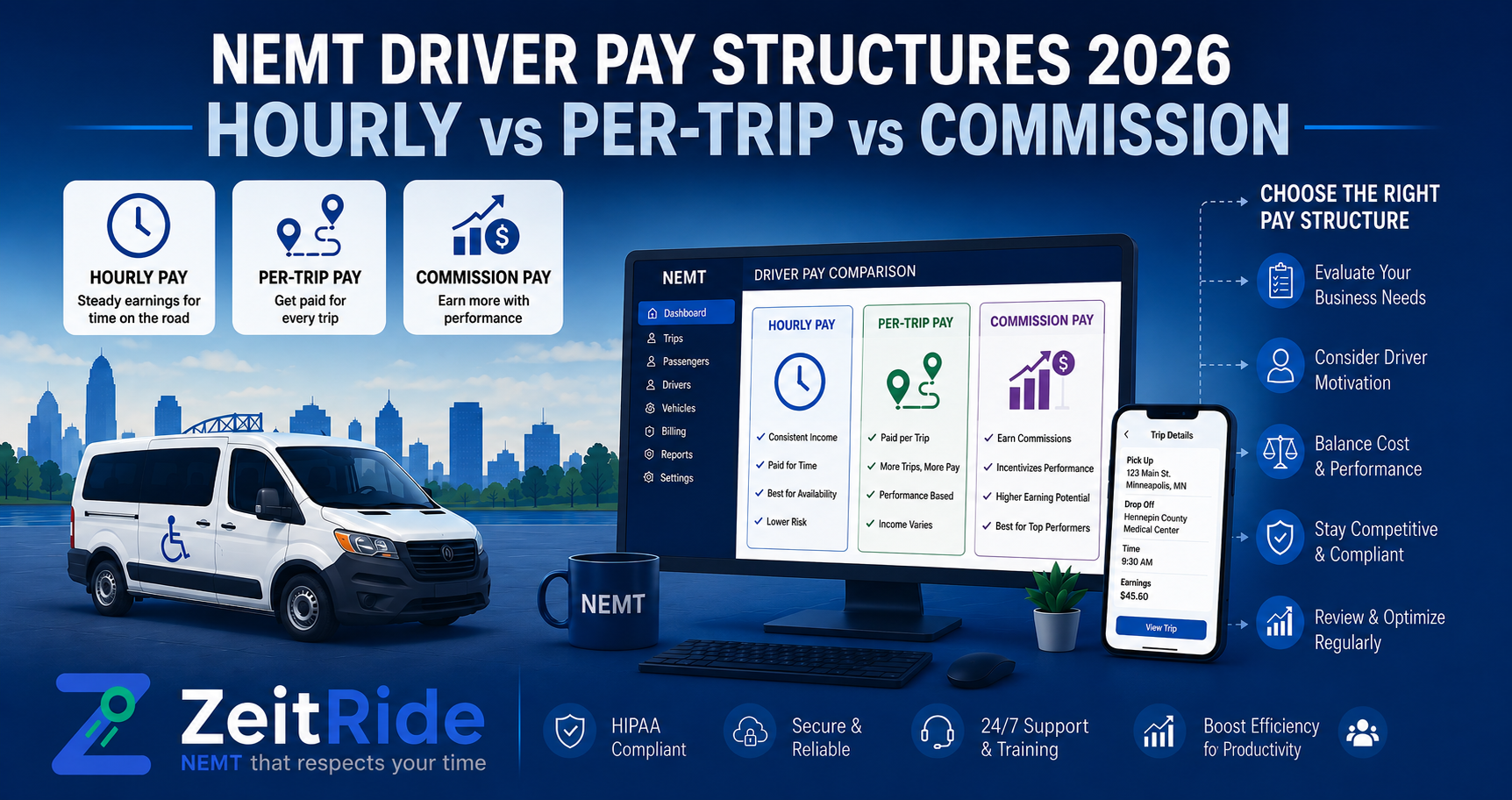
NEMT Driver Pay Structures 2026: Hourly vs Per-Trip vs Commission
Compare hourly, per-trip, commission, and hybrid NEMT driver pay structures with practical examples for U.S. fleet operators.
Quick answer
There is no single best NEMT driver pay structure. Hourly pay offers predictability, per-trip and commission models tie pay to production, and hybrid pay combines a base rate with incentives. The right fit depends on trip density, wait time, mileage, service mix, and labor rules.
ZeitRide Team
NEMT Operations Expert
Paying NEMT drivers is not simply a matter of choosing an hourly rate. An operator also has to account for trip volume, waiting time, loaded and deadhead mileage, cancellations, wheelchair service, route density, payroll rules, and the amount actually collected from each payer. The right NEMT driver pay structure should make compensation understandable to drivers while giving the business a reliable way to measure labor cost.
This guide compares the four models NEMT operators are most likely to evaluate — hourly, per-trip, commission, and hybrid compensation. The examples are hypothetical and are designed to show how the math changes under each structure, not to recommend a specific wage level for every market.
Quick Answer: Which NEMT Driver Pay Structure Is Best?
There is no universal best NEMT driver pay structure. Hourly pay is easier for drivers to predict, per-trip pay connects compensation directly to completed work, commission links compensation to trip revenue, and hybrid pay combines guaranteed base compensation with a defined incentive. The best fit depends on the fleet's route density, wait time, service mix, trip revenue, and applicable wage-and-hour requirements.
For most operators, the most important first step is not choosing a percentage or dollar amount. It is making sure the business can accurately connect each driver's working time, completed trips, and mileage to the payroll period. ZeitRide's NEMT driver payroll workflow keeps those operational records together instead of requiring payroll staff to reconcile separate trip logs and spreadsheets.
NEMT Driver Pay Structures Compared
| Pay Structure | How It Works | Main Advantage | Main Challenge | Best Operational Fit |
|---|---|---|---|---|
| Hourly | Driver earns a defined amount for eligible working time | Predictable for drivers and payroll | Labor cost can rise when routes contain excessive waiting or deadhead time | Fleets with variable trip volume or significant waiting time |
| Per-Trip | Driver earns a fixed amount for each qualifying completed trip | Simple connection between production and compensation | Short and long trips may require different treatment | Dense routes with relatively consistent trip profiles |
| Commission | Driver receives a defined percentage or revenue-based amount | Compensation moves with trip value | Revenue differences and adjustments can make calculations harder to explain | Fleets with clean and consistent revenue data |
| Hybrid | Base compensation plus a defined trip, productivity, or performance incentive | Balances predictability with incentives | Requires clear rules and reliable tracking | Fleets seeking stability plus measurable performance incentives |
How Does Hourly Pay Work for NEMT Drivers?
With hourly compensation, the operator pays the driver based primarily on qualifying working time rather than the number or value of trips completed. This can be practical when drivers regularly encounter unpredictable appointment delays, traffic, long pickups, vehicle preparation, or other work that does not translate neatly into a trip count.
The operational challenge is that two eight-hour shifts can produce very different results. One driver might complete many short trips in a dense service area, while another covers fewer long-distance trips with significant waiting time. The payroll record therefore needs to show more than completed-trip totals.
How Does NEMT Driver Pay Per Trip Work?
Under an NEMT driver pay-per-trip model, compensation is connected to a completed trip rather than only to elapsed time. For example, an operator could define an amount for each qualifying completed assignment, subject to the company's written compensation policy and applicable wage rules.
The model becomes harder to manage when trips vary significantly. A five-mile ambulatory trip, a long rural pickup, and a wheelchair trip with extended loading time may consume very different amounts of driver time even though each counts as one completed trip.
Operators evaluating per-trip compensation should therefore measure the effective labor cost per completed trip, not merely the nominal payment. ZeitRide's NEMT cost per trip calculator provides a broader framework for combining driver labor with mileage, vehicle expenses, overhead, and payment leakage.
How Does NEMT Driver Commission Work?
NEMT driver commission usually means connecting some portion of compensation to the value of qualifying trips rather than paying the same fixed amount for every trip. A company might base its formula on a defined revenue amount, but the policy should clearly explain what revenue is included, what happens when a payer adjusts a claim, and how canceled or partially completed trips are handled.
Commission arrangements require especially clean records because the driver and payroll team need to understand how the final amount was calculated. The compensation formula should never depend on numbers that cannot be traced back to the underlying trip and payroll record.
What Is a Hybrid NEMT Driver Pay Structure?
A hybrid structure combines a base form of compensation with a clearly defined incentive. For example, a business might use hourly base pay plus a fixed incentive tied to qualifying completed trips or another documented performance measure.
The advantage is balance: drivers have a more predictable base while the operator can reward defined outcomes. The disadvantage is administrative complexity. A hybrid plan only works well when drivers know exactly which actions qualify and the company can reproduce every calculation from its records.
NEMT Driver Pay Calculator Example
The following example is hypothetical. It demonstrates how different formulas can produce different labor costs from the same operating day.
| Example Input | Amount |
|---|---|
| Driver working time | 8 hours |
| Completed trips | 10 |
| Collected trip revenue | $600 |
| Example Pay Model | Hypothetical Calculation | Driver Compensation | Labor Cost Per Completed Trip |
|---|---|---|---|
| Hourly | 8 × $18 | $144 | $14.40 |
| Per-Trip | 10 × $14 | $140 | $14.00 |
| Commission | 25% × $600 | $150 | $15.00 |
| Hybrid | 8 × $16 + 10 × $2 | $148 | $14.80 |
These numbers are calculation examples, not recommended market rates. The more useful exercise is to replace them with your own driver records and then compare compensation against completed trips, total miles, waiting time, and collected revenue.
How to Pay NEMT Drivers: 6 Factors to Compare
- Trip density: Ten short urban trips create a different workload from three long rural trips.
- Waiting time: Medical appointments and facility pickups can create substantial non-driving time.
- Loaded and deadhead mileage: A driver may spend significant time traveling without a passenger in the vehicle.
- Service level: Ambulatory, wheelchair, stretcher, and other service types can require different amounts of time and assistance.
- Revenue consistency: Commission-style formulas become harder to administer when payer rates, adjustments, or denials vary.
- Payroll and compliance requirements: The compensation method still has to operate within applicable federal, state, and local rules.
Pay Structure and Worker Classification Are Different Decisions
Paying someone per trip or by commission does not by itself determine whether that person is an employee or an independent contractor. For federal tax purposes, the IRS evaluates the overall relationship, including behavioral control, financial control, and the type of relationship between the parties. Operators should review the IRS worker classification guidance and applicable state requirements before making classification decisions.
Federal worker-classification guidance can change, and state rules may apply different tests. NEMT operators should verify the current U.S. Department of Labor worker classification guidance and applicable state requirements before implementing an employee or independent-contractor arrangement.
For covered employees, the method used to calculate wages does not eliminate applicable minimum-wage, overtime, recordkeeping, or hours-worked obligations. Waiting time can also count as working time depending on the circumstances, which matters in NEMT operations where drivers may be required to wait between trip legs or at medical facilities.
What Records Should an NEMT Operator Track for Driver Pay?
A dependable compensation process should allow the operator to reconstruct how every payroll amount was calculated. At minimum, the underlying operational record should make it possible to review the driver, date, shift or working time, assigned and completed trips, pickup and drop-off activity, mileage, adjustments, and relevant exceptions.
- Driver and payroll period
- Working-time records
- Completed trips
- Pickup and drop-off timestamps
- Loaded and operational mileage
- Cancellations and no-shows
- Pay-rate or incentive rules
- Manual corrections or adjustments
- Supporting trip records
- Approval or audit history
ZeitRide keeps completed trips, driver hours, mileage, and GPS-backed trip activity connected to the same operating workflow. Operators can also use NEMT driver management software to keep driver qualifications, availability, and trip history connected to daily operations.
Why Route Type Can Change the Best Pay Model
Dense Urban Routes
A driver working a compact urban route may complete a larger number of short trips during a shift. A production-based component may therefore behave very differently than it does in a rural fleet.
Rural and Long-Distance Routes
Rural drivers may complete fewer trips while spending substantially more time and mileage between pickups and destinations. Looking only at trip count can make productive long-distance work appear inefficient.
Wheelchair and Higher-Assistance Trips
Trips that require additional boarding, securement, assistance, or facility coordination should be evaluated using the actual time and operational requirements involved rather than assuming every completed trip creates the same workload.
How NEMT Software Makes Driver Pay Easier to Verify
The compensation formula is only as reliable as the data behind it. If hours are kept on one spreadsheet, mileage comes from another system, and completed trips live in dispatch software, payroll becomes a reconciliation project every pay period.
A connected NEMT software platform can reduce that fragmentation by linking dispatch activity, trip completion, driver records, GPS-backed mileage, and payroll-ready information. ZeitRide does not replace your payroll processor; it organizes the operational data the payroll process depends on.
Choose the Pay Structure Using Your Own Fleet Data
Do not choose hourly, per-trip, commission, or hybrid compensation simply because another NEMT company uses it. Model each option against your own routes. Compare driver working time, completed trips, total mileage, wait time, service level, and collected revenue. Then review the structure against applicable employment rules and your company's retention goals.
The strongest compensation plan is one your drivers can understand, your payroll team can reproduce, and your operation can afford.
See Your Driver Hours, Trips, and Mileage in One Workflow
If payroll still starts with someone comparing driver logs against dispatch records, the problem may not be your compensation formula — it may be the data feeding it. ZeitRide connects driver activity, completed trips, mileage, dispatch, and reporting in one NEMT workflow.
See how ZeitRide can organize the operational records behind driver compensation and payroll — book a 15-minute demo and bring one representative route and your current driver-pay process.
Methodology note: This article provides general operational information for U.S. NEMT businesses. The hypothetical calculations are illustrative and are not wage recommendations, legal advice, tax advice, or payroll advice. Wage, overtime, worker-classification, and recordkeeping requirements vary by jurisdiction and circumstances.
Frequently Asked Questions
Q: What is the best NEMT driver pay structure?
There is no universal best structure. Hourly, per-trip, commission, and hybrid models each create different trade-offs. Compare them using your actual trip density, driver time, mileage, service mix, revenue, and applicable employment requirements.
Q: Can NEMT drivers be paid per trip?
A business may consider trip-based compensation, but the arrangement must still comply with applicable federal, state, and local wage-and-hour requirements. Operators should review the complete compensation arrangement before implementation.
Q: How does NEMT driver commission work?
NEMT driver commission connects some portion of compensation to qualifying trip revenue or another defined revenue measure. The calculation should clearly document qualifying revenue, adjustments, cancellations, and supporting trip records.
Q: What is hybrid pay for NEMT drivers?
Hybrid pay combines a base compensation method with a defined incentive, such as a trip-based or performance component. It is designed to combine predictable base compensation with measurable incentives.
Q: How do you calculate driver labor cost per NEMT trip?
Divide the driver's applicable labor cost for the period by completed trips attributed to that period. For true trip profitability, also account for mileage, vehicle expenses, administrative overhead, and payment leakage.
Q: Does ZeitRide process NEMT driver paychecks?
No. ZeitRide tracks driver hours, completed trips, mileage, and supporting trip records so the information is organized and ready to export to the payroll system or provider your company already uses.
Rather see it than read about it?
Bring a real route, a couple of drivers, and your current process. 15 minutes, zero pitch.