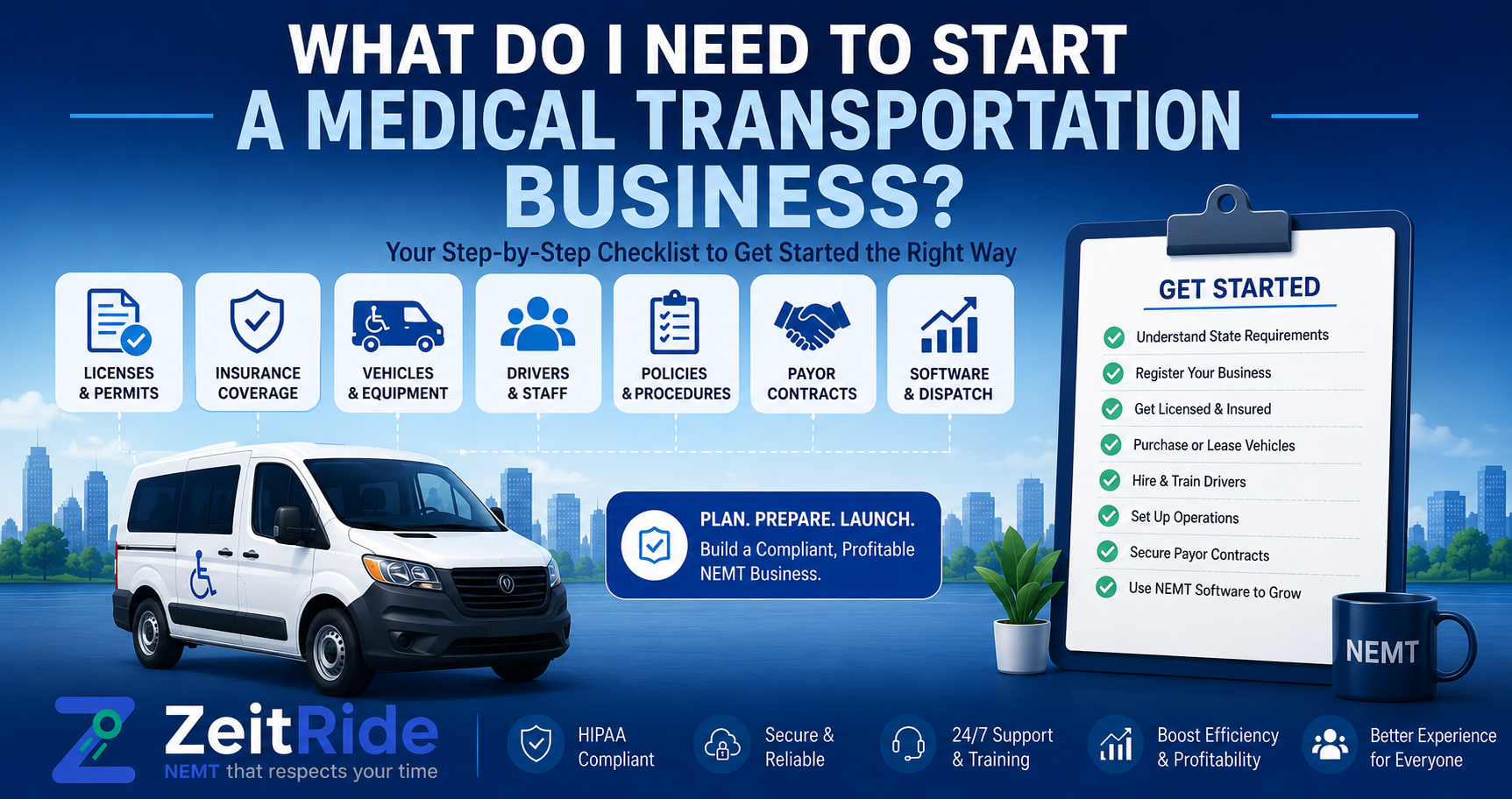
What do I need to start a medical transportation business?
Learn what you need to start a medical transportation business, including licensing, insurance, ADA vehicles, drivers, and NEMT software.
ZeitRide Team
NEMT Operations Expert
Most people find out what they need to start a medical transportation business after they've already spent money on the wrong things a van before a license, insurance before a broker contract, spreadsheets before software. You need six things in order: a business plan, a legal entity and NEMT business license, insurance, vehicles that meet ADA and state standards, trained drivers, and a system to run trips without losing money on empty miles. ZeitRide runs that last piece for $49 per vehicle per month, with most operators live within 30 minutes of signing up.
What starting a non emergency medical transportation business actually requires
Starting a non emergency medical transportation business requires proof, on paper, that you can run trips safely, legally, and profitably before you ever pick up a passenger. States and Medicaid brokers won't hand you a contract on good intentions — they want a business license, insurance certificates, a fleet that meets ADA standards, and a business plan that shows you understand the numbers.
Here's the full list, in the order most operators actually need it:
- A legal business entity — LLC or corporation, registered with your state
- A non emergency medical transportation business plan — covers your market, services, pricing, and financial projections
- A business license for non emergency medical transportation — issued at the state or local level, sometimes both
- A Motor Carrier Permit or USDOT number, depending on vehicle weight
- Commercial auto, general liability, and workers' comp insurance
- ADA-compliant vehicles — wheelchair lifts, ramps, restraints
- A dispatch, scheduling, and billing system that can handle broker trip imports and Medicaid documentation
Skip any one of these and you'll stall out at the credentialing stage with a broker like MTM Health or ProCare — they check every box before they send you a single trip.
Skip any one of these and you'll stall out at the credentialing stage with a broker like MTM Health or ProCare — they check every box before they send you a single trip.
A business license for non emergency medical transportation typically runs a few hundred dollars, but full credentialing with brokers and Medicaid can take 60 to 90 days. Every state licenses NEMT operators differently. Some require a standalone medical transportation permit on top of your standard business license; others fold it into general passenger transport authority. What's consistent across states is the paperwork brokers want before they'll route trips to you: proof of insurance, vehicle inspection records, driver background checks, and HIPAA training documentation.
This is where most new NEMT business owners lose weeks. They get the business license, then discover the broker application asks for electronic trip records and EVV (Electronic Visit Verification) capability they haven't set up yet. Building that into your plan from day one — instead of scrambling once a broker asks for it — is the difference between a 30-day and a 90-day ramp to your first paid trip.
How ZeitRide handles the operations side once you're licensed
Once your NEMT business license and insurance are in place, the operational side is what determines whether you're profitable in month one or month six. ZeitRide runs dispatch, scheduling, routing, billing, and broker integrations in one flat-fee platform:
- $49 per vehicle per month — dispatch, scheduling, routing, billing, and the driver app included, no add-ons or setup fees
- AI route optimization that averages a 20% reduction in miles driven, which matters directly for your NEMT rates and fuel costs
- Broker integrations already built for MTM Health, CTS Transit, Provide A Ride, ProCare, DD Med Trans, and Tennessee Carriers — so trip imports don't require manual entry
- HIPAA-aware, Medicaid-ready, EVV-supported infrastructure, with data encrypted in transit and at rest
- A driver app for iOS and Android with offline GPS and under a 15-minute learning curve, so new hires are running trips the same day
- 99.9% uptime target, active in 10+ states
What new operators get wrong about their non emergency medical transportation business plan
The single biggest mistake in a non emergency medical transportation business plan is guessing at NEMT rates instead of building them from real cost data. Operators price a trip based on what a competitor charges, without knowing their own loaded cost per trip — vehicle payment, insurance, driver wage, fuel, and software overhead all rolled together. When Medicaid reimbursement comes in below that number, the trip loses money every time it's run.
The second mistake is underestimating NEMT insurance cost. Commercial auto and liability coverage for a wheelchair-accessible vehicle costs meaningfully more than a standard passenger vehicle policy, and most new operators budget for the vehicle before they get a real quote on the policy. Get insurance quotes during the business plan stage, not after you've already committed to a fleet size.
The third mistake is choosing NEMT software based on price alone. Legacy platforms like RouteGenie, TripMaster, and Bambi often carry per-trip fees, per-seat charges, or $5,000 to $25,000 implementation costs on top of the sticker price. That's a cost your business plan needs to account for honestly — or avoid altogether with a flat month-to-month rate.
Who this is built for
- Fleet owners launching their first NEMT business who need software that's running before their first broker contract starts sending trips
- Operations directors scaling from a handful of vehicles into a 5–100+ vehicle operation without adding dispatch headcount
- Dispatch coordinators who are still building routes and driver schedules manually and losing hours to it every day
- Fleet managers trying to cut the number of vehicles needed to serve the same member count, the way Sandra Mills did at SafeTrip NEMT
Setting up compliant in your state
Requirements for a business license for non emergency medical transportation vary by state, and so do the Medicaid brokers you'll need to credential with. If you're launching in Pennsylvania or Florida, ZeitRide's state-specific NEMT software pages walk through the local broker landscape and compliance requirements so you're not guessing at what your state Medicaid office expects. Rural fleets and urban fleets also face different route density and driver scheduling challenges, which is worth mapping out in your business plan's market analysis section before you set your service area.
Start your NEMT business with the operations side already solved
Knowing what you need to start a medical transportation business is the easy part — licensing, insurance, and vehicles are checklist items every state publishes. The part that actually determines whether you're profitable is the operations layer underneath your non emergency medical transportation business plan: how you set NEMT rates, run dispatch, and bill brokers without losing margin on every trip. ZeitRide runs all of it for $49 per vehicle per month, with route optimization that averages a 20% reduction in miles driven.
Frequently Asked Questions
Q: What do I need to start a medical transportation business?
You need a registered business entity, a business license for non emergency medical transportation, insurance, ADA-compliant vehicles, trained drivers, and a dispatch and billing system. ZeitRide covers the software side at $49 per vehicle per month, with most operators live within 30 minutes.
Q: How much does an NEMT business plan need to cover?
A non emergency medical transportation business plan should cover market analysis, services offered, legal structure, startup and ongoing costs, NEMT rates, marketing strategy, and financial projections. Lenders and brokers use it to judge whether your pricing and Medicaid reimbursement numbers actually cover your loaded cost per trip.
Q: How much is NEMT insurance cost typically?
NEMT insurance cost depends on your state, fleet size, and whether vehicles are wheelchair-accessible, but commercial auto, general liability, and workers' comp are the three policies every NEMT business needs before credentialing with a broker. Get quotes during the business plan stage so your financial projections reflect real numbers.
Q: What NEMT software do I need to run a compliant business?
You need software that handles dispatch, scheduling, routing, billing, and broker trip imports with HIPAA-aware, Medicaid-ready, EVV support. ZeitRide includes all of that for $49 per vehicle per month, with no setup fees or contracts, and integrates directly with brokers like MTM Health and ProCare.
Q: You need software that handles dispatch, scheduling, routing, billing, and broker trip imports with HIPAA-aware, Medicaid-ready, EVV support. ZeitRide includes all of that for $49 per vehicle per month, with no setup fees or contracts, and integrates directly with brokers like MTM Health and ProCare.
The business license itself can take a few weeks depending on your state, but full Medicaid broker credentialing — insurance verification, vehicle inspections, driver background checks — typically takes 60 to 90 days. Building your compliance documentation into your operations plan early shortens that window. C
Rather see it than read about it?
Bring a real route, a couple of drivers, and your current process. 15 minutes, zero pitch.