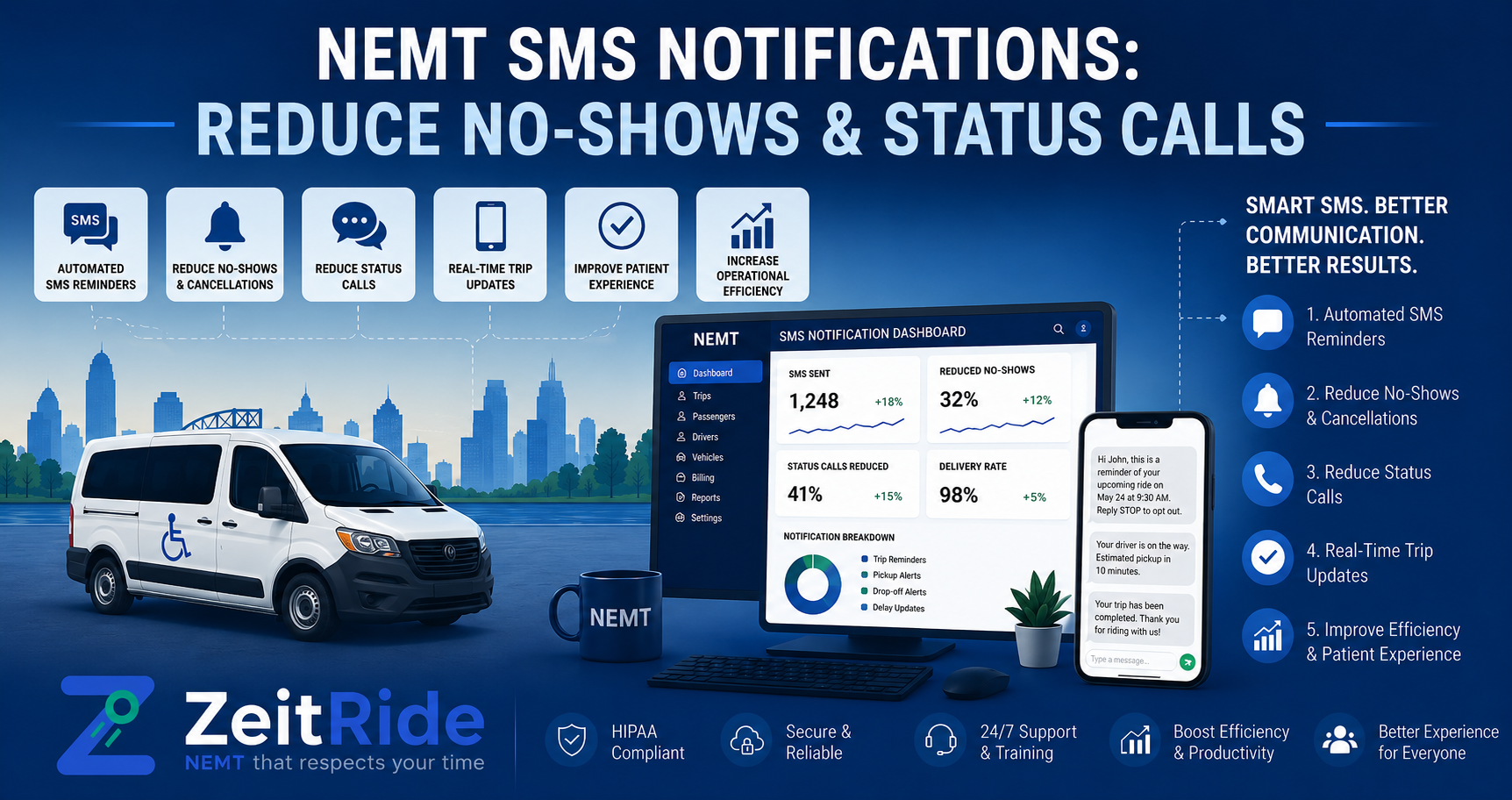
NEMT SMS Notifications: Reduce No-Shows & Status Calls
Learn how NEMT SMS notifications, trip reminders, ETA alerts, and voice updates can reduce no-shows, status calls, and dispatcher workload.
Quick answer
NEMT SMS notifications send timely ride updates for booking, reminders, driver status, ETAs, arrivals, delays, and cancellations. When connected to scheduling, dispatch, and GPS data, they can reduce rider uncertainty, avoidable no-shows, and repetitive status calls to dispatch.
ZeitRide Team
NEMT Operations Expert
A rider has a 9:00 a.m. pickup but is unsure whether the trip is still on schedule. The facility calls dispatch asking where the vehicle is. A few minutes later, the rider calls with the same question. The dispatcher checks the live board, confirms the driver's status, and repeats the same information twice. Nothing is necessarily wrong with the trip — the problem is that the people involved cannot see what is happening. NEMT SMS notifications help close that information gap by turning trip events into timely rider, caregiver, and facility updates.
The goal is not to send more messages. It is to send the right message when it can prevent uncertainty, a missed pickup, or another manual status call. The strongest workflow connects notifications directly to NEMT dispatch software, scheduling, driver status, and GPS data so the message reflects what is actually happening with the ride.
What Are NEMT SMS Notifications?
NEMT SMS notifications are automated or operational text messages used to keep riders and approved contacts informed before and during a non-emergency medical transportation trip. They can confirm that a ride was booked, remind the rider to prepare, communicate an estimated arrival time, report that the driver has arrived, or explain a delay, cancellation, or other trip-status change.
The most useful NEMT trip notifications are tied to the same trip record used by NEMT scheduling software, dispatch, GPS, and the driver application. That connection matters because a notification is only as reliable as the operational information behind it.
The NEMT Trip Notification Lifecycle
A practical notification strategy follows the trip from booking through completion. Not every NEMT provider needs every notification below, but these are the major trip events worth evaluating when designing an automated communication workflow.
| Trip Event | Recommended Recipient | Best-Fit Channel | Purpose |
|---|---|---|---|
| Trip booked | Rider or approved contact | SMS or email | Confirm the date, pickup window, and scheduled ride |
| Pre-trip reminder | Rider or caregiver | SMS or voice | Remind the rider to prepare and report changes early |
| Driver assigned | Rider or facility | SMS | Confirm that the trip is progressing |
| Driver en route | Rider, caregiver, or facility | SMS | Tell the recipient that the vehicle is on the way |
| ETA updated | Rider, caregiver, or facility | SMS | Set a more accurate pickup expectation |
| Driver arrived | Rider or facility | SMS or voice | Prompt the rider to meet the vehicle |
| Delay detected | Relevant trip contacts | SMS | Explain the change and provide an updated expectation |
| Trip canceled | Relevant trip contacts | SMS or voice | Prevent unnecessary waiting or vehicle movement |
| Trip completed | Rider or approved contact | SMS or email | Confirm completion when operationally useful |
| Return trip ready | Rider or facility | SMS or voice | Coordinate a will-call or return pickup |
The operating principle is simple: right message, right person, right trip event. Sending a large number of generic texts does not automatically improve communication. The most valuable notifications are the ones that answer a question before someone has to call dispatch.
Which NEMT Trip Notifications Should You Automate First?
1. Booking Confirmations
A booking confirmation answers the rider's first question: is my transportation actually scheduled? It should contain enough information for the recipient to recognize the trip and identify obvious errors without exposing unnecessary information.
Example: "Your ride with ABC Transportation is scheduled for Tuesday, August 25. Pickup window: 8:30–8:45 a.m. Contact 555-555-5555 if your plans change."
2. NEMT Trip Reminders
NEMT trip reminders are particularly useful for rides booked days in advance, recurring transportation, and trips where a caregiver or facility helps coordinate the pickup. A reminder creates another opportunity to catch a forgotten appointment, incorrect pickup time, outdated contact detail, or cancellation before the driver is already on the road.
A day-before reminder plus a closer pre-pickup reminder can be a practical starting point, but providers should test timing against their own rider population, broker requirements, trip types, cancellations, and no-show patterns. For a broader operational strategy, see how to reduce NEMT no-shows.
3. En-Route and NEMT ETA Notifications
An en-route message becomes significantly more useful when it is connected to current driver and route status rather than a fixed estimate created hours earlier. NEMT ETA notifications can give riders, caregivers, and facilities a clearer expectation of when the vehicle will reach the pickup location.
Example: "Your driver is on the way. Current estimated arrival: 8:42 a.m. Please be ready at your designated pickup location." The word estimated matters because traffic, previous pickups, facility delays, same-day changes, and other operating conditions can affect arrival time.
4. Driver Arrival Notifications
Arrival notifications help close the gap between the vehicle physically reaching the pickup location and the rider knowing it is time to meet the driver. They can be particularly useful at apartment complexes, hospitals, rehabilitation facilities, and buildings with multiple entrances.
5. Delay and Cancellation Notifications
Silence becomes more frustrating when a ride changes than when everything is running normally. If dispatch knows a vehicle is delayed, a pickup window has shifted, or a trip has been canceled, notifying the appropriate people can prevent unnecessary waiting and repeated phone calls.
When the event ultimately becomes a documented cancellation or failed pickup, communication should remain connected to the operational record. ZeitRide's no-show and cancellation logs help capture trip events with GPS, timestamps, and reason information instead of leaving the full story in phone calls or disconnected notes.
How Can NEMT SMS Notifications Help Reduce No-Shows?
A notification cannot eliminate every NEMT no-show. Riders become ill, appointments change, facilities run behind, addresses may be incorrect, and eligibility or scheduling issues can occur. What notifications can reduce is avoidable uncertainty.
Before pickup, a reminder gives the rider or caregiver another opportunity to notice an incorrect time, confirm that transportation is still needed, or report a cancellation. On the day of service, an en-route update and arrival notification help the rider understand when the vehicle is approaching.
The difference is operationally important. Without proactive communication, the sequence may become vehicle arrives, rider is surprised, driver waits, and dispatch starts calling. With a structured notification workflow, the rider receives a reminder, an en-route update, and an arrival alert before the pickup attempt.
How Do NEMT ETA Notifications Reduce Where's My Ride Calls?
A where's my ride call is usually a visibility problem. The rider wants to know whether the vehicle is coming. A caregiver wants to know whether the driver is ten minutes away or significantly delayed. A facility wants to know when staff should begin preparing the patient.
Without proactive trip status, dispatch becomes the information relay. A dispatcher checks the board, locates the vehicle, reviews the current route, estimates arrival, and communicates the answer manually. The same process may be repeated for multiple people connected to the same trip.
When real-time NEMT dispatch, GPS, driver status, and messaging work from the same operational data, relevant updates can reach riders or authorized contacts without requiring a dispatcher to answer every routine status question. Fleets looking to reduce repetitive office work can also review cutting NEMT dispatch labor costs with automation.
SMS vs. Voice vs. Email for NEMT Patient Notifications
No single communication channel works for every rider. Some people prefer text messages, while others use a landline, rely on a caregiver, have limited texting ability, or respond better to a voice call. Facilities may have different communication needs from individual riders.
| Channel | Best Use | Main Strength | What to Watch |
|---|---|---|---|
| SMS | Confirmations, reminders, ETAs, and status updates | Fast and concise without requiring a separate app | Consent, opt-outs, and accurate mobile numbers |
| Voice | Important reminders or riders who prefer calls | Useful when texting is not appropriate | Call-answer rates, voicemail, and consent requirements |
| Longer confirmations or facility communication | Provides room for additional details | Often less useful for urgent trip-status changes | |
| App or push notification | Riders actively using a passenger application | Can combine status with richer trip information | Requires app adoption and device access |
| Live phone call | Exceptions and sensitive situations | Allows human judgment and two-way resolution | Requires dispatcher time and does not scale as easily |
For organizations that also need business calling, call queues, IVR, voicemail, and texting, NEMT VoIP software can handle the office communication layer while dispatch and the driver workflow manage live trip operations. NEMT voice reminders should complement SMS rather than being treated as a mandatory replacement for it.
NEMT SMS Notification Examples
Templates should be short enough to understand quickly, specific enough to be useful, and flexible enough to populate accurate trip information.
- Booking confirmation: "Your ride is scheduled for [date]. Pickup window: [time]. Contact [number] if your transportation needs change."
- Trip reminder: "Reminder: Your transportation is scheduled tomorrow. Pickup begins at [time]. Please be ready at your designated pickup location."
- Driver en route: "Your driver is on the way. Current estimated arrival: [ETA]."
- Arrival alert: "Your driver has arrived at the designated pickup location. Please proceed when ready."
- Delay alert: "Your ride is delayed. Updated estimated arrival: [ETA]. We apologize for the change."
- Cancellation: "Your transportation scheduled for [date/time] has been canceled. Contact [number] if you believe this is incorrect."
- Return-trip update: "Your return transportation is being coordinated. Current estimated pickup: [ETA]."
Avoid adding a diagnosis, treatment name, medical condition, or other unnecessary sensitive information to a routine transportation message. Use the minimum amount of trip information needed to communicate the operational update.
Who Should Receive NEMT Patient Notifications?
The rider is not always the only person coordinating a medical transportation trip. Depending on authorization, program requirements, and communication preferences, NEMT patient notifications may also need to reach another approved party.
- The rider or member
- A parent or legal guardian
- An authorized caregiver
- A residential or assisted-living contact
- A skilled nursing or rehabilitation facility
- A dialysis or treatment facility coordinator
- An authorized care manager
The important word is authorized. Contact records should clearly identify who may receive trip information and which communication channels are permitted. That helps prevent a technically correct trip update from reaching the wrong person.
TCPA, HIPAA, Consent, and Privacy for NEMT Notifications
NEMT providers should not treat automated texts and calls as compliance-free communication channels. For automated calls or robotexts subject to the Telephone Consumer Protection Act, providers should review the FCC's current TCPA guidance and build an appropriate consent and revocation process for their specific use case.
HIPAA obligations depend on the organization's role and the information being created, received, maintained, or transmitted. The HHS HIPAA Security Rule guidance explains the safeguards regulated entities must consider for electronic protected health information.
HHS also provides guidance on the minimum necessary requirement. For routine trip communication, that supports a practical principle: send the information needed to coordinate transportation, not every detail stored on the trip record.
Broker contracts, state Medicaid programs, facilities, and health plans may impose additional communication or documentation requirements. Providers should review the rules that apply to their operation and obtain appropriate legal or compliance guidance instead of treating a generic SMS template as a substitute for policy.
What Metrics Should an NEMT Fleet Track?
The purpose of a notification program is not to maximize the number of texts sent. It is to improve the trip workflow. Record a baseline before changing the process, then compare operational results after the workflow has enough volume to evaluate meaningfully.
| Metric | What It Tells You |
|---|---|
| Notification delivery rate | Whether messages are reaching valid destinations |
| Opt-out rate | Whether frequency, relevance, or communication expectations need review |
| No-show rate | Whether missed pickups change after reminders are introduced |
| Late cancellation rate | Whether riders are reporting changes earlier |
| Rider status-call volume | Whether proactive updates are reducing routine where's my ride calls |
| Driver wait time | Whether riders are more prepared when the vehicle arrives |
| On-time pickup performance | Whether communication and operations remain aligned |
| Notification failure rate | Whether contact data or delivery rules need attention |
| Exception-resolution time | Whether dispatch can respond more efficiently when trips change |
What Should NEMT Notification Software Include?
A notification feature is only as useful as the trip data feeding it. When evaluating NEMT software, look beyond whether the feature list simply says SMS or text messaging.
- Trip-triggered notifications instead of manual mass texting
- Booking confirmation and reminder workflows
- En-route, arrival, delay, and cancellation notifications
- Live trip status connected to dispatch
- GPS-aware ETA information
- Rider, caregiver, and facility recipient controls
- Communication preferences and consent records
- Configurable message templates
- Notification or delivery history
- SMS plus alternative communication channels where appropriate
- Support for recurring trips and schedule changes
- Driver-status integration
- No-show and cancellation workflow
- Role-based access and security controls
The key connection is between trip data and communication. A standalone messaging tool can send a text successfully while still forcing dispatchers to copy pickup times, status changes, or ETAs manually. A connected NEMT platform can keep communication closer to the operational source of truth.
NEMT Notification Implementation Checklist
- Audit rider and caregiver phone numbers before enabling automated notifications.
- Identify which contacts are authorized to receive trip information.
- Document communication preferences and applicable consent.
- Start with a small number of high-value trip triggers.
- Write concise templates using only necessary trip information.
- Test each template with realistic trip scenarios.
- Verify what happens after a trip is rescheduled, reassigned, delayed, or canceled.
- Test SMS and voice reminder workflows separately.
- Make sure dispatch can identify failed or undelivered notifications where supported.
- Train staff on when automation is enough and when a live phone call is still needed.
- Track no-shows, rider status calls, wait time, failures, and opt-outs.
- Review notification rules regularly instead of setting them once and forgetting them.
How ZeitRide Connects NEMT Notifications With Live Operations
NEMT trip notifications become more valuable when scheduling, dispatch, GPS, routing, driver workflows, and communication are connected. ZeitRide's NEMT software brings these operational pieces together so transportation providers can manage trips without maintaining separate systems for every stage of the workflow.
With NEMT scheduling software, one-time and recurring trips remain connected to the operating schedule, while NEMT dispatch software gives dispatchers visibility into current trips, routes, drivers, and same-day changes. That creates a stronger foundation for member, caregiver, and facility communication because notifications can be tied to current trip information instead of a disconnected manual process.
For fleets that also need business calling and office communication tools, NEMT VoIP software can support that layer without separating the organization from the trip-management workflow.
The Goal Is Fewer Information Gaps, Not More Messages
A strong NEMT notification workflow should make each ride easier to understand for the people involved. The rider knows the transportation is scheduled. The caregiver knows when the vehicle is approaching. The facility has a clearer pickup expectation. Dispatchers spend less time repeating information that already exists in the system.
That is the real value of NEMT SMS notifications: not texting for the sake of texting, but turning current trip information into useful communication at the moments when uncertainty would otherwise create a call, a delay, or a missed pickup.
If your team is still managing rider reminders, status calls, scheduling changes, and dispatch through disconnected tools, book a ZeitRide demo and bring a real trip workflow. See how scheduling, dispatch, communication, driver operations, and exception handling can work from one platform.
Frequently Asked Questions
Q: What are NEMT SMS notifications?
NEMT SMS notifications are text messages used to communicate transportation events such as booking confirmations, trip reminders, driver status, ETA updates, arrivals, delays, cancellations, and trip completion. The most useful workflows connect those messages to current scheduling and dispatch data.
Q: Can NEMT software send trip reminders automatically?
Yes. NEMT software can automate trip reminders when notification rules are connected to scheduled rides. Providers should control the timing, recipient, content, communication preference, and applicable consent process.
Q: When should NEMT trip reminders be sent?
A day-before reminder and a closer pre-pickup reminder can be a practical starting point, but there is no universal timing rule. Providers should adjust reminder timing based on broker requirements, rider needs, trip type, cancellations, no-shows, and communication preferences.
Q: How do NEMT ETA notifications reduce where's my ride calls?
NEMT ETA notifications proactively tell riders, caregivers, or facilities when a vehicle is approaching. When the ETA is based on current driver and dispatch information, recipients have less need to call dispatch simply to request vehicle status.
Q: Should NEMT providers use SMS or voice reminders?
Use the channel that best fits the recipient and the purpose of the message. SMS works well for concise trip updates, while voice reminders may be better for riders who do not use texting or prefer calls. Email, app notifications, and live calls can support other situations.
Q: Can NEMT trip notifications help reduce no-shows?
NEMT trip notifications can help reduce avoidable no-shows by reminding riders about scheduled transportation, clarifying trip status, and giving riders or caregivers another opportunity to report cancellations or incorrect trip details before pickup.
Q: What should an NEMT SMS notification include?
Include only the information necessary to understand the transportation update, such as the transportation company, pickup date or window, ETA, arrival status, or contact instructions. Avoid unnecessary sensitive information and follow applicable privacy, consent, broker, and program requirements.
Rather see it than read about it?
Bring a real route, a couple of drivers, and your current process. 15 minutes, zero pitch.