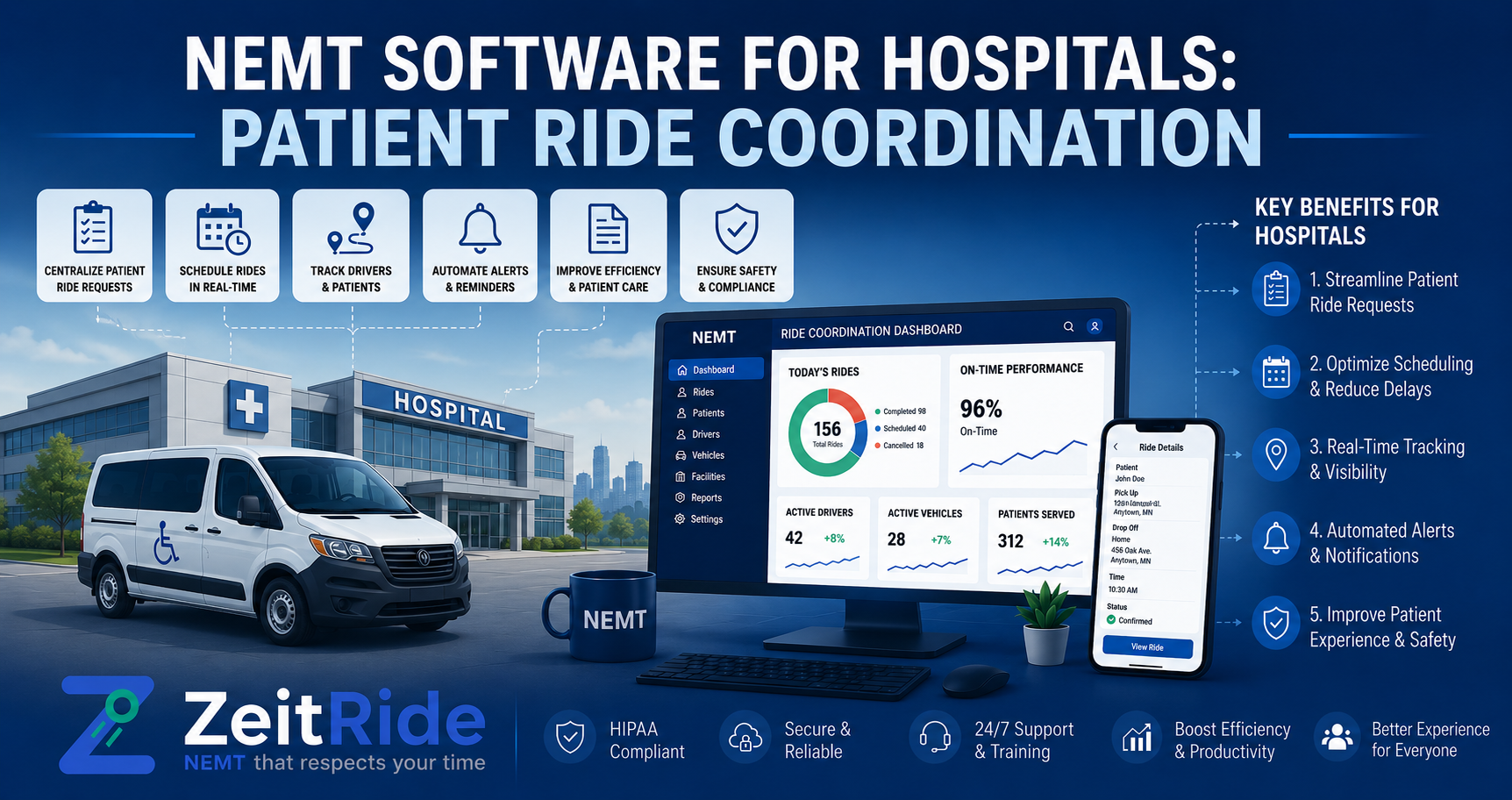
NEMT Software for Hospitals: Patient Ride Coordination
See how hospitals and healthcare facilities can coordinate NEMT scheduling, live ride tracking, discharges, recurring trips, and billing.
Quick answer
NEMT software for hospitals connects patient ride requests with scheduling, dispatch, live tracking, discharge coordination, trip documentation, and billing. It gives healthcare facilities and NEMT providers one shared workflow instead of relying on calls, spreadsheets, and separate systems.
ZeitRide Team
NEMT Operations Expert
Hospital transportation is easy to underestimate until a discharge time changes, a wheelchair trip requires a different vehicle, or a recurring treatment ride collides with the rest of the day's schedule. NEMT software for hospitals gives healthcare facilities and transportation providers a connected way to move patient ride requests from intake through scheduling, dispatch, live tracking, documentation, and billing.
Instead of rebuilding each trip across phone calls, spreadsheets, text messages, and separate systems, the transportation workflow can remain connected. ZeitRide brings NEMT trip requests, NEMT scheduling software, real-time NEMT dispatch, and NEMT billing software into the same operational platform.
What Is NEMT Software for Hospitals?
NEMT software for hospitals is technology used to coordinate non-emergency patient transportation from the initial ride request through scheduling, vehicle assignment, dispatch, trip tracking, documentation, and billing. It can connect healthcare facilities with the NEMT providers responsible for completing those trips.
The goal is not simply to put a patient in a vehicle. A useful hospital transportation workflow must account for pickup timing, mobility needs, appointment or discharge status, vehicle availability, driver assignment, trip changes, proof of service, and the financial record created after transportation is completed.
For Medicaid-funded transportation, requirements can differ by state and delivery model. The CMS Medicaid transportation guidance explains the federal framework for assuring necessary transportation to covered medical care.
Why Hospital and Healthcare Facility Transportation Gets Complicated
A single scheduled ride may be straightforward. Hospital and healthcare transportation becomes harder when several variables change at the same time.
- Discharge times move. A patient expected to leave at 2:00 PM may not be ready until later.
- Recurring treatments create standing demand. Dialysis, rehabilitation, therapy, and other services may require transportation several times per week.
- Patients have different mobility requirements. Ambulatory, wheelchair, and stretcher trips cannot always use the same vehicle.
- Several teams may be involved. Facility staff, dispatchers, drivers, transportation providers, patients, caregivers, brokers, and payers may all need different information.
- Same-day changes are common. Cancellations, no-shows, delayed appointments, driver changes, and return-trip requests can affect the schedule.
- Completed rides still require documentation. Transportation records may later support invoicing, broker reconciliation, payer requirements, or audits.
The software therefore has to do more than maintain a calendar. It needs to keep the transportation request connected to what actually happens on the road.
How Patient Transportation Software for Hospitals Works
| Stage | Hospital or Facility Need | Connected NEMT Workflow |
|---|---|---|
| 1. Ride request | Enter patient, pickup, destination, time, and mobility information | Request enters the transportation workflow without being recreated later |
| 2. Scheduling | Plan one-time, recurring, or same-day transportation | Trip is placed into the active schedule |
| 3. Vehicle matching | Match the rider's service level to an appropriate vehicle | Ambulatory, wheelchair, or stretcher requirements guide assignment |
| 4. Dispatch and tracking | Know whether the trip is assigned, moving, delayed, or completed | Dispatch monitors drivers, vehicles, stops, and changing trip conditions |
| 5. Exceptions | Manage cancellations, no-shows, delays, or changed pickup times | Exception information stays attached to the trip record |
| 6. Documentation and billing | Verify what occurred and prepare the financial record | Trip activity flows into documentation and billing workflows |
ZeitRide's multi-facility NEMT software is designed to keep hospital discharge requests, recurring facility trips, different transportation modes, dispatch, and facility billing within a connected operation.
Hospital Discharge Transportation Needs Live Coordination
Hospital discharge transportation is one of the clearest examples of why a static schedule is not enough.
The ride may be entered hours in advance, but the actual release time can change. A dispatcher may need to move the trip, reassign a driver, account for another passenger's schedule, or respond to a return-trip change without rebuilding the entire day.
That is where real-time NEMT dispatch becomes important. Dispatchers need current visibility into routes, vehicles, stops, and active assignments so transportation can be adjusted when circumstances change.
What Should Staff Be Able to See?
A well-designed hospital transportation workflow should make it easy to determine the current status of every patient ride.
- Requested
- Scheduled
- Assigned
- En route
- Arrived
- Delayed or changed
- Canceled or marked as a no-show
- Completed
Exceptions should also be documented rather than disappearing into phone calls. ZeitRide's no-show and cancellation logs connect driver-reported exceptions with timestamps, GPS information, reason codes, and the related trip record.
NEMT Scheduling Software for Hospitals and Recurring Care
Not every healthcare trip begins with a hospital discharge. Dialysis centers, rehabilitation facilities, therapy programs, skilled nursing facilities, and other care settings may generate transportation on repeating schedules.
NEMT scheduling software for hospitals and healthcare facilities should therefore support both one-time requests and recurring transportation without forcing dispatchers to rebuild the same ride pattern every day.
For a transportation provider working with several healthcare organizations, multi-facility NEMT software can keep recurring facility trips and one-off hospital discharge requests visible within the same schedule instead of treating each contract as a separate operation.
Match the Patient to the Right Transportation Mode
Scheduling also has to consider mobility. A patient who can travel in a standard ambulatory vehicle has different requirements from a wheelchair rider or a patient requiring stretcher transportation. The transportation mode should therefore be part of the trip information before the vehicle is assigned.
ZeitRide supports vehicle-and-mode matching across ambulatory, wheelchair, and stretcher transportation within its multi-facility workflow.
Tracking and Notifications Reduce Transportation Guesswork
One of the most useful jobs of NEMT software for healthcare facilities is creating visibility after the ride leaves the schedule.
Without live information, a simple question such as "Where is the driver?" can trigger several calls between a facility, dispatcher, driver, patient, and transportation provider.
A connected system gives dispatchers real-time fleet information and allows relevant trip updates to move through the same workflow. ZeitRide combines live GPS visibility with dispatch and supports automated SMS and email notifications for members, caregivers, and facilities.
The practical objective is simple: staff should spend less time locating information and more time resolving the exceptions that actually need human attention.
Billing and Documentation Should Start With the Trip Record
A transportation workflow is not finished when the patient reaches the destination.
The completed ride may still need timestamps, trip status history, mileage where applicable, signatures or other proof of service, exception records, payer information, and billing documentation.
That is why NEMT billing software should remain connected to operational trip data rather than forcing billing staff to reconstruct transportation from separate spreadsheets and messages. ZeitRide's billing workflow connects completed trip activity with billing-ready records, while its NEMT e-signatures attach rider signatures to the associated trip record.
Exact documentation and payment rules vary by Medicaid program, payer, broker, contract, and state. ZeitRide's NEMT documentation requirements guide explains the records providers should evaluate when building an audit-ready workflow.
Because patient transportation can also involve health information, healthcare organizations should evaluate privacy and security requirements with their own compliance teams. The HHS HIPAA Privacy Rule establishes federal standards for protected health information.
What Should Hospitals Look for in Medical Transportation Software?
When evaluating medical transportation software for hospitals, focus on whether the system can support the real transportation workflow rather than the length of the feature list.
- Can facilities submit or communicate trip requests without repeated manual data entry?
- Can the system manage one-time, same-day, and recurring transportation?
- Can it distinguish ambulatory, wheelchair, stretcher, and other service requirements?
- Can dispatchers reassign trips when a discharge or appointment time changes?
- Is live vehicle and trip visibility available to the people who need it?
- Are cancellations, no-shows, and other exceptions documented?
- Do completed trips remain connected to billing and proof-of-service records?
- Can several hospitals, clinics, dialysis centers, or other facilities be managed together?
- Are access controls, privacy, security, and audit history appropriate for the organization's requirements?
- Can the vendor demonstrate the workflow using real operating scenarios instead of a canned feature tour?
A hospital evaluating patient transportation software for hospitals should ultimately test the hardest transportation day it expects to manage — not just the cleanest scheduled ride.
How ZeitRide Connects Hospital and NEMT Operations
ZeitRide is built for NEMT providers, brokers, and transportation operators, with workflows that connect facility transportation to the rest of the operation.
The ZeitRide NEMT software platform brings trip intake, scheduling, dispatch, routing, driver activity, GPS tracking, e-signatures, billing workflows, reporting, and multi-facility management together. Its facility workflows support recurring transportation alongside one-off hospital discharge requests rather than forcing providers to operate a separate system for every healthcare relationship.
For NEMT providers trying to grow direct healthcare relationships, reliable operational records also become part of the sales story. ZeitRide's guide to getting NEMT contracts with brokers and healthcare facilities explains why hospitals, dialysis centers, nursing facilities, and other organizations evaluate reliability, documentation, and the provider's ability to prove service performance.
Bring One Real Hospital Transportation Workflow
The best way to evaluate hospital NEMT software is to test it against the work your team actually handles.
Bring one hospital discharge, one recurring treatment route, or one multi-facility schedule. ZeitRide can walk through how that workflow moves from request and scheduling into dispatch, tracking, documentation, and billing.
Ready to see how your hospital or healthcare transportation workflow would run in one connected platform? Talk to the ZeitRide team and bring a real workflow to the demo.
Frequently Asked Questions
Q: What is NEMT software for hospitals?
NEMT software for hospitals coordinates non-emergency patient transportation from the initial trip request through scheduling, dispatch, live tracking, documentation, and billing. It helps healthcare facilities and transportation providers manage the ride through one connected workflow.
Q: Can hospitals track NEMT rides in real time?
Hospital transportation workflows can use GPS and live dispatch information to monitor vehicle location and trip progress. ZeitRide connects real-time fleet visibility with dispatch and supports transportation notifications for members, caregivers, and facilities.
Q: Can NEMT software handle same-day hospital discharges?
Yes. NEMT software can support same-day discharge transportation when dispatchers can see current vehicle availability, routes, and trip status and can assign or reassign transportation as discharge timing changes.
Q: Can NEMT software manage recurring patient transportation?
Yes. Recurring transportation software can manage repeating rides for services such as dialysis, rehabilitation, and therapy. ZeitRide supports recurring facility trips alongside one-time transportation requests in the same workflow.
Q: How does NEMT software handle wheelchair and stretcher transportation?
NEMT software can record a patient's required transportation mode and use that information during vehicle assignment. ZeitRide supports ambulatory, wheelchair, and stretcher vehicle-and-mode matching within its multi-facility workflow.
Q: Does hospital NEMT software include billing and documentation?
A connected NEMT platform can keep completed trip information tied to billing and documentation. ZeitRide connects transportation activity with billing workflows, e-signatures, no-show records, and related trip documentation.
Rather see it than read about it?
Bring a real route, a couple of drivers, and your current process. 15 minutes, zero pitch.