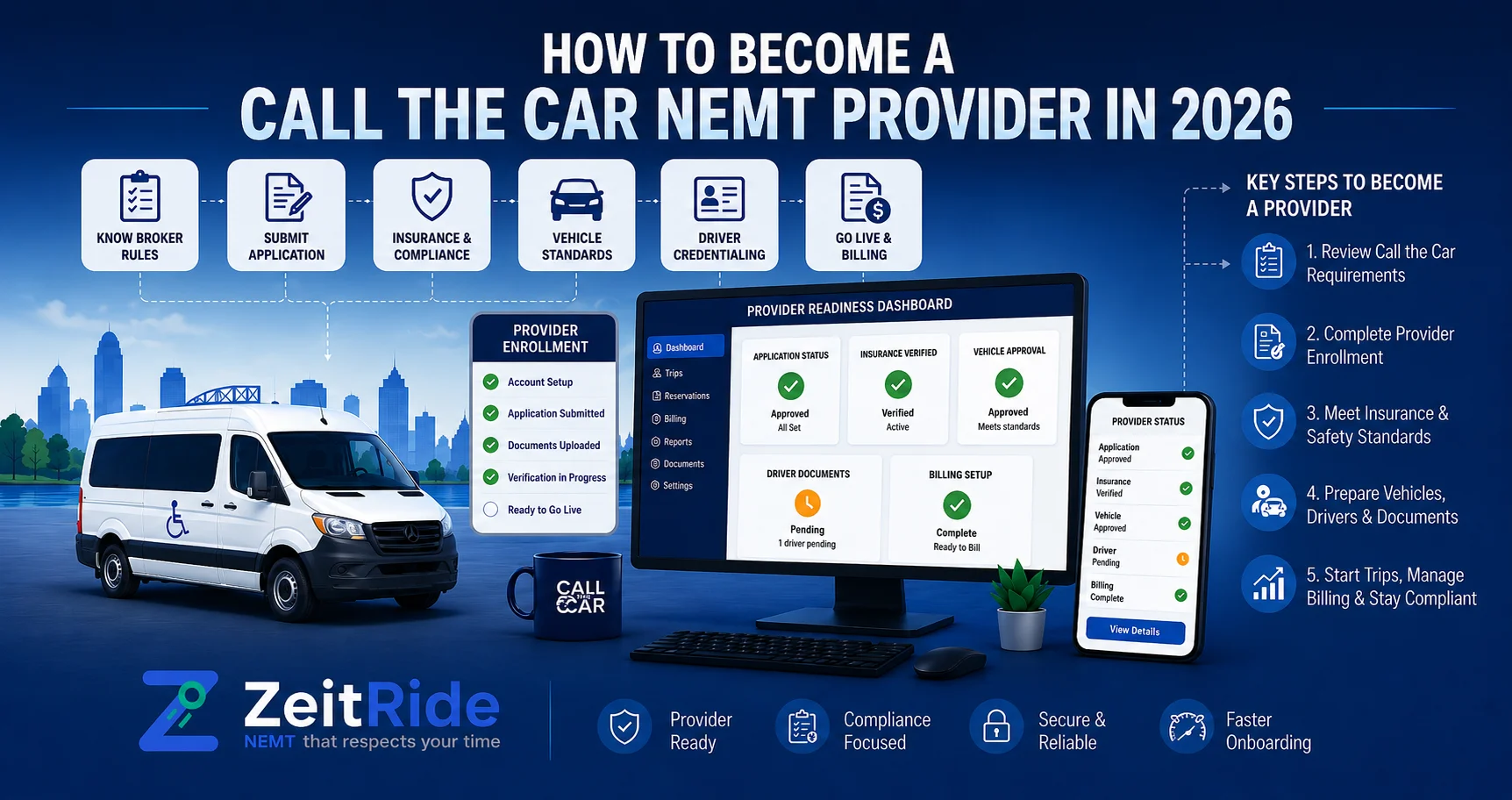
How to Become a Call the Car NEMT Provider in 2026
Learn how to become a Call the Car NEMT provider in 2026, including application fields, provider requirements, credentialing, and dispatch setup.
Quick answer
To become a Call the Car NEMT provider, submit its vehicle subcontractor form with your business, service area, fleet, Medicaid/Medi-Cal, and dispatch software details. A Call the Car representative then contacts you about the next onboarding steps.
ZeitRide Team
NEMT Operations Expert
If you operate a non-emergency medical transportation company and want to add another source of contracted trip volume, becoming a Call the Car provider may be worth evaluating. Call the Car refers to transportation companies in its network as vehicle subcontractors, and its current application asks for much more than a company name and phone number. It collects information about your operating area, Medicaid/Medi-Cal status, fleet capacity, service levels, permits, and dispatch technology. For California operators, that broker relationship should sit inside a larger Medi-Cal strategy. ZeitRide's California NEMT software guide explains how managed-care and Fee-for-Service transportation workflows can differ operationally.
How Do You Become a Call the Car NEMT Provider?
The short answer is to complete Call the Car's vehicle subcontractor application with accurate business, service-area, fleet, Medicaid/Medi-Cal, permit, service-level, and dispatch-software information. Call the Car says that after the form is submitted, a representative will contact the applicant to discuss next steps. The public form is the starting point, not proof that your company has completed credentialing or been guaranteed trips. Exact contracting, credentialing, documentation, insurance, and operational requirements can depend on the network opportunity and transportation work you are being considered for. If you are still completing state-level enrollment, review how to become a Medicaid transportation provider before treating broker enrollment as a substitute for Medi-Cal or Medicaid provider requirements.
What Does Call the Car Mean by a Vehicle Subcontractor?
Call the Car uses the term vehicle subcontractor for transportation companies interested in joining its network. In practical NEMT terms, this is the transportation-provider side of the relationship: your business supplies transportation capacity, qualified drivers, appropriate vehicles, and the operating processes needed to perform assigned transportation safely and reliably. Call the Car's public network page says it is seeking professional service providers interested in expanding their business opportunities. That does not mean every applicant or service area is automatically accepted. Network needs can change, so providers should confirm current opportunities directly rather than purchasing vehicles or hiring drivers based only on an application submission.
Call the Car NEMT Provider Requirements: What the Current Application Asks
One of the best ways to prepare for the Call the Car subcontractor application is to work directly from the fields on the current form instead of relying on a generic broker checklist. A field appearing on the public interest form does not by itself prove that the same item is a final credentialing requirement in every contract. Some information is collected for provider evaluation, while final standards should come from Call the Car's current onboarding instructions and your actual agreement.
| Application Area | What Call the Car Asks | What to Prepare Before Applying |
|---|---|---|
| Business identity | Company, contact, owner, and business address | Matching legal business records and current contact information |
| Operating schedule | Hours of operation | Realistic availability your fleet can consistently support |
| Service area | State, counties, and cities | Counties and cities you can reliably cover without excessive deadhead |
| Languages | Languages spoken | Languages your team can genuinely support |
| Provider identity | National Provider Identification Number | Current organization/provider information if applicable |
| Medicaid/Medi-Cal | Identification number and provider status | Current enrollment information or accurate Pending/No status |
| Dispatch technology | Dispatch Software Utilized | The actual platform or workflow your operation uses |
| Operating authority | Permits held by the company | Current applicable permits and supporting records |
| Driver capacity | Total number of drivers | Current active-driver roster |
| Vehicle capacity | Total number of vehicles | Current operational fleet count |
| Service levels | Ambulatory, wheelchair, gurney, BLS, ALS, specialty/critical care | Only transportation levels your company is equipped and authorized to provide |
How to Complete the Call the Car Subcontractor Application
Step 1: Confirm the Market You Want to Serve
Do not start with the application form. Start with the market. Identify the California counties, member populations, health plans, facilities, and transportation modes your fleet can actually serve. A statewide address does not mean every trip is operationally profitable or that one transportation network controls every Medi-Cal ride. Use ZeitRide's NEMT brokers by state directory as a broader starting point, then verify the current plan-specific arrangement before making expansion decisions.
Step 2: Get Your Provider Information Organized
The Call the Car form collects NPI and State Medicaid/Medi-Cal identification information and asks whether your company is an approved Medicaid/Medi-Cal provider, with Yes, No, and Pending options. That wording is useful because it shows the public interest form can capture applicants at different enrollment stages. It should not be interpreted as a promise that Medicaid/Medi-Cal enrollment is optional for every trip type or contract. For California Medi-Cal transportation, providers should separately follow current California DHCS enrollment requirements that apply to the service they intend to furnish.
Step 3: Define Your Real Service Area
List counties and cities you can cover consistently, not every location your vehicles could theoretically reach. A wider service area can create more opportunity, but it can also create longer deadhead miles, greater driver uncertainty, more schedule risk, and higher operating cost. During onboarding, a precise operating footprint is more useful than an ambitious one that cannot sustain on-time performance.
Step 4: Verify Your Fleet and Service Levels
The current form asks for total drivers, total vehicles, and the transportation levels your company offers. The listed options include ambulatory, wheelchair, gurney, Basic Life Support ambulance, Advanced Life Support ambulance, and specialty/critical-care transport. Only identify services that your company can legitimately and safely perform. Equipment, vehicle, driver, licensing, clinical, insurance, and other requirements can differ significantly by transportation level.
Step 5: Be Ready to Name Your Dispatch Software
This is one of the most commercially relevant fields for a growing NEMT operation: Dispatch Software Utilized. Call the Car's public form specifically asks what dispatch software the applicant uses, which makes technology readiness part of the provider information being collected before the relationship moves forward. A serious dispatch workflow should help keep trip intake, driver assignments, vehicle availability, service levels, pickup and drop-off activity, exceptions, and documentation connected. ZeitRide's NEMT dispatch software is built around those daily provider workflows.
Step 6: Submit the Application and Wait for Provider Relations
Submit the official Call the Car vehicle subcontractor application only after checking names, service areas, contact information, fleet counts, and provider identifiers for accuracy. Call the Car publicly states that a representative will contact you to discuss next steps after submission. It does not publish one guaranteed approval timeline on the application page, so avoid planning a fleet launch around an assumed two-, four-, or six-week credentialing window.
Step 7: Complete Invitation-Based Portal Setup When Directed
Call the Car also operates a subcontractor portal. Its current registration page requests an invitation code, NPI, Tax ID, contact information, username, and password. The invitation-code requirement matters: finding the portal online does not mean a new applicant should bypass the normal application process and self-onboard. Follow the instructions provided by Call the Car after your application progresses.
What Happens During Call the Car Credentialing?
Publicly available information confirms the application and follow-up process, but not every detail of Call the Car credentialing is published as one universal checklist. Call the Car says its network companies are verified and reviewed and references certifications, permits, liability insurance, and adherence to its policies and procedures. Your actual onboarding packet may therefore request information beyond what appears on the initial interest form. A practical readiness file should keep business, driver, vehicle, insurance, permit, enrollment, and operational records current. ZeitRide's NEMT documentation requirements checklist can help you organize those records before a broker asks for them.
- Make sure your legal business name is consistent across documents.
- Keep contact and ownership information current.
- Keep NPI and Medi-Cal/Medicaid records accurate for your current status.
- Maintain current insurance certificates.
- Keep company permits and operating authority current where applicable.
- Maintain complete driver and vehicle records.
- Make sure listed service levels match your equipment and authorization.
- Keep your stated service area aligned with your real operating capacity.
- Have a reliable dispatch process ready before assigned trips begin.
Do You Need an NPI to Apply to Call the Car?
Call the Car's current public subcontractor form contains fields for an NPI and State Medicaid/Medi-Cal identification number. The separate subcontractor portal registration page also requests an NPI along with an invitation code and Tax ID. The practical takeaway is to avoid oversimplifying the requirement: keep your provider-identification records accurate and ready, and follow the instructions that apply to your onboarding stage. Organizations that need an NPI can apply through the National Plan and Provider Enumeration System.
Do You Need Medi-Cal Approval Before Applying?
The public Call the Car form asks whether you are an approved Medicaid/Medi-Cal provider and provides Yes, No, or Pending as possible responses. That means the initial interest form can collect applicants at different stages of enrollment. However, submitting an interest form and being eligible to perform a particular Medi-Cal-funded transportation service are different questions. California DHCS maintains separate provider-enrollment requirements for medical transportation and non-medical transportation providers. If Medi-Cal work is part of your business model, complete the appropriate state enrollment process and follow the requirements for the transportation type you intend to provide.
Why Call the Car Dispatch Software Setup Matters Before Your First Broker Trip
Credentialing solves one problem: getting into a network. It does not solve the operational problem that arrives when new trips start hitting your schedule. Every additional broker or payer can introduce another source of trip data, schedule changes, cancellations, member details, service levels, documentation expectations, and billing records. Manual copying between portals and spreadsheets becomes harder to control as volume increases. A connected NEMT broker integration workflow should help move a trip from intake through scheduling, live dispatch, driver activity, documentation, and billing without rebuilding the same record several times.
What Your Dispatch Workflow Should Be Ready to Handle
- One-time and recurring trip scheduling
- Driver and vehicle assignments
- Ambulatory and mobility-specific service levels
- Same-day changes and cancellations
- Live pickup and drop-off statuses
- GPS-aware trip activity
- No-show and exception notes
- Electronic forms and signatures where applicable
- Driver and vehicle documentation
- Billing-oriented trip records
- Multiple broker and payer workflows
ZeitRide publishes confirmed direct integrations with selected transportation networks and supports additional broker workflows based on the connection or trip format available. Call the Car is not currently named on ZeitRide's public confirmed-integration list, so providers should confirm the current import or integration method with ZeitRide before assuming direct synchronization. Your software decision should be based on the exact Call the Car workflow available to your company, not a generic promise that every broker connects in the same way.
Call the Car Provider Readiness Checklist
- Legal business and owner information is correct.
- Primary state, counties, and cities are clearly defined.
- Operating hours match your actual capacity.
- NPI information is ready if applicable.
- Medicaid/Medi-Cal status is accurately represented.
- Applicable permits are current.
- Driver count reflects active drivers.
- Vehicle count reflects usable vehicles.
- Service levels match your equipment and authorization.
- Dispatch software or workflow is identified.
- Driver and vehicle records are organized.
- Insurance records are current.
- Your team knows how new broker trips will enter dispatch.
- Your team can document pickup, drop-off, exceptions, and trip completion.
- Your billing workflow is ready before the first trip is completed.
Before You Build Around a Call the Car Contract
A broker application should support a business plan, not replace one. Before adding vehicles or drivers, understand which counties and plans you can serve, what transportation levels you can perform, the reimbursement structure offered to your company, documentation expectations, payment timing, and the unloaded mileage required to cover the work. If expanding broker revenue is the larger goal, ZeitRide's guide to how to get NEMT contracts explains how broker networks fit alongside direct facility contracts, Medicaid opportunities, and private-pay work.
Turn Provider Approval Into an Operation You Can Scale
Learning how to become a Call the Car NEMT provider is only the first half of the project. The second half is making sure new trip volume does not create dispatch chaos. Before your first assignment, your operation should know how trips enter the schedule, how drivers receive changes, how pickup and drop-off activity is documented, how exceptions are recorded, and how completed trips move toward billing.
If you are evaluating software while applying, see how ZeitRide handles NEMT operations. Bring your real fleet, current broker workflow, and one sample route to a demo so the team can map scheduling, dispatch, driver workflows, documentation, and billing, and confirm the appropriate Call the Car import or integration path instead of assuming one.
Ready to build a cleaner workflow before new broker trips arrive? Book a 15-minute ZeitRide demo and bring a real route. The goal is to map your actual operation, not force your company into a generic dispatch setup.
Frequently Asked Questions
Q: How do I become a Call the Car NEMT provider?
Complete Call the Car's vehicle subcontractor form with accurate business, service-area, fleet, provider, service-level, permit, and dispatch-software information. Call the Car says a representative will contact applicants after submission to discuss next steps.
Q: What are the Call the Car NEMT provider requirements?
The public application collects business and contact information, operating area, languages, NPI, Medicaid/Medi-Cal information, dispatch software, permits, driver and vehicle counts, and transportation service levels. Additional credentialing requirements may apply after submission.
Q: Does Call the Car call NEMT providers subcontractors?
Yes. Call the Car's public network materials use the term vehicle subcontractor for transportation service providers interested in joining its network.
Q: Do I need an NPI to apply to Call the Car?
Call the Car's public subcontractor form asks for an NPI, and its separate subcontractor portal registration also requests an NPI along with an invitation code and Tax ID. Follow the requirements that apply to your onboarding stage.
Q: Do I need to be an approved Medi-Cal provider before applying?
The Call the Car interest form lets applicants report their Medicaid/Medi-Cal status as Yes, No, or Pending. Eligibility to perform specific Medi-Cal-funded transportation can still involve separate California DHCS and contract requirements.
Q: What dispatch software does Call the Car require?
Call the Car's current application asks applicants to identify the dispatch software they use but does not publicly prescribe one specific software vendor on the form.
Q: How long does Call the Car credentialing take?
Call the Car does not publish one guaranteed credentialing timeline on its public subcontractor application page. It states that a representative will contact applicants after submission to discuss next steps.
Q: What transportation service levels can I list on the Call the Car application?
The current application lists ambulatory, wheelchair, gurney, Basic Life Support ambulance, Advanced Life Support ambulance, and specialty or critical-care transportation. Select only services your company is equipped and authorized to provide.
Q: Does ZeitRide directly integrate with Call the Car?
Call the Car is not currently named on ZeitRide's public confirmed-integration list. Providers should ask ZeitRide to review their Call the Car trip format or connection requirements and confirm the appropriate import or integration workflow.
Rather see it than read about it?
Bring a real route, a couple of drivers, and your current process. 15 minutes, zero pitch.