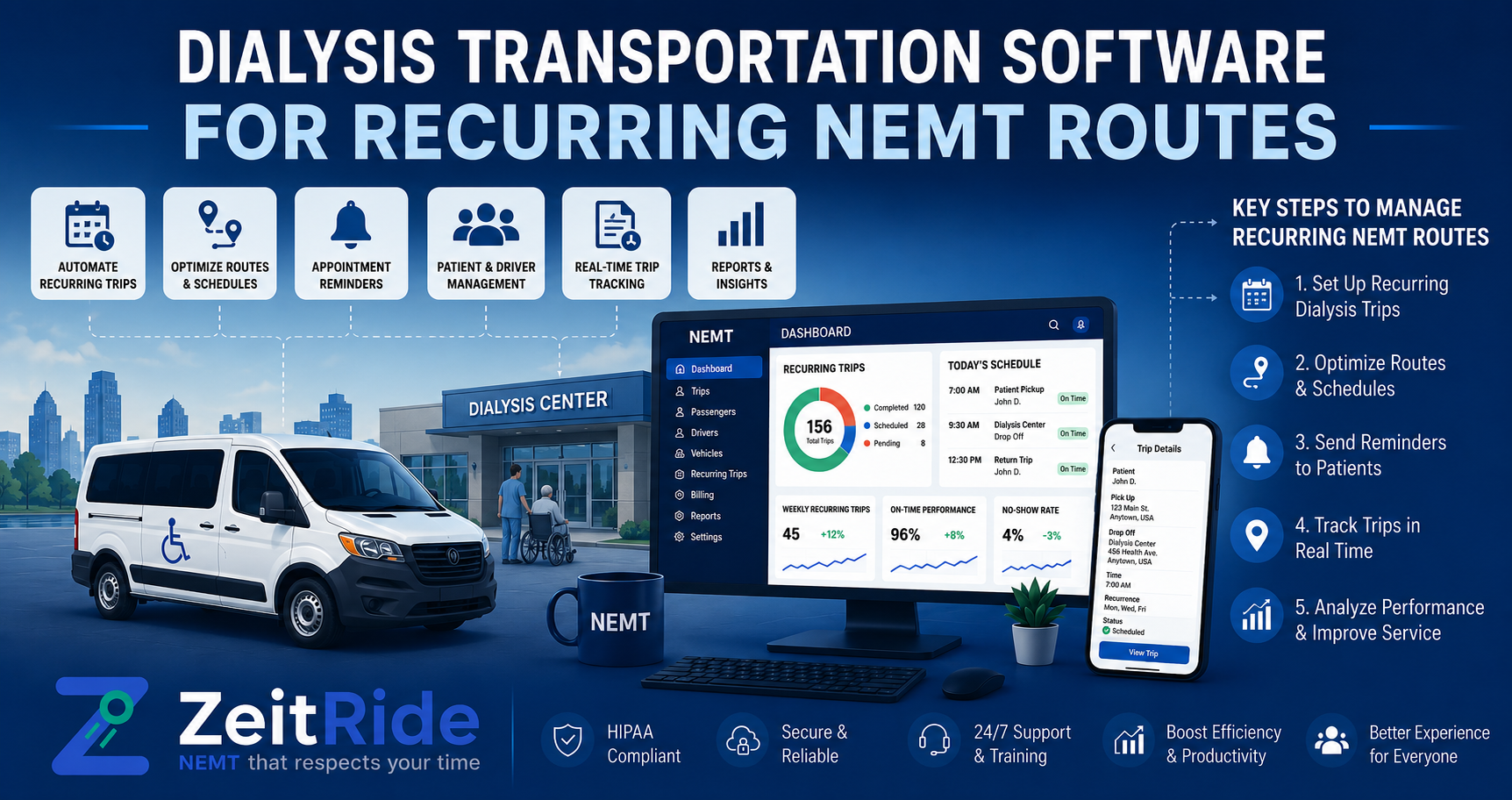
Dialysis Transportation Software for Recurring NEMT Routes
Learn how dialysis transportation software simplifies recurring scheduling, dispatch, route optimization, trip documentation, and billing.
Quick answer
Dialysis transportation software helps NEMT providers create recurring trips, match riders with qualified drivers and vehicles, manage will-call returns, optimize routes, document service, and prepare completed trips for billing.
ZeitRide Team
NEMT Operations Expert
Dialysis transportation is repetitive, but it is not simple. NEMT providers must coordinate high-frequency trips across treatment schedules, rider mobility needs, qualified drivers, accessible vehicles, broker updates, cancellations, and return pickups. When those details live in separate spreadsheets, texts, and notes, one small change can disrupt an entire route.
Dialysis transportation software connects recurring scheduling, dispatch, route optimization, trip documentation, and billing. It helps providers build repeatable routes while giving dispatchers the flexibility to handle daily exceptions.
Quick Answer
Dialysis transportation software helps NEMT providers create recurring trips once, match riders with suitable drivers and vehicles, manage fixed or will-call returns, optimize routes, capture proof of service, and prepare completed trips for billing.
What Is Dialysis Transportation Software?
Dialysis transportation software is a specialized NEMT system for managing repeated trips to and from dialysis centers. Unlike a basic calendar, it keeps the rider profile, trip series, vehicle requirements, driver assignment, dispatch status, route, documentation, and billing record connected.
The National Institute of Diabetes and Digestive and Kidney Diseases explains that in-center hemodialysis is commonly scheduled three times per week. One rider may therefore require several one-way trip legs every week. Although the schedule repeats, treatment delays, cancellations, vehicle availability, and return readiness can change.
Medicaid transportation and documentation processes can also vary by state, broker, and program. Providers should review the official Medicaid assurance of transportation guidance alongside the requirements of their state and contracted brokers.
Why Recurring Dialysis Routes Need Specialized Software
Recurring dialysis transportation software should address four common operational problems.
- Repeated data entry: Create a standing order once instead of rebuilding weekly trips.
- Rider compatibility: Keep mobility, vehicle, capacity, and preferred-driver requirements attached to each occurrence.
- Variable return times: Manage riders whose treatment completion time is not exact.
- Trip documentation: Connect statuses, timestamps, mileage, signatures, cancellations, and no-shows to the trip.
A spreadsheet can display a schedule. It cannot automatically update drivers, manage will-call returns, re-optimize routes, or carry completed trip data into billing.
How Dialysis Transportation Scheduling Software Works
1. Create the Recurring Trip
Enter the rider, pickup address, dialysis center, service days, appointment time, return setup, mobility requirements, and payer information. ZeitRide's recurring NEMT routes let staff create the schedule once and generate future trips from the standing order.
When a chair time, pickup address, or service day changes, staff can edit one occurrence or the relevant series instead of rebuilding every trip.
2. Match the Right Driver and Vehicle
The platform should match each trip with a suitable vehicle and qualified driver. ZeitRide's member-to-route assignment software helps preserve vehicle requirements, capacity limits, preferred drivers, and rider compatibility across recurring trips.
3. Choose Individual Trips or Shared Routes
Use an individual recurring trip when one rider requires a separate schedule. Use shared transport routes when compatible riders travel to the same dialysis center within similar time windows.
The decision should consider pickup geography, appointment times, vehicle capacity, mobility needs, and acceptable ride time.
4. Manage Fixed and Will-Call Returns
Some return pickups can be scheduled at a fixed time. Others work better as will-call trips that remain visible until the center or rider confirms readiness.
Dialysis transportation dispatch software should let the dispatcher assign or reassign a qualified driver, update the pickup, and send the change to the driver app without starting a separate workflow.
5. Complete Documentation and Billing
Drivers should record pickup, arrival, drop-off, signatures, mileage, and trip outcomes in the same workflow used to perform the ride. That information can move into NEMT billing software instead of being reconstructed from paper logs.
NEMT broker integrations can also reduce duplicate data entry and help keep trip changes, completion records, and reporting aligned.
Manual Workflow vs. Connected Software
| Task | Manual Workflow | Connected Software |
|---|---|---|
| Recurring trips | Copy schedules weekly | Generate trips from one standing order |
| Schedule changes | Edit several records | Update one trip or series |
| Return readiness | Manage calls and texts | Use a visible will-call queue |
| Vehicle matching | Check spreadsheets or memory | Apply rider and vehicle rules |
| Trip documentation | Reconcile paper and notes | Capture data in the driver workflow |
| Billing preparation | Rebuild trip records | Use connected completion data |
How Route Optimization Protects Margins
Dialysis transportation route optimization software should evaluate appointment windows, pickup geography, driver availability, vehicle capacity, mobility requirements, shared-ride compatibility, and return legs—not only the shortest path.
AI-assisted NEMT route optimization can cluster compatible pickups, reduce unnecessary backtracking, adjust routes after cancellations, and pair return work with nearby productive trips. The goal is better use of each vehicle and driver hour without compromising rider service.
What Should Providers Test During a Demo?
When comparing NEMT software for dialysis transportation, ask the vendor to use one real route and demonstrate the following workflows.
- Creating and editing a recurring trip series
- Assigning an accessible vehicle and qualified driver
- Building an individual trip and shared route
- Managing a will-call return
- Reassigning a driver after a delay
- Recording a cancellation or no-show
- Showing how a completed trip becomes billing-ready
A real workflow test reveals how the platform handles your vehicles, brokers, service area, and operating rules. It provides more useful information than a scripted feature tour.
How ZeitRide Supports the Complete Workflow
ZeitRide connects recurring scheduling, shared routes, member assignments, will-call trips, live NEMT dispatch, route optimization, broker integrations, driver documentation, and billing in one platform.
Providers serving several dialysis centers can also use multi-facility NEMT software to view facility, broker, and private-pay work from one operating dashboard.
Frequently Asked Questions
Q: What is dialysis transportation software?
Dialysis transportation software is an NEMT platform used to schedule, dispatch, route, document, and bill recurring trips to dialysis centers.
Q: How does software schedule recurring dialysis trips?
Staff create the service days, pickup, destination, appointment time, return setup, and transportation requirements once. The platform then generates future trips from that standing order.
Q: How are variable dialysis return times handled?
The return can be created as a will-call trip. It remains visible until the rider or center confirms readiness and a qualified driver is assigned.
Q: Can several dialysis riders share one vehicle?
Yes, when their pickup locations, appointment windows, mobility needs, vehicle capacity, and permitted ride times are compatible.
Q: Can the software support Medicaid broker trips?
Yes, when supported broker integrations or import workflows are available. These connections can reduce duplicate entry and align trip changes with completion records.
Run One Real Dialysis Route Through ZeitRide
Bring one active dialysis route to a 15-minute walkthrough. ZeitRide will show how to create recurring trips, assign appropriate drivers and vehicles, manage will-call returns, adjust the route, and move completed trip records toward billing.
Book a ZeitRide demo using your own route and schedule.
Rather see it than read about it?
Bring a real route, a couple of drivers, and your current process. 15 minutes, zero pitch.