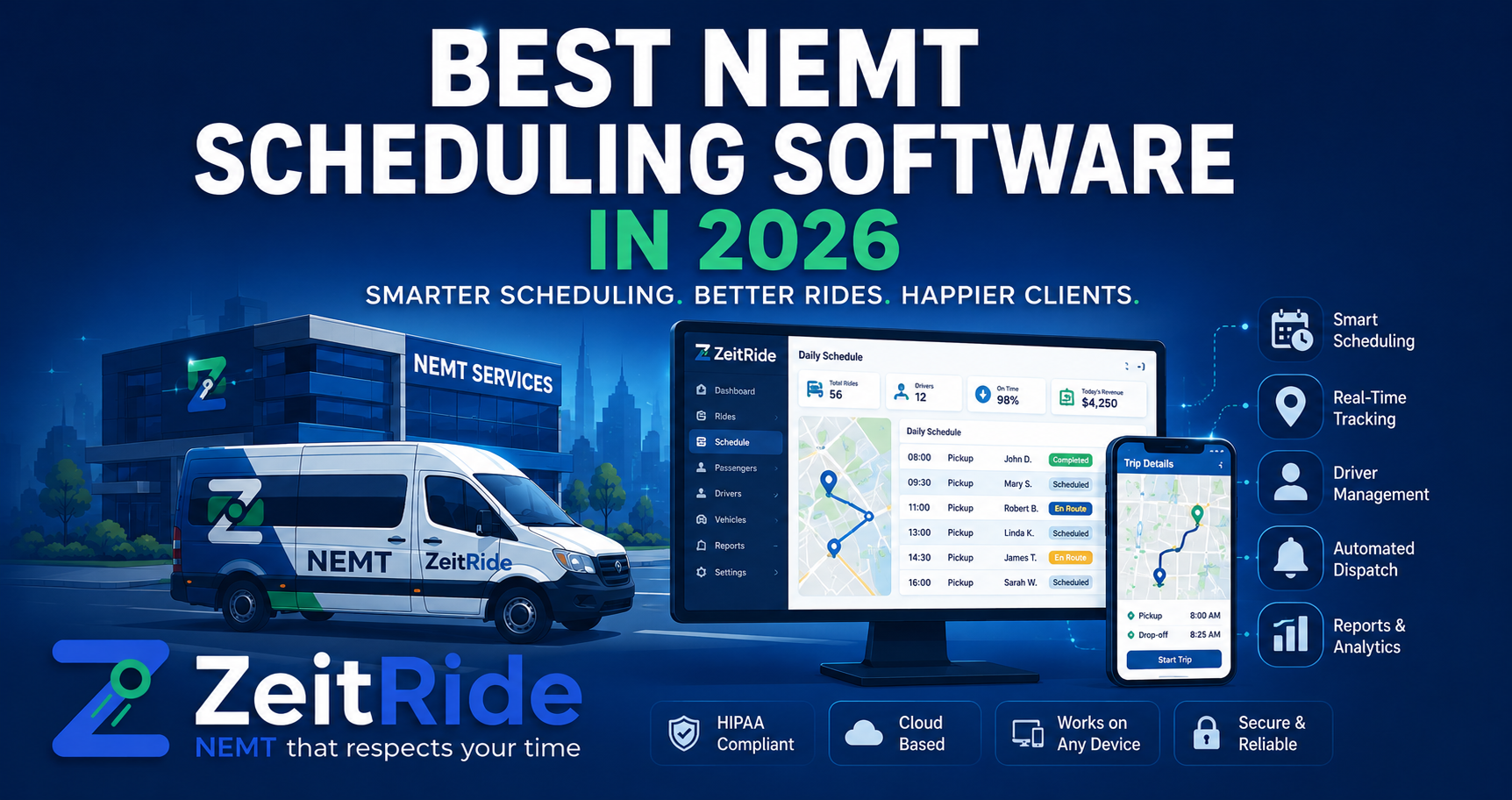
Best NEMT Scheduling Software for Growing Fleets 2026
Compare seven NEMT scheduling platforms by automation, broker integrations, driver apps, fleet fit, and pricing for growing fleets.
Quick answer
The best NEMT scheduling software connects trip intake, driver and vehicle assignment, route planning, live dispatch, broker updates, and trip documentation in one workflow. Compare platforms by automation depth, integrations, usability, pricing, and fleet fit.
ZeitRide Team
NEMT Operations Expert
Choosing the best NEMT scheduling software is not simply a matter of finding a digital calendar. A growing transportation provider needs a platform that can receive trips, match the right driver and vehicle, manage recurring appointments, sequence stops, respond to same-day changes, and keep dispatchers and drivers working from the same schedule.
The right NEMT scheduling software should reduce manual trip entry without separating scheduling from live dispatch, routing, the driver app, broker workflows, and completed-trip documentation. This guide compares seven platforms by scheduling automation, operational fit, integrations, driver tools, and publicly available pricing.
What Is the Best NEMT Scheduling Software in 2026?
For most small and midsize NEMT fleets, ZeitRide offers the strongest overall balance of connected scheduling, live dispatch, AI-assisted routing, driver workflows, broker integrations, billing tools, and predictable pricing. The platform costs $49 per active vehicle per month, with core operational capabilities included in one plan.
The best choice still depends on how your operation runs. A provider handling recurring dialysis trips may prioritize standing orders and multi-loading. A high-volume broker fleet may care more about direct trip imports and status exchanges. A public transit agency may need advanced reporting, reservation management, and modular configuration.
Before signing a contract, ask each vendor to schedule a real sample day using your trips, drivers, vehicle types, appointment windows, and broker requirements. A live workflow reveals more than a feature checklist.
Best NEMT Scheduling Software Compared
| Platform | Best For | Scheduling Strength | Pricing Model | Key Point to Verify |
|---|---|---|---|---|
| ZeitRide | Small and midsize growing fleets | Connected scheduling, dispatch, routing, driver app, broker workflows, and billing | $49 per active vehicle per month | Confirm the exact broker workflow required in your market |
| RouteGenie | Operations needing deep automation and multi-loading | Automated driver and vehicle matching with real-time schedule adjustments | Starts at about $50 per vehicle per month; add-ons may apply | Confirm which automation modules and integrations are included |
| Bambi | Small and midsize fleets prioritizing simple AI scheduling | One-click trip assignment, route optimization, recurring trips, and broker imports | $69 per vehicle per month | Test complex constraints and exception handling with real trips |
| MediRoutes | Multi-broker and trip-volume-based operations | Optimized scheduling, live dispatch, broker connections, and passenger notifications | Monthly base fee plus $0.50 per managed trip | Calculate the total cost at your monthly trip volume |
| Tobi Cloud | Specialized transportation organizations | Scheduling and dispatch across NEMT, PACE, student, and veteran transportation | Starts at $60 per vehicle per month | Confirm which capabilities are included in the quoted core plan |
| TripMaster | Public transit, paratransit, and established agencies | Automated scheduling, recurring reservations, demand response, and custom reporting | Quote-based and modular | Confirm implementation, training, and required module costs |
| NEMT Platform | Providers wanting flexible trip or vehicle-based plans | Cloud dispatch, auto-scheduling, route optimization, portals, and driver app | Contact vendor; plan limits and add-ons vary | Confirm whether auto-scheduling is included in the selected plan |
The table reflects information available on official vendor websites reviewed for this comparison. Pricing, broker connections, modules, and implementation terms can change. Always verify the exact plan and integration scope directly with the vendor.
How We Evaluated the Platforms
Each platform was evaluated against the operational tasks that determine whether a schedule survives contact with the real world.
- Trip intake: manual bookings, bulk uploads, facility requests, and broker-driven imports
- Driver and vehicle matching: availability, service level, capacity, location, and passenger requirements
- Recurring scheduling: standing orders for dialysis, therapy, PACE, and other repeat transportation
- Route planning: stop sequencing, shared rides, multi-loading, and reduced deadhead mileage
- Live operations: cancellations, no-shows, will-calls, add-on trips, driver call-offs, and vehicle changes
- Driver workflow: current manifests, navigation, status updates, signatures, and offline access
- Integration depth: broker trip exchange, billing connection, reporting, and facility portals
- Total cost: subscription, trip fees, modules, setup, support, training, and contracts
ZeitRide publishes this comparison and is one of the evaluated products. The purpose is to explain where each platform appears strongest and what buyers should verify rather than present one product as the answer for every fleet.
What Growing Fleets Need From NEMT Scheduling Software
1. Scheduling Connected to Live Dispatch
Scheduling creates the plan; dispatch manages what actually happens. A platform should let a dispatcher reassign a trip, change a pickup time, respond to a no-show, or add an urgent ride without rebuilding the day in a separate system.
Connected NEMT dispatch software also prevents drivers from following an outdated manifest after the office has changed the schedule. The driver view should update when the dispatch board changes.
2. Intelligent Driver and Vehicle Matching
Useful NEMT vehicle scheduling software should consider more than which driver has an open time slot. The assignment may depend on ambulatory or wheelchair service, vehicle capacity, driver availability, pickup geography, appointment time, shift rules, passenger needs, and whether riders can safely share a route.
Ask the vendor which constraints the scheduling engine applies automatically and which decisions still require manual dispatcher review.
3. Recurring Trips and Standing Orders
Dialysis, therapy, adult day care, and PACE trips often repeat on a predictable schedule. Automated NEMT scheduling software should create recurring trip patterns without forcing staff to rebuild every ride individually.
It should also make exceptions manageable. A clinic closure, holiday, temporary address, or changed appointment time should update the affected trip without unintentionally changing the entire recurring series.
4. Route Optimization and Multi-Loading
Scheduling decides who travels when; routing determines the efficient sequence. Connected NEMT routing software should group compatible trips, respect pickup and appointment windows, and reduce unnecessary empty driving.
Multi-loading can improve vehicle utilization, but it must account for capacity, service type, ride-time limits, pickup windows, and the passenger experience. Ask the vendor to optimize a difficult day rather than a simple demonstration route.
5. Broker and Facility Integrations
NEMT scheduling software with broker integrations can reduce manual entry, but the word integration can describe several different capabilities. One connection may only import trips, while another may exchange statuses, GPS events, ride receipts, billing records, or cancellations.
Review the guide to essential NEMT scheduling software integrations, then ask the vendor to demonstrate the precise data exchange required by your broker or facility.
The 7 Best NEMT Scheduling Platforms
1. ZeitRide: Best Overall for Growing NEMT Fleets
ZeitRide is designed for providers that want scheduling, live dispatch, AI-assisted routing, driver workflows, broker integrations, billing tools, and reporting in one operational platform. It supports recurring and one-off trips, broker-driven intake where integrations apply, live schedule changes, and alignment between the dispatch board and driver manifests.
ZeitRide costs $49 per active vehicle per month. Its main advantage for a growing fleet is predictable cost without separating scheduling, routing, dispatch, and the driver app into different products. It is best suited to small and midsize providers that want one system of record and fewer manual handoffs.
Verify the exact trip import, status exchange, and broker workflow required in your state during the demo.
2. RouteGenie: Best for Detailed Scheduling Automation
RouteGenie emphasizes automated driver and vehicle matching, route building, multi-loading opportunities, and real-time responses to add-on trips, will-calls, cancellations, driver call-offs, and vehicle breakdowns.
The platform is a strong candidate for operations that want extensive automation across scheduling, dispatch, routing, and billing. Public pricing starts around $50 per vehicle per month, but integrations and advanced modules may affect the final cost.
Ask for a line-item proposal and a live demonstration showing which decisions are automated, which require dispatcher approval, and which features are included in the quoted plan.
3. Bambi: Best for Simple One-Click Optimization
Bambi combines scheduling, routing, dispatch, billing, broker imports, recurring trip subscriptions, multi-loading, and a driver application in one product. Its Run Bambi Run function is designed to analyze trips, recommend driver assignments, and optimize routes through a simplified workflow.
Bambi lists a flat price of $69 per vehicle per month with its core platform included. It may appeal to small and midsize operators that prioritize ease of use and fast adoption.
During the demo, test complicated service constraints, recurring-trip exceptions, driver shifts, wheelchair capacity, and last-minute schedule changes rather than evaluating only the one-click experience.
4. MediRoutes: Best for Multi-Broker Operations
MediRoutes combines trip coordination, optimized scheduling, live dispatch, driver tracking, broker integrations, passenger notifications, billing compliance, and revenue reporting. The platform states that it supports fleets ranging from one vehicle to hundreds of vehicles.
Its public pricing begins at $150 per month plus $0.50 per managed trip for one broker integration. A higher plan begins at $250 per month plus $0.50 per managed trip and includes unlimited broker integrations.
This model may suit providers with multiple broker relationships, but buyers should calculate the total monthly cost at their actual trip volume rather than comparing only the base fee.
5. Tobi Cloud: Best for Specialized Transportation Programs
Tobi Cloud serves NEMT, PACE, veterans transportation, student point-to-point services, and other specialized transportation operations. Its platform focuses on scheduling, dispatch, fleet visibility, billing, compliance, and scalable operations.
Public pricing starts at $60 per vehicle per month for core platform capabilities. Tobi may be a good fit for organizations running more than one specialized transportation program or preparing for greater operational complexity.
Because the final plan is tailored to the fleet, confirm which broker connections, automation tools, billing functions, support services, and implementation requirements are included.
6. TripMaster: Best for Transit and Paratransit Agencies
TripMaster provides scheduling, reservation management, dispatch, vehicle tracking, billing, reporting, rider tools, and broker-related workflows for public transit, paratransit, demand-response, and NEMT organizations.
Its reservation tools support recurring and demand-response bookings, same-day changes, route maps, and on-screen vehicle tracking. TripMaster is likely to fit established agencies that need configurable workflows and detailed reporting in addition to basic scheduling.
Pricing is quote-based and modular. Ask about implementation, training, migration, required modules, integrations, support, and the expected time to launch.
7. NEMT Platform: Best for Flexible Plan Structures
NEMT Platform provides cloud-based trip scheduling, real-time dispatch, route planning, driver tools, portals, broker connections, billing functions, and reporting. Its plan structure includes options aimed at startups, active fleets, and larger operations.
The platform offers both trip-limited and per-vehicle approaches, while auto-scheduling and route optimization may depend on the selected plan or add-on. This can provide flexibility, but it also makes plan comparison important.
Confirm the monthly trip allowance, overage charges, auto-scheduler availability, tracking features, training, support level, and billing services before deciding.
Which Scheduling Platform Should You Choose?
- Choose ZeitRide for connected operations, transparent per-vehicle pricing, and growing small-to-midsize fleets.
- Choose RouteGenie for detailed automation, multi-loading, and modular operational workflows.
- Choose Bambi for a simplified interface and one-click scheduling and route recommendations.
- Choose MediRoutes for multi-broker operations and a pricing model not tied to vehicle count.
- Choose Tobi Cloud for organizations managing several specialized transportation programs.
- Choose TripMaster for public transit, paratransit, reservation management, and advanced reporting.
- Choose NEMT Platform for flexible plan structures and optional operational or billing support.
Use the complete NEMT software selection framework to compare implementation, support, total cost, broker fit, and workflow risk before making the final decision.
Questions to Ask During a Scheduling Software Demo
- Can the system import trips from every broker and facility we currently use?
- Which trip, status, GPS, cancellation, and billing data moves through each integration?
- How does the scheduler match wheelchair, ambulatory, and other service requirements?
- Can it manage recurring trips without rebuilding each reservation?
- How does it handle will-calls, add-ons, no-shows, cancellations, and driver call-offs?
- Can it identify safe and practical multi-loading opportunities?
- Do schedule changes update the dispatch board and driver app immediately?
- What happens when a driver loses cellular service?
- Which features require separate modules, setup charges, or third-party fees?
- What will our total monthly and first-year cost be at our expected fleet size and trip volume?
Pricing should be compared as a complete operational cost. ZeitRide's NEMT software pricing guide explains how per-vehicle, per-trip, modular, and enterprise models can produce very different totals.
Final Verdict
The best NEMT scheduling software for growing fleets is the platform that keeps trip intake, scheduling, routing, dispatch, drivers, brokers, and completed-trip records connected while remaining usable during a difficult service day.
For most small and midsize providers, ZeitRide offers the strongest combination of connected operations, scheduling functionality, predictable pricing, and room to grow. Fleets with specialized public-transit, enterprise, or highly customized requirements should compare the relevant alternatives using their own trips and constraints.
Test ZeitRide With a Real Schedule
Bring one normal service day, one difficult recurring route, and the broker or facility workflows your team currently manages. ZeitRide will show how the trips move from intake and scheduling into routes, live dispatch, the driver app, and completed-trip records.
Book a 15-minute scheduling workflow review.
Frequently Asked Questions
Q: What is the best NEMT scheduling software for growing fleets?
The best platform depends on fleet size, trip volume, brokers, service types, and operational complexity. ZeitRide is a strong choice for small and midsize growing fleets because scheduling, dispatch, routing, driver workflows, broker integrations, and billing tools are connected in one $49-per-active-vehicle plan.
Q: What does NEMT scheduling software do?
NEMT scheduling software helps providers create and import trips, manage recurring reservations, match drivers and vehicles, plan routes, respond to schedule changes, communicate with drivers, and connect completed trip records to billing and reporting.
Q: Can NEMT scheduling software manage recurring trips?
Yes. Purpose-built platforms can create standing orders for recurring transportation such as dialysis, therapy, adult day care, and PACE trips. Buyers should also test how the platform handles holidays, temporary address changes, cancellations, and changes to one occurrence.
Q: Does NEMT scheduling software integrate with ModivCare and MTM Health?
Several platforms advertise broker integrations, but the scope varies. A connection may import trips only or may also exchange statuses, GPS events, cancellations, ride receipts, and billing data. Ask each vendor to demonstrate the exact workflow required by your broker contract.
Q: How much does NEMT scheduling software cost?
Public prices commonly use per-vehicle, monthly base plus per-trip, tiered, modular, or custom quote models. Compare the full cost of scheduling, routing, dispatch, driver apps, broker connections, setup, training, support, trip overages, and contracts rather than only the advertised starting rate.
Rather see it than read about it?
Bring a real route, a couple of drivers, and your current process. 15 minutes, zero pitch.