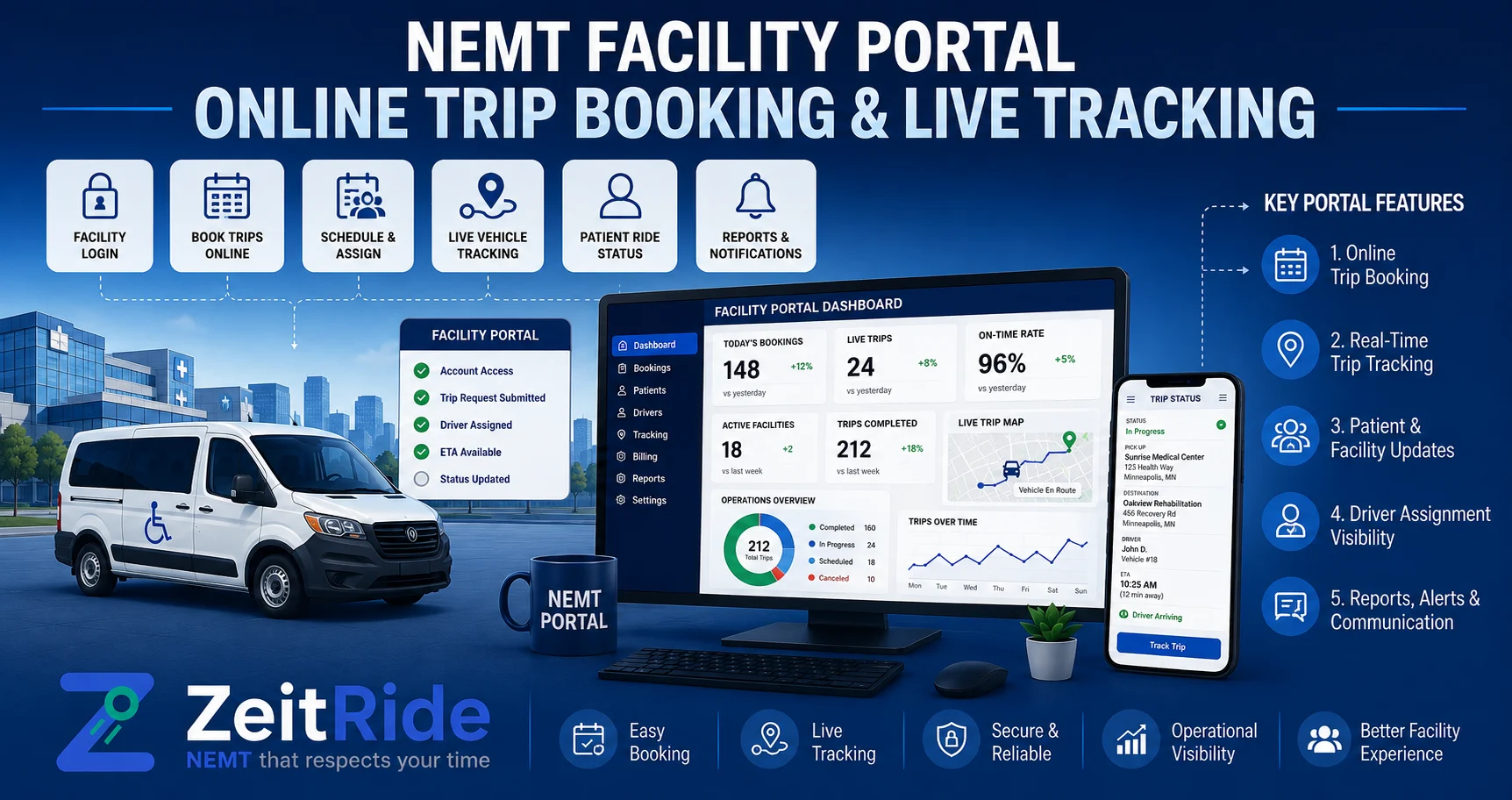
NEMT Facility Portal: Online Trip Booking & Live Tracking
Learn how an NEMT facility portal lets hospitals, dialysis centers, and care teams request trips, manage recurring rides, and track transportation live.
Quick answer
An NEMT facility portal is an online interface that lets authorized healthcare staff request patient transportation, manage recurring rides, and monitor trip status without relying on repeated calls, faxes, or manual re-entry.
ZeitRide Team
NEMT Operations Expert
A healthcare facility may need to arrange a hospital discharge this afternoon, confirm tomorrow's wheelchair trip, and manage recurring dialysis transportation for the rest of the week. When every request depends on a phone call, fax, email, or handwritten note, both the facility and the NEMT provider spend time chasing information that should already be part of the transportation workflow.
An NEMT facility portal gives authorized healthcare staff a direct online way to submit transportation requests and follow the rides they coordinate. The important part is not simply putting a booking form online. A useful portal keeps the request connected to the provider's scheduling, dispatch, driver, tracking, and trip-record workflow after the facility clicks submit.
Providers that want a broader look at all trip-intake channels can also review NEMT booking software, which covers facility, online, phone, and broker requests in one operating workflow.
What Is an NEMT Facility Portal?
An NEMT facility portal is an online interface that allows authorized staff at hospitals, dialysis centers, skilled nursing facilities, rehabilitation centers, assisted living communities, adult day programs, and other healthcare organizations to request and manage non-emergency medical transportation with an NEMT provider.
You may also see similar systems described as a facility transportation portal, NEMT client portal, or partner booking portal. The terminology varies, but the core purpose is the same: give a healthcare partner a structured transportation workflow instead of making every ride begin with an unstructured phone call, fax, or email.
For an NEMT operator, the portal should not become a separate transportation system. Facility requests should move into the same operating environment used for direct, recurring, broker, and other trips.
Why Facility Transportation Requests Become Hard to Manage
The problem usually appears as trip volume grows. One hospital calls the dispatch line. A dialysis center emails its recurring schedule. A nursing facility faxes a request. Another coordinator calls later to ask whether tomorrow's wheelchair pickup was confirmed. Each request may be valid, but the transportation provider still has to turn that information into an accurate trip.
- Re-enter passenger or member information
- Confirm pickup and destination details
- Verify appointment or requested pickup times
- Identify ambulatory, wheelchair, or stretcher requirements
- Build return legs
- Recreate recurring transportation
- Confirm the request with the facility
- Answer status calls after the trip begins
A dedicated NEMT facility booking portal can reduce that friction by standardizing what the facility submits before the request reaches operations.
How NEMT Facility Portal Software Should Work
The best way to evaluate NEMT facility portal software is to follow one transportation request from beginning to end. The portal is most valuable when the same information can move from facility intake into provider operations instead of being recreated at each stage.
| Stage | Facility Side | NEMT Provider Side |
|---|---|---|
| Trip request | Staff enters passenger, locations, date, time, mobility needs, and trip details | Request enters a structured review workflow |
| Review | Facility can see that the request was submitted | Staff verifies availability, service area, payer, timing, and transportation requirements |
| Scheduling | Approved transportation becomes visible as an upcoming ride | Trip moves into the operating schedule |
| Assignment | Relevant trip status can be communicated back | Dispatcher matches the appropriate driver and vehicle |
| Live operation | Facility can follow useful ride-status information | Dispatch monitors vehicle, driver, stops, and exceptions |
| Completion | Facility has a clearer record of what occurred | Completed-trip information remains connected to documentation and billing workflows |
The biggest operational test is the handoff between booking and execution. Once an approved request becomes a trip, NEMT scheduling software should be able to plan it without forcing office staff to rebuild the same ride from scratch.
When the service day arrives, real-time NEMT dispatch should keep the trip connected to the assigned driver, vehicle, route, and changing conditions.
What Information Should a Facility Booking Portal Capture?
A facility portal should collect enough information for the transportation provider to evaluate the request without forcing staff to make another call simply to understand the ride. The objective is not to create the longest possible form. It is to capture the information that scheduling and dispatch actually need.
- Passenger or member name and contact information
- Pickup address
- Destination or healthcare location
- Requested pickup time
- Appointment time where relevant
- One-way, round-trip, or return transportation
- Ambulatory, wheelchair, stretcher, or other service requirement
- Attendant or additional passenger information
- Facility contact information
- Recurring schedule details
- Special transportation instructions
- Payer or funding information where appropriate
- Will-call or flexible return requirements
Online Booking Should Lead Into Operations, Not Another Inbox
A basic web form may technically allow online booking while still creating manual work. A hospital submits a form, an email reaches dispatch, and someone then copies the same passenger, timing, mobility, and return-trip information into another system. The form was digital, but the workflow was not.
A connected NEMT healthcare facility portal should make the submitted request usable as operational data. Once the provider reviews and accepts the request, the same core trip information should be able to move forward into scheduling and dispatch.
This is especially important for operators managing several healthcare relationships. Multi-facility NEMT software can help keep facility work alongside broker and private-pay transportation instead of turning every contract into a separate operating silo.
What Should Facilities Be Able to Track?
Booking is only half of the coordination problem. After a ride is scheduled, facility staff may still need to know whether transportation is assigned, approaching the pickup location, delayed, completed, canceled, or otherwise changed.
- Requested
- Accepted or scheduled
- Driver or vehicle assigned
- En route
- Arrived
- Passenger picked up
- Delayed or changed
- Canceled or no-show
- Completed
The exact level of visibility should depend on user permissions and the workflow being offered. The objective is to give the appropriate people enough information to coordinate transportation without exposing an internal dispatch console or forcing them to call for every update.
ZeitRide's guide to NEMT software for hospitals explains how live trip information, discharge coordination, dispatch, and documentation fit together across healthcare transportation workflows.
NEMT Facility Portal vs. Phone, Fax, and Email
| Workflow | Phone / Fax / Email | Facility Portal |
|---|---|---|
| Trip intake | Information may arrive in different formats | Request follows structured fields |
| Data entry | Dispatcher may need to recreate the ride | Submitted information can enter a review workflow |
| Confirmation | Often requires another call or message | Status can be visible in the same workflow |
| Recurring rides | Repeated schedules can become difficult to maintain | Recurring details can be captured consistently |
| Trip-status questions | Facility contacts dispatch | Relevant status can be surfaced electronically |
| Record keeping | Details may be split across inboxes, notes, and systems | Request history can stay associated with the trip |
A portal does not have to eliminate phone calls. Urgent exceptions and unusual transportation needs will still require human communication. The goal is to stop making the phone the database.
NEMT Facility Portal vs. Broker Portal
These two portals serve different relationships and should not be treated as interchangeable. A broker portal is generally operated by a transportation broker or network and may be used to assign, manage, or document payer-originated transportation.
A provider's facility transportation portal gives that NEMT company's healthcare partners a direct channel for requesting or monitoring transportation with the provider. An NEMT company may therefore work with broker portals while also offering a facility-facing workflow for direct hospital, dialysis, nursing, rehabilitation, or other healthcare relationships.
The provider's internal operation should ideally bring these trip sources together instead of requiring dispatchers to manage a different schedule for each channel.
Example: A Same-Day Hospital Discharge
Consider a discharge planner arranging wheelchair transportation for a patient expected to leave the hospital at 3:00 PM. The facility enters the pickup location, destination, requested time, wheelchair requirement, passenger information, and relevant instructions. The transportation provider reviews the request and confirms whether the trip can be accepted.
Once approved, it enters the schedule and dispatch can assign an appropriate vehicle and driver. If discharge moves from 3:00 PM to 4:00 PM, the operational question is no longer whether a booking exists. The question is whether the provider can adjust the active transportation plan while keeping the facility, dispatcher, and driver aligned.
That is why facility booking should connect directly with live operations rather than ending when the form is submitted.
Example: Recurring Dialysis Transportation
Recurring medical transportation creates a different challenge. A dialysis center may coordinate trips several days per week for the same rider, but the schedule still has to account for pickup times, return transportation, mobility requirements, vehicle availability, cancellations, and changes to individual occurrences.
A portal can give the facility a consistent way to communicate the transportation requirement, while the NEMT provider manages the operating pattern through scheduling and dispatch. ZeitRide's guide to dialysis transportation software goes deeper into recurring routes, vehicles, drivers, and return-trip workflows.
Security, Permissions, and Healthcare Information Matter
A facility portal may handle sensitive passenger and healthcare-related information, so convenience cannot be the only evaluation criterion. Organizations should review authentication, role-based permissions, encryption, audit history, account access, retention practices, and applicable contractual requirements before adopting a workflow.
- User authentication
- Role-based permissions
- Appropriate access to passenger information
- Data encryption
- Audit history
- Account removal procedures
- Privacy policies
- Business associate requirements where applicable
- State, payer, broker, and contract requirements
- Data retention practices
Healthcare organizations and NEMT providers should evaluate their own obligations rather than assuming that simply using a portal makes a workflow compliant. For federal guidance, review the HHS HIPAA Privacy Rule. Providers serving Medicaid populations should also review CMS Medicaid transportation guidance together with applicable state, payer, and broker requirements.
What Should NEMT Providers Look for in a Facility Portal?
Do not evaluate a portal from screenshots alone. Ask the vendor to run a realistic facility request through the entire operation and show exactly where the facility workflow connects with scheduling, dispatch, trip status, and completed records.
- Submit a one-time facility trip
- Create recurring transportation
- Capture wheelchair or stretcher requirements
- Review a request before acceptance
- Send the accepted ride into scheduling
- Assign the correct vehicle and driver
- Handle a changed pickup time
- Show meaningful trip status
- Record a cancellation or no-show
- Keep the completed trip tied to its operational history
- Manage several healthcare facilities without separate systems
- Show exactly what facility users can and cannot access
A useful demo exposes the handoffs. If the dispatcher still has to re-enter the same trip several times, the portal has digitized the request without fixing the workflow.
How ZeitRide Connects Facility Requests With NEMT Operations
ZeitRide is built around a connected NEMT operating workflow. The broader ZeitRide NEMT software platform combines trip intake, scheduling, routing, live dispatch, driver workflows, documentation, billing workflows, and multi-facility management in one platform.
For providers working with hospitals, dialysis centers, assisted living communities, adult day programs, skilled nursing facilities, and other healthcare partners, the goal is straightforward: a facility-originated trip should fit alongside the rest of the transportation operation instead of becoming another disconnected process.
That connection also matters when a provider grows. Winning another facility relationship should create more trip volume, not another spreadsheet, inbox, or dispatch board.
Bring One Real Facility Booking to the Demo
The easiest way to evaluate an NEMT facility portal is to test a transportation request your operation actually handles. Bring one hospital discharge, recurring dialysis request, or other facility-originated trip and follow it from intake through scheduling, assignment, live dispatch, trip status, completion, and documentation.
See where information has to be entered, who can see it, and what happens when the original plan changes. Book a 15-minute ZeitRide demo and use one of your real facility workflows instead of a canned sample.
Frequently Asked Questions
Q: What is an NEMT facility portal?
An NEMT facility portal is an online interface that lets authorized healthcare-facility staff request and manage non-emergency medical transportation with an NEMT provider. Depending on the system, staff may also view upcoming rides and relevant trip-status information.
Q: Who uses an NEMT facility portal?
Hospitals, dialysis centers, skilled nursing facilities, rehabilitation centers, assisted living communities, adult day programs, and other healthcare organizations that regularly coordinate patient or resident transportation may use a facility portal.
Q: Can hospitals book NEMT rides online?
Yes. When an NEMT provider offers a facility booking workflow, authorized hospital staff can submit transportation requests electronically. The provider may review availability, service area, mobility requirements, payer information, and timing before accepting the trip.
Q: Can facilities track NEMT rides in real time?
A facility portal can provide relevant ride-status or live transportation information when supported and when the user has appropriate access. Visibility may include assignment, en-route, arrival, delay, pickup, and completion status.
Q: Can a facility portal handle recurring dialysis trips?
Yes. A facility portal can capture recurring transportation requests while the NEMT provider's scheduling system manages the repeating trip pattern, vehicles, drivers, individual changes, cancellations, and return transportation.
Q: What is the difference between an NEMT facility portal and a broker portal?
A broker portal generally manages transportation originating through a broker or payer network. An NEMT facility portal gives a transportation provider's healthcare partners a direct channel for requesting or monitoring rides with that provider.
Rather see it than read about it?
Bring a real route, a couple of drivers, and your current process. 15 minutes, zero pitch.