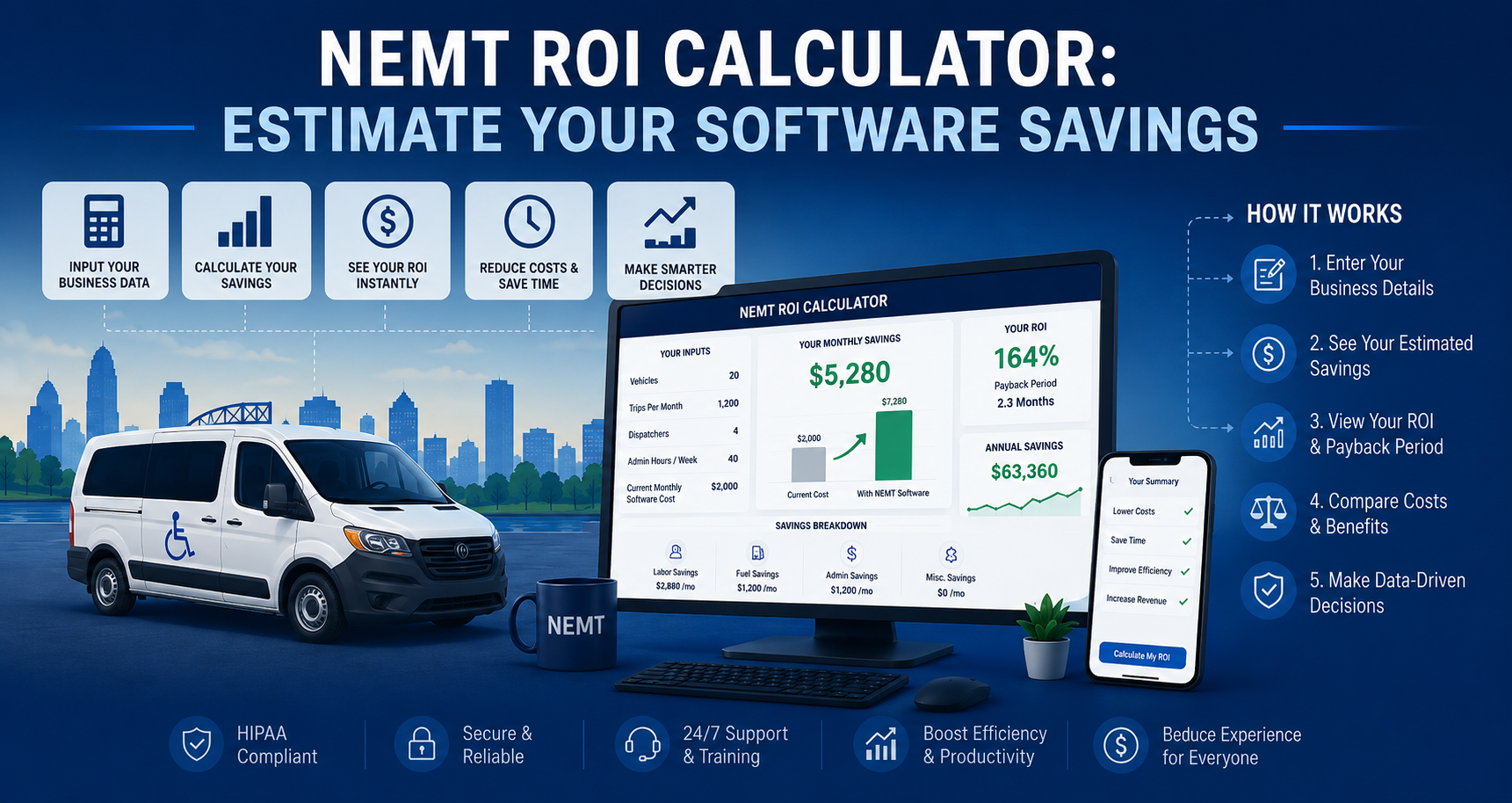
NEMT ROI Calculator: Estimate Your Software Savings
Calculate the potential ROI of NEMT software using your fleet’s labor, mileage, trip, billing, and software costs.
Quick answer
An NEMT ROI calculator compares software costs with potential labor, mileage, trip-capacity, and billing gains. Enter your fleet’s actual data to estimate monthly savings, first-year ROI, and payback period.
ZeitRide Team
NEMT Operations Expert
The price of NEMT software tells you what the platform costs. It does not tell you how much your operation could save through reduced dispatcher work, better routing, cleaner trip documentation, or additional completed trips.
This NEMT ROI calculator helps you estimate those results using your own fleet data. It measures the potential financial impact of NEMT dispatch software, route optimization, billing improvements, and operational automation.
Start with conservative assumptions. A realistic estimate is more useful than a high projected return based on improvements your fleet may not achieve.
Use the NEMT ROI Calculator
Enter figures from a recent, representative month. Avoid using an unusually busy or unusually slow period.
The calculator should collect the following information:
- Number of active vehicles
- Monthly completed trips
- Average contribution margin per trip
- Dispatcher and administrative hours
- Loaded hourly labor cost
- Monthly deadhead miles
- Vehicle operating cost per mile
- Preventable billing leakage
- Expected additional completed trips
- Current or proposed software costs
- Implementation, migration, training, or hardware costs
NEMT ROI Calculator
Use your current operating data and the formulas below to estimate monthly savings, first-year net savings, ROI, and payback period. For the most reliable result, use figures from a recent representative month and begin with conservative assumptions.
Your NEMT ROI Results
| Result | Your Estimated Amount |
|---|---|
| Monthly labor savings | $________ |
| Monthly mileage savings | $________ |
| Monthly billing recovery | $________ |
| Additional-trip contribution | $________ |
| Gross monthly benefit | $________ |
| Monthly software cost | $________ |
| Net monthly benefit | $________ |
| First-year net savings | $________ |
| First-year ROI | ________% |
| Estimated payback period | ________ months |
| Break-even additional trips | ________ trips |
Calculate each result using the formulas in the next section. You can record your figures in a spreadsheet, notes application, or printed copy of this worksheet.
Important: These calculations are estimates based on the information and assumptions used. Actual results depend on trip demand, staffing, operating costs, documentation quality, implementation, and consistent software adoption.
How to Calculate NEMT Software ROI
The standard formula is:
NEMT software ROI = [(First-year benefits − First-year software investment) ÷ First-year software investment] × 100
First-year investment should include the subscription, implementation, training, migration, integrations, and required hardware.
Benefits should include only measurable improvements that can be compared with a reliable operational baseline.
| ROI Component | Calculation |
|---|---|
| Labor savings | Reduced administrative hours × loaded hourly cost |
| Mileage savings | Reduced deadhead miles × operating cost per mile |
| Billing recovery | Preventable lost revenue × expected recovery rate |
| Additional-trip contribution | Additional trips × contribution margin per trip |
| Net monthly benefit | Total monthly benefits − monthly software cost |
| First-year ROI | First-year net benefit ÷ first-year investment × 100 |
| Payback period | Upfront costs ÷ monthly net benefit |
What the Calculator Measures
Dispatch and Administrative Labor
Manual dispatch creates work beyond building the original schedule. Staff must manage cancellations, driver callouts, return trips, broker updates, trip-status calls, and billing preparation.
Connected NEMT software can reduce duplicate entry and repetitive communication. Calculate the value using actual hours rather than assuming that automation will eliminate an entire staff position.
Deadhead Mileage and Vehicle Costs
Deadhead miles are miles driven without a passenger or billable trip. They consume fuel, driver time, tires, maintenance capacity, and vehicle life.
Better NEMT route optimization can reduce unnecessary mileage by grouping compatible trips and helping dispatchers respond more efficiently to schedule changes.
Use your actual operating cost per mile whenever possible.
Additional Completed Trips
Improved scheduling may allow a fleet to complete more trips without immediately adding another vehicle. However, additional trips should be valued using contribution margin rather than total revenue.
Contribution margin = Trip revenue − Direct trip costs
Direct costs may include driver pay, fuel, tolls, and other expenses caused by completing the trip.
Billing and Documentation Recovery
A completed trip may remain unpaid when timestamps, mileage, signatures, authorization details, or status records are missing.
A connected NEMT billing workflow can move operational data into billing without rebuilding the trip record from paper manifests, text messages, or separate systems.
Only include revenue that is realistically recoverable through better documentation and workflow control.
Hypothetical NEMT Software ROI Example
Consider a five-vehicle fleet with the following estimated monthly benefits:
| Benefit | Estimated Monthly Value |
|---|---|
| Dispatcher labor savings | $624 |
| Deadhead mileage savings | $228 |
| Billing recovery | $300 |
| Additional-trip contribution | $300 |
| Gross monthly benefit | $1,452 |
| Software cost | $245 |
| Net monthly benefit | $1,207 |
With no implementation fee, the estimated first-year software investment would be $2,940. The modeled first-year net benefit would be approximately $14,484.
This is a hypothetical example, not a promised customer result. Your ROI depends on the figures entered into the calculator.
Test at least two scenarios:
- A conservative scenario with no additional trip revenue
- An expected scenario using realistic operational improvements
If the result remains positive without new-trip income, the business case is less dependent on growth.
Is NEMT Software Worth It?
NEMT software may be worth the investment when manual operations create measurable costs.
The financial case is usually stronger when:
- Dispatchers repeatedly enter the same trip information
- Drivers receive schedule changes through calls or group texts
- Routes contain significant deadhead mileage
- Completed trips are delayed or lost before billing
- Billing staff rebuild records from paper documents
- The fleet rejects trips because scheduling is too difficult
- Multiple systems are required to manage one trip
- Current software charges per trip, user, or integration
Fleet size is not the only factor. A small operator spending evenings rebuilding manifests and invoices may have a stronger NEMT software ROI than a larger fleet with efficient existing systems.
A negative calculation is also useful. It may show that the operation first needs more trip volume, better baseline data, or stronger internal adoption.
How ZeitRide Affects the Cost Calculation
ZeitRide combines scheduling, live dispatch, routing, driver workflows, billing, broker integrations, payroll, and reporting in one platform.
Published NEMT software pricing is based on active vehicles:
Monthly ZeitRide cost = Active vehicles × $49
There are no setup or per-trip charges for the core platform. When comparing another provider, include its complete monthly and upfront cost—not only its lowest advertised price.
For a broader cost comparison, read how much NEMT software costs.
Calculate the Opportunity, Then Test the Workflow
A calculator identifies where savings may exist. A live workflow review helps determine whether those improvements are realistic for your operation.
Bring your vehicle count, current software cost, dispatcher hours, approximate deadhead mileage, and one real route.
Contact the ZeitRide team to review your calculation and see how the route would move through scheduling, dispatch, the driver app, and billing.
Use your real operating numbers and evaluate the potential savings without relying on a generic percentage.
Frequently Asked Questions
Q: How do you calculate NEMT software ROI?
Add measurable annual benefits such as labor savings, mileage savings, billing recovery, and additional-trip contribution. Subtract annual software and implementation costs, divide the net benefit by the total investment, and multiply by 100.
Q: What costs should an NEMT software ROI calculator include?
Include subscription fees, implementation, migration, training, paid integrations, required hardware, and transition costs. Use the complete investment rather than the lowest advertised software price.
Q: Is NEMT software worth it for a small fleet?
It can be when manual scheduling, dispatch communication, documentation, routing, or billing consumes measurable time or causes lost revenue. The decision should be based on workflow costs rather than fleet size alone.
Q: How does route optimization affect NEMT software ROI?
Route optimization can reduce deadhead mileage, fuel use, maintenance exposure, and driver time. It may also create capacity for additional completed trips.
Q: Should additional trips be valued using revenue or profit?
Use contribution margin rather than total revenue. Subtract the direct costs required to complete each additional trip before adding its value to the ROI calculation.
Rather see it than read about it?
Bring a real route, a couple of drivers, and your current process. 15 minutes, zero pitch.