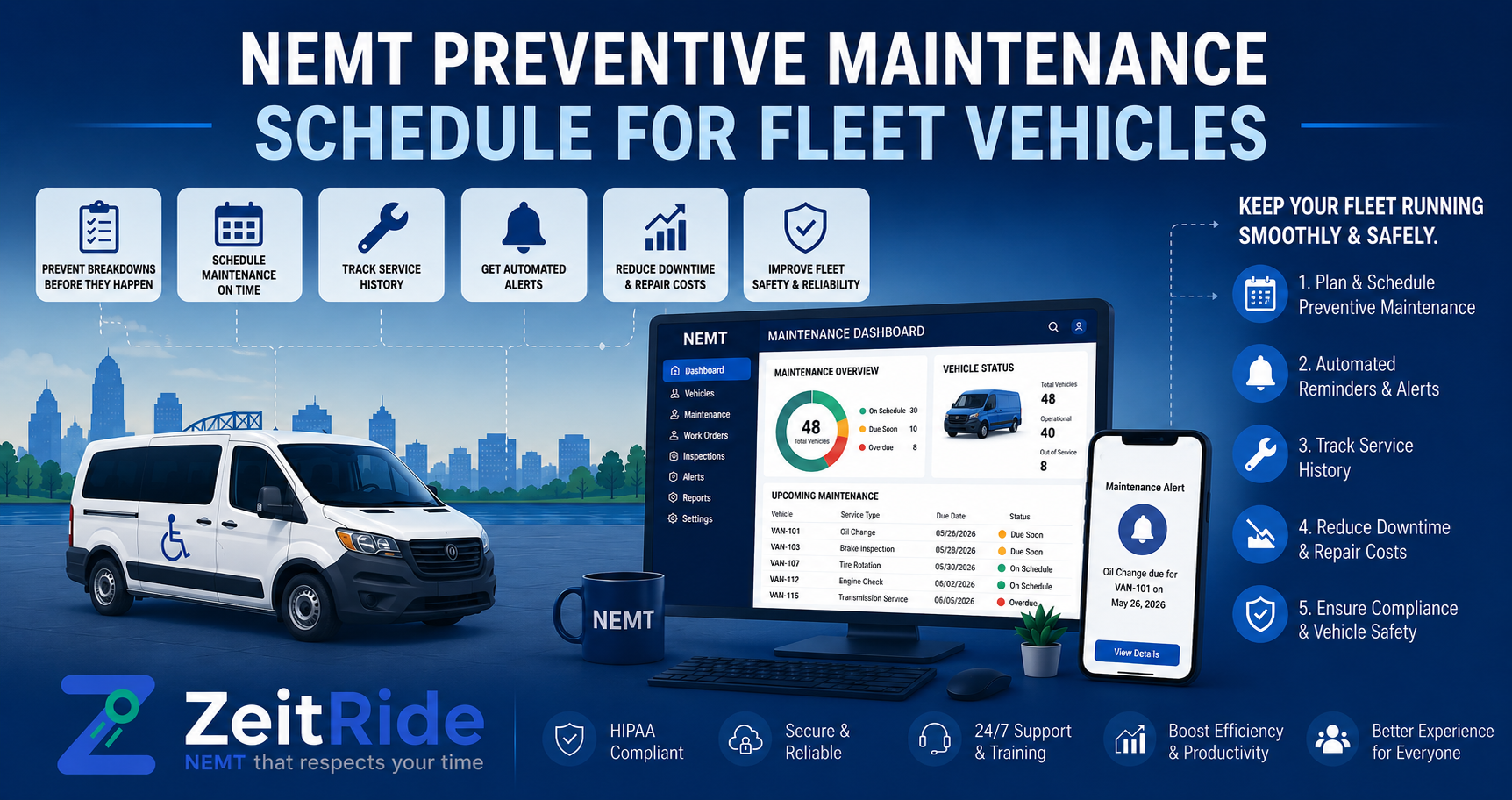
NEMT Preventive Maintenance Schedule for Fleet Vehicles
Build a practical NEMT preventive maintenance schedule for fleet vehicles, wheelchair lifts, inspections, service records, and vehicle readiness.
Quick answer
An NEMT preventive maintenance schedule should combine manufacturer service intervals, mileage and time triggers, driver inspections, wheelchair lift requirements, defect handling, service records, and clear rules for taking vehicles out of service and returning them to dispatch.
ZeitRide Team
NEMT Operations Expert
A reliable NEMT preventive maintenance schedule does more than remind someone when service is due. It connects vehicle maintenance, driver inspections, wheelchair-accessibility equipment, service records, and vehicle availability so a unit that needs attention does not quietly remain in the dispatch rotation. For NEMT operators, that connection matters because one maintenance issue can quickly become a missed trip, an avoidable breakdown, or a dispatch problem.
The strongest approach is not to copy one universal mileage chart. Build each vehicle's schedule from the manufacturer's requirements, actual mileage and usage, wheelchair lift or conversion-equipment instructions, and any state, broker, payer, insurer, or contract requirements that apply to your operation. ZeitRide's NEMT fleet maintenance management workflow follows the same principle: maintenance status should affect vehicle readiness instead of living in a separate spreadsheet that dispatch never sees.
This guide provides a practical framework for U.S. NEMT operators. Exact maintenance intervals should always come from the vehicle manufacturer, conversion manufacturer, accessibility-equipment manufacturer, and any applicable regulatory or contractual requirements.
What Should an NEMT Preventive Maintenance Schedule Include?
An NEMT preventive maintenance schedule should combine manufacturer service intervals, mileage and time triggers, driver inspections, wheelchair lift requirements, defect handling, service records, and clear rules for taking a vehicle out of service and returning it to dispatch.
A useful schedule should answer six operational questions for every maintenance item:
- What needs inspection, maintenance, service, or replacement?
- What triggers the task: date, mileage, usage, equipment cycles, a defect, or an expiration?
- Who is responsible for monitoring and completing the task?
- Where is completion documented?
- What conditions make the vehicle unavailable for service?
- Who is authorized to clear the vehicle and return it to dispatch?
Use Three Clocks: Time, Mileage, and Equipment Cycles
One calendar is rarely enough for an active medical transportation fleet. A stronger NEMT preventive maintenance plan tracks three different clocks together: calendar time, actual vehicle mileage or usage, and accessibility-equipment cycles.
1. Calendar Time
Some maintenance and compliance items become due by date even when a vehicle has relatively low mileage. Depending on the vehicle and operating requirements, this may include scheduled inspections, selected fluid or component checks, document renewals, seasonal preparation, and manufacturer-defined time-based service.
2. Vehicle Mileage and Usage
A high-use wheelchair van can reach a manufacturer service threshold much faster than a backup unit that only runs a few trips each week. Record actual mileage consistently and monitor approaching service points so the fleet team can schedule work before a vehicle becomes overdue.
3. Wheelchair Lift and Accessibility-Equipment Cycles
Wheelchair lifts, ramps, and related accessibility equipment have components and maintenance requirements separate from the base vehicle. The correct interval depends on the equipment installed, so use its manufacturer documentation instead of assuming the vehicle's engine or chassis maintenance schedule also covers the lift.
NEMT Vehicle Maintenance Schedule: Practical Template
Use the following NEMT vehicle maintenance schedule as a framework for your fleet SOP, spreadsheet, or maintenance software. Replace generic trigger descriptions with the exact requirements for each vehicle, conversion, lift, ramp, and other accessibility equipment in your fleet.
| Trigger | What to Review | Owner | If a Problem Is Found | Record |
|---|---|---|---|---|
| Before each shift or service day | Tires, visible leaks, lights, mirrors, wipers, warning indicators, safety equipment, wheelchair lift or ramp operation | Driver | Report and escalate before service according to company policy | Driver inspection record |
| Weekly operations review | Open defects, repeated driver reports, upcoming maintenance, unresolved repairs, unavailable vehicles | Fleet or operations manager | Assign responsibility and confirm vehicle status | Defect and action log |
| OEM time or mileage interval | Oil and filters, brakes, fluids, tires, battery, belts, hoses, HVAC, drivetrain, and other manufacturer-specified items | Technician or service vendor | Complete required service before the applicable interval is exceeded | Work order and service history |
| Usage-based trigger | Items affected by high mileage, heavy utilization, idling, stop-and-go driving, or severe-duty conditions | Fleet manager | Advance service when actual operating conditions justify it | Odometer, usage, and maintenance record |
| Wheelchair lift or ramp trigger | Accessibility-equipment inspection and service requirements specified by its manufacturer | Qualified technician or assigned fleet staff | Restrict wheelchair service or vehicle use when safe operation is affected | Lift or ramp maintenance record |
| Seasonal review | Battery condition, HVAC, tires, fluids, wipers, visibility, and weather-related wear | Fleet manager or vendor | Complete climate-specific preparation and repairs | Seasonal maintenance record |
| Compliance or document due date | Applicable vehicle inspections, registration, insurance, certificates, permits, or broker requirements | Compliance or fleet manager | Restrict operation where expired requirements prohibit service | Current document and renewal history |
| Periodic recall review | Vehicle and relevant equipment recall status | Fleet manager | Follow the manufacturer's or responsible authority's remedy instructions | Recall check and repair record |
This template intentionally avoids prescribing one oil-change, brake-service, transmission-service, or tire-replacement interval for every fleet. Different vehicle models, conversions, engines, duty cycles, operating environments, and wheelchair systems can have different requirements.
The same principle applies when building a medical transportation vehicle maintenance schedule: use the documentation for the actual vehicle and equipment as the source of truth, then layer operational controls around inspections, mileage, defects, service history, and dispatch availability.
For additional tire safety and maintenance guidance, operators can review NHTSA TireWise alongside the vehicle placard and owner's manual. It is also useful to include the NHTSA recall lookup in a periodic fleet review so open safety recalls are not overlooked.
Preventive Maintenance Is Not the Same as a Pre-Trip Inspection
A pre-trip inspection evaluates a vehicle's current condition before service. Preventive maintenance is planned servicing intended to keep the vehicle and its equipment operating correctly over time. The two processes support each other, but one does not replace the other.
Your digital NEMT fleet inspections should feed directly into the maintenance process. When a driver reports a tire issue, warning light, visible leak, securement problem, ramp problem, or wheelchair-lift defect, that information should reach the person responsible for deciding whether the vehicle can remain available.
A strong inspection-to-maintenance workflow follows a clear sequence:
- The driver completes the required inspection before service.
- Any defect is documented with enough detail for fleet staff to evaluate it.
- Fleet or operations personnel review the reported issue.
- Vehicle status changes when the defect affects safe or compliant operation.
- Dispatch sees the updated vehicle availability.
- Repair or maintenance is completed and documented.
- An authorized person verifies the result and returns the vehicle to service.
This closes an important operational gap. A maintenance process is incomplete if the shop knows a vehicle has a problem while dispatch still treats that vehicle as ready for trips.
NEMT Wheelchair Lift Maintenance Needs Its Own Schedule
NEMT wheelchair lift maintenance should be managed as its own maintenance layer because the lift, ramp, securement equipment, electrical components, hydraulic components, and conversion systems may have requirements separate from the underlying vehicle.
For each wheelchair-accessible unit, keep enough information to identify and service the equipment correctly.
- Lift or ramp manufacturer, model, and serial number
- Applicable owner and service manuals
- Calendar-based service requirements
- Usage or cycle-based triggers where applicable
- Driver-reported lift or ramp defects
- Wheelchair securement-system condition
- Completed maintenance and repair work
- Technician or service vendor
- Date the vehicle or equipment was restricted from service
- Date and authorization for return to service
Do not create a universal wheelchair-lift service interval from a generic maintenance chart. Use the documentation for the actual equipment installed on the vehicle. For example, BraunAbility provides commercial product manuals for its commercial lifts, ramps, and accessible-vehicle products.
If an accessibility-equipment defect means a vehicle cannot safely perform a wheelchair trip, its capability and dispatch availability should reflect that condition until the required inspection or repair is completed.
How to Create an NEMT Preventive Maintenance Plan
Step 1: Create a Complete Record for Every Vehicle
Start with an accurate fleet inventory. Record the unit number, VIN, year, make, model, mileage, passenger capacity, wheelchair capability, lift or ramp details, service vendor, key documents, and current operating status.
Step 2: Collect the Source Maintenance Requirements
Gather the vehicle owner's manual, manufacturer maintenance schedule, conversion documentation, wheelchair-lift or ramp manuals, tire information, and applicable state, broker, payer, insurer, or contractual requirements.
Step 3: Convert Requirements Into Trackable Triggers
For every task, define exactly what makes it due. The trigger may be a calendar date, odometer reading, actual usage, lift cycles, an inspection defect, a recall notice, or a document expiration.
Step 4: Assign an Owner to Every Maintenance Task
Someone should be responsible for reviewing upcoming work, arranging service, verifying completion, and updating the vehicle record. A reminder without a clearly assigned owner can still be missed.
Step 5: Define When a Vehicle Becomes Out of Service
Document which conditions require a vehicle to be removed from normal trip assignments and who has authority to make that decision. The same policy should explain who can clear the vehicle after repair or inspection.
Step 6: Connect Maintenance Status to Dispatch
A maintenance calendar is operationally weak if only the fleet or shop team can see it. Dispatch needs to know whether a vehicle is ready, under review, in maintenance, or out of service. This is where NEMT fleet management software becomes more useful than a standalone reminder because vehicle readiness can sit alongside the trips that depend on that vehicle.
Step 7: Improve the Plan With Your Own Fleet Data
Review recurring defects, unscheduled downtime, repeated repairs, completed maintenance, inspection failures, and vehicle-specific patterns. Your fleet data may show that a heavily used unit needs closer monitoring than another vehicle with the same age but much lower utilization.
What Should an NEMT Maintenance Log Record?
A useful maintenance log should let an operator reconstruct what was due, what was found, what work was completed, who completed it, whether the vehicle was restricted from service, and when it became ready again.
| Field | What to Record |
|---|---|
| Vehicle | Unit number, VIN, year, make, and model |
| Service trigger | Date, mileage, usage, equipment cycle, defect, recall, or expiration |
| Due point | The date, mileage, usage value, or other threshold that triggered action |
| Reported issue | Driver report, technician finding, system alert, inspection result, or other source |
| Work performed | Inspection, preventive service, repair, test, adjustment, or replacement |
| Service provider | Technician, repair shop, vendor, or qualified employee |
| Supporting record | Work order, invoice, inspection form, photo, certificate, or service note |
| Vehicle status | Ready, under review, maintenance, or out of service |
| Return to service | Date, time, and person who authorized return |
| Next trigger | Next date, mileage, usage point, or accessibility-equipment trigger |
Good maintenance records also support broader NEMT documentation requirements by helping the operator establish which vehicle was maintained, documented, and available for service at a particular point in time.
How Often Should NEMT Vehicles Be Serviced?
There is no single service interval that applies to every NEMT vehicle. The correct frequency depends on the vehicle manufacturer's schedule, mileage, operating conditions, age, drivetrain, conversion equipment, wheelchair-lift requirements, and any applicable inspection or contractual rules.
For most fleets, the practical approach is to track applicable time, mileage, usage, and accessibility-equipment triggers together and act when the relevant requirement becomes due.
The bigger operational mistake is not choosing one generic mileage number over another. It is applying the same calendar reminder to every vehicle in a mixed fleet while ignoring how differently those vehicles are actually being used.
How NEMT Software Turns Maintenance Into Vehicle Readiness
A spreadsheet can tell you that maintenance is due. A connected NEMT system can also help make the vehicle's current readiness visible to the people scheduling and dispatching trips.
ZeitRide supports mileage- and usage-based maintenance triggers, driver inspection workflows, vehicle-status controls, centralized maintenance records, fleet visibility, and separate wheelchair-lift tracking. That allows maintenance information to become part of the daily operating workflow instead of an isolated administrative record.
A practical connected workflow looks like this:
- A service or inspection trigger approaches.
- The fleet team receives visibility into the upcoming requirement.
- Maintenance, inspection, or repair is completed.
- The vehicle record is updated.
- The vehicle is restricted from assignments when necessary.
- Dispatch sees the current vehicle status.
- An authorized person clears the vehicle.
- The unit returns to active service.
The real value is not simply storing another maintenance log. It is helping the people assigning tomorrow's trips see whether tomorrow's vehicles are actually ready.
If your team still manages due dates in spreadsheets or separate calendars, explore ZeitRide's NEMT fleet maintenance tools to see how maintenance status, inspections, fleet availability, scheduling, and dispatch can work together.
Build a Maintenance Process Your Dispatch Team Can Actually Use
A good NEMT preventive maintenance schedule should make it easy to answer three questions at any time: what is due, what needs attention now, and which vehicles are actually ready for trips. When those answers live in different spreadsheets, inspection forms, text messages, and dispatch screens, small maintenance issues are easier to miss.
ZeitRide connects maintenance, vehicle inspections, vehicle status, scheduling, and dispatch in one NEMT workflow. If you want to see how your current fleet process could work without separate maintenance spreadsheets and dispatch guesswork, book a 15-minute demo and bring one real vehicle-maintenance workflow.
Frequently Asked Questions
Q: What is preventive maintenance in NEMT?
Preventive maintenance in NEMT is planned inspection and servicing performed before a failure occurs. It combines manufacturer requirements with actual fleet usage, accessibility-equipment needs, driver-reported defects, maintenance records, and vehicle-readiness rules.
Q: What is the difference between an NEMT maintenance schedule and an inspection checklist?
An inspection checklist records the vehicle's current condition, while a maintenance schedule defines planned service tasks and their time, mileage, usage, or equipment-based triggers. Inspection findings should feed the maintenance and repair process.
Q: Should an NEMT maintenance schedule use mileage or dates?
Usually both. Some maintenance requirements are time-based, others are mileage- or usage-based, and accessibility equipment may have separate calendar or cycle-based requirements. Operators should follow the applicable manufacturer and equipment instructions for each asset.
Q: How should wheelchair lift maintenance be tracked?
Track the lift separately by manufacturer, model, serial number, service instructions, applicable calendar or usage triggers, reported defects, completed maintenance, and return-to-service status.
Q: How often should NEMT vehicles be serviced?
There is no universal NEMT service interval. Service frequency depends on the vehicle manufacturer's schedule, mileage, operating conditions, age, conversion equipment, wheelchair-lift requirements, and applicable inspection or contractual requirements.
Q: Can NEMT software keep a maintenance-due vehicle out of dispatch?
A connected NEMT fleet system can use maintenance and vehicle-readiness status to keep unavailable vehicles out of normal assignment workflows. The exact rules should match the provider's maintenance, safety, inspection, and dispatch policies.
Rather see it than read about it?
Bring a real route, a couple of drivers, and your current process. 15 minutes, zero pitch.