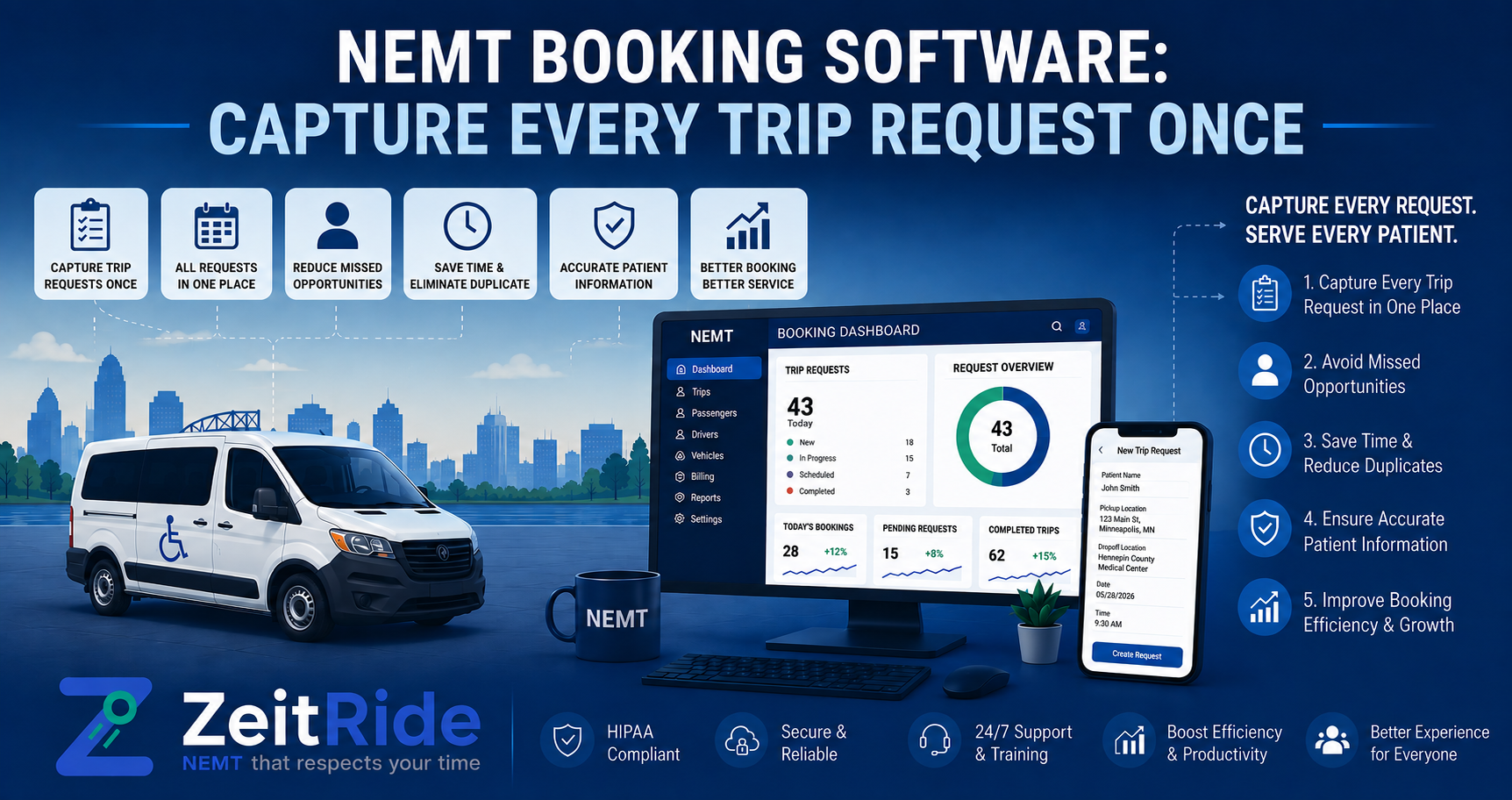
NEMT Booking Software: Capture Every Trip Request Once
Learn how NEMT providers can capture online, facility, phone, and broker trip requests in one workflow without repetitive manual re-entry.
Quick answer
NEMT booking software centralizes online, facility, phone, and broker trip requests into one operational workflow. Staff review each request once, then move the same trip record into scheduling, routing, dispatch, driver operations, and billing without repeatedly re-entering the data.
ZeitRide Team
NEMT Operations Expert
Every NEMT trip has to enter the operation somewhere. A passenger may submit a request online. A hospital may call about a discharge. A dialysis center may send recurring transportation details. A Medicaid broker may assign dozens of trips electronically. The problem begins when every booking channel creates a separate workflow and dispatchers have to re-enter the same information into multiple systems.
NEMT booking software should solve that problem by turning different request sources into one consistent operational trip record. Instead of reading an email, opening a broker portal, copying details into a spreadsheet, and then rebuilding the ride inside scheduling software, providers should be able to review the request once and move it forward. ZeitRide's NEMT trip request software is built around bringing broker, phone-in, direct, and online requests into the operating workflow without repeatedly recreating the same trip.
What Does NEMT Booking Software Do?
NEMT booking software captures transportation requests and turns them into structured trip records that can move into scheduling and dispatch. A request may originate online, from a healthcare facility, through a phone call, or from a transportation broker. The important part is that the request becomes usable operational data instead of another message that staff must manually recreate.
What Is NEMT Booking Software?
NEMT booking software is a system for capturing, organizing, reviewing, and processing non-emergency medical transportation requests before they become active scheduled or dispatched trips. It may also be described as medical transportation booking software, reservation software, trip-request software, or an NEMT booking portal.
The terminology varies, but the operational goal is the same: capture complete trip information as early as possible and keep that information connected as the ride moves through scheduling, routing, dispatch, driver operations, completion, and billing.
- Passenger or member information
- Pickup and drop-off addresses
- Requested pickup or appointment time
- Payer or funding source
- Healthcare facility information
- Ambulatory, wheelchair, or other mobility requirements
- Attendants or additional passengers
- One-way or return-trip requirements
- Recurring schedule information
- Special transportation instructions
Why Manual Re-Entry Creates Problems for NEMT Providers
Manual entry and manual re-entry are not the same thing. If a passenger calls to request a ride, a dispatcher may still need to enter that information once. The waste appears when the same information has to be typed again into another spreadsheet, dispatch board, scheduling platform, broker workflow, or billing system.
| Trip Source | Fragmented Workflow | Connected Booking Workflow |
|---|---|---|
| Online request | A form creates an email that staff later re-types | The request enters a review queue with trip details already available |
| Healthcare facility | Calls, faxes, or emails must be manually recreated | Facility requests follow a standardized intake workflow |
| Broker trip | Dispatcher copies data from a broker portal or manifest | Supported integration or import creates the operational trip record |
| Phone booking | Details are written in notes before later entry | The dispatcher enters the trip once into the operating system |
Different channels can feed an NEMT business, but they should not create separate operating systems. The strongest booking workflow standardizes the trip after intake regardless of where the original request came from.
NEMT Booking vs. Scheduling vs. Dispatch
Booking, scheduling, routing, and dispatch are closely connected, but each handles a different stage of the NEMT trip lifecycle. Understanding the difference matters when evaluating software because a booking feature is only useful if the trip can move cleanly into the next operational stage.
| Stage | Main Job | Typical Question |
|---|---|---|
| Booking / Intake | Capture the transportation request | What ride has been requested? |
| Scheduling | Plan the accepted trip | When should it run and what resources does it need? |
| Routing | Organize stops efficiently | What sequence should the vehicle follow? |
| Dispatch | Operate and adjust the day | Which driver is handling the trip right now? |
| Completion | Record the trip outcome | Was the passenger picked up and dropped off as expected? |
Booking comes first. Once a request becomes an accepted trip, NEMT scheduling software can help place it into the operating plan. Day-of assignments, changes, and trip progress then move into NEMT dispatch software. A booking tool that does not connect with those later stages can simply replace one disconnected process with another.
How Should NEMT Online Booking Software Work?
Good NEMT online booking software should do more than place a form on a website. The request needs to enter a controlled operational process where staff can review the information and convert an approved request into a usable trip.
1. The Requester Enters the Trip Details
The booking form should collect enough information to evaluate the requested transportation, including passenger details, pickup and destination addresses, requested date and time, mobility needs, return-trip requirements, and relevant contact information.
2. Staff Reviews the Request
An online submission should not automatically mean operational acceptance. A dispatcher or authorized team member may still need to confirm service area, availability, payer requirements, vehicle capabilities, mobility needs, and timing before the request becomes an active trip.
3. The Accepted Request Becomes a Trip
This is where a useful NEMT booking portal separates itself from a basic contact form. Instead of rebuilding the entire ride from an email notification, the dispatcher should be able to review the information already supplied and use it to create or approve the operational trip record.
4. The Trip Moves Into Scheduling and Dispatch
Once accepted, the trip should become part of the same workflow used for scheduling, route planning, driver assignments, status tracking, and completion. The fewer disconnected handoffs involved, the less opportunity there is for information to be missed or entered inconsistently.
What Is an NEMT Facility Portal?
An NEMT facility portal is an online intake environment that allows authorized healthcare-facility staff to submit transportation requests to an NEMT provider. The concept is especially relevant for organizations that regularly coordinate transportation for patients or residents.
- Hospitals and discharge teams
- Dialysis centers
- Skilled nursing facilities
- Assisted living communities
- Rehabilitation facilities
- Adult day programs
- Other recurring healthcare transportation partners
A dedicated portal is one way to handle facility requests, but the real operational question is what happens after the facility submits the trip. If the request only generates an email that a dispatcher must completely recreate, much of the efficiency benefit disappears.
Providers managing transportation for several organizations should be able to coordinate facility work alongside broker and direct trips. ZeitRide's multi-facility NEMT software helps operators manage transportation activity across multiple facilities and trip sources in one environment.
Recurring facility transportation creates another layer of complexity. Dialysis trips, for example, often repeat several days each week and require dependable scheduling around appointment times. The ZeitRide guide to dialysis transportation software explains how recurring medical transportation routes can be managed more efficiently.
How Should Broker Trip Requests Enter NEMT Software?
Broker intake is different from online or facility booking because the NEMT provider usually does not control the broker's platform. Depending on the broker, assigned trips may arrive through an API, scheduled connection, spreadsheet, file, broker portal, or another electronic workflow.
The operational objective is still the same: avoid manually rebuilding transportation assignments that already exist electronically. With supported NEMT broker integrations, providers can bring broker-originated trip information into their operating environment through the appropriate integration or import process.
Providers should verify the exact capabilities available for each broker because trip intake, modifications, cancellations, status exchanges, and reporting requirements can differ by network and contract. For a deeper software evaluation, see Best NEMT Software for Broker Integrations.
What Information Should an NEMT Booking Workflow Capture?
A strong booking workflow captures enough information for the next person in the process to make an operational decision without calling around to reconstruct the request. The goal is not to collect the maximum possible number of fields. It is to capture the right information early enough that scheduling and dispatch can work efficiently.
- Rider identity and contact details
- Pickup address
- Destination address
- Requested pickup time or appointment time
- One-way or round-trip transportation
- Ambulatory, wheelchair, or other service requirements
- Attendants or additional passengers
- Healthcare facility
- Payer or funding source
- Recurring schedule details
- Special transportation instructions
- Return-trip timing or will-call information
How a Connected NEMT Booking Workflow Should Move Through Operations
The ideal trip lifecycle is straightforward: Request → Review → Trip Record → Scheduling → Routing → Dispatch → Driver → Completion. The same core trip information should survive that entire process.
Once a booking is accepted, schedulers should not need to rebuild it. When the trip reaches dispatch, dispatchers should not have to recreate it again. When it is assigned to a driver, the operational information needed to perform the ride should already be connected to that trip.
That is the difference between digitizing a booking form and actually connecting the NEMT operating workflow.
Example: A Recurring Dialysis Transportation Request
Consider a dialysis center arranging Monday, Wednesday, and Friday wheelchair transportation for a patient. In a fragmented workflow, the facility may call or email the request, someone records the details, another person creates the trip, recurring rides are copied manually, and dispatch later works out the appropriate vehicle and driver.
In a connected workflow, the request is reviewed once, converted into the appropriate recurring trip structure, and then managed through the same scheduling and dispatch environment used for the rest of the fleet.
The operational advantage is not simply online booking. It is continuity from intake through trip completion.
What Should NEMT Providers Look for When Choosing Booking Software?
When evaluating non emergency medical transportation booking software, test the real workflow rather than relying only on a feature checklist. A vendor may technically offer online booking while still requiring dispatchers to manually rebuild requests elsewhere in the system.
- Submit an online trip request
- Enter a phone-in booking
- Create a healthcare-facility request
- Bring in a broker-assigned trip
- Set up a recurring ride
- Handle a same-day request
- Create a wheelchair transportation trip
- Move the booking into scheduling
- Move the scheduled trip into dispatch
- Show exactly what information reaches the driver
A useful software demonstration should make it obvious where staff still have to type the same information twice. Providers should also evaluate security, privacy, payer requirements, broker requirements, and applicable contractual obligations before adopting any booking workflow.
For official federal privacy guidance, review the HIPAA Privacy Rule. Providers serving Medicaid populations should also review official Medicaid transportation guidance together with state-specific and broker-specific requirements.
See Your Real Booking Workflow in ZeitRide
The best way to evaluate NEMT booking software is not with a perfect sample trip created specifically for a sales presentation. Use one of your own. Bring a recent online request, healthcare-facility booking, phone booking, or broker assignment and follow it from intake through scheduling and dispatch.
ZeitRide can show how its NEMT trip request software fits your existing workflow and where repetitive data entry can be reduced.
Want to see what that process looks like with one of your actual trips? Book a ZeitRide demo and walk through your own booking, scheduling, and dispatch workflow.
Frequently Asked Questions
Q: What is NEMT booking software?
NEMT booking software captures non-emergency medical transportation requests and converts them into structured trip records for scheduling and dispatch. Requests may come from online forms, phone calls, healthcare facilities, or broker integrations.
Q: How is NEMT booking software different from scheduling software?
Booking software captures the requested ride and its required information. Scheduling software determines when the accepted trip will operate and how it fits with drivers, vehicles, routes, and other transportation already on the schedule.
Q: Can NEMT passengers request trips online?
Yes. When a provider offers an online trip-request or booking workflow, passengers or other authorized requesters can submit transportation details electronically. Providers may still review the request before accepting it based on service area, availability, payer rules, timing, and transportation requirements.
Q: What is an NEMT booking portal?
An NEMT booking portal is an online interface that allows passengers, caregivers, healthcare facilities, or other authorized users to submit transportation requests to an NEMT provider.
Q: What is an NEMT facility portal?
An NEMT facility portal allows authorized healthcare-facility staff to submit transportation requests electronically. Hospitals, dialysis centers, nursing facilities, rehabilitation facilities, assisted living communities, and similar organizations may use this type of workflow.
Q: How do broker trips enter NEMT software?
Broker trips may enter through an API, automated data connection, file import, spreadsheet, portal, or manual workflow depending on the broker and software platform. Providers should verify the exact capabilities supported for every broker they work with.
Rather see it than read about it?
Bring a real route, a couple of drivers, and your current process. 15 minutes, zero pitch.