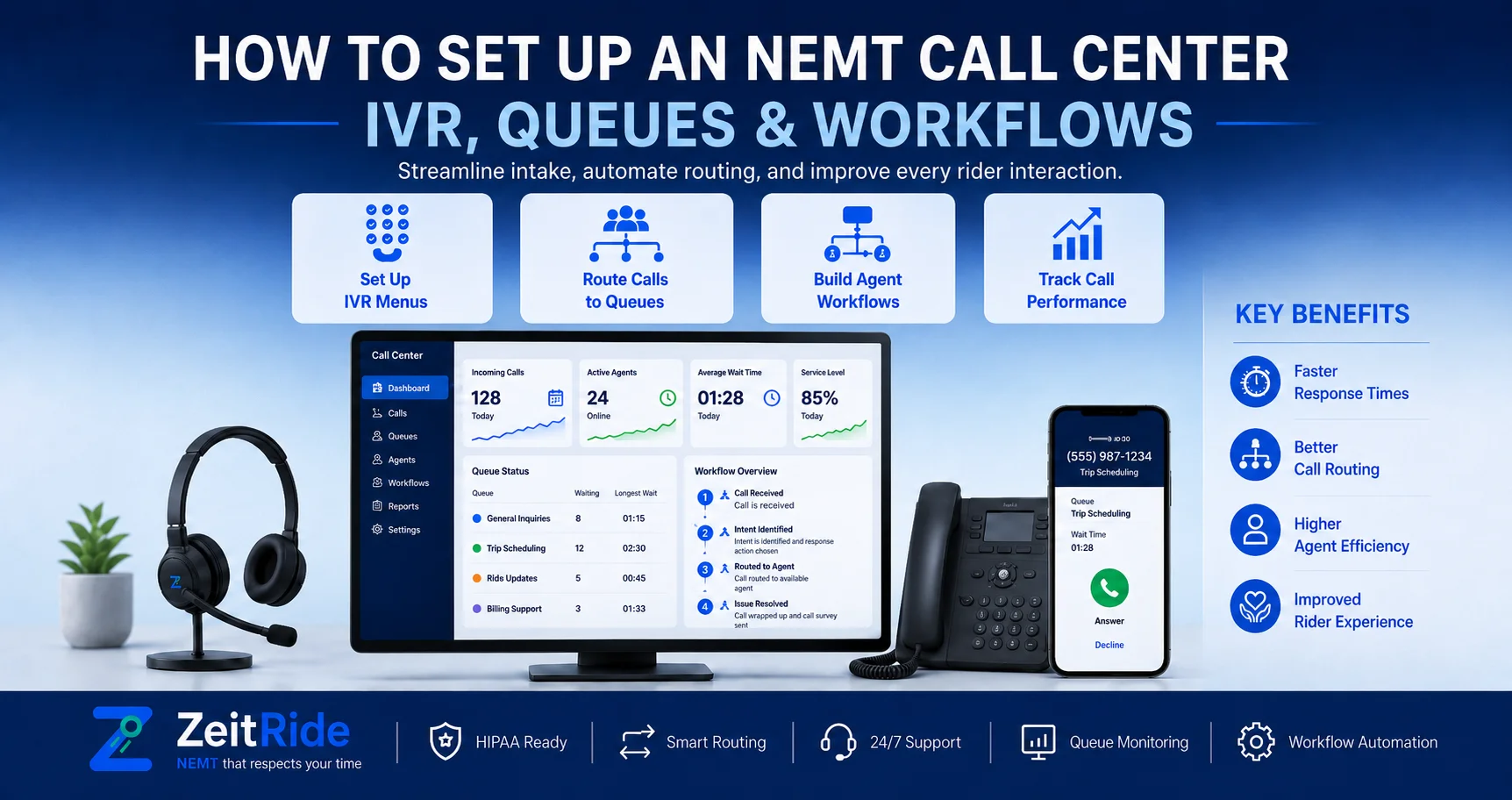
How to Set Up an NEMT Call Center: IVR, Queues & Workflows
Learn how to set up an NEMT call center with IVR, call queues, booking, dispatch routing, after-hours coverage, and performance metrics.
Quick answer
Set up an NEMT call center by separating reservations from live dispatch, routing callers through a short IVR, using dedicated call queues, capturing trip details once, defining after-hours rules, and tracking call performance. Connect each booking to scheduling and dispatch.
ZeitRide Team
NEMT Operations Expert
An NEMT phone line can become chaotic long before a fleet looks large on paper. A rider calls to book next week's trip. A dialysis facility wants to change tomorrow's pickup. Someone else is ready for a will-call return, while another caller only wants to know where today's vehicle is. If every call reaches the same dispatcher, routine phone work quickly competes with live trip operations.
Knowing how to set up an NEMT call center means designing a clear path for those calls instead of simply adding more phones. The goal is to separate reservations from live dispatch, route callers to the right queue, capture trip information consistently, define after-hours handling, and make sure phone activity supports rather than interrupts the transportation workflow.
What Should an NEMT Call Center Handle?
An NEMT call center is the communication layer for riders, facilities, care coordinators, brokers, drivers, and office staff. It may handle several different types of requests during the same hour, which is why every call should not follow the same path.
- New and future trip reservations
- Changes to existing bookings
- Same-day ride questions
- Will-call return activation
- ETA and Where's my ride? calls
- Healthcare facility requests
- Cancellations and no-shows
- Billing or payment questions
- Driver and staff calls
- Voicemail and after-hours messages
The first NEMT call center setup decision should therefore be about call ownership: which team should handle each type of request, and which calls actually need a live dispatcher?
Reservations usually concern future transportation. Dispatch deals with trips that are operating now. Mixing the two can leave dispatchers answering next week's booking questions while today's routes are changing.
Separate Reservations From Live Dispatch
A simple operating rule is useful: reservations manage what should happen, while dispatch manages what is happening now.
Reservation staff can collect trip information, review future ride requests, create recurring transportation, and manage advance changes. Dispatchers need to focus on today's assignments, delays, will-calls, cancellations, vehicle availability, and driver activity.
That does not mean the teams operate in isolation. The booking still has to move into scheduling and eventually live operations. ZeitRide's NEMT booking software explains how phone, facility, online, and broker requests can become structured trip information rather than separate notes that must be repeatedly recreated.
Once a scheduled trip becomes part of the active service day, NEMT dispatch software handles a different job: assigning and reassigning trips, monitoring active work, and responding when the plan changes.
Build a Simple NEMT IVR and Call Queue Structure
An IVR, or interactive voice response system, is the menu callers hear before reaching a person or queue. A good NEMT IVR setup should make routing faster without forcing riders through a complicated phone tree.
For many providers, the first-level menu can remain simple.
| Caller Need | Example IVR Option | Recommended Destination |
|---|---|---|
| New or future trip | Press 1 for Reservations | Booking / scheduling queue |
| Today's ride, ETA, or will-call | Press 2 for Today's Transportation | Dispatch queue |
| Billing question | Press 3 for Billing | Billing team |
| Facility or other request | Press 4 for Other Assistance | Appropriate office queue |
The exact menu will depend on your operation, but adding more options is not automatically better. Callers should be able to understand the choices quickly, and important queues should have clear overflow, voicemail, and after-hours rules.
ZeitRide's NEMT VoIP software supports business calling, multi-level IVR, call queues, ring groups, transfers, forwarding, voicemail, time-based routing, and after-hours call flows. Those features matter most when they reflect an intentional NEMT workflow rather than a generic office-phone configuration.
Turn Booking Calls Into Structured Trip Information
The phone call itself is not the trip record. An agent still needs to collect the transportation information required to evaluate and create the ride.
A booking workflow may need:
- Rider or member information
- Pickup address
- Destination
- Appointment or requested arrival time
- One-way or round-trip requirement
- Will-call return status
- Mobility or transportation mode
- Attendant or additional rider information
- Facility contact details
- Payer, broker, or funding information when applicable
- Relevant transportation instructions
The operational objective is to capture the information once and move it into the appropriate booking and scheduling process instead of leaving details in a handwritten note, voicemail, or unrelated inbox.
Healthcare partners may not need to call for every routine trip either. When appropriate, an NEMT facility portal can give authorized hospitals, dialysis centers, skilled nursing facilities, and other partners a structured digital booking channel while the phone remains available for exceptions and situations that require human communication.
A strong NEMT call center workflow therefore connects the communication channel with the correct operational action: caller to IVR, IVR to queue, queue to staff member, staff member to booking or trip action, and then into scheduling or dispatch.
Plan for Will-Calls, Same-Day Changes, and After-Hours Calls
Routine future reservations are generally easier to control than calls arriving during the service day.
A rider may finish an appointment earlier than expected. A dialysis treatment may run late. A facility may change a discharge time. A vehicle may be delayed while the caller is already waiting.
Will-call and same-day requests should therefore have a clear path to the team operating today's trips. Avoid sending them into the same queue used for future reservations if that creates another handoff before dispatch can act.
After-hours routing needs the same level of clarity. Decide in advance:
- Which calls require live coverage
- Which calls can enter voicemail
- When calls should overflow to another person or queue
- How urgent operational messages are escalated
- What happens on weekends and holidays
Proactive communication can also reduce avoidable inbound calls. NEMT SMS notifications can support reminders and trip updates so riders or facilities do not always need to call dispatch simply to confirm basic ride status.
Handle Call Recording, Transcription, and Privacy Carefully
Call recording and transcription can help with quality review, dispute investigation, training, voicemail follow-up, and documenting what was discussed. They also create information that must be handled appropriately.
ZeitRide's VoIP capabilities can support call recording, configurable consent announcements, access controls, retention settings, AI-assisted transcription, summaries, and voicemail-to-text where those features are enabled.
However, providers should not assume one recording policy works everywhere. Call-recording and consent requirements vary by jurisdiction. Organizations should define who can access recordings and transcripts, how long they are retained, and what information agents should avoid collecting unless it is operationally necessary.
If protected health information is involved, review the official HHS HIPAA Privacy Rule guidance and your organization's applicable responsibilities. Legal and contractual obligations can depend on the organization's role and circumstances.
Track the NEMT Call Center Metrics That Reveal Bottlenecks
Adding more agents does not automatically fix a poorly designed call operation. NEMT call center metrics help show where callers are waiting, abandoning calls, being transferred unnecessarily, or repeatedly contacting the office.
- Total inbound call volume
- Calls by queue or department
- Average speed to answer
- Missed call rate
- Abandoned call rate
- Average handle time
- Transfer rate
- First-call resolution
- Voicemail volume
- Missed-call recovery
- Calls by hour or day
- Booking completion rate where applicable
Do not optimize one number in isolation. A very low average handle time is not useful if callers have to call again because their issue was not resolved.
One of the most practical NEMT call center best practices is to review metrics alongside actual workflows. If dispatch receives a large number of routine ETA calls, for example, the answer may not be to add another dispatcher. Better status communication or call routing may address the underlying problem.
When Is It Time to Move Beyond a Basic Business Phone?
There is no universal fleet size that determines when a provider needs a more structured call-center setup. The better signal is operational friction.
You may have outgrown a basic phone line when:
- Multiple employees answer the same business number
- Riders regularly reach the wrong department
- Dispatch is interrupted by future booking calls
- Busy periods create missed calls or long waits
- Staff rely on personal cell phones
- After-hours calls have no consistent routing
- Facilities repeatedly call for trip status
- Voicemail follow-up is difficult to track
- Managers cannot see call volume or queue performance
ZeitRide NEMT software handles the broader transportation operation, while its VoIP capabilities provide a dedicated business-phone layer for inbound and outbound calling, IVR, queues, voicemail, recording, transcription, and SMS. Driver trip assignments, status changes, and GPS activity remain part of the dispatch and driver workflow rather than being treated as ordinary phone calls.
The strongest way to evaluate an NEMT phone workflow is with your actual operation. Map how a new reservation, today's ETA call, will-call return, facility request, billing question, and after-hours call are handled now. Then identify where callers wait, where information gets re-entered, and where dispatch is interrupted.
Want to see how to set up an NEMT call center around your real workflow? Book a 15-minute ZeitRide demo and bring your current call flow — not a perfect sample.
Frequently Asked Questions
Q: What does an NEMT call center do?
An NEMT call center handles transportation-related calls from riders, healthcare facilities, staff, and other partners. Common tasks include reservations, trip changes, ETA questions, will-call returns, cancellations, billing inquiries, and routing operational issues to dispatch.
Q: How should an NEMT IVR system be set up?
Keep the first-level IVR simple. Separate future reservations from today's transportation and dispatch calls, then route billing or other requests to the appropriate queue. Add overflow, voicemail, business-hours, and after-hours rules based on your actual staffing model.
Q: Should NEMT reservations and dispatch use separate call queues?
In many operations, yes. Reservations primarily handle future transportation, while dispatch manages active trips and same-day exceptions. Separate queues can reduce unnecessary interruptions while still allowing staff to transfer or escalate calls when needed.
Q: How should an NEMT call center handle will-call return trips?
Will-call requests should reach the team managing active transportation. Once the rider or facility confirms readiness, dispatch can evaluate current driver, vehicle, route, and timing conditions before assigning the return trip.
Q: What NEMT call center metrics should providers track?
Useful metrics include call volume, average speed to answer, missed and abandoned calls, average handle time, transfer rate, first-call resolution, voicemail volume, calls by queue, and booking completion rate where applicable.
Rather see it than read about it?
Bring a real route, a couple of drivers, and your current process. 15 minutes, zero pitch.