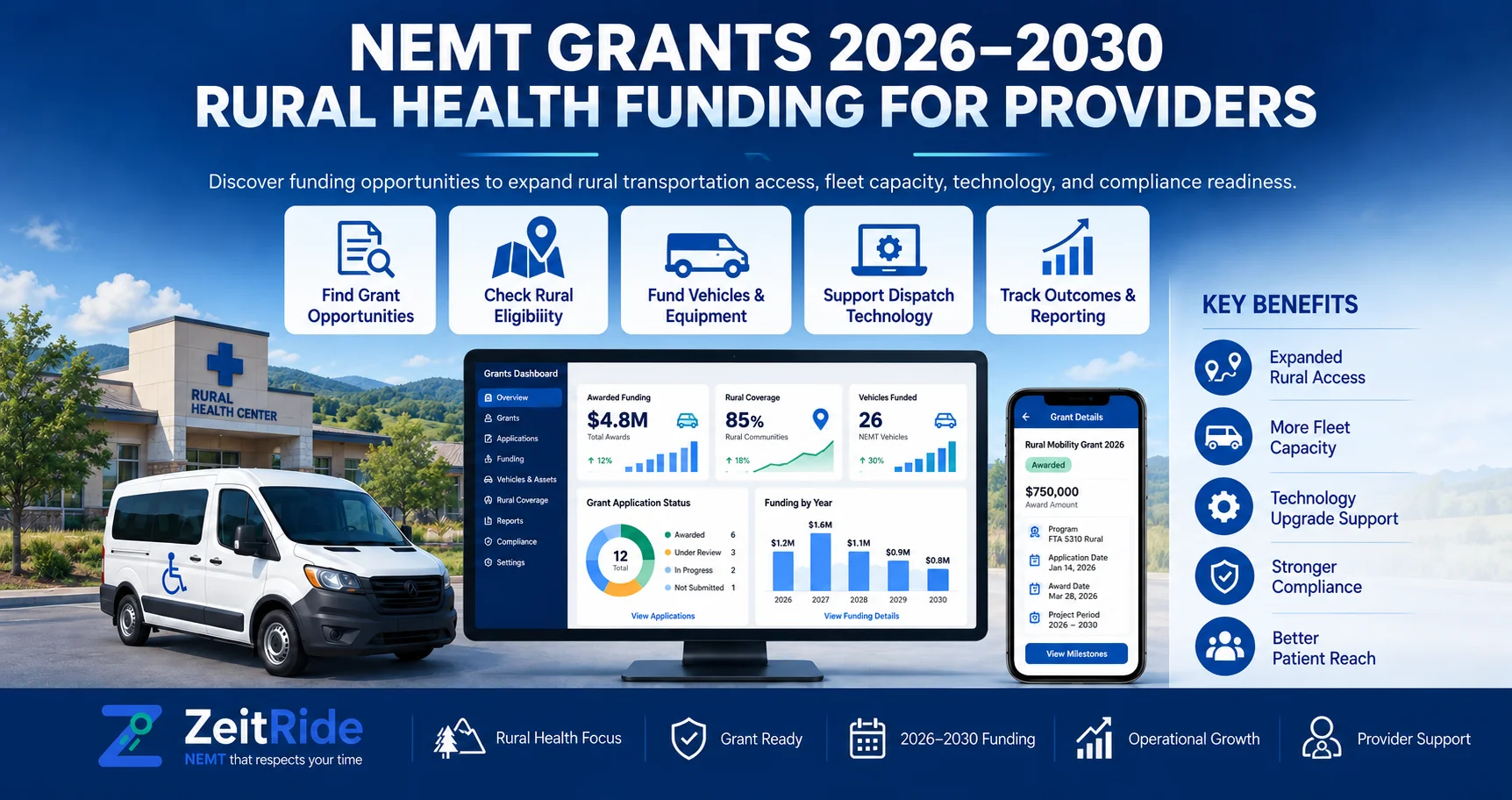
NEMT Grants 2026–2030: Rural Health Funding for Providers
Explore NEMT grants, Rural Health Transformation funding, provider eligibility, current state programs, and practical steps to prepare.
Quick answer
Yes. NEMT funding opportunities exist in 2026, but eligibility varies by state and program. Rural Health Transformation funding goes to states first, which may then support transportation through grants, contracts, partnerships, or other state-run programs.
ZeitRide Team
NEMT Operations Expert
NEMT grants are becoming more relevant to transportation providers in 2026 as states begin putting new rural healthcare funding into practice. The largest new opportunity comes from the Rural Health Transformation Program, a five-year federal initiative administered by the Centers for Medicare & Medicaid Services. CMS awarded funding to all 50 states, with $50 billion allocated across fiscal years 2026 through 2030. But there is an important distinction for NEMT companies: providers generally do not apply directly to CMS. Funding reaches transportation through state programs, grants, procurements, partnerships, and other initiatives. This guide explains how that process works, where transportation funding is already appearing, and what providers should prepare before pursuing an opportunity.
Are Non Emergency Medical Transportation Grants Available in 2026?
Yes. Non emergency medical transportation grants and related funding opportunities exist in 2026, but there is no single nationwide application available to every private NEMT company. States control how Rural Health Transformation Program funding is implemented, so eligibility and allowable costs can differ significantly.
- Accessible transportation vehicles
- New or expanded rural transportation services
- Patient mobility and transportation coordination
- Vehicle-tracking or supporting technology when specifically allowed
- Healthcare transportation partnerships and community-based programs
A private provider may qualify directly under one program but need to work with a hospital, clinic, health system, nonprofit, or public agency under another. The right question is not simply whether grant money exists; it is whether your organization is eligible for the specific transportation opportunity in your state.
What Is the Rural Health Transformation Program?
The Rural Health Transformation Program, or RHTP, is a $50 billion federal investment designed to strengthen rural healthcare systems and access. CMS is distributing the funding to states over five fiscal years, from 2026 through 2030, with $10 billion available each year. The program supports state-led strategies involving care delivery, workforce, infrastructure, technology, and other rural-health priorities.
Transportation fits naturally within that mission because healthcare access depends on patients being able to reach appointments. Several states are using Rural Health Transformation Program funding for projects involving patient transportation, accessible vehicles, mobility programs, and transportation coordination.
How RHTP funding reaches NEMT providers
The simplest way to understand the funding path is: CMS → state RHTP program → state grant, procurement, contract, or partnership → eligible organization → transportation service or infrastructure. Providers should therefore follow state implementation rather than assuming a federal CMS award can be accessed directly.
Can Private NEMT Providers Qualify for Funding?
Sometimes. Eligibility depends on the individual state program. Michigan's 2026 Improving Care Delivery and Access through Transportation initiative included for-profit organizations among eligible applicants, alongside nonprofits, public entities, transit agencies, health systems, health plans, and other organizations. The state anticipated 15 awards totaling $12 million.
North Dakota used a more restrictive model. Its 2026 Non-Emergency Medical Transportation Acquisition opportunity supported accessible transportation vehicles for eligible rural healthcare organizations, including qualifying hospitals, clinics, federally qualified health centers, and certain tribal facilities. These differences show why providers should never assume all Rural Health Transformation grants have the same applicant rules.
If your company cannot apply directly, it may still be able to participate as the transportation partner of an eligible healthcare or community organization. Providers focused more broadly on recurring payer or facility business should also review how to get NEMT contracts, which covers a different acquisition path.
NEMT and Rural Transportation Funding Examples in 2026
Current RHTP transportation funding shows that rural patient mobility is moving from policy language into real state programs. The examples below are useful signals, but they should not be treated as one national eligibility rule.
| State | 2026 Transportation Activity | Provider Takeaway |
|---|---|---|
| Alabama | Rural-health awards funded new non-emergency transportation and NEMT programs. | NEMT can be directly connected to funded rural-health projects. |
| Michigan | $12 million transportation grant initiative with 15 anticipated awards. | For-profit organizations were included among eligible applicant types. |
| North Dakota | Approximately $2 million NEMT vehicle-acquisition opportunity. | Funding focused on accessible vehicles for specified rural healthcare organizations. |
Alabama provides a particularly clear example. In August 2026, the state announced Rural Health Transformation awards that included $2 million for the DCH Health Care Authority to establish a dedicated non-emergency medical transportation program. The lesson for operators is not that every state will copy Alabama, but that transportation is becoming a real part of rural-health implementation.
What Can NEMT Funding Potentially Pay For?
Allowable costs vary by program, so providers should confirm expenses directly with the administering agency before committing funds. Current state initiatives show several transportation-related categories that may appear.
- Accessible vehicles: North Dakota's NEMT opportunity supported the purchase of accessible transportation vehicles for rural residents, including Medicaid members.
- Vehicle-related technology: North Dakota also addressed certain technology supporting vehicle-tracking hardware within the vehicle project.
- New transportation capacity: Alabama funded projects establishing new non-emergency transportation and NEMT services.
- Community mobility programs: Michigan's transportation initiative supports programs designed to improve access to healthcare in rural communities with limited transportation options.
A vehicle-focused opportunity may exclude payroll or other operating expenses, while another program may support a broader transportation model. Never purchase equipment, hire staff, or subscribe to technology on the assumption that a grant will reimburse the cost unless the program rules clearly allow it.
How to Find NEMT Funding Opportunities in Your State
Providers looking for NEMT funding opportunities should use a state-first approach instead of relying on generic grant lists.
- Find your state's official Rural Health Transformation Program page.
- Review the state's approved rural-health plan and search for NEMT, transportation, mobility, vehicles, access, and care coordination.
- Identify the agency responsible for each transportation initiative.
- Monitor state grant, procurement, and contracting portals.
- Verify applicant eligibility before preparing an application.
- Watch hospitals, FQHCs, health systems, and community organizations that may need transportation partners.
- Subscribe to state agency updates where available.
- Track later funding rounds even when an earlier application period has closed.
Because the federal program runs through 2030, providers should view this as an ongoing funding environment rather than a one-time 2026 search. State plans, procurement methods, and individual opportunities can continue to evolve.
NEMT Grant Readiness Checklist
The strongest time to organize your operation is before a funding window opens. A provider should be able to show both that it is qualified to operate and that the proposed transportation project solves a measurable access problem.
- Business registration, licenses, and insurance
- Medicaid enrollment where required
- Driver credentials and background documentation
- Vehicle records and wheelchair-accessible capacity
- Counties, communities, and service hours covered
- Healthcare and community partnerships
- Trip volume and performance history
- Transportation policies and operating procedures
- Financial information required by the program
- A clear plan for reporting project results
Providers building their records can use ZeitRide's NEMT documentation requirements guide as a broader reference for trip, driver, vehicle, and operational documentation.
What Performance Data Should Providers Track?
A funding application becomes stronger when the provider can show both the transportation problem and the results it can measure. Useful operational metrics may include completed trips, on-time pickup rate, cancellations, missed rides, wheelchair trips, rural communities served, wait times, vehicle utilization, service hours, and trip-verification completeness.
The goal is not to collect every possible KPI. It is to demonstrate what transportation was delivered and whether additional capacity improved access. A connected NEMT software platform can help keep scheduling, dispatch, driver activity, and reporting tied to the same transportation records rather than reconstructing information later.
Where Does Technology Fit?
Adding vehicles or drivers increases capacity, but it also increases coordination work. Dispatchers still need to manage recurring trips, route changes, vehicle assignments, driver communication, pickup and drop-off status, GPS activity, and completed trip records. NEMT dispatch software can help centralize those workflows as a transportation program grows.
ZeitRide connects scheduling, routing, live dispatch, driver workflows, GPS-aware trip activity, billing workflows, and reporting in one NEMT platform. For programs that require stronger trip evidence, the NEMT GPS tracking software guide explains how location data can connect with trip status and verification. Technology should still be included in a funding request only when the specific program allows it.
Common NEMT Grant Mistakes to Avoid
- Assuming an NEMT company applies directly to CMS for RHTP funding.
- Assuming every state's eligibility requirements are the same.
- Treating a targeted healthcare-access grant as general startup capital.
- Buying vehicles, software, or other equipment before confirming allowable costs.
- Ignoring partnership opportunities when your company cannot be the primary applicant.
The Bottom Line on NEMT Grants
NEMT grants are a real opportunity in 2026, especially as states turn Rural Health Transformation funding into specific transportation initiatives. But there is no single nationwide application path for private providers. The best approach is to understand your state's plan, monitor transportation-related opportunities, confirm eligibility, and build partnerships when direct application is not available.
Providers that prepare early will be in a stronger position when the right opportunity appears. Keep credentials organized, document your service capacity, track performance, and make sure the operation can scale without losing visibility. If your fleet is preparing for growth, book a 15-minute ZeitRide demo to see how scheduling, routing, dispatch, driver workflows, trip records, and reporting can stay connected as volume increases.
Frequently Asked Questions
Q: Are there NEMT grants available in 2026?
Yes. NEMT grants and transportation funding opportunities exist through state Rural Health Transformation programs and other funding channels. Eligibility and allowable expenses vary by program.
Q: Can an NEMT company apply directly to CMS for Rural Health Transformation funding?
Generally, no. Rural Health Transformation Program awards go to states. States then implement their plans through grants, procurements, contracts, partnerships, and other programs with their own eligibility rules.
Q: Can a for-profit NEMT company receive Rural Health Transformation funding?
Potentially. Eligibility is program-specific. Michigan included for-profit organizations among eligible applicants for a 2026 transportation grant, while other state programs have limited direct eligibility to specified healthcare organizations.
Q: Can NEMT grants pay for wheelchair-accessible vehicles?
Some can. North Dakota's 2026 NEMT Acquisition opportunity specifically supported accessible transportation vehicles for eligible rural healthcare organizations. Providers should confirm allowable costs before making a purchase.
Q: How do I find NEMT funding opportunities in my state?
Start with your state's official Rural Health Transformation Program page, review its approved plan for transportation initiatives, and monitor state grant and procurement portals. Also watch healthcare organizations that may need transportation partners.
Rather see it than read about it?
Bring a real route, a couple of drivers, and your current process. 15 minutes, zero pitch.