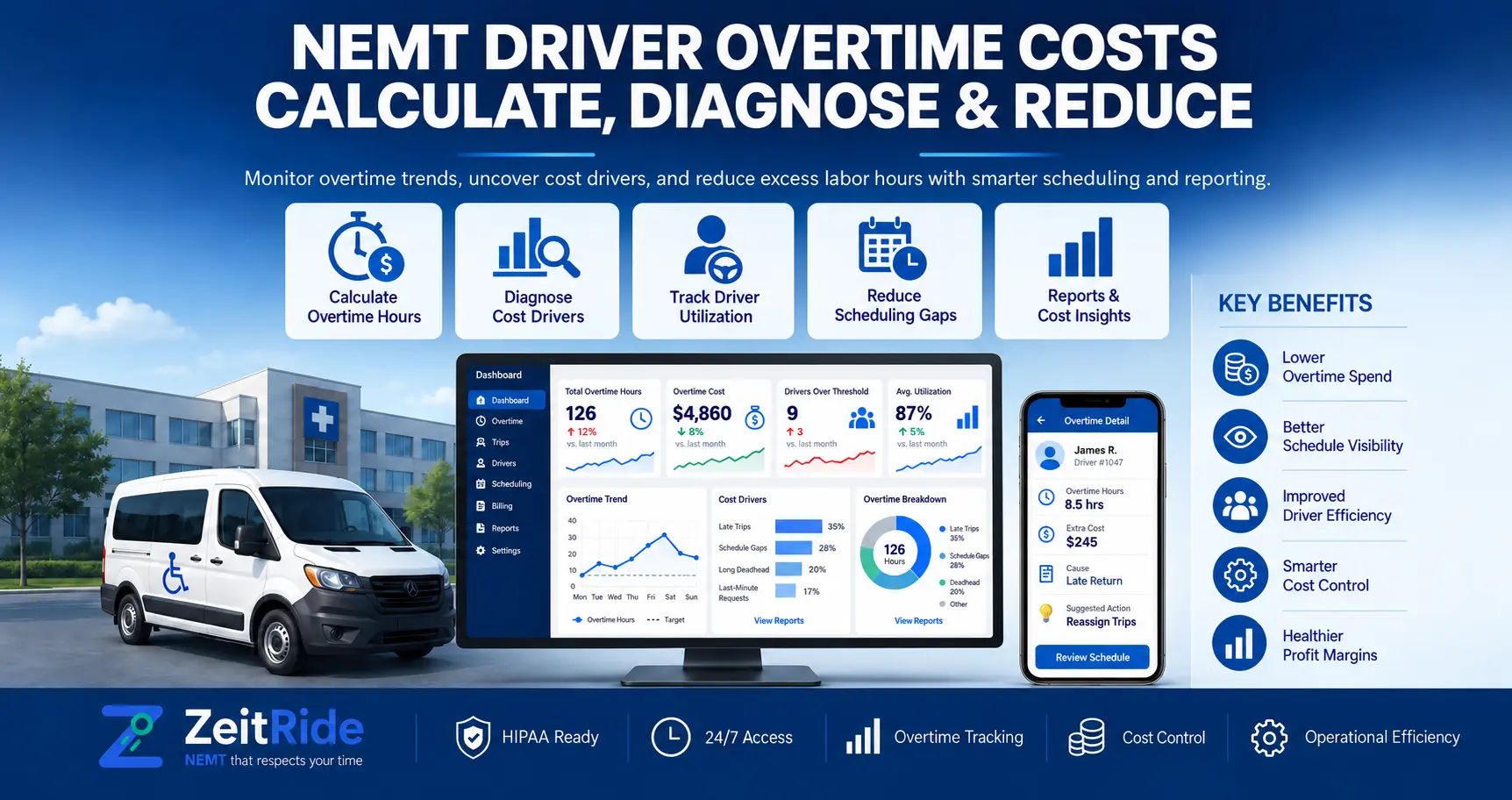
NEMT Driver Overtime Costs: Calculate, Diagnose & Reduce
Learn how to calculate NEMT driver overtime costs, find what causes extra hours, and reduce preventable overtime without cutting trip coverage.
Quick answer
NEMT providers can calculate driver overtime costs from actual hours worked and the applicable regular/overtime rate, then reduce avoidable overtime by tracing extra hours to scheduling gaps, facility delays, deadhead travel, late returns, and uneven workloads.
ZeitRide Team
NEMT Operations Expert
A driver can start the day with a reasonable schedule and still finish well beyond the planned shift. A late dialysis return, extended facility wait, unnecessary deadhead, same-day trip, or poorly timed reassignment can add minutes throughout the day. By payroll, those minutes have become a measurable labor expense. That is why NEMT driver overtime costs should not be treated only as a payroll problem. Operators need to understand what created the extra hours in the first place. The goal is not necessarily zero overtime. Some extra hours may be necessary to protect passenger service and trip coverage. The real opportunity is finding preventable overtime caused by inefficient driver scheduling, dispatch decisions, routing, waiting time, or uneven workloads.
This guide explains how to calculate overtime costs, identify common operational causes, and reduce unnecessary overtime without cutting needed trips.
What Are NEMT Driver Overtime Costs?
NEMT driver overtime costs are the wages and related labor expenses associated with driver hours that qualify for overtime under the rules applicable to that employee. For fleet management purposes, however, knowing the payroll amount is only the first step. Operators should also determine what happened during those additional hours.
- Legitimate late-day transportation demand
- Long facility waits
- Excessive deadhead between trips
- Poorly distributed assignments
- Unexpected return trips
- Breakdown or call-out recovery
- Missing or late clock-outs
Two drivers can record the same amount of overtime for completely different operational reasons. That is why the best analysis connects payroll hours with actual trips and daily operations.
NEMT Overtime Calculation: Formula and Example
A practical NEMT overtime calculation begins with accurate worked-hour records and the overtime rules applicable to the employee. For a simplified hourly example: Overtime wages = Overtime hours × Applicable overtime rate. Operators may also isolate the additional premium with: Overtime premium = Overtime hours × (Overtime rate − Regular hourly rate).
Simple Example
Assume a driver has a regular hourly rate of $20, works 46 hours during the workweek, has 6 overtime hours, and is subject to an example overtime rate of $30 per hour.
| Calculation | Amount |
|---|---|
| Regular wages for 40 hours | $800 |
| Overtime wages for 6 hours | $180 |
| Total wages | $980 |
| Incremental overtime premium | $60 |
The $180 represents wages paid during the six overtime hours. The $60 represents the additional premium above paying those six hours at the regular $20 rate. This simplified example is useful for operational analysis, but payroll calculations should follow the federal, state, and employee-specific rules that actually apply. For broader profitability analysis involving fuel, insurance, vehicle expenses, deadhead, and overhead, use the NEMT cost per trip calculator instead of turning overtime into a complete trip-cost model.
What Causes NEMT Driver Overtime?
Overtime often develops through several smaller operating problems rather than one major event. The goal is to identify recurring patterns instead of assuming that overtime automatically means poor driver performance.
| What You See | Possible Cause | What to Review |
|---|---|---|
| Drivers regularly finish late | Routes or shifts are too tight | Planned vs. actual trip times |
| Long gaps between trips | Weak schedule density | Driver timeline and idle periods |
| Too much repositioning | Excess deadhead | Pickup and drop-off geography |
| Late-day overtime | Coverage ends before demand | Trips by time of day |
| Same driver repeatedly has overtime | Uneven workload | Hours and trips by driver |
| Overtime follows certain facilities | Repeated facility dwell | Arrival and departure patterns |
| Overtime follows same-day trips | Capacity checked too late | Remaining work before assignment |
| Extra hours after call-outs | Recovery burden is concentrated | Dispatch and reassignment history |
When reviewing NEMT driver performance metrics, operators should separate driver-controlled issues from delays caused by dispatch, facilities, traffic, vehicle problems, or unrealistic scheduling.
Necessary vs. Preventable Overtime
Not every overtime hour should be treated as a failure. Extra hours may be reasonable when a legitimate return trip becomes ready late, unexpected demand must be covered, traffic or weather creates an unavoidable delay, a vehicle or driver becomes unavailable, or passenger service would otherwise be disrupted.
Preventable overtime deserves closer attention when extra hours repeatedly come from avoidable schedule gaps, excessive deadhead, poor stop sequencing, uneven driver workloads, recurring facility delays that are ignored during planning, last-minute assignments without checking remaining capacity, or inaccurate time records. This distinction is central to NEMT overtime prevention: the objective is to remove avoidable cost without reducing required service quality or trip coverage.
Which NEMT Driver Hours Should You Track?
To diagnose NEMT driver hours, operators need more information than a weekly payroll total. Useful records include clock-in and clock-out, breaks, total worked hours, trip hours, first pickup and final drop-off, completed trips, time between assignments, facility waiting time, late-day assignments, and dispatch changes or reassignments.
The ZeitRide Driver App helps connect driver activity with trip workflows instead of relying only on disconnected time records. The key question is: what happened during the paid hours? A driver working ten hours because transportation demand required ten productive hours is different from a driver reaching ten hours because of preventable schedule gaps, unnecessary repositioning, or poor assignment timing. That distinction helps operators understand whether rising NEMT driver labor costs reflect genuine demand or an operational efficiency problem.
How to Reduce NEMT Overtime Without Cutting Service
Knowing how to reduce NEMT overtime requires fixing the operating causes rather than simply placing an arbitrary cap on driver hours. If the transportation still has to happen, the workload must be handled more efficiently.
Match Shifts to Actual Trip Demand
Compare transportation demand by hour and day with driver availability. If late-afternoon demand regularly extends the same early-starting drivers, staggered shifts may provide better coverage.
Rebalance Assignments Earlier
Do not wait until a driver is already approaching overtime. If another qualified driver has realistic capacity, NEMT dispatch software can support earlier reassignment and workload balancing.
Reduce Unnecessary Deadhead
Empty travel still consumes driver time. Review whether NEMT routing software and better stop sequencing can reduce unnecessary repositioning between trips.
Account for Recurring Facility Delays
If a facility repeatedly takes longer than expected, continuing to schedule it with unrealistic timing creates the same problem every week. Use actual historical timing to improve planning.
Check Remaining Workload Before Same-Day Assignments
A driver who appears free now may already have enough remaining work to finish near the end of the planned shift. Check the full remaining schedule before adding another trip, and focus management attention on recurring patterns rather than one unusual overtime event.
Two Overtime KPIs Worth Tracking
A large dashboard is not necessary to begin improving overtime. Start with two measures that give overtime context as trip volume changes.
Overtime Hours per 100 Trips
OT Hours per 100 Trips = Overtime Hours ÷ Completed Trips × 100. If total overtime rises because the fleet completed significantly more trips, the raw overtime number alone may be misleading. If overtime per 100 trips also rises, there may be an efficiency problem worth investigating.
Overtime Premium per Completed Trip
Overtime Premium per Trip = Incremental Overtime Premium ÷ Completed Trips. This helps operators understand how much additional premium cost overtime is adding to completed transportation. Neither KPI should be used alone; review overtime together with trip coverage, on-time performance, and service quality.
Know Which Overtime Rules Apply
For covered, nonexempt employees under the federal Fair Labor Standards Act, the general rule is overtime pay of at least one and one-half times the employee's regular rate for hours worked over 40 in a workweek. However, transportation-related exemptions and state or local rules can affect specific employees. Review the U.S. Department of Labor overtime guidance and Motor Carrier Exemption guidance, and confirm the rules that apply to your workforce. This article focuses on operational analysis, not legal or payroll advice.
Turn Overtime Into an Operational Signal
The most useful way to review NEMT driver overtime costs is to answer three questions: What did we pay? Which hours produced that cost? What operational condition produced those hours? When driver time, trips, dispatch changes, and route activity live in separate systems, answering these questions often requires manual reconstruction.
When the records are connected, managers can move from the payroll result back to the operating decision that caused it. ZeitRide connects scheduling, dispatch, routing, driver workflows, reporting, and payroll-related operations within one NEMT platform. If overtime is becoming a recurring fleet expense, view ZeitRide pricing or book a demo to see how your driver-hours workflow can be managed alongside daily trip operations.
Frequently Asked Questions
Q: How do you calculate NEMT driver overtime costs?
Start with accurate hours worked and the overtime rules applicable to the employee. For a simplified hourly calculation, multiply qualifying overtime hours by the applicable overtime rate. Operators can also isolate the incremental overtime premium for operational cost analysis.
Q: What causes driver overtime in an NEMT business?
Common causes include late return trips, facility waits, excess deadhead, schedule gaps, same-day additions, uneven workloads, call-outs, breakdown recovery, and assignments that extend beyond planned shift capacity.
Q: How can an NEMT company reduce overtime without cutting trips?
Review shift coverage, driver workload, route sequencing, deadhead, recurring facility delays, and remaining capacity before new assignments. The goal is to remove avoidable paid time rather than reduce necessary transportation.
Q: Is all NEMT driver overtime preventable?
No. Some overtime may result from legitimate transportation demand or unavoidable disruptions. Operators should separate necessary overtime from recurring overtime caused by scheduling, routing, dispatch, or workload inefficiencies.
Q: Do all NEMT drivers receive overtime after 40 hours?
Not necessarily. Federal overtime requirements generally apply to covered, nonexempt employees, while transportation-related exemptions and state or local rules can affect specific situations. Providers should verify the requirements that apply to their workforce.
Rather see it than read about it?
Bring a real route, a couple of drivers, and your current process. 15 minutes, zero pitch.