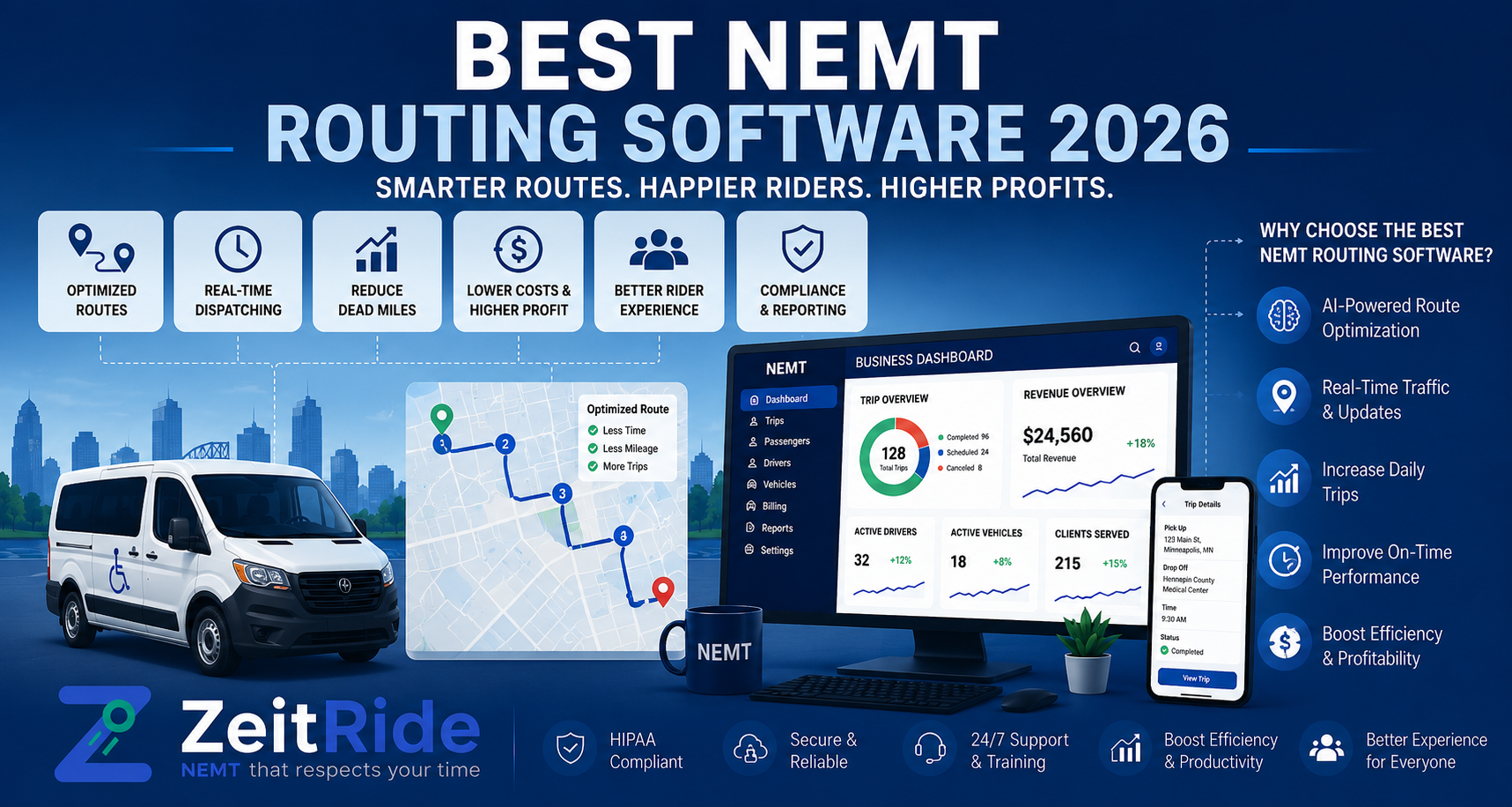
Best NEMT Routing Software for Growing Fleets 2026
Compare seven NEMT routing platforms by route optimization, multi-loading, real-time rerouting, broker integrations, driver apps, pricing, and dead-mile reduction.
Quick answer
The best NEMT routing software for growing fleets optimizes trips around appointment windows, passenger needs, vehicle capacity, driver availability, multi-loading, and live route changes. Compare platforms by optimization depth, integrations, driver tools, pricing, and fleet fit.
ZeitRide Team
NEMT Operations Expert
Choosing the best NEMT routing software requires more than finding a tool that draws a line between two addresses. NEMT providers must coordinate appointment windows, wheelchair capacity, recurring medical trips, shared rides, driver shifts, broker requirements, return trips, and same-day changes.
Ordinary navigation applications help one driver reach the next stop. Purpose-built NEMT routing software helps an entire fleet determine which driver and vehicle should serve each trip, how compatible passengers can share routes, and how the plan should change when real operations no longer match the original schedule.
Strong non emergency medical transportation routing software connects optimization with dispatch, driver instructions, broker workflows, and completed-trip records. This guide compares seven platforms by optimization, multi-loading, rerouting, integrations, driver apps, pricing, and fleet fit.
What Is the Best NEMT Routing Software in 2026?
For most small and midsize providers, ZeitRide offers the strongest overall combination of AI-assisted route optimization, scheduling, live dispatch, driver workflows, broker integrations, billing, and transparent pricing.
ZeitRide costs $49 per active vehicle per month. Its routing tools are included with the rest of the operational platform rather than sold as a separate module. The platform is designed to keep routes, dispatch changes, driver instructions, and completed-trip records synchronized throughout the day.
The right choice depends on the operation. Dialysis fleets may prioritize recurring routes and shared rides, multi-broker providers may value direct trip imports, and public agencies may need configurable reporting and reservation tools.
Ask every vendor to optimize a real day using your trips, vehicles, appointment windows, wheelchair requirements, and driver shifts. Simple demonstrations rarely reveal how the system handles overlapping constraints.
Best NEMT Routing Software Compared
| Platform | Best For | Routing Strength | Pricing Model | Key Point to Verify |
|---|---|---|---|---|
| ZeitRide | Small and midsize growing fleets | Connected optimization, routing, dispatch, driver app, brokers, and billing | $49 per active vehicle per month | Confirm the exact broker workflow required |
| RouteGenie | Fleets prioritizing deep optimization | Vehicle matching, multi-loading, route building, and live adjustments | Starts at $50 per vehicle per month; add-ons may apply | Confirm which modules and integrations are included |
| Bambi | Fleets prioritizing ease of use | AI-assisted assignments, multi-loading, recurring trips, and route optimization | $69 per vehicle per month | Test performance with complex constraints |
| MediRoutes | Multi-broker and high-volume providers | Optimized scheduling, live dispatch, broker APIs, and fleet visibility | Base fee plus $0.50 per managed trip | Calculate total cost at actual trip volume |
| Tobi Cloud | Specialized transportation organizations | Routing within a broader transportation-management platform | Starts at $60 per vehicle per month | Confirm which capabilities are included |
| TripMaster | Transit and paratransit agencies | Automated scheduling, route management, reservations, and reporting | Quote-based, modular, or pay-as-you-go | Confirm implementation, training, and module costs |
| NEMT Platform | Providers wanting flexible plans | Auto-scheduling and route optimization on selected plans | Contact vendor; plan limits vary | Confirm whether optimization is included or an add-on |
Pricing and product functionality reflect information available from official vendor pages reviewed for this comparison. Plans, integrations, and implementation terms may change. Request a written proposal based on your fleet and workflows.
How We Evaluated the Platforms
- NEMT-specific constraints: Wheelchair capacity, service level, passenger needs, appointment times, and driver qualifications
- Multi-stop sequencing: Organizing several pickups and drop-offs into a practical route
- Multi-loading: Grouping compatible passengers without creating unsafe or unreasonable ride times
- Recurring trips: Managing dialysis, therapy, adult day care, and PACE transportation
- Live rerouting: Responding to cancellations, add-ons, delays, no-shows, will-calls, and vehicle changes
- Driver workflow: Sending the current route, navigation, and trip changes to the driver application
- Broker connectivity: Importing trips and exchanging required operational data
- Billing continuity: Keeping route execution and completed-trip documentation connected to billing
- Total cost: Subscription, trip fees, modules, integrations, training, and implementation
ZeitRide publishes this comparison and is one of the products evaluated. The purpose is to clarify product fit and buyer-verification points rather than claim that a single system is appropriate for every provider.
What NEMT Providers Should Look for in Routing Software
1. Optimization Beyond Basic Navigation
Navigation answers how one driver reaches the next address. NEMT route optimization software must answer more complex questions about vehicle compatibility, driver qualifications, passenger sharing, appointment windows, later trips, and shift limits.
- Which vehicle can accommodate the rider?
- Which driver is qualified and available?
- Can two or more passengers safely share part of a route?
- Will every rider arrive within the required appointment window?
- How will a new assignment affect later trips?
- Can the vehicle complete the work before the driver's shift ends?
The platform should optimize the operating day rather than simply calculate driving directions. Scheduling, live dispatch, and routing should remain connected so a change in one workflow does not create conflicting instructions elsewhere.
2. Multi-Loading With Practical Controls
NEMT routing software with multi-loading can reduce empty miles and increase the number of productive trips completed by each vehicle.
However, combining riders is only useful when the software considers vehicle seating and wheelchair capacity, passenger service level, pickup and appointment windows, maximum acceptable ride time, direction of travel, driver availability, and contract restrictions.
Ask the vendor to show why the system grouped specific riders and how a dispatcher can accept, modify, or reject the recommendation.
3. Real-Time Rerouting
A route created in the morning rarely survives the day unchanged. Real-time NEMT routing software should help the dispatcher respond when a passenger cancels, a driver calls off, a vehicle breaks down, a facility delays discharge, a broker adds an urgent trip, a will-call passenger becomes ready, or traffic threatens an appointment window.
When a trip is reassigned or stops are resequenced, the route should update for both the dispatcher and driver without creating conflicting instructions.
4. Connected Driver Application
The driver application should provide the current route, trip details, passenger requirements, navigation, status controls, and documentation tools.
When the office changes a route, the driver should receive the update without relying on repeated phone calls or text messages. Offline synchronization is also valuable in rural areas, parking garages, hospital campuses, and other low-connectivity environments.
5. Broker Integrations With Defined Scope
NEMT routing software with broker integrations can reduce manual trip entry, but the scope of each integration varies.
- Trip imports
- Cancellations and updates
- Driver or vehicle information
- Trip-status exchange
- GPS or timestamp events
- Ride receipts
- Billing files
- Remittance information
Review ZeitRide's guide to essential NEMT software integrations, then ask each vendor to demonstrate the exact data exchange required by your broker agreements.
The 7 Best NEMT Routing Platforms
1. ZeitRide: Best Overall for Growing Fleets
ZeitRide connects AI-assisted route optimization with scheduling, live dispatch, broker workflows, the driver application, billing, and reporting.
The platform orders and groups stops into efficient vehicle runs. When dispatch adjusts a trip, routes and driver views remain aligned.
ZeitRide costs $49 per active vehicle per month. Unlimited trips, route optimization, dispatch, live tracking, the driver application, broker integrations, offline GPS, reporting, and support are included. The company states that there are no setup fees, per-trip software charges, module fees, or annual contracts.
It best fits small and midsize providers seeking predictable pricing and one connected operational platform. Confirm the precise broker connections required in your service area during the demo.
2. RouteGenie: Best for Detailed Multi-Loading and Optimization
RouteGenie emphasizes automated trip management, driver and vehicle selection, route building, and multi-loading.
Its routing system evaluates passenger needs, vehicle schedules, vehicle starting locations, and shared-ride opportunities. RouteGenie also describes real-time adjustments for traffic, cancellations, no-shows, driver call-offs, vehicle breakdowns, and add-on trips.
The Growth plan starts at $50 per vehicle per month. Broker integrations, automatic dispatching, communication tools, and passenger applications may be individually priced, while higher-tier plans bundle more functionality.
RouteGenie suits providers wanting extensive automation. Request a line-item quote covering the platform, integrations, routing tools, billing, setup, and support.
3. Bambi: Best for Simple AI-Assisted Optimization
Bambi combines scheduling, route optimization, real-time dispatch, multi-loading, recurring trips, billing, broker imports, and a driver application.
Its Run Bambi Run workflow is designed to analyze trips, recommend driver assignments, and optimize routes through a simplified interface. Bambi also supports recurring dialysis and PACE trips and groups compatible passengers into shared routes.
Bambi publicly lists one price of $69 per vehicle per month, with onboarding, support, and its main platform features included.
It may appeal to fleets prioritizing usability. Test wheelchair capacity, recurring-trip exceptions, driver shifts, appointment windows, and several same-day changes during the demo.
4. MediRoutes: Best for Multi-Broker Operations
MediRoutes combines optimized trip planning, live dispatch, driver tracking, broker integrations, passenger notifications, billing compliance, and reporting.
Its public pricing begins at $150 per month plus $0.50 per managed trip for one broker integration. A second plan starts at $250 per month plus $0.50 per managed trip and includes unlimited broker integrations, unlimited vehicles, the mobile application, onboarding, and support.
This model may suit fleets working with several brokers because pricing is not directly tied to the number of vehicles. However, per-trip charges increase with volume.
Calculate cost using actual trip volume and confirm which broker APIs, routing, notifications, and reporting tools are included.
5. Tobi Cloud: Best for Multiple Transportation Programs
Tobi Cloud serves NEMT, PACE, veterans transportation, student transportation, and other specialized mobility programs.
The platform positions routing within a broader transportation-management system covering dispatch, fleet utilization, billing, compliance, reporting, and passenger experience.
Public pricing starts at $60 per vehicle per month for core platform functionality. Tobi states that final pricing depends on fleet size, operational complexity, service model, and growth requirements.
Tobi may fit organizations running several transportation programs. Confirm which routing, integrations, driver tools, billing, reporting, and implementation services are included.
6. TripMaster: Best for Transit and Paratransit Agencies
TripMaster supports public transit, paratransit, demand-response, PACE, and private NEMT operations.
Its platform includes automated scheduling, route management, dispatch, reservations, vehicle location, mobile tools, reporting, billing, rider applications, and broker interfaces.
TripMaster uses modular and quote-based pricing and also advertises pay-as-you-go options. Its FAQ states that standard implementation is 30 days, although focused deployments may go live sooner.
TripMaster suits established agencies needing configurable reports, reservations, and formal implementation. Request the full cost of modules, integrations, migration, training, and support.
7. NEMT Platform: Best for Flexible Plan Structures
NEMT Platform combines cloud dispatch, scheduling, a driver application, portals, route optimization, broker connections, billing, and reporting.
Its Freedom Flat plan includes up to 250 trips per month and unlimited vehicles, but auto-scheduling and route optimization are not included by default. The Freedom Per-Vehicle plan includes auto-scheduling and route optimization, while the Corporate plan adds advanced billing and support services.
Base prices require contacting the vendor. NEMT Platform states that it has no setup fees or long-term contracts, while some plans include trip limits, overage charges, or paid add-ons.
This structure may suit providers wanting plan flexibility. Confirm whether optimization, tracking, notifications, managed billing, and support are included or separately priced.
Which Routing Platform Should You Choose?
- Choose ZeitRide for connected operations, predictable pricing, and growing small-to-midsize fleets
- Choose RouteGenie for detailed optimization, vehicle matching, and multi-loading
- Choose Bambi for a simplified AI-assisted routing workflow
- Choose MediRoutes for multi-broker operations and unlimited vehicles
- Choose Tobi Cloud for organizations operating several specialized transportation programs
- Choose TripMaster for transit, paratransit, reservations, and configurable reporting
- Choose NEMT Platform for flexible plan structures and optional managed services
Use the complete NEMT software selection framework to compare implementation, integrations, support, and total first-year cost before deciding.
Questions to Ask During a Routing Software Demo
- Can the platform optimize a complete service day using our actual trips?
- Which passenger, driver, and vehicle constraints affect assignments?
- How does the system identify appropriate multi-loading opportunities?
- Can a dispatcher explain and override an optimization recommendation?
- How are recurring trips and one-time exceptions handled?
- What happens when a driver, vehicle, or appointment changes?
- Do route updates appear immediately in the driver application?
- What information moves through each broker integration?
- Does completed route data flow directly into billing?
- Which features require extra modules or third-party fees?
- What is the complete first-year cost at our fleet size and trip volume?
ZeitRide's NEMT software pricing guide explains how per-vehicle, per-trip, modular, and quote-based pricing affects total cost.
Final Verdict
The best NEMT routing software is the platform that can build a practical route before service begins and keep that route usable as real-world conditions change.
It should consider passenger needs, appointment times, vehicle capacity, driver availability, multi-loading, broker requirements, and completed-trip documentation rather than simply calculate the shortest driving path.
For most small and midsize providers, ZeitRide offers the strongest overall balance of connected routing, dispatch, driver workflows, broker integrations, transparent pricing, and room to grow.
Test ZeitRide With a Real Route
Bring one normal service day, one difficult recurring route, and one route containing wheelchair trips, strict appointment windows, a will-call, and a possible multi-load.
The ZeitRide team will show how those trips move from scheduling into route optimization, live dispatch, the driver application, and completed-trip records.
Book a 15-minute routing workflow review.
Frequently Asked Questions
Q: What is the best NEMT routing software for growing fleets?
The best platform depends on fleet size, trip volume, broker relationships, service types, and routing complexity. ZeitRide is a strong option for small and midsize fleets because routing, scheduling, dispatch, driver workflows, broker integrations, and billing are connected in one platform.
Q: What does NEMT route optimization software do?
It evaluates trips, appointment windows, passenger requirements, drivers, vehicles, capacity, and geography to create more practical routes. It may also support multi-loading, recurring trips, live rerouting, and driver-app updates.
Q: Can NEMT routing software reduce dead miles?
Routing software can reduce unnecessary empty driving by improving trip grouping, vehicle assignment, stop sequencing, and return-trip pairing. Results depend on trip density, service area, passenger constraints, driver schedules, and dispatcher use.
Q: What is multi-loading in NEMT routing?
Multi-loading means transporting compatible passengers on the same vehicle route. The software should consider seating or wheelchair capacity, service level, pickup windows, appointment times, acceptable ride duration, and contract restrictions.
Q: Does NEMT routing software integrate with ModivCare and MTM Health?
Several platforms advertise broker integrations, but the scope varies. A connection may import trips only or may also exchange cancellations, statuses, GPS events, ride receipts, billing records, and payment information. Ask the vendor to demonstrate the exact workflow required by your contract.
Rather see it than read about it?
Bring a real route, a couple of drivers, and your current process. 15 minutes, zero pitch.