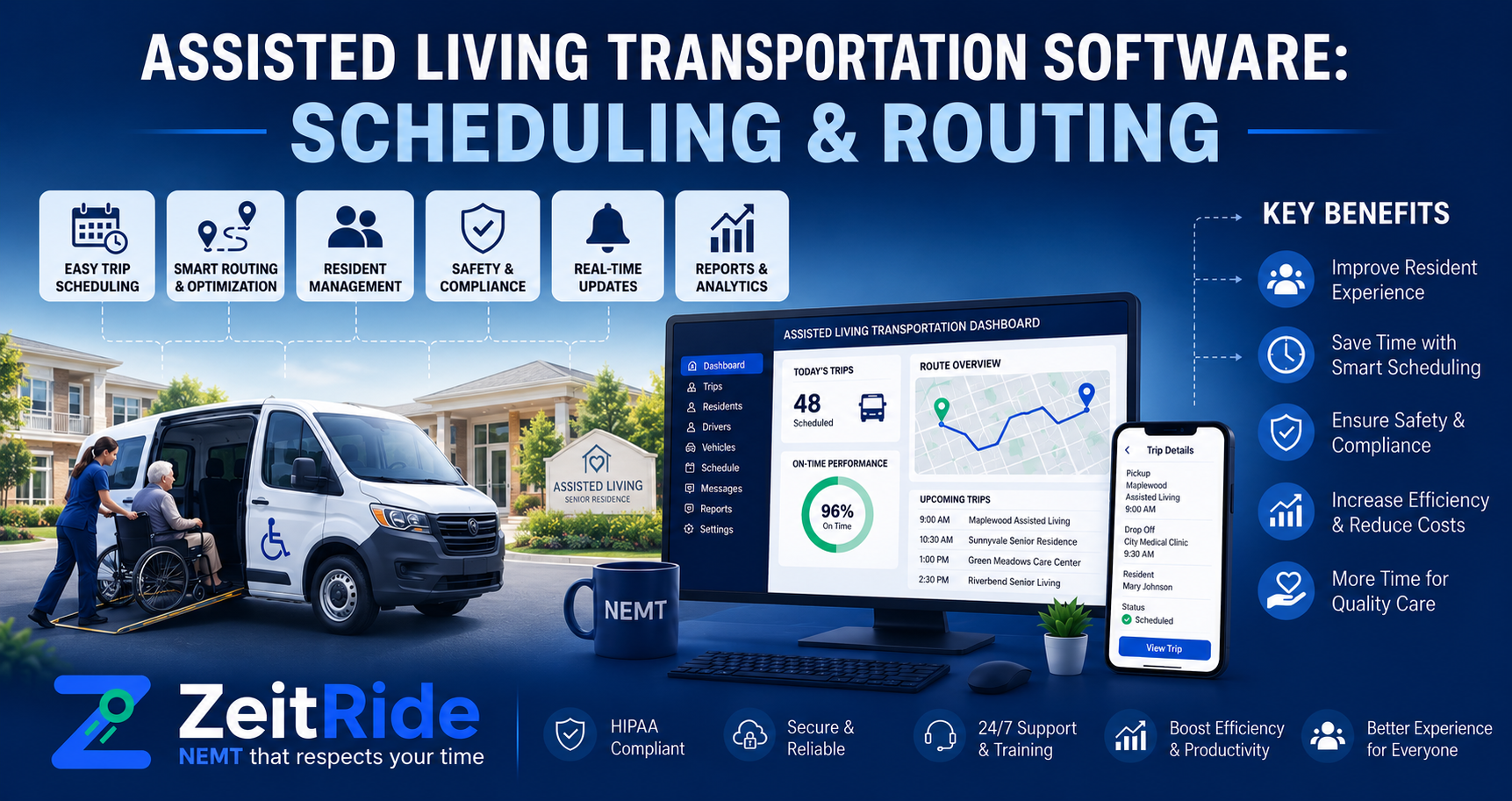
Assisted Living Transportation Software: Scheduling & Routing
Learn how assisted living transportation software manages resident rides, recurring schedules, routes, drivers, vehicles, live changes, and trip records.
Quick answer
Assisted living transportation software helps senior living communities and NEMT providers manage resident ride requests, recurring medical appointments, drivers, vehicles, routes, same-day changes, and completed-trip records in one transportation workflow.
ZeitRide Team
NEMT Operations Expert
Transportation inside an assisted living community can look simple on a calendar: a medical appointment at 9:00, a pharmacy trip at 11:00, and a group outing in the afternoon. The operational reality is more complicated. Every ride has to fit around resident mobility needs, appointment times, vehicle capacity, driver availability, pickup windows, return rides, cancellations, and the rest of the day's schedule.
Assisted living transportation software brings those moving parts into one transportation workflow. Instead of coordinating resident rides through paper calendars, spreadsheets, phone calls, and separate driver notes, a transportation team can schedule recurring and one-time trips, assign drivers and vehicles, organize routes, respond to same-day changes, and maintain completed-trip records from one system.
What Is Assisted Living Transportation Software?
Assisted living transportation software is a system for planning, assigning, routing, dispatching, tracking, and documenting resident transportation. It can be used by a senior living community operating its own vehicles or by an NEMT provider transporting residents under a facility agreement.
The important distinction is transportation depth. General senior living software may manage resident records, activities, dining, care documentation, and facility administration. Transportation-focused software concentrates on the movement itself: who needs a ride, when they need it, which driver and vehicle should handle it, how multiple rides fit together, what happens when the schedule changes, and how the completed trip is documented.
For operations managing repeated medical appointments and facility rides, NEMT scheduling software can keep recurring and one-time trips connected with routing, dispatch, and the driver's daily workflow instead of maintaining separate versions of the schedule.
Why Assisted Living Transportation Is More Than a Calendar
A calendar can tell staff that a resident has an appointment at 10:00 a.m. It does not automatically answer the transportation questions that determine whether that resident actually gets there on time.
- Which driver is available at the required pickup time?
- Which vehicle can accommodate the resident's mobility requirements?
- Is that vehicle already committed to another trip?
- Can multiple residents safely share part of the route?
- How much travel time is needed before the appointment?
- Does the resident need a scheduled return trip or a flexible return pickup?
- What happens when an appointment runs late?
- How should the route change if a resident cancels that morning?
- Can the transportation coordinator see what the driver is doing right now?
These are transportation-management questions, not simply calendar questions. The Federal Transit Administration describes mobility management as coordinating transportation services around individual customer needs, including the needs of older adults and people with disabilities. That same coordination principle is useful inside senior living transportation operations, where riders, vehicles, drivers, destinations, and schedules must stay aligned.
For broader federal context on coordinated transportation for older adults and people with disabilities, see the Federal Transit Administration's mobility management guidance.
How Does Assisted Living Transportation Scheduling Software Work?
Assisted living transportation scheduling software should connect the resident's transportation request with the resources required to complete it. A practical workflow moves from resident information to scheduling, vehicle and driver matching, route planning, live execution, and completed-trip documentation.
1. Create the Resident Transportation Profile
Start with the information that affects transportation: pickup location, common destinations, mobility requirements, transportation instructions, contact details, and any operational notes the driver or dispatcher needs.
Keeping this information attached to the resident reduces the need for staff to re-enter the same instructions every time a recurring appointment is scheduled.
2. Schedule Recurring and One-Time Rides
Some resident transportation is predictable. A resident may attend physical therapy every Tuesday and Thursday, for example. Other trips are one-time rides to a specialist, dentist, pharmacy, social event, shopping center, or family appointment.
A connected recurring transportation scheduling system should support both patterns so staff can maintain standing rides without losing flexibility when an individual date changes.
3. Match Mobility Needs With the Right Vehicle
Vehicle assignment should consider more than availability. The transportation team may need to account for ambulatory riders, wheelchair positions, vehicle seating capacity, equipment, and other requirements before a trip is placed on a driver's schedule.
This becomes particularly important when several residents share a vehicle. A van may have enough total seats but still be the wrong fit for the specific mobility mix assigned to that route.
4. Assign the Driver
The driver assignment needs to fit the trip time, vehicle, route, and operational requirements. Transportation coordinators should be able to see which drivers are already committed and avoid building overlapping assignments that have to be untangled later.
5. Build and Optimize the Route
When one vehicle handles multiple resident trips, the order of stops matters. Senior transportation scheduling software should help coordinators evaluate pickup windows, appointment times, destinations, vehicle capacity, and the other rides already assigned.
ZeitRide's NEMT routing software connects AI-assisted route optimization with scheduling and dispatch so route planning does not live in a separate spreadsheet. For a deeper operational explanation, see the NEMT route optimization guide.
6. Keep the Schedule Live When the Day Changes
The schedule created in the morning will not always survive the day unchanged. A resident may cancel, an appointment may run longer than expected, a driver may become unavailable, or a vehicle may need to be taken out of service.
With live NEMT dispatch software, transportation coordinators can manage active trips, reassign work, and keep office staff and drivers aligned when the operating plan changes.
7. Record What Actually Happened
The original schedule shows what was supposed to happen. Transportation records should show what actually happened: trip status, pickup and drop-off progress, cancellations, no-shows, exceptions, and other information needed by the operation.
A connected NEMT driver app helps drivers work from the current trip plan while keeping field activity connected with dispatch rather than relying entirely on handwritten manifests and end-of-day updates.
Assisted Living Transportation Management Software: Features to Evaluate
| Capability | Why It Matters | What to Verify During a Demo |
|---|---|---|
| Resident trip scheduling | Keeps transportation requests organized | Can staff create both recurring and one-time rides? |
| Recurring appointments | Reduces repetitive schedule entry | Can one occurrence change without changing the whole series? |
| Mobility requirements | Supports practical vehicle assignments | Can staff record wheelchair and other transportation needs? |
| Vehicle capacity | Helps prevent overbooking | Can the system account for seating and wheelchair positions? |
| Driver assignment | Reduces overlapping work | Can staff see availability and active assignments clearly? |
| Route optimization | Helps organize multiple resident stops | Which timing and vehicle constraints does optimization consider? |
| Live dispatch | Keeps the operation usable when plans change | How quickly can staff reassign a driver, vehicle, or trip? |
| Driver mobile workflow | Keeps drivers on the current schedule | Do changes reach the driver without rebuilding a paper manifest? |
| Cancellation and no-show records | Creates a record of exceptions | Can staff distinguish cancellation reasons and trip status? |
| Completed-trip records | Connects transportation with administration | What trip details remain available after completion? |
| Multi-facility support | Matters for NEMT providers serving several communities | Can several facility contracts be managed in the same operation? |
Example: Building One Day of Assisted Living Resident Transportation
Consider a fictional senior living community planning transportation for five residents. Looking only at appointment times makes the schedule appear straightforward, but adding mobility requirements, return rides, and vehicle availability changes the picture.
| Resident | Trip | Mobility | Pickup | Return |
|---|---|---|---|---|
| Resident A | Cardiology appointment | Ambulatory | 8:15 AM | 11:00 AM |
| Resident B | Physical therapy | Wheelchair | 8:40 AM | 10:30 AM |
| Resident C | Recurring dialysis | Ambulatory | 9:00 AM | 1:00 PM |
| Resident D | Pharmacy and shopping | Ambulatory | 10:30 AM | 12:00 PM |
| Resident E | Specialist appointment | Wheelchair | 1:15 PM | Flexible |
Now add two available vehicles, only one with the wheelchair capacity required for Residents B and E, and a driver who becomes unavailable after noon. The transportation problem is no longer just five calendar entries.
The coordinator has to decide which rides can be combined, which vehicle should carry each resident, whether the morning schedule leaves enough time for return pickups, and how the afternoon plan changes when one driver is no longer available.
This is the type of real operating day that should be used when evaluating transportation software for assisted living. A vendor should be able to show how its system handles the complete scenario rather than demonstrating a perfectly clean sample route.
How Should Software Handle Wheelchair and Mobility Requirements?
Mobility requirements should be part of transportation planning before a vehicle is assigned. If a resident requires wheelchair transportation, the scheduler needs to know whether an appropriate vehicle is available, whether the required capacity remains open, and whether the assigned trip fits with the other riders already on the vehicle.
For NEMT providers serving senior living communities, ZeitRide's multi-facility transportation workflow supports transportation across facility contracts while keeping ambulatory, wheelchair, and stretcher modes connected to vehicle and operational planning.
Software does not replace an operator's responsibility to follow applicable vehicle, accessibility, securement, driver-training, licensing, contractual, and payer requirements. Those requirements can vary by transportation model and jurisdiction.
What Happens When a Resident Cancels or an Appointment Changes?
A same-day cancellation should trigger more than deleting a name from a calendar. The transportation coordinator should update the active trip, make sure the assigned driver has the current information, determine whether the remaining route still makes sense, and preserve an accurate record of why the ride was not completed.
Appointment changes create a similar chain reaction. Moving one pickup can create a vehicle conflict, change the most efficient stop order, or affect another resident's return ride.
These exceptions are why live scheduling and dispatch matter. ZeitRide's guide to reducing NEMT no-shows and dry runs explains the operational impact of missed and cancelled transportation and why consistent exception tracking matters.
Senior Living Transportation Software vs. Staff Scheduling Software
Staff scheduling and transportation scheduling overlap, but they solve different operating problems. A system can be excellent at assigning employee shifts and still be poorly suited to managing resident rides.
| Need | Staff Scheduling Software | Transportation Software |
|---|---|---|
| Employee shifts | Core function | Supporting function |
| Resident ride requests | Usually not core | Core function |
| Recurring medical appointments | Limited or manual | Core workflow |
| Vehicle assignment | Usually not included | Core workflow |
| Wheelchair capacity | Usually not included | Transportation-specific |
| Route optimization | Usually not included | Core transportation function |
| Live trip status | Limited | Core transportation function |
| Driver trip workflow | Shift-focused | Trip and route-focused |
| Completed-trip records | Not transportation-specific | Core transportation record |
In-House Transportation vs. Outsourced NEMT
Not every assisted living community operates transportation the same way. Some communities own vehicles and employ drivers. Others outsource medical rides to one or more NEMT providers. Some use a hybrid model: facility vehicles for planned activities and outside transportation providers for medical appointments, wheelchair trips, overflow demand, or longer-distance rides.
| Operating Model | Transportation Software Priority |
|---|---|
| Facility-owned vehicles | Resident scheduling, vehicles, drivers, routes, availability, and daily execution |
| Outsourced NEMT | Clear ride requests, provider coordination, trip status, and transportation records |
| Hybrid model | Visibility across internal rides and outside transportation workflows |
The software evaluation should match the operating model. A senior living community running two shuttle vehicles has different needs from an NEMT provider managing ten facility contracts across a city.
How NEMT Providers Can Manage Multiple Senior Living Contracts
For an NEMT provider, one assisted living account may be straightforward. Complexity rises when the fleet serves several senior communities alongside dialysis centers, hospitals, broker trips, and private-pay riders.
A dispatcher needs to see the complete operating day rather than treating each facility as a separate transportation island. ZeitRide's multi-facility NEMT software is designed to keep multiple facility relationships, transportation modes, recurring trips, and other trip sources visible in the same operational environment.
Providers still building their facility pipeline can also review how to get NEMT contracts, which covers direct agreements with nursing homes, healthcare facilities, and other recurring transportation clients.
Which Transportation KPIs Should Assisted Living Teams Track?
Software becomes more useful when transportation managers use its records to improve the operation rather than treating the platform only as a digital calendar.
- On-time pickup performance
- On-time arrival for scheduled appointments
- Resident cancellations and no-shows
- Driver utilization
- Vehicle utilization
- Wheelchair-capable vehicle utilization
- Empty or unproductive mileage
- Trips completed per vehicle
- Same-day schedule changes
- Late return pickups
- Trip documentation completeness
- Transportation cost per completed trip
The exact KPI set should match the operation. A facility running one shuttle may care most about conflicts and on-time appointments, while an NEMT provider serving several senior communities may also need to track fleet utilization, cost per trip, route efficiency, billing accuracy, and contract-level performance.
How to Evaluate Assisted Living Transportation Software
A transportation software demo should test the messy parts of the operation, not only the easiest route. Before the meeting, choose one representative day and ask the vendor to build it using your real scheduling logic.
- Include recurring and one-time resident rides.
- Include at least one wheelchair or mobility-related vehicle constraint.
- Use your real appointment and pickup windows.
- Include several rides that could potentially share a vehicle.
- Change one recurring appointment without changing every future occurrence.
- Cancel one resident after the route has been built.
- Make one driver unavailable and ask the vendor to reassign the work.
- Ask what the driver sees after the schedule changes.
- Review the completed-trip record.
- Ask how completed transportation connects with reporting or billing.
- Confirm exactly which features are included in the quoted price.
If a platform can handle your actual operating day, it is much easier to judge whether it fits your transportation program than by comparing feature checkboxes.
How ZeitRide Supports Assisted Living Transportation
ZeitRide is built as a transportation operations platform rather than a senior living clinical or resident-care management system. Its role is the transportation layer: scheduling trips, organizing routes, managing live dispatch, coordinating drivers and vehicles, and keeping field activity connected with operational records.
For assisted living transportation, that means recurring and one-time resident rides can stay connected with scheduling, AI-assisted routing, real-time dispatch, the ZeitRide Driver app, and NEMT billing workflows instead of being managed in separate systems.
For NEMT providers serving several senior living communities, the same platform can also keep facility trips alongside other transportation work rather than forcing dispatchers to operate one schedule per contract.
Bring One Day of Resident Rides and Test It
The fastest way to evaluate assisted living transportation software is to test it against the transportation day your team actually has to manage.
Bring one day of resident rides, including recurring appointments, wheelchair requirements, your available drivers and vehicles, and at least one schedule change. ZeitRide can show how that same day would move from scheduling to routing, live dispatch, driver execution, and completed-trip records.
See how ZeitRide works and bring a real transportation schedule to the demo.
Frequently Asked Questions
Q: What is assisted living transportation software?
Assisted living transportation software helps senior living communities and transportation providers schedule resident rides, coordinate drivers and vehicles, manage recurring medical appointments, organize routes, handle schedule changes, and maintain completed-trip records.
Q: How does assisted living transportation scheduling software work?
The software connects a resident's ride request with the required pickup time, destination, vehicle, driver, route, and trip status. Recurring appointments can be scheduled in advance while one-time and same-day changes are managed within the active transportation schedule.
Q: Can transportation software manage recurring medical appointments?
Yes. Transportation software can manage recurring rides for residents who attend regular medical appointments or programs while allowing individual occurrences to be adjusted when appointment times, drivers, vehicles, or attendance patterns change.
Q: Can assisted living transportation software handle wheelchair rides?
Transportation software can store mobility requirements and vehicle capabilities so schedulers can account for wheelchair transportation during assignment and route planning. Facilities and providers should still follow applicable accessibility, securement, vehicle, driver, and contractual requirements.
Q: What is the difference between senior living transportation software and staff scheduling software?
Staff scheduling software primarily manages employee shifts and availability. Senior living transportation software focuses on resident rides, appointment times, destinations, drivers, vehicles, mobility requirements, routes, live trip changes, and transportation records.
Q: Can NEMT providers use the same software for multiple assisted living contracts?
Yes, if the platform supports multi-facility transportation. NEMT providers can manage trips from several assisted living and healthcare facility relationships while keeping schedules, drivers, vehicles, routing, and completed trips organized.
Q: How should an assisted living facility choose transportation software?
Test the software using a real day of resident rides. Include recurring trips, mobility requirements, multiple vehicles, driver availability, a cancellation, and a schedule change to see whether the platform can manage your actual workflow.
Rather see it than read about it?
Bring a real route, a couple of drivers, and your current process. 15 minutes, zero pitch.