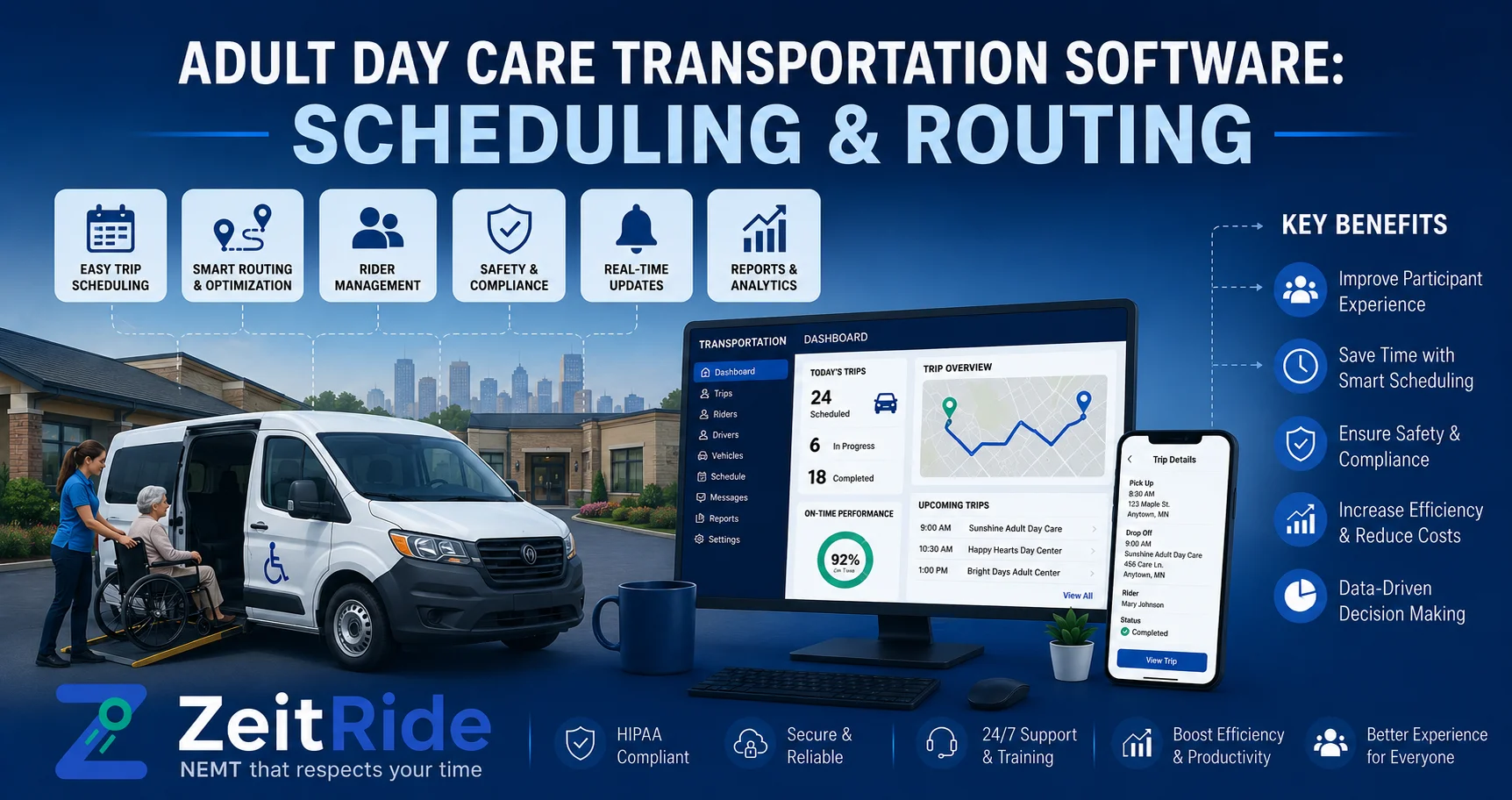
Adult Day Care Transportation Software: Scheduling & Routing
Learn how adult day care transportation software manages recurring schedules, routes, drivers, vehicles, live changes, trip records, and billing.
Quick answer
Adult day care transportation software helps centers and transportation providers manage recurring participant schedules, build efficient pickup and return routes, match drivers and vehicles, handle same-day changes, track trip status, and keep completed-trip records connected to billing.
ZeitRide Team
NEMT Operations Expert
For an adult day center, transportation usually has two rush hours every day: getting participants to the center on time in the morning and getting everyone home smoothly in the afternoon. The challenge is not simply putting addresses on a route. Schedulers have to account for recurring attendance, pickup windows, mobility needs, vehicle capacity, driver availability, cancellations, and changes that happen after the day's routes are already built. Adult day care transportation software brings those moving parts into one transportation workflow. Instead of rebuilding routes in spreadsheets or coordinating changes through phone calls and texts, teams can manage recurring trips, assign vehicles and drivers, optimize stops, monitor live progress, and document completed transportation from one system.
What Is Adult Day Care Transportation Software?
Adult day care transportation software is a system used to plan, route, dispatch, track, and document recurring transportation for participants attending adult day care or adult day health programs. It may be used directly by a center that operates its own vehicles or by an NEMT provider that transports participants under a facility contract.
The key distinction is transportation depth. General adult day care software may manage attendance, care plans, clinical records, activities, and billing. Transportation-focused software goes deeper into the operational questions that happen before a participant reaches the center: Who needs a ride today? Which vehicle can accommodate them? Which driver should run the route? What order should the pickups follow? What changes if someone cancels?
For operations handling repeated trips, NEMT scheduling software can keep recurring transportation connected with routing and dispatch instead of forcing staff to recreate the same rides every day.
Why Adult Day Transportation Is a Recurring-Route Problem
Adult day transportation looks predictable because many participants travel to the same center several days each week. Operationally, that repetition creates its own complexity. A route that works on Monday may not work on Tuesday because the participant roster, mobility mix, driver, vehicle, or pickup windows have changed.
- Participants may attend on different days of the week.
- Morning and afternoon routes often need separate sequencing.
- Ambulatory and wheelchair riders may require different vehicle capacity.
- A participant may temporarily change pickup location or attendance.
- Same-day cancellations can leave an inefficient gap in a route.
- Drivers or vehicles may become unavailable after a recurring route is already assigned.
- New participants need to be inserted without rebuilding the entire operation.
- Return transportation has to stay aligned with the day's attendance and actual arrivals.
That is why effective adult day transportation software should treat recurring transportation as a live operational schedule rather than a static route sheet. The master schedule provides consistency, but dispatchers still need the flexibility to make date-specific changes without breaking the underlying recurring pattern.
How Does Adult Day Care Transportation Scheduling Software Work?
Adult day care transportation scheduling software should connect participant information, recurring schedules, route planning, vehicle assignments, live dispatch, and trip completion. A practical workflow moves from participant setup to recurring scheduling, vehicle matching, route optimization, live driver execution, and completed-trip documentation.
1. Build the Participant Transportation Profile
Start with the information that affects the ride: pickup and drop-off locations, scheduled attendance days, mobility requirements, relevant pickup instructions, and any transportation-specific notes your operation needs. The goal is to prevent dispatchers from rediscovering the same information every morning.
2. Create Recurring Morning and Return Trips
When a participant attends every Monday, Wednesday, and Friday, the transportation schedule should reflect that recurrence rather than requiring three new rides every week. ZeitRide's recurring scheduling workflow can keep standing transportation connected to the rest of the daily operation while still allowing exceptions when an individual occurrence changes.
3. Match Participants With Appropriate Vehicles
Transportation planning should account for more than the number of open seats. Mobility needs, wheelchair positions, vehicle capabilities, driver qualifications, and the mix of participants riding together can all affect whether an assignment is practical. This is particularly important when several participants are grouped onto the same morning or afternoon run.
4. Optimize the Stop Sequence
Once the day's participants and constraints are known, adult day care routing software can help determine an efficient stop sequence. Instead of routing only by whichever address looks closest on a map, a transportation-focused system should account for timing, vehicle capacity, participant requirements, and the other stops already assigned.
For a deeper explanation of this process, see ZeitRide's guide to NEMT route optimization and its AI-assisted routing software.
5. Keep Dispatchers and Drivers Synchronized
A good route at 7:00 a.m. can become outdated at 7:20. A participant may cancel, a driver may call out, or a vehicle may need to be reassigned. With live NEMT dispatch software, an office team can update the operating plan while drivers receive current trip and route information through the field workflow instead of relying on repeated phone calls.
6. Capture What Actually Happened
The scheduled trip is only the plan. Completed-trip records should show what occurred in the field: pickup and drop-off status, actual times, exceptions, cancellations, no-shows, and supporting documentation where required. A connected NEMT driver app helps move those field events back into dispatch and downstream administrative workflows without waiting for handwritten manifests to return to the office.
Adult Day Care Transportation Management Software: Features to Evaluate
| Capability | Why It Matters | What to Verify During a Demo |
|---|---|---|
| Recurring schedules | Avoid rebuilding predictable rides every day | Can one occurrence change without changing the entire recurring series? |
| Participant-to-route assignment | Keeps each rider connected to the correct recurring route | Can participants have different attendance days and stop positions? |
| Mobility and capacity matching | Helps prevent impractical vehicle assignments | Can the system distinguish vehicle and rider requirements? |
| Route optimization | Helps sequence pickups and returns efficiently | Which constraints does the routing engine actually consider? |
| Same-day dispatch changes | Keeps the operation usable when plans change | How quickly can a trip, driver, vehicle, or stop be reassigned? |
| Driver mobile workflow | Gives drivers the current operating plan | Do route changes reach the driver's phone automatically? |
| No-show and cancellation records | Creates a reliable record of exceptions | Are no-shows and cancellations recorded separately? |
| Trip documentation | Connects field activity with administration | Are timestamps and completed-trip details retained? |
| Billing workflow | Reduces re-entry after transportation is completed | Does completed trip data flow into billing or export cleanly? |
| Multi-facility visibility | Matters for providers serving several centers | Can dispatch see multiple facility contracts from one operation? |
Example: Building a Recurring Morning Adult Day Care Route
Consider an illustrative center that wants all morning participants delivered by 9:00 a.m. Four riders attend during the week, but they do not have identical transportation requirements.
| Participant | Attendance | Mobility | Pickup Window | Center Arrival |
|---|---|---|---|---|
| Participant A | Mon-Fri | Ambulatory | 7:30-8:00 | By 9:00 |
| Participant B | Mon/Wed/Fri | Wheelchair | 7:45-8:15 | By 9:00 |
| Participant C | Tue/Thu | Ambulatory | 7:50-8:20 | By 9:00 |
| Participant D | Mon-Fri | Ambulatory | 8:00-8:25 | By 9:00 |
On Monday, Participants A, B, and D need transportation. On Tuesday, the roster changes to A, C, and D. A static route template can show the normal pattern, but the actual daily route still has to reflect who is attending, which vehicle is available, whether the vehicle can serve the mobility mix, and whether every pickup can reach the center within the required window.
This is where transportation-specific scheduling and routing become more valuable than maintaining a list of addresses in a spreadsheet. The system should preserve the recurring pattern while optimizing the actual day's manifest.
What Happens When a Participant Cancels the Same Day?
When a participant cancels, the best response is not simply deleting the stop. The dispatcher should confirm the cancellation, update the driver's current manifest, evaluate whether the remaining stop sequence still makes sense, and preserve a record of why the trip was not completed.
For frequent recurring routes, this matters because one cancelled pickup can change the most efficient sequence for every stop after it. ZeitRide's guide on reducing NEMT no-shows and dry runs explains how transportation operators can manage the operational impact of missed and cancelled trips.
Adult Day Care Routing Software vs. General Adult Day Care Software
| Need | General Adult Day Care Software | Transportation-Focused Software |
|---|---|---|
| Participant attendance | Core function | Used as a transportation input |
| Clinical/care documentation | Often core function | Usually outside transportation scope |
| Activities/program management | Often included | Not the primary purpose |
| Recurring pickup and return routes | May be basic or included | Core transportation workflow |
| Vehicle/driver assignment | Varies | Core workflow |
| Route optimization | Varies | Core workflow |
| Live dispatch changes | Often limited | Core workflow |
| Driver mobile execution | Varies | Core workflow |
| Fleet visibility | Varies | Core workflow |
| Completed-trip documentation | Transportation-specific | Core workflow |
The right system depends on what problem you are trying to solve. A center looking for clinical documentation, attendance, care planning, and activities may need a broader adult day care management platform.
A center or transportation provider struggling specifically with routes, drivers, vehicles, recurring rides, and field coordination should evaluate the transportation layer separately. The strongest setup may be an adult day management system for care operations and purpose-built transportation software for moving participants reliably.
Adult Day Care Fleet Management Software: Keep Vehicles and Drivers in the Same Workflow
Adult day care fleet management software should give transportation teams visibility beyond today's route. Vehicles need capacity and capability records, drivers need current assignments, and the office needs to know whether the resources normally attached to a recurring route are actually available.
For organizations serving more than one facility, multi-facility NEMT software can help keep trips from different contracts visible in one operating environment instead of splitting transportation across disconnected schedules.
The driver experience matters as well. ZeitRide's driver app gives field staff access to route and stop information while keeping driver activity connected with dispatch.
How Should You Evaluate Adult Day Care Transportation Software?
Do not evaluate transportation software from a polished sample route alone. The most useful demo is one based on the conditions your team handles every week.
- Give the vendor one real recurring AM or PM route.
- Include at least one participant with a mobility or vehicle constraint.
- Include participants who attend on different days.
- Ask the vendor to change one occurrence without altering the master recurrence.
- Cancel one participant after the route is built.
- Reassign a driver or vehicle.
- Ask what the driver sees after the change.
- Review the completed-trip record.
- Ask how trip information reaches billing or your existing billing process.
- Confirm what is included in the quoted software price.
A vendor that can demonstrate the complete workflow on your real transportation pattern gives you far more useful information than a checklist of 50 features.
If Medicaid-funded transportation is part of your operation, verify the rules that apply to your state, program, payer, and contract. The federal Medicaid Assurance of Transportation guidance is a useful starting point, but operational and documentation requirements can vary.
How ZeitRide Supports Adult Day Care Transportation
ZeitRide is built as a transportation operating platform rather than a clinical adult day care EHR. That distinction matters. An adult day center or an NEMT provider serving adult day facilities can use ZeitRide to bring recurring schedules, route planning, dispatch, drivers, vehicles, trip status, and administrative workflows into the same transportation system.
ZeitRide supports recurring transportation workflows, driver and vehicle assignments, route planning, live dispatch changes, and a synchronized driver application. Completed transportation can then remain connected with NEMT billing workflows instead of requiring the office to rebuild each trip from paper records.
Is Adult Day Care Transportation Software Worth It?
Adult day care transportation software is most valuable when recurring transportation has become too complex for static spreadsheets, printed route sheets, phone calls, and separate driver records.
The business case should be based on your own operation: dispatcher time, route-building effort, avoidable mileage, vehicle utilization, missed communications, documentation work, and how much manual effort is required after a trip is completed.
The goal is not automation for its own sake. The goal is a transportation process that remains organized when the participant roster, driver availability, vehicle assignments, and daily conditions change.
Bring One Adult Day Care Route and Test It
The fastest way to evaluate adult day care transportation software is to stop looking at generic screenshots and test an actual route. Bring one recurring morning or afternoon route, your normal participant schedule, a few vehicle constraints, and the way your team currently handles cancellations. ZeitRide can walk through how that same workflow would move from scheduling to routing, dispatch, the driver app, and completed-trip records.
See how ZeitRide works or review ZeitRide pricing before scheduling a demo.
Frequently Asked Questions
Q: What is adult day care transportation software?
Adult day care transportation software helps centers and transportation providers schedule recurring participant rides, organize routes, assign drivers and vehicles, manage same-day changes, track trip progress, and document completed transportation in one workflow.
Q: Can adult day care transportation software manage recurring rides?
Yes. Purpose-built transportation software can create recurring schedules for participants who attend on specific days each week while allowing individual dates to be changed when attendance, pickup times, drivers, or vehicles change.
Q: Can adult day care transportation software handle wheelchair riders?
Transportation software can store participant mobility requirements and vehicle capabilities so schedulers can identify appropriate vehicle assignments. Buyers should verify how the platform handles wheelchair positions, capacity, driver requirements, and other constraints.
Q: How does adult day care routing software handle cancellations?
When a participant cancels, the system should update the active manifest, notify the affected driver, preserve the cancellation record, and let dispatch determine whether the remaining route needs to be changed or re-optimized.
Q: What is the difference between adult day care software and transportation software?
Adult day care software often focuses on attendance, care documentation, activities, billing, and center administration. Transportation software focuses on recurring rides, routes, vehicles, drivers, live dispatch, trip status, and completed-trip records.
Q: Can an NEMT provider use transportation software for adult day care contracts?
Yes. NEMT providers serving adult day centers can use transportation software to manage recurring facility trips alongside other transportation work, provided the platform supports the operational and documentation requirements of their contracts.
Rather see it than read about it?
Bring a real route, a couple of drivers, and your current process. 15 minutes, zero pitch.