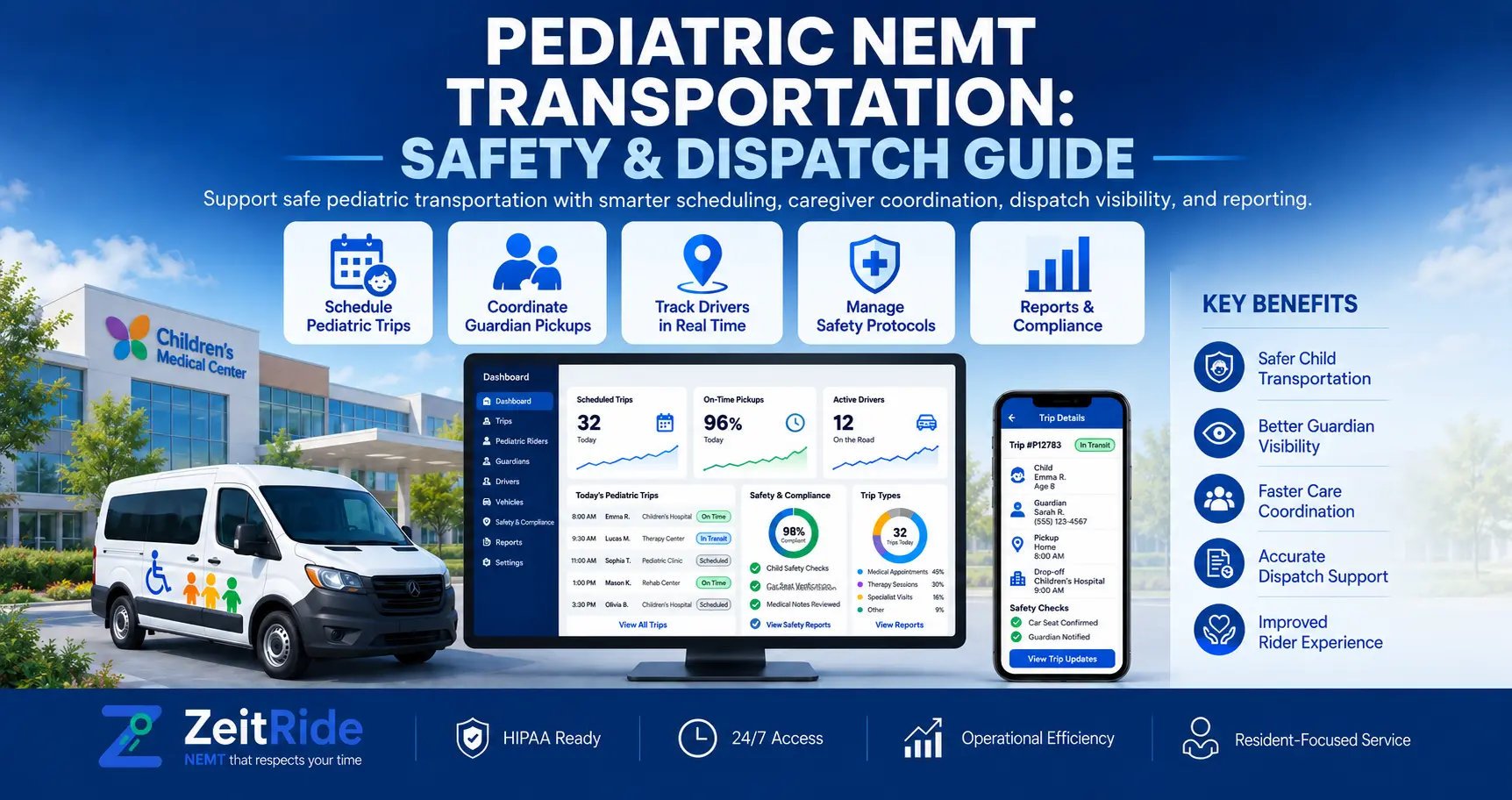
Pediatric NEMT Transportation: Safety & Dispatch Guide
Plan safer pediatric NEMT trips with practical guidance on car seats, escorts, guardian consent, scheduling, and documented handoffs.
Quick answer
Pediatric NEMT transportation needs verified guardian and escort arrangements, appropriate child restraints, and a documented pickup-to-drop-off handoff. State Medicaid, broker, and vehicle safety rules determine the exact requirements.
ZeitRide Team
NEMT Operations Expert
Pediatric NEMT transportation requires more planning than assigning a driver and confirming an appointment time. A child may need an approved adult escort, an age- and size-appropriate car seat, additional mobility support, or a verified handoff at the destination. Missing any of these details can delay a pickup or make a trip unsafe to complete.
For non-emergency medical transportation providers, the solution begins before dispatch. Staff should confirm the child's transportation authorization, guardian arrangements, vehicle requirements, and receiving contact while creating the trip.
The practical answer: Use a consistent pediatric intake checklist, verify the applicable state and broker requirements, assign suitable transportation, and document what happened at pickup and drop-off. This guide explains how NEMT providers can organize those steps without treating every pediatric ride as a routine adult transportation request.
What Is Pediatric NEMT Transportation?
Pediatric NEMT transportation is non-emergency transportation that helps eligible children and adolescents reach medical appointments and covered healthcare services when suitable transportation is otherwise unavailable. Depending on the payer and transportation program, these rides may support:
- Pediatric primary care and specialist appointments
- Dental and preventive healthcare visits
- Physical, occupational, or speech therapy
- Behavioral health appointments
- Outpatient testing and rehabilitation
- Follow-up visits after hospitalization
- Other eligible medically necessary appointments
These trips can involve infants, younger children, teenagers, and children with disabilities or specialized mobility needs.
Pediatric NEMT is not the same as emergency ambulance transportation. A child whose condition requires emergency intervention, medical monitoring, or clinical care beyond the provider's authorized capabilities needs an appropriate clinical transport assessment rather than a routine NEMT assignment. For dispatchers, the important distinction is that a pediatric trip may have requirements involving both the passenger and the adult responsible for the passenger's care.
Pediatric NEMT Rules: Medicaid, Escorts, and Consent
There is no single nationwide guardian-consent age or escort policy covering every pediatric NEMT trip. Federal Medicaid requirements establish a transportation framework, but specific arrangements depend on the state program, managed-care plan, broker agreement, and circumstances of the child.
Under the Medicaid Early and Periodic Screening, Diagnostic, and Treatment (EPSDT) framework, 42 CFR 441.62 requires state agencies to offer and, when requested, provide necessary assistance with transportation and appointment scheduling.
The broader CMS Medicaid transportation guidance explains the responsibility of state Medicaid programs to arrange necessary access to covered medical care. Transportation providers must still verify the specific trip authorization and operating requirements.
NEMT Escort Requirements for Children
A parent, guardian, caregiver, or approved attendant may need to accompany a pediatric passenger. The requirement depends on the child's age, support needs, and applicable program rules. For example, Missouri's fee-for-service NEMT guide states that:
- The broker must arrange transportation for one parent or guardian accompanying a member under 21 when requested.
- Children under 17 generally must be accompanied by a parent, guardian, or designated adult, subject to the state's specified exception.
- An attendant may be arranged when appropriate because a child cannot travel independently.
These requirements are described in the official MO HealthNet NEMT guide. They are Missouri program rules, not universal requirements for every state. Georgia's Medicaid NEMT FAQs separately describe escort authorization and distinguish an escort from a transportation attendant.
Before accepting a trip, dispatch should confirm who is authorized to accompany the child and whether that person must remain with the child during the medical appointment.
Does Medicaid Pay for an Escort or Attendant?
Federal regulation 42 CFR 440.170(a)(3) includes the cost of a necessary attendant within Medicaid transportation-related travel expenses. However, that does not mean transportation companies can automatically submit an additional escort charge.
Whether a separate attendant payment is available depends on the state program, contract, required approval, applicable billing code, and actual service provided. Providers should verify the permitted payment arrangement before billing. An accompanying parent, an approved passenger escort, and a provider-employed transportation attendant may be treated differently.
NEMT Car Seat Requirements for Pediatric Passengers
NEMT car seat requirements should be addressed during booking, not when the driver reaches the pickup location. The National Highway Traffic Safety Administration (NHTSA) recommends selecting child restraints based on the child's age and size, the restraint manufacturer's limits, and compatibility with the vehicle. Common restraint categories include:
| Restraint type | General purpose | Dispatch consideration |
|---|---|---|
| Rear-facing car seat | Infants and younger children within the restraint's limits | Verify an appropriate seat and rear seating position |
| Forward-facing harness seat | Children who have outgrown rear-facing limits | Confirm correct harness and installation requirements |
| Booster seat | Children who have outgrown a forward-facing harness but do not fit an adult belt properly | Confirm suitable vehicle seating and belt positioning |
| Vehicle seat belt | Children who have outgrown booster-seat use and fit the adult belt correctly | Confirm proper belt fit and applicable legal requirements |
| Specialized restraint | Children whose physical needs require specialized equipment | Obtain an appropriate transport plan and verify equipment compatibility |
These are general safety categories, not universal legal age thresholds. State child passenger laws and transportation contracts may impose additional requirements. NHTSA also recommends that children remain in the rear seat at least through age 12. See its official car-seat selection guidance.
An NEMT provider should confirm:
- Which child restraint is required
- Whether the family or provider supplies the equipment
- Who is responsible for installation under the applicable rules
- Whether the restraint is suitable for the vehicle
- Whether additional disability-related equipment or assistance is required
- Whether the vehicle has enough suitable, belted seating positions
Do not assume a standard child car seat is suitable for a child who uses a specialized positioning device or wheelchair. If specialized equipment is required, obtain instructions from the relevant clinical or equipment professionals and verify that the vehicle and crew can meet the authorized transport requirements.
The driver should not proceed with transportation when a required child restraint is unavailable, unsuitable, damaged, or improperly installed. Dispatch should follow the payer's escalation and trip-classification procedure rather than improvising a replacement.
NEMT Minor Consent Requirements and Safe Handoffs
NEMT minor consent requirements are especially important when a child is booked to travel without a parent or guardian in the vehicle. Providers should not assume that a teenager can travel alone simply because the teenager can communicate independently or has previously used transportation. Before accepting an unaccompanied-minor trip, determine whether the applicable program permits it and what documentation or permissions are required.
What Must Be Confirmed Before Pickup?
- Identity and authority of the parent, guardian, or legally authorized representative
- Whether the child is permitted to travel unaccompanied
- Required written consent or broker authorization
- Identity of the adult or authorized facility representative at pickup
- Identity of the person authorized to receive the child
- Required supervision or hand-to-hand service level
- Emergency contact and escalation instructions
The NEMT levels of service guide explains how hand-to-hand transportation differs from curb-to-curb and door-to-door service. A hand-to-hand requirement means that the provider must follow the authorized transfer procedure instead of assuming that dropping the child at an address completes the responsibility.
For a child requiring a verified handoff, the driver should confirm that the designated receiving person is available before concluding the transfer. If nobody is available, the driver should keep the child supervised within the applicable operating policy and contact dispatch immediately. The dispatcher should escalate through the approved guardian, facility, or broker contacts rather than directing the driver to leave the child unattended.
Pediatric Medical Transportation Scheduling: Step by Step
A reliable pediatric medical transportation scheduling workflow separates authorization, safety, capacity, and handoff verification into clear responsibilities.
Step 1 - Verify the Trip Request
Confirm the trip identifier, authorized service date, medical destination, payer, and pickup arrangements. Verify that the requested ride falls within the provider's approved service capabilities. An approved medical appointment does not automatically establish that every transportation arrangement has been authorized.
Step 2 - Confirm the Child's Transportation Needs
Determine the required seating or mobility equipment, assistance level, accompanying adult arrangements, and any approved transportation instructions. Keep necessary operational information organized in the rider's record. ZeitRide's NEMT member profile management connects mobility needs, contact information, and trip instructions with scheduling.
Step 3 - Verify Guardian and Escort Details
Confirm the authorized adult, required consent, escort count, and whether the escort travels on both legs. This is particularly important for multi-passenger routes because an accompanying adult uses a separate passenger seat and must be included in capacity planning.
Step 4 - Assign a Suitable Driver and Vehicle
Check that the vehicle offers the required restraint-compatible seating, mobility equipment, and passenger capacity. Verify the driver's relevant qualifications, training, and broker approval. The existing NEMT driver requirements guide covers the broader credentialing and passenger-assistance considerations.
Step 5 - Confirm the Pickup and Receiving Arrangements
Contact the responsible person or facility when necessary to confirm the pickup entrance, timing, approved accompanying adult, and destination handoff. For recurring pediatric trips, confirm whether the receiving contact changes on particular days rather than assuming one contact remains available for every appointment.
Step 6 - Dispatch and Monitor the Ride
Make sure the driver receives the correct trip instructions before departure. The driver should update the trip status as events occur, while dispatch monitors delays or changes. A connected NEMT dispatch software workflow helps transportation operators manage assignments, vehicle visibility, and changing trip conditions.
Step 7 - Complete and Document the Handoff
At the destination, complete the authorized handoff before closing the trip. Record actual arrival and departure activity, required acknowledgments, and any relevant exception. If an approved receiving adult is absent or the appointment location has changed, contact dispatch before taking an action outside the agreed procedure.
NEMT Child Passenger Safety Checklist for Dispatchers
Use the following NEMT child passenger safety checklist before confirming a pediatric transportation assignment. Adapt it to the state, broker, service level, and company policy.
| Checkpoint | What dispatch should verify |
|---|---|
| Trip authorization | Valid booking, payer, authorization, and service date |
| Passenger details | Child's identity and necessary transportation information |
| Guardian consent | Required approval and any applicable supporting record |
| Escort or attendant | Whether required, who is accompanying, and passenger count |
| Child restraint | Suitable car seat, booster, or approved specialized restraint |
| Vehicle capacity | Correct seating, belts, mobility space, and equipment |
| Driver readiness | Required credentials, training, and service eligibility |
| Pickup contact | Authorized person or facility and correct pickup instructions |
| Destination handoff | Approved receiving party and required assistance level |
| Return transportation | Whether a return leg is booked and how it will be activated |
| Documentation | Required timestamps, signatures, status updates, and exceptions |
This checklist should function as a pre-dispatch decision tool. A missing critical authorization or safety requirement should trigger review before the vehicle is assigned or the trip begins.
The checklist is also useful for recurring appointments, where previously approved arrangements may need updating when the child, vehicle, escort, or treatment schedule changes.
Common Pediatric NEMT Dispatch Problems and Responses
Even a correctly scheduled trip may change on the service day. A defined exception workflow keeps decisions consistent.
| Situation | Recommended dispatch response |
|---|---|
| Required car seat is missing | Pause transport, notify dispatch, and follow the applicable broker or payer procedure |
| Escort is absent | Check whether an escort is mandatory and obtain an approved resolution before proceeding |
| Guardian or minor consent is unclear | Verify authorization through the responsible party or broker |
| Vehicle lacks suitable seating | Reassign to an appropriate vehicle or escalate the capacity conflict |
| No authorized adult is available at drop-off | Maintain required supervision and contact dispatch for instructions |
| Appointment time changes | Confirm the revised time and update the assigned trip or return arrangement |
| Child develops an urgent medical problem | Follow the emergency response protocol and request emergency services when indicated |
These situations should not automatically be recorded as passenger no-shows. The correct trip outcome depends on what happened and the applicable program's classification rules. An operations team should document the actual circumstances, responsible contacts, and final disposition.
What Should Pediatric NEMT Drivers Document?
Pediatric transportation records should be sufficient to show what service was authorized, who performed it, and how the child was safely transferred. Depending on the applicable rules, useful records include:
- Trip and authorization reference
- Actual pickup and drop-off times
- Assigned driver and vehicle
- Required and actual accompanying passenger information
- Applicable restraint and service-level checks
- Required guardian or facility acknowledgments
- Name or identifier of the authorized receiving person, where required
- Delays, incidents, cancellations, and escalation notes
- Required signatures or electronic forms
Do not collect unnecessary medical details or photographs of children simply to create more documentation. Information collection, storage, access, and retention should follow applicable privacy requirements and the provider's approved policies.
ZeitRide's digital NEMT forms and Driver app support configurable trip documentation, electronic signatures, timestamps, and field updates. Operators remain responsible for configuring the appropriate forms and verifying their contract-specific requirements.
How NEMT Software Helps Coordinate Pediatric Transportation
Reliable pediatric transportation depends on multiple people having the same approved trip information. A dispatcher may know the child's guardian details, while the driver has an outdated manifest. A facility may change the appointment time without informing the provider. A booking may include an escort that is missing from the vehicle-capacity plan.
Connecting these workflows reduces reliance on scattered notes and repeated phone calls. ZeitRide brings scheduling, live dispatch, rider information, driver assignments, mobile trip updates, documentation, and reporting into one NEMT platform.
For pediatric workflows, providers can use relevant existing capabilities to support:
- Structured transportation requests and scheduling
- Rider mobility details and special instructions
- Driver and vehicle assignment
- Live route and trip-status visibility
- Digital forms and signatures
- Pickup and drop-off timestamps
- Updated driver manifests and dispatch communication
- Records that support operational reviews
These capabilities help providers organize transportation requirements, but the software does not independently establish guardian authority, approve a minor to travel alone, certify a child restraint, or replace broker authorization. Those decisions still need to follow the applicable program rules and the provider's documented process.
Build a More Reliable Pediatric NEMT Transportation Process
A safer pediatric trip starts with the right questions at booking and ends with a documented transfer at the destination. Providers should define the information dispatch must collect, the safety checks drivers must complete, and the situations that require escalation. Review the workflow when state or broker requirements change, and make sure recurring trips are not exempt from necessary checks.
For transportation operators managing pediatric and adult trips together, consistent processes become especially valuable as trip volume grows. ZeitRide can help connect trip planning, driver activity, documentation, and live dispatch without requiring separate operating systems for each part of the transportation workflow.
Want to see how your current workflow fits into one platform? Contact ZeitRide to book a demo and review your scheduling, dispatch, and driver documentation process using your own transportation operation.
Frequently Asked Questions About Pediatric NEMT
Q: Can a parent or guardian ride with a child on Medicaid NEMT?
Yes, accompanying-adult transportation may be covered or required depending on the Medicaid program and the child's circumstances. For example, Missouri's fee-for-service NEMT program arranges transportation for one parent or guardian accompanying a member under 21 when requested. Providers should verify the applicable state and broker rules.
Q: Who provides the car seat for a pediatric NEMT trip?
The responsibility depends on the state, broker agreement, and transportation arrangement. Some programs require the parent or caregiver to provide and install an appropriate child restraint. Dispatch should confirm the applicable requirement before assigning the trip.
Q: Can a minor travel alone on an NEMT trip?
Possibly, but only when permitted by the applicable state and transportation program. Some programs require adult accompaniment below a specified age or written permission for eligible older minors. Providers must verify consent and receiving-party requirements before transport.
Q: Should an escort count as a passenger when dispatching a trip?
Yes. An accompanying escort generally needs a suitable passenger seat and restraint, so the person must be considered when calculating vehicle capacity. The trip must also comply with the applicable authorization and escort requirements.
Q: What should drivers document during pediatric NEMT transportation?
Drivers should record accurate trip activity and the documentation required by the relevant payer, broker, and company policy. This may include pickup and drop-off times, required safety checks, authorized handoff information, signatures, and trip exceptions.
Rather see it than read about it?
Bring a real route, a couple of drivers, and your current process. 15 minutes, zero pitch.