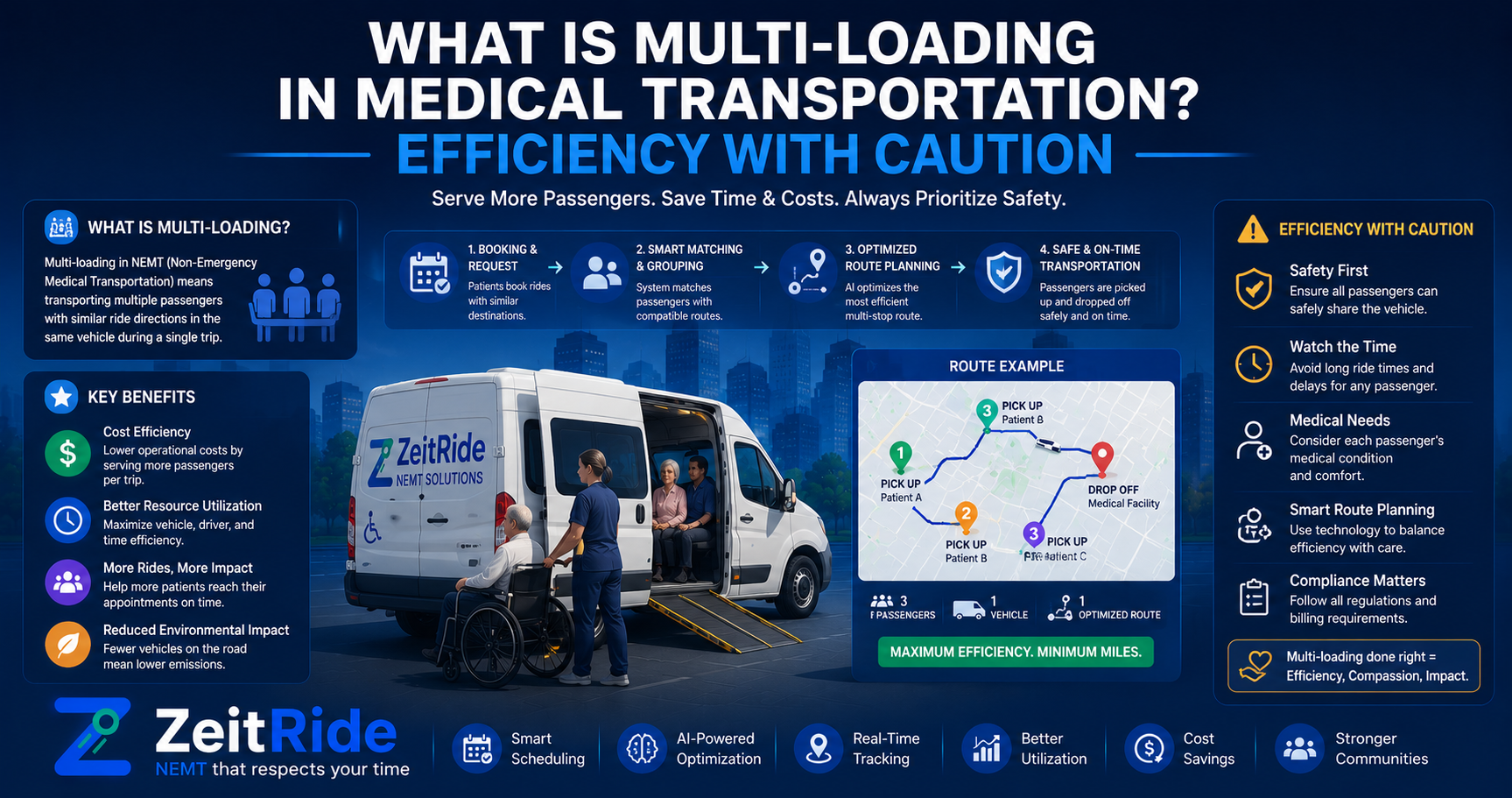
What Is Multi-Loading in Medical Transportation? Efficiency with Caution
Multi-loading can improve vehicle utilization and margins when used selectively. Learn when it helps—and when it creates delays and complaints—so you can use it wisely.
Quick answer
Multi-loading in NEMT means transporting more than one passenger in a vehicle during a single trip. It improves vehicle utilization and reduces cost per trip when passengers have compatible destinations and pickup windows. Used incorrectly, multi-loading causes excessive detours, longer ride times, and passenger complaints. The key is AI-assisted compatibility matching and strict ride time limits.
ZeitRide Team
NEMT Operations Expert
What Is Multi-Loading in NEMT?
Multi-loading (also called shared rides or multiloading) in non-emergency medical transportation means transporting two or more passengers in the same vehicle during a single trip run. Instead of one vehicle per passenger, a multi-loaded vehicle picks up Passenger A, then Passenger B, drops off Passenger A at their facility, then continues to Passenger B's destination—or some variation of that sequence depending on geography.
Multi-loading is explicitly authorized by many Medicaid transportation programs and broker contracts as a cost-containment strategy. When done correctly, it reduces cost per trip for providers and payers alike. When done poorly, it means passengers arrive late to appointments, wait in vehicles longer than expected, and lodge complaints with brokers—damaging your scorecard.
When Multi-Loading Works
Multi-loading works when passengers have compatible destinations and pickup windows. Two passengers going to the same dialysis center within 20 minutes of each other, with similar mobility requirements and a total detour of under 10 minutes per passenger, is a near-ideal multi-load scenario. The vehicle gets twice the trip revenue for roughly the same distance and time.
High-utilization scenarios for multi-loading: dialysis routes (same facility, regular schedule), group home pickups (same origin, different destinations), and facility discharge runs (same origin, clustered destinations). In these scenarios, passengers often know each other, schedules are predictable, and detours are minimal.
When Multi-Loading Creates Problems
Multi-loading fails when the detour added for the second passenger materially extends the first passenger's ride time. Most Medicaid programs have explicit ride time limits—often 30 minutes for urban trips and 60 minutes for rural. A multi-load that adds 25 minutes to a passenger's ride may push them over the limit, creating a compliance violation and a complaint.
Problem scenarios: passengers with incompatible mobility equipment (a stretcher transport combined with a wheelchair passenger may not be possible in most vehicles), significantly different appointment times requiring early arrival for one passenger, or destinations in opposite directions that create excessive mileage.
The most common multi-loading mistake is over-optimizing for vehicle utilization without adequately modeling ride time impact. Dispatchers under pressure to maximize loads sometimes create combinations that look efficient on a map but result in a passenger arriving 45 minutes early (waiting at the facility) or borderline late to their appointment.
How AI Improves Multi-Loading Decisions
AI-assisted multiload optimization evaluates trip combinations across pickup windows, destinations, vehicle capability, and projected ride times simultaneously—finding combinations that meet service level requirements that human dispatchers may miss or overlook under time pressure.
The best NEMT platforms apply ride time constraints as hard limits in their optimization models, rejecting multi-load combinations that would violate those limits even if they'd improve vehicle utilization. This prevents the compliance and complaint risk that comes from manual over-loading decisions.
Setting Multi-Loading Policy for Your Fleet
Before enabling multi-loading, define your policy clearly: maximum ride time addition per passenger for a multi-load, vehicle types eligible for multi-loading, facility types where multi-loading is appropriate, and broker-specific rules that may override your defaults. Document this policy in your dispatch platform so it's enforced consistently rather than left to individual dispatcher judgment.
Track multi-load performance as a separate metric: multi-load rate (% of trips that are multi-loaded), average ride time for multi-loaded trips vs. solo trips, and complaint rate from multi-loaded trips. This data tells you whether your multi-loading policy is generating profit or generating problems.
You can aslo read: What Is NEMT Software? Complete 2026 Guide for NEMT Providers
Final Words
Multi-loading can be a powerful strategy to improve efficiency and reduce cost per trip in NEMT—but only when it’s done with precision, not pressure. The difference between a profitable multi-load and a problematic one often comes down to how well your system understands timing, compatibility, and patient experience.
Without proper controls, multi-loading can quickly lead to longer ride times, missed appointments, and unhappy passengers. But with the right approach supported by smart optimization and clear rules—it becomes a tool for scaling operations without sacrificing service quality.
That’s why modern platforms like ZeitRide focus on intelligent multi-load planning that balances efficiency with compliance and rider comfort. When used correctly, multi-loading isn’t just about filling seats—it’s about building a smarter, more reliable transportation network.
Rather see it than read about it?
Bring a real route, a couple of drivers, and your current process. 15 minutes, zero pitch.