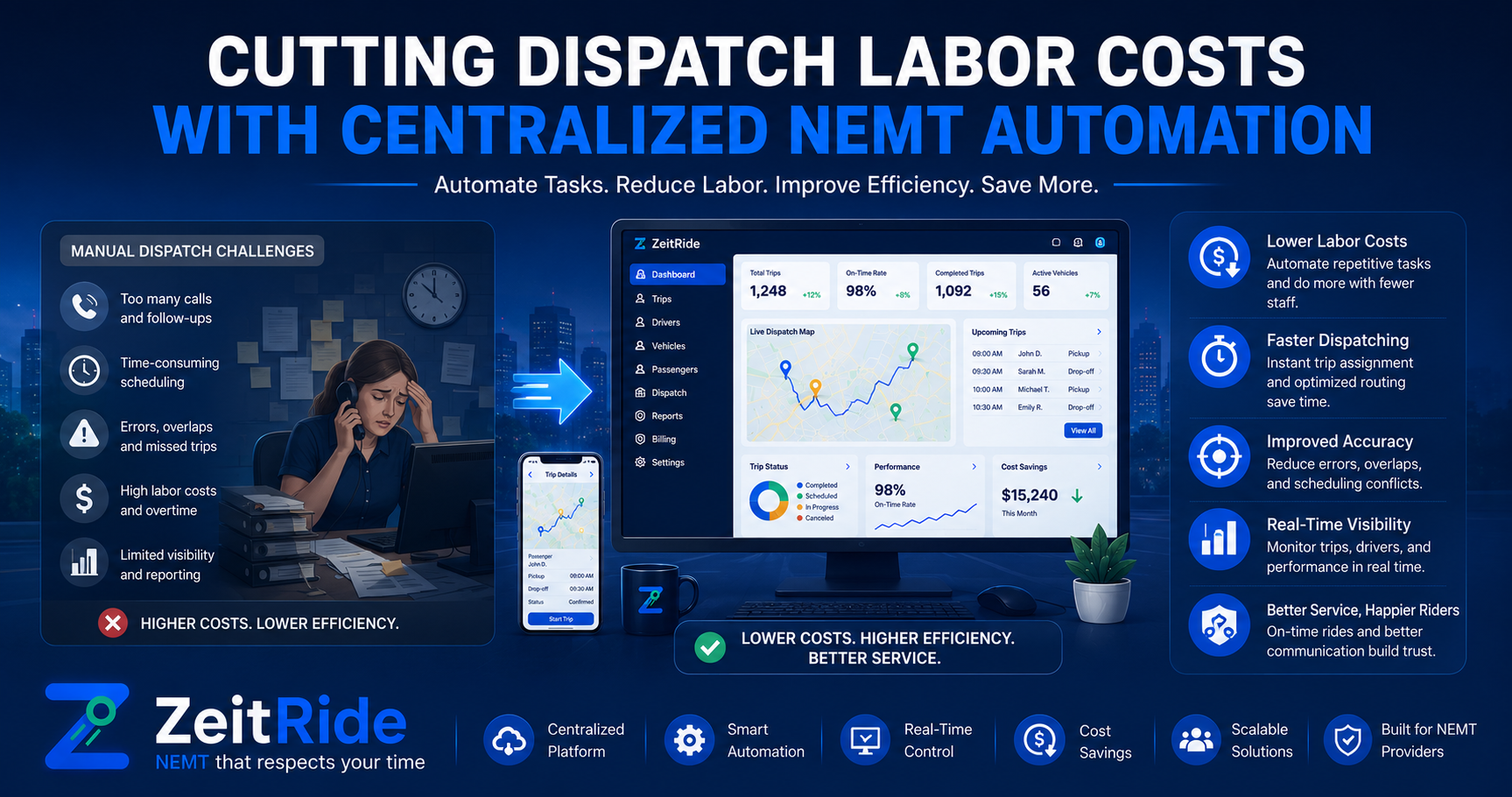
Cutting Dispatch Labor Costs with Centralized NEMT Automation
In the NEMT industry, large fleets can reduce labor costs and errors by centralizing scheduling, routing, and billing in one platform. Learn how automation frees dispatchers for higher-value work.
Quick answer
NEMT providers cut dispatch labor costs by centralizing trip scheduling, routing, and status updates in one platform—reducing manual calls, re-entry errors, and overtime. AI route optimization reduces trips per dispatcher by automating sequencing. Automated broker trip imports eliminate manual data entry. Driver apps handle status updates without dispatcher involvement, allowing smaller dispatch teams to manage larger fleets.
ZeitRide Team
NEMT Operations Expert
Where Dispatch Labor Costs Come From
Dispatch labor in NEMT operations is rarely a single line item—it's embedded in every manual step of the trip lifecycle. A dispatcher who spends 4 minutes on the phone confirming a broker trip, then 3 minutes manually entering it into scheduling software, then 2 minutes calling a driver to update them on a change has spent 9 minutes on a single trip. Multiply that by 80 trips per shift and you have a full-time labor cost that doesn't show up labeled as 'dispatch inefficiency' on your P&L.
The largest dispatch labor cost drivers in NEMT are: manual trip entry from broker portals, inbound and outbound driver communication (status calls, location checks, manifest updates), reactive scheduling when trips change or no-shows occur, and manual billing reconciliation at the end of each shift. Each of these has a direct automation path in modern NEMT platforms.
Automation That Directly Reduces Dispatch Labor
Automated broker trip import. Most NEMT brokers now provide structured trip data via APIs or file feeds. Platforms that import this data directly—matching trips to drivers and vehicles based on availability, proximity, and capability—eliminate the manual entry step entirely. For fleets processing 50+ broker trips per day, this alone can save 2–3 dispatcher hours daily.
AI route optimization. Manual sequencing requires a dispatcher to mentally balance pickup windows, vehicle capacity, member locations, and driver start/end points across a fleet. AI route optimization handles this computation instantly and continuously—adjusting routes as add-ons and cancellations come in. The result is faster scheduling and fewer dispatcher decisions per trip.
Driver app status updates. When drivers use a purpose-built app to confirm pickups, document drop-offs, capture e-signatures, and report vehicle issues, dispatchers receive live status without phone calls. A dispatcher managing 15 drivers via an app dashboard can supervise the same volume that previously required 2–3 people on phones.
Automated passenger notifications. Sending ETA notifications to passengers and facility coordinators automatically—triggered by driver location milestones—removes another category of inbound calls. Facilities that receive automated 'driver is 10 minutes away' texts don't call dispatch to check status.
You Can Also Read: What Is the Average Cost of Non Emergency Medical Transportation?
The Dispatcher Role After Automation
Automation doesn't eliminate dispatch—it changes what dispatchers do. In automated NEMT operations, dispatchers shift from data entry and status-chasing to exception management, relationship coordination, and escalation handling. They're watching for the trips that the system can't self-resolve: a driver breakdown, a passenger not ready, a medical emergency, a weather-related route change.
This is a higher-value use of dispatcher time. An experienced coordinator handling genuine exceptions is more productive—and more satisfied—than one spending the morning re-entering broker trips and making status calls. Turnover in dispatch roles often correlates with repetitive, low-value task volume. Automation that removes that volume improves retention as well as efficiency.
Measuring Dispatch Labor Efficiency
Track trips managed per dispatcher per shift before and after automation. A well-automated NEMT operation typically handles 80–120 trips per dispatcher per shift versus 40–60 in manual environments. Also track time-to-assign (how long between a trip being available and a driver being confirmed), which is a direct proxy for dispatcher workload and system efficiency.
Providers using ZeitRide's centralized dispatch have reported reducing dispatcher-to-vehicle ratios from 1:8 to 1:15 after full platform adoption—effectively halving dispatch labor cost per vehicle while maintaining or improving service quality.
Final Thought
Cutting dispatch labor costs in NEMT isn’t about reducing staff—it’s about removing the manual friction that keeps skilled dispatchers stuck in repetitive tasks. When scheduling, routing, communications, and billing are unified in one automated system, dispatch teams shift from constant reaction mode to proactive control.
The real transformation happens when automation handles the volume, and people handle the exceptions. Fleets gain faster response times, fewer errors, and the ability to scale without continuously expanding headcount.
With platforms like ZeitRide, dispatch becomes less about managing chaos and more about managing outcomes—turning labor cost reduction into a long-term operational advantage rather than a short-term cut.
Rather see it than read about it?
Bring a real route, a couple of drivers, and your current process. 15 minutes, zero pitch.