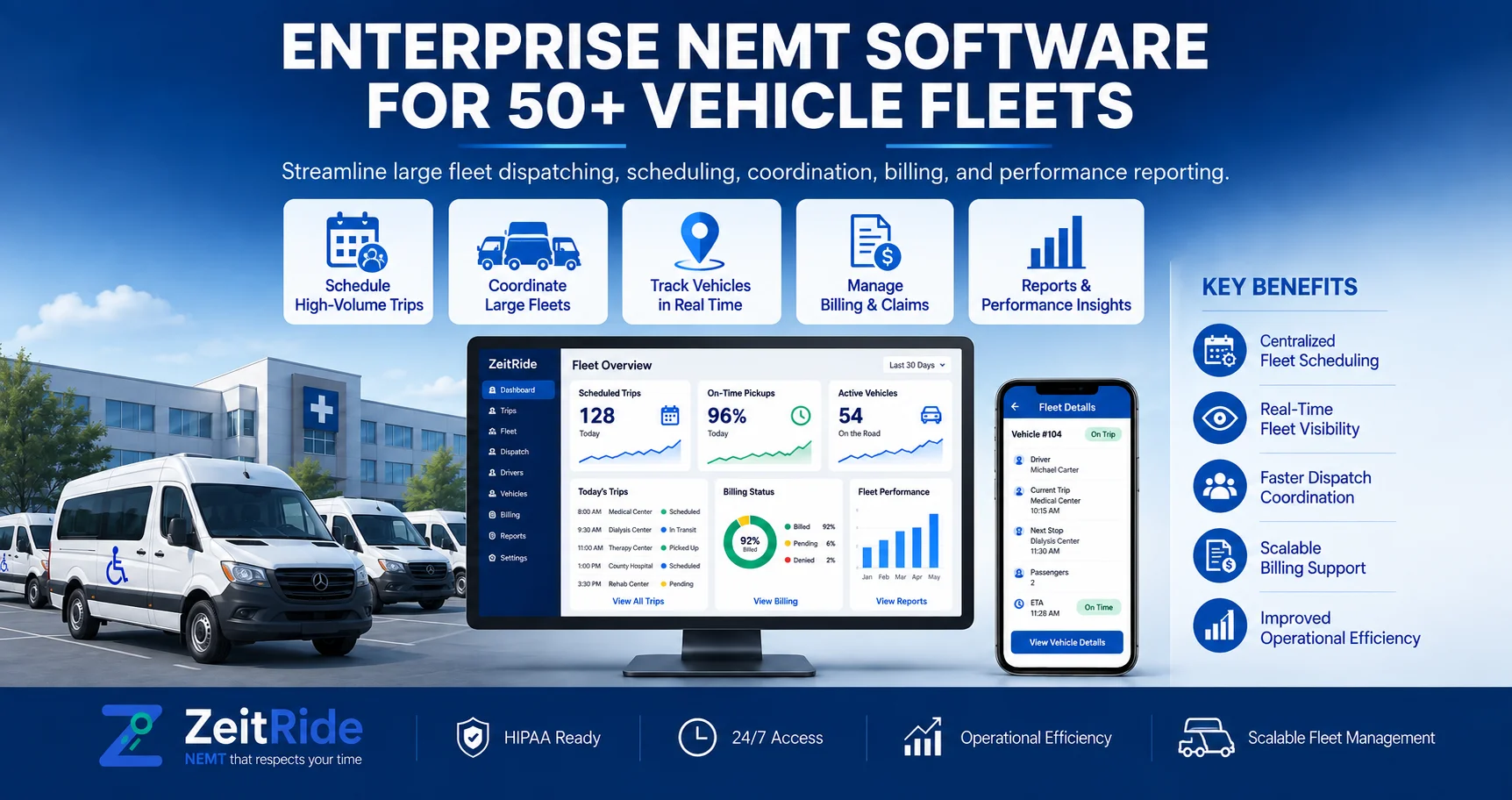
Enterprise NEMT Software for 50+ Vehicle Fleets
Learn what enterprise NEMT software should handle for 50+ vehicle fleets, from dispatch and multi-location operations to billing and reporting.
Quick answer
Enterprise NEMT software should connect high-volume scheduling, routing, live dispatch, driver workflows, broker trip intake, billing, permissions, and reporting as a fleet grows across 50+ vehicles and multiple locations.
ZeitRide Team
NEMT Operations Expert
Running 50 vehicles is not simply the same job as running 10 vehicles five times over. As an NEMT fleet grows, it usually adds more drivers, dispatchers, broker relationships, recurring schedules, facilities, billing exceptions, user permissions, and reporting requirements at the same time. That changes what the company needs from its software.
The question is no longer just, "Can this system schedule and dispatch trips?" It becomes, "Can the entire operation stay connected as trip volume and organizational complexity increase?" That is where enterprise NEMT software becomes relevant. A connected NEMT software platform should help carry a trip from intake through scheduling, routing, dispatch, driver execution, billing, and reporting without forcing multiple departments to recreate the same information.
What Is Enterprise NEMT Software?
Enterprise NEMT software is transportation management software designed for larger or more complex NEMT operations that need to coordinate high trip volume, multiple users, broker relationships, locations, drivers, vehicles, billing workflows, and management reporting in one connected environment.
Enterprise should not be defined only by vehicle count. A 45-vehicle provider working with multiple brokers and operating locations may have more complexity than a 70-vehicle company working from one office under a simpler contract structure. A better question is whether the operation has become too complex to manage reliably through separate systems, spreadsheets, manual handoffs, and individual staff knowledge. If the answer is yes, the company should begin evaluating enterprise-level capabilities.
When Does a Fleet Need Enterprise-Level Software?
NEMT software for large fleets becomes especially valuable when business growth starts creating more administrative work than operational visibility. Common warning signs include:
- 50+ vehicles are being scheduled and dispatched regularly.
- Multiple dispatchers or shifts need access to the same live operation.
- Trips arrive from several brokers, facilities, private-pay sources, or internal booking teams.
- Recurring trips and standing orders make up a significant portion of the schedule.
- Different mobility levels, vehicle types, or driver qualifications affect assignments.
- The company operates across multiple locations or service areas.
- Billing teams manually reconcile completed trips with operational records.
- Management depends on manually prepared reports.
- Dispatch, driver activity, billing, and reporting live in different systems.
- Additional trip volume continually requires additional administrative staff.
The clearest signal is not fleet size alone. It is when complexity begins growing faster than the company's ability to see and control the operation.
Standard NEMT Software vs. Enterprise NEMT Software
| Area | Smaller-Fleet Need | Enterprise-Scale Need |
|---|---|---|
| Scheduling | Create and assign trips | Coordinate high-volume, recurring, broker, facility, and same-day trips |
| Dispatch | Monitor active trips | Manage multiple dispatchers, exceptions, shifts, and operating areas |
| Routing | Build efficient routes | Balance capacity, timing, mobility requirements, and larger trip sets |
| Drivers | Send assignments | Keep trip statuses and field activity connected in real time |
| Locations | One primary operation | Local operational control with centralized visibility |
| Brokers | Limited trip sources | Multiple imports, integrations, updates, and workflows |
| Billing | Generate billing records | Preserve completed-trip data through billing and reconciliation |
| Reporting | Basic operations reports | Fleet, broker, location, utilization, and management reporting |
| Users | Basic access | Role-based permissions for different departments |
What Should Enterprise NEMT Software Actually Handle?
The strongest way to evaluate scalable NEMT software is not to count features. Follow one trip through the entire operation and see whether its information remains connected.
High-Volume Scheduling, Routing, and Dispatch
A larger provider may handle recurring dialysis transportation, broker trips, facility requests, appointment changes, cancellations, will-calls, and same-day additions in the same service day. Effective NEMT scheduling software needs to connect those trips with available drivers, vehicles, recurring patterns, and operational requirements.
The schedule then needs to flow into NEMT routing software that understands more than simple distance. Appointment times, wheelchair capacity, pickup windows, vehicle availability, driver schedules, and shared rides can all affect the route. Finally, live NEMT dispatch software needs to help dispatchers react when the plan changes. A scalable platform should keep these functions connected instead of forcing teams to update the same trip independently.
Driver Execution
The driver workflow is where the planned trip becomes an executed trip. Large fleets should not depend on dispatchers constantly calling drivers for statuses or reconstructing events later. The ZeitRide Driver app connects trip assignments, navigation, GPS-supported workflows, inspections, electronic signatures, and trip status information with the main operation.
Whatever platform you evaluate, test the driver experience under real operating conditions, not only on a desktop demonstration.
Multi-Location Operations
Multi-location NEMT software should provide both separation and visibility. A dispatcher may need to see only the trips and vehicles relevant to a particular operation, while management may need consolidated information across several branches or service areas.
Providers managing several facility relationships should also consider how multi-facility NEMT operations fit into the larger organization. The goal is to avoid recreating each location as a disconnected spreadsheet or software account.
Broker Workflows
Multiple brokers should not automatically mean multiple manual operating processes. For each broker, evaluate how the complete trip lifecycle works.
- How do new trips enter the system?
- How are members matched?
- How are trip modifications and cancellations handled?
- How are recurring trips managed?
- How are completed trips documented?
- How are exceptions identified?
- How does operational data reach billing?
The important test is not whether a broker logo appears on a vendor's website. It is how much manual work remains after the integration is connected.
Billing and Reporting
Enterprise billing becomes difficult when the finance team has to reconstruct what happened after a trip is completed. A connected NEMT billing workflow should begin with the executed trip record and carry relevant operational information into the billing process.
Management also needs reporting that goes beyond individual trip lists. Useful enterprise reporting may include completed versus scheduled trips, on-time performance, cancellations and no-shows, fleet utilization, driver activity, broker performance, billing readiness, reconciliation exceptions, and location performance.
What Changes at 50, 100, and 200+ Vehicles?
| Fleet Scale | Common Operational Challenge | What to Validate |
|---|---|---|
| 50+ vehicles | More dispatchers, trip sources, exceptions, and back-office coordination | Connected workflows, permissions, reporting, billing, and predictable pricing |
| 100+ vehicles | More teams, brokers, service areas, or locations | Standardized workflows, cross-location visibility, integrations, and management reporting |
| 200+ vehicles | Greater organizational and data complexity | Role control, enterprise reporting, integration strategy, migration, and data ownership |
These are not universal definitions. A fleet does not suddenly become enterprise at exactly 50 vehicles. However, 50+ vehicles is a useful point to evaluate whether the systems that worked during earlier growth will remain efficient at the next stage.
NEMT software for 100+ vehicles should be tested even more carefully against the company's real operating structure rather than a simplified vendor demonstration.
How Should Large Fleets Evaluate NEMT Software?
Do not let the vendor demonstrate only its easiest workflow. Instead, anonymize one representative operating day from your business and ask each serious vendor to run the same scenario.
- Recurring trips
- Multiple mobility levels
- Broker-assigned transportation
- A same-day trip
- A will-call
- A cancellation or no-show
- A driver callout
- A vehicle becoming unavailable
- A reassignment
- Required proof-of-service information
- A completed trip moving into billing
- Users with different permissions
Then watch what happens between the steps. If dispatch changes an assignment, does the driver receive it? Does the trip keep its mobility requirements? Does the completed record reach billing? Can management see what happened afterward?
Use the NEMT software evaluation checklist for a more detailed vendor review. The strongest enterprise platform is not necessarily the one with the longest feature list. It is the one that supports your real operating workflow with the fewest manual workarounds.
How Much Should Enterprise NEMT Software Cost?
Enterprise software should be evaluated using total cost at your actual operating scale. Ask whether pricing changes based on:
- Vehicles
- Trips
- Dispatchers or staff users
- Driver accounts
- Locations
- Integrations
- Billing modules
- Implementation
- Data migration
- Training
- Support
ZeitRide's current NEMT software pricing is $49 per active vehicle per month for its core platform, with unlimited trips, dispatchers, and staff seats. Fleets above 50 vehicles can request negotiated volume pricing and dedicated onboarding.
When comparing vendors, price the same fleet, users, integrations, and implementation requirements with each platform so the comparison is meaningful.
How ZeitRide Fits a 50+ Vehicle Evaluation
ZeitRide brings scheduling, routing, dispatch, driver workflows, broker integrations, billing workflows, fleet operations, and reporting into one NEMT platform.
For a 50+ vehicle company, however, the best evaluation is not to rely on the feature list alone. Bring a real operating day to the demonstration. Show the trips your company actually handles, the brokers you work with, the mobility requirements you manage, the exceptions dispatchers face, and the information billing needs afterward.
Then ask the team to show how that workflow moves through ZeitRide from trip intake to completion. That gives you a much clearer answer to the question that matters: Can this system support the way our fleet actually operates as we continue to grow?
Enterprise NEMT Software Buying Checklist
- Manage your actual trip volume and trip mix
- Support your broker workflows
- Coordinate recurring and same-day trips
- Account for driver, vehicle, capacity, and mobility requirements
- Manage real-time dispatch exceptions
- Connect routing with the live schedule
- Provide a practical driver workflow
- Preserve trip information through billing
- Support multiple operating locations where needed
- Provide appropriate user permissions
- Produce useful management reports
- Export your data
- Explain implementation and migration clearly
- Provide transparent pricing at your fleet size
Frequently Asked Questions
Q: What is enterprise NEMT software?
Enterprise NEMT software is transportation operations software designed to coordinate larger or more complex NEMT fleets across scheduling, routing, dispatch, drivers, brokers, billing, permissions, and reporting.
Q: When should a fleet consider enterprise NEMT software?
A fleet should consider enterprise-level capabilities when higher trip volume, multiple brokers or locations, more dispatchers, billing reconciliation, and reporting requirements begin creating significant manual coordination. Fleet size matters, but operational complexity matters more.
Q: What should NEMT software for 50+ vehicles include?
NEMT software for 50+ vehicles should connect high-volume scheduling, routing, live dispatch, driver workflows, broker trip intake, billing, permissions, reporting, and data export.
Q: Can enterprise NEMT software manage multiple locations?
Yes. Multi-location NEMT software should allow local teams to manage relevant operations while giving authorized leadership centralized visibility across the organization.
Q: What should NEMT software for 100+ vehicles prioritize?
It should prioritize scalable workflows, multi-team visibility, permissions, broker integrations, billing continuity, reporting, implementation planning, and reliable operational data.
Q: How should a large fleet test enterprise NEMT software?
Use a representative operating day containing real trip types, broker workflows, dispatch exceptions, driver activity, billing requirements, and user roles. Ask the vendor to demonstrate the workflow from trip intake through completion.
See Your 50+ Vehicle Workflow in ZeitRide
If you operate 50+ vehicles, do not judge enterprise NEMT software from a generic slideshow. Bring ZeitRide a representative service day — your trip mix, brokers, recurring rides, drivers, vehicles, common dispatch exceptions, and billing workflow.
We will show you how that operating day moves through the platform so your team can evaluate ZeitRide against the same criteria covered in this guide. Book a 15-minute fleet workflow demo.
Rather see it than read about it?
Bring a real route, a couple of drivers, and your current process. 15 minutes, zero pitch.