How much does Medicaid pay for transportation per mile?
Learn how much Medicaid pays for transportation per mile in 2026, typical NEMT reimbursement rates by state, and ways to improve fleet profitability.
Quick answer
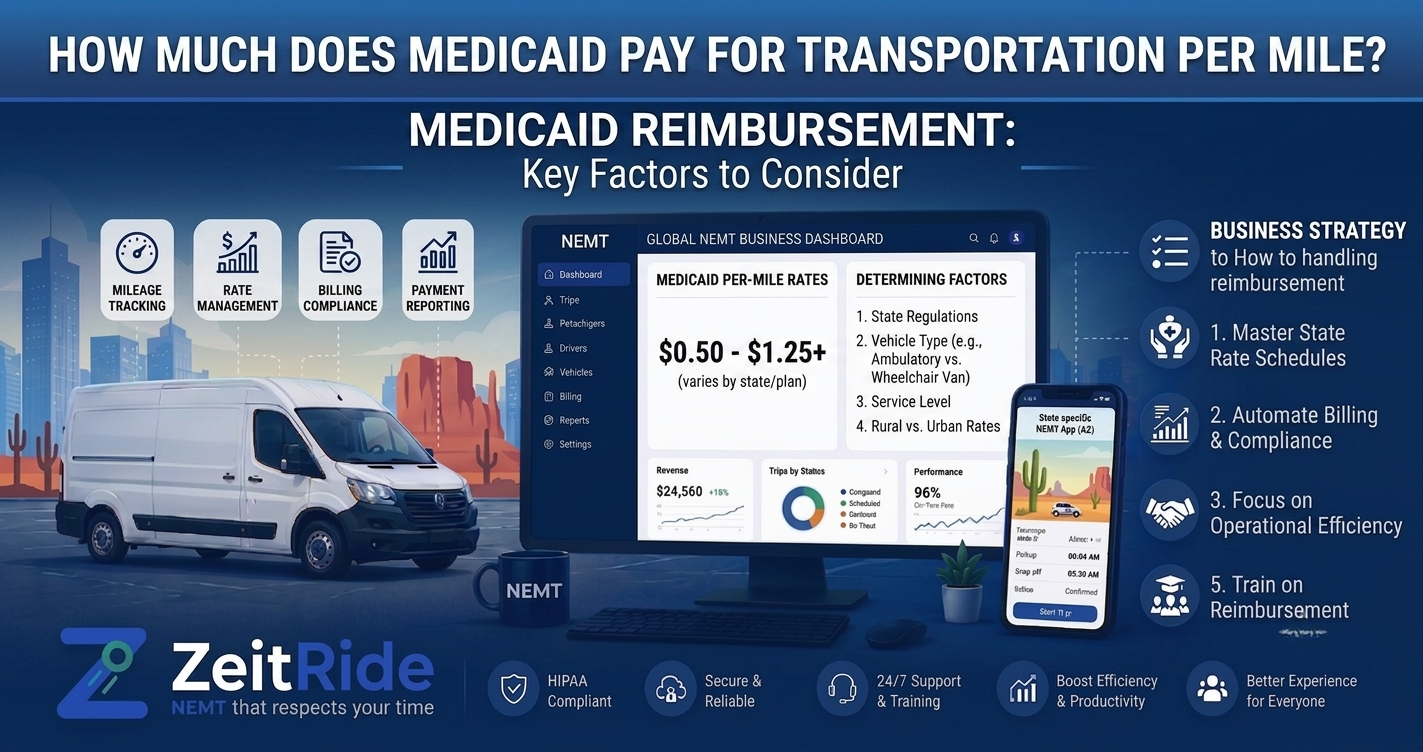
Medicaid typically pays between $0.50 and $5.00 per loaded mile for non-emergency medical transportation (NEMT), depending on the state, broker, vehicle type, and service level.
ZeitRide Team
NEMT Operations Expert
If you're running NEMT trips and trying to figure out how much does Medicaid pay for transportation per mile, the honest answer is: it depends on your state, your broker, and whether the mile is "loaded" or not. Rates run anywhere from $0.50 to $5.00 per mile depending on where you operate. ZeitRide doesn't set those rates, but our route optimization feature cuts an average of 20% off miles driven, which matters a lot when your reimbursement is mileage-based and every deadhead mile costs you money instead of making you any.
Why Medicaid mileage rates vary so much by state
There's no single national rate because Medicaid NEMT is administered at the state level, not set by CMS. Each state Medicaid agency either negotiates rates through a transportation broker or publishes its own fee-for-service schedule, and the two methods produce very different numbers. Broker-managed states (where companies like MTM Health or ModivCare run the network) often pay base trip fees plus a per-mile add-on, while fee-for-service states set flat mileage rates that haven't always kept pace with fuel and labor costs.
This is also why "how much does Medicaid pay for non emergency transportation" doesn't have one clean answer. A wheelchair van trip in a broker-managed urban market can reimburse at $3–$5 per mile, while a rural fee-for-service ambulatory trip might pay closer to $0.50–$1.00 per mile. Service type matters too — stretcher and wheelchair transport almost always reimburse higher than standard ambulatory rides because of the equipment, staffing, and load time involved.
One detail that trips up a lot of new operators: most states only pay for loaded miles — the distance traveled with a member in the vehicle. Driving to the pickup or back to base after drop-off usually isn't reimbursed at all. That single rule is why fleets that run tighter routes keep more of every dollar Medicaid pays out, and it's the reason mileage tracking accuracy matters as much as the rate itself.
How ZeitRide handles mileage tracking and route efficiency
ZeitRide won't change what your state pays per mile, but it controls the variables you actually have power over: how many miles your drivers run, how accurately those miles get logged, and how cleanly they get billed.
- AI route optimization plans trips to cut unnecessary mileage, averaging a 20% reduction in miles driven across our fleets — which means fewer unreimbursed deadhead miles eating into your margin.
- GPS tracking through the driver app logs actual loaded miles automatically, so you're not relying on a driver's memory or a paper log when a broker disputes a trip.
- Electronic trip records sync directly into billing, giving you a clean paper trail for broker remittance instead of a spreadsheet reconciliation at month-end.
- Broker import pulls trips straight from MTM Health, Provide A Ride, ProCare, and DD Med Trans, so mileage and pickup data match what the broker already has on file — fewer denied claims, less back-and-forth.
See exactly how ZeitRide handles route optimization and mileage tracking — no pitch, just your workflow on our platform.
What NEMT operators get wrong about Medicaid mileage rates
The biggest mistake operators make is treating the per-mile rate as the whole picture. It isn't. Two fleets running the exact same state rate can have wildly different profitability depending on how efficiently they route, how accurately they bill, and how many miles get burned on deadhead runs that never show up on an invoice.
A few things operators consistently underestimate:
- Deadhead miles are invisible until you measure them. Without route optimization, a fleet can easily run 15–25% more total miles than necessary, all unpaid.
- Manual mileage logs create disputes. Brokers reject claims when logged mileage doesn't match GPS data or doesn't follow loaded-mile rules — and disputes take weeks to resolve.
- Long distance medical transport cost gets miscalculated. Cross-state or out-of-area trips often require prior authorization before Medicaid will reimburse, and fleets that don't track this lose entire trips, not just a few miles.
- Legacy software like Bambi, Tobi Cloud, RouteGenie, or TripMaster often charges per trip or per seat on top of a monthly fee, which eats into whatever the mileage rate brings in. ZeitRide runs at a flat $49 per vehicle per month with no add-ons or setup fees.
Does Medicaid offer transportation for long-distance trips?
Yes, but it's not automatic. Does Medicaid offer transportation for long-distance medical transport cost situations — like a specialist three counties over or an out-of-state treatment center? Generally yes, but most states require prior authorization to confirm the care isn't available locally first. Once approved, long-distance trips usually reimburse at a higher mileage rate or a negotiated flat rate, since they tie up a vehicle for hours instead of minutes.
For fleets handling these trips regularly, the operational risk isn't the rate — it's tracking authorization status correctly so claims don't get denied after the trip already happened. ZeitRide's dispatch software flags trip details at scheduling time, so coordinators aren't discovering a missing authorization after the vehicle's already on the road.
Bottom line
How much does Medicaid pay for transportation per mile isn't a fixed number — it shifts by state, broker, and service type, and most operators don't control it directly. What you do control is how many miles you run to deliver each trip and how cleanly those miles get billed. ZeitRide's route optimization averages a 20% reduction in miles driven, and the platform runs at a flat $49 per vehicle per month with no setup fees or contracts. Most providers are live within 30 minutes and running their first route within a day.
Frequently Asked Questions
Q: How much does Medicaid pay for transportation per mile?
Rates typically range from $0.50 to $5.00 per loaded mile depending on the state, broker, and vehicle type, with wheelchair and stretcher transport reimbursing higher than standard ambulatory rides. ZeitRide doesn't set these rates, but its route optimization helps fleets keep more of what they collect by cutting unnecessary mileage.
Q: How much does Medicaid pay for non emergency transportation overall, not just mileage?
Most states pay a base trip fee plus a per-mile rate, rather than mileage alone, with some adding wait-time reimbursement for facility delays. The exact structure depends on whether your state uses fee-for-service billing or a managed broker like MTM Health.
Q: Does Medicaid offer transportation in every state?
Yes, federal Medicaid regulations require states to ensure access to non-emergency transportation for eligible members with no other way to reach covered care. How each state delivers it — broker-managed, fee-for-service, or a hybrid — varies significantly.
Q: What's the non emergency medical transport cost per mile difference between ambulatory and wheelchair trips?
Wheelchair and stretcher transport generally reimburse at a meaningfully higher per-mile rate than standard ambulatory trips due to equipment, extra staffing, and longer load times. Fleets running mixed service types need billing software that applies the correct rate per trip type automatically, which is built into ZeitRide's billing platform.
Q: What drives long distance medical transport cost beyond the per-mile rate?
Long-distance trips usually require prior authorization, and costs climb with wait time, vehicle type, and whether the trip crosses state lines. Fleets that track authorization status at scheduling time avoid denied claims after the trip is already complete.
Rather see it than read about it?
Bring a real route, a couple of drivers, and your current process. 15 minutes, zero pitch.