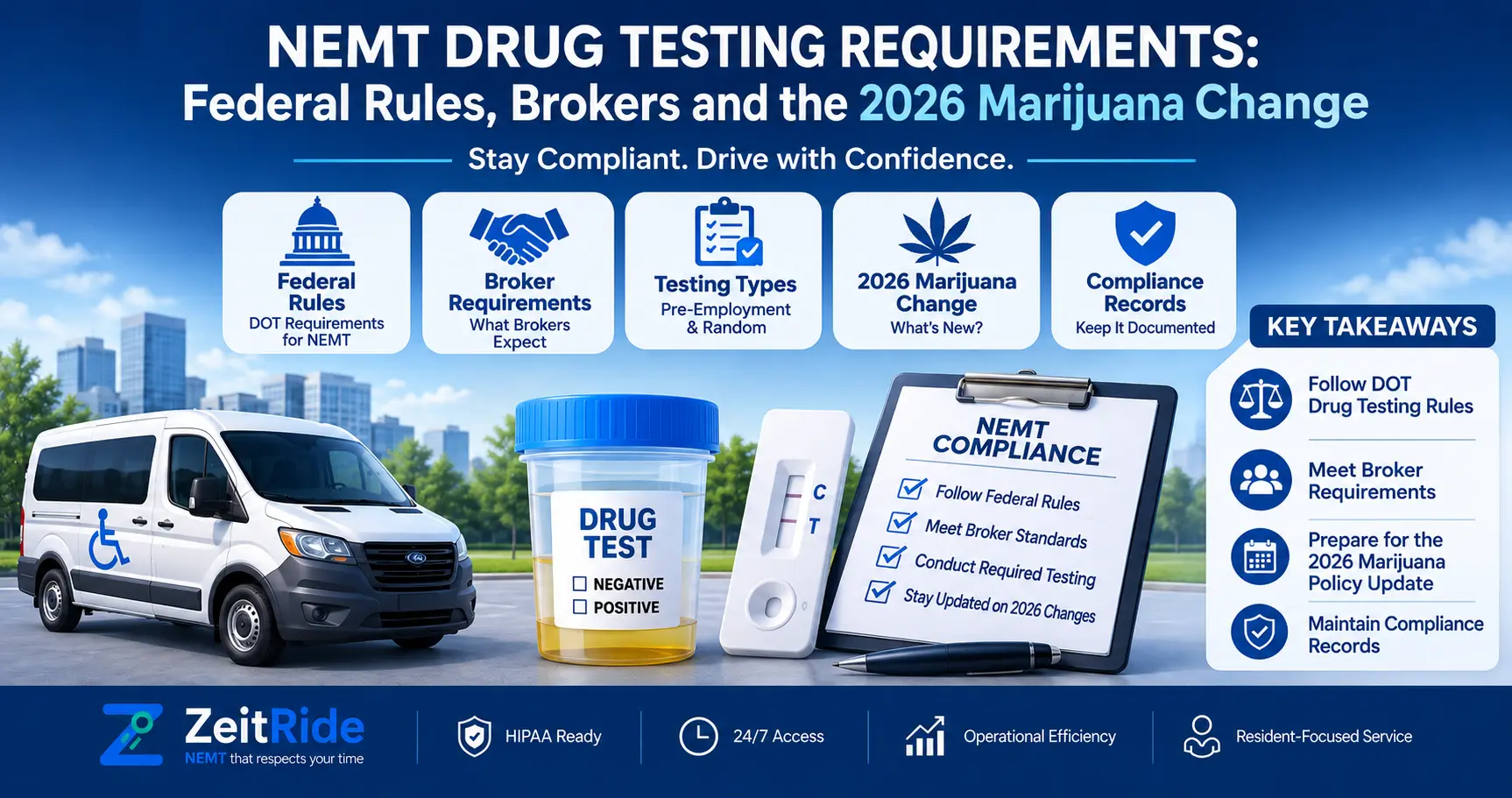
NEMT Drug Testing Requirements: Federal Rules, Brokers and the 2026 Marijuana Change
Federal Medicaid law doesn't require NEMT drug tests, but DOT rules, brokers and insurers often do. Here is which rules apply to your drivers and how to build a policy.
Do NEMT drivers have to be drug tested?
Quick answer
Federal Medicaid law does not require NEMT drug tests; it requires each provider to have a process for drivers who violate state drug laws. Testing is mandatory under DOT rules for CDL drivers and for contractors of FTA-funded transit agencies, and most brokers, health plans and insurers require at least a pre-hire drug screen.
NEMT Operations Expert
NEMT drug testing requirements come from three places, and only one of them is Medicaid. Federal Medicaid law asks every NEMT provider to have a process for handling drivers who violate state drug laws, but it does not require a drug test. A test becomes mandatory when DOT rules apply to your drivers or when a broker, health plan or insurer writes it into your contract, which most do.
That split confuses a lot of operators, and the April 2026 marijuana rescheduling added a new layer of questions. This guide explains which rule applies to which fleet, what brokers check at credentialing, how medical marijuana fits in now, and how to build a testing policy that holds up in an audit. If you need the full driver checklist beyond drug testing, start with our guide to NEMT driver requirements.
What Are the NEMT Drug Testing Requirements Under Federal Medicaid Law?
The federal floor comes from section 209 of the Consolidated Appropriations Act, 2021, which added NEMT provider and driver standards to section 1902(a)(87) of the Social Security Act. The CMS informational bulletin of July 12, 2021 lists four minimum requirements that applied to NEMT services from December 27, 2021.
- Each provider and individual driver is not excluded from any federal health care program
- Each driver has a valid driver's license
- Each provider has a process in place to address any violation of a state drug law
- Each provider has a process to disclose each driver's driving history, including traffic violations, to the state Medicaid program
Notice the third item. It asks for a process, not a urine cup. A provider meets it by screening for drug-law violations and acting on what it finds, which is why many states and brokers satisfy it with a criminal background check. The rule sets a minimum, so your state Medicaid agency or broker can add testing on top, and many do.
Do NEMT Drivers Get Drug Tested If They Don't Have a CDL?
They can be, and in some fleets they must be. DOT drug testing for NEMT drivers is triggered either by the vehicle and license a driver uses or by the funding behind the trips. Most sedan and wheelchair van drivers fall outside both triggers, but larger vehicles and transit contracts bring federal testing with them.
FMCSA rules for CDL drivers
The FMCSA drug and alcohol program covers drivers who need a commercial driver's license to run a commercial motor vehicle on public roads: vehicles over 26,000 pounds gross vehicle weight rating, vehicles designed to carry 16 or more people including the driver, and placarded hazardous materials loads. A paratransit bus seating 16 or more falls inside the program. A minivan with a ramp does not. Our guide on whether NEMT vehicles need DOT inspections walks through those vehicle thresholds in detail.
FTA rules for transit contractors
This is the trigger operators miss. Under 49 CFR Part 655, recipients and subrecipients of Federal Transit Administration funds under sections 5307, 5309 and 5311, and their contractors, must test employees who perform safety-sensitive functions. Operating a revenue service vehicle counts whether or not the driver holds a CDL, and so does controlling the dispatch or movement of those vehicles. If you run ADA paratransit or rural demand-response trips for a transit agency, your sedan drivers and your dispatchers may both be in the pool.
Section 5310, the program that funds many senior and disability transportation vehicles, is not on that list. Read your agency agreement rather than assuming: the contract states whether Part 655 testing applies to your work.
| Your situation | Rule that requires testing | Who is tested |
|---|---|---|
| Medicaid broker trips in sedans or wheelchair vans | No federal testing mandate; federal Medicaid rule requires a drug-law violation process | Per broker, plan or insurer contract |
| Vehicle over 26,000 lb GVWR or designed for 16+ people including the driver | FMCSA, 49 CFR Part 382 | CDL drivers of those vehicles |
| Contractor to an FTA 5307, 5309 or 5311 recipient | FTA, 49 CFR Part 655 | Revenue vehicle operators, dispatchers, mechanics, with or without a CDL |
| Only FTA section 5310-funded service | Not listed in Part 655 | Per your grant agreement and company policy |
| Private pay and facility contracts | None federally | Per your own policy and customer contracts |
What Brokers and Health Plans Add on Top
Broker credentialing is where most fleets meet drug testing for the first time. Brokers turn the federal minimum into a document list with due dates, and many go further with pre-hire drug screens, random testing or a ban on driving under any impairing substance. Ask each broker for its current driver credential list in writing, since terms differ by state contract.
Modivcare's driver credentialing reminder shows how one large broker reads the federal rule. It asks for an exclusion check at hire and every month after, a copy of each current license, an annual motor vehicle report, and annual proof that the driver has not violated state drug laws, for example through a criminal background check. It also requires records to be kept for 10 years and produced within three business days of a request.
That three-day window is the practical test of your system. If drug screen results sit in a filing cabinet, an inbox and a lab portal, you will struggle to pull a complete driver file on short notice. ZeitRide's NEMT compliance tracking stores each driver's screens, licenses and checks with expiry alerts, so a lapsed item shows up before a broker audit does.
NEMT Drivers and Medical Marijuana After the 2026 Rescheduling
On April 28, 2026, a DEA final rule moved FDA-approved marijuana drug products, and marijuana covered by a state medical marijuana license, into Schedule III. Marijuana outside those two categories stayed in Schedule I. Drivers have heard that marijuana was rescheduled, and some assume that a medical card now clears them to drive.
For DOT-covered drivers, it does not. When the rescheduling order was announced, the DOT Office of Drug and Alcohol Policy and Compliance said its testing regulations would not change, that safety-sensitive employees remain subject to marijuana testing, and that its guidance on medical marijuana and CBD remains in effect. Labs and medical review officers still follow 49 CFR Part 40.
For non-DOT drivers, the answer sits in your contracts and state law. A broker or plan contract that bars driving while impaired applies regardless of a medical card, and state employment law decides how far you can go in testing for, and acting on, off-duty use. Write a clear rule, apply it to every driver the same way, and have an employment attorney review it in your state.
Which Tests Should an NEMT Drug and Alcohol Testing Policy Include?
Use the DOT categories as the template even when the federal rules don't reach you. They are the structure brokers, insurers and auditors recognize, and FMCSA and FTA use nearly the same set. The table shows when each test happens and what to do in a fleet with no federal mandate.
| Test | When it happens | DOT-covered drivers | Non-DOT drivers (good practice) |
|---|---|---|---|
| Pre-employment | Before the first trip | Negative drug result required before driving | Required by most brokers; screen every new hire |
| Random | Unannounced, through the year | Required at set annual rates | Use if a broker or insurer requires it; pick names by computer |
| Post-accident | After a qualifying crash | Alcohol within 8 hours, drugs within 32 hours under FMCSA | Test after any crash with injury, tow-away or citation |
| Reasonable suspicion | When a trained supervisor sees signs of use | Required | Train supervisors and write down what they observed |
| Return-to-duty and follow-up | After a positive or refused test | Directly observed; at least 6 follow-up tests in 12 months | Decide in writing whether you allow a return at all |
The timing figures come from FMCSA's driver brochure. If a driver is involved in a crash, tie the test to your NEMT incident report so the report, the test time and the result stay in one record.
How random drug testing for NEMT drivers works
A random program puts every covered driver into a pool and selects names by a scientifically valid method, such as a computer generator, at intervals spread through the year. Each driver has the same chance of selection every time, so someone tested in March can be picked again in April. Small fleets often join a consortium or third-party administrator that runs one shared pool, which keeps selections random and the paperwork consistent.
How to Write an NEMT Drug and Alcohol Testing Policy
A written NEMT drug and alcohol testing policy protects you twice: it shows brokers and insurers you meet their terms, and it gives you a fair basis for removing a driver. Build it in this order.
- List every rule that reaches your fleet: FMCSA, FTA, each broker and plan contract, and your insurer
- Keep DOT and company-policy testing in separate programs, with separate forms and pools
- Name who is covered, including dispatchers if you hold FTA work
- Define each test type, the substances tested and the cutoff for removing a driver from duty
- Choose a certified lab, a collection network and a medical review officer or third-party administrator
- Set what happens after a positive or refused test, from removal through any return-to-duty steps
- Train supervisors to spot impairment and document what they see
- Have every driver sign the policy at onboarding and again when it changes
Then make the policy part of daily operations. In ZeitRide's driver management, a driver with an expired or missing credential can be flagged before dispatch assigns the next trip, so policy and scheduling don't drift apart.
What Records Do NEMT Drug Testing Requirements Create?
Every test produces paperwork you may need to produce years later: the custody form, the verified result, the selection list for randoms, the supervisor's notes for a suspicion test and the driver's signed policy acknowledgment. Store results separately from general personnel files, limit who can open them, and keep them for the longest period any of your contracts requires.
An audit history of who uploaded, changed or viewed a driver record helps when a broker questions a file. It shows the screen was on file before the driver's first trip, not added after the request came in.
Getting NEMT Drug Testing Requirements Right
NEMT drug testing requirements are layered: a federal Medicaid process for drug-law violations, DOT testing when CDL vehicles or FTA contracts are involved, and broker, plan and insurer terms that usually ask for more. Map which layers apply to you, write one policy that covers them, and keep every result and due date where you can find it in minutes.
ZeitRide brings scheduling, dispatch, routing, the driver app, compliance tracking and billing into one platform for $49 per vehicle per month, with no contract. Book a ZeitRide demo and we will show you how to load your drivers' screens and credentials so your next broker audit is a quick export.
Frequently Asked Questions
Q: Do NEMT drivers get drug tested?
Most do, but the reason varies. Federal Medicaid law does not require a drug test; it requires a process for state drug-law violations. Testing becomes mandatory under DOT rules for CDL drivers and for contractors of FTA-funded transit agencies, and most brokers, health plans and insurers require at least a pre-hire screen.
Q: Is DOT drug testing required for wheelchair van drivers?
Usually not under FMCSA, because a typical wheelchair van needs no CDL: it weighs under 26,001 pounds and is not designed for 16 or more people. The exception is FTA work. If you operate trips for a transit agency funded under sections 5307, 5309 or 5311, your drivers can fall under DOT testing without a CDL.
Q: Can NEMT drivers use medical marijuana?
Not if they are under DOT testing. DOT says its rules did not change with rescheduling, and its guidance on medical marijuana still stands. For non-DOT drivers, your broker contract, insurer and state employment law decide. Many NEMT contracts bar driving under the influence of any impairing substance, so set a written rule.
Q: How often should NEMT drivers be drug tested?
DOT-covered drivers are tested before they start, at random through the year, after qualifying accidents, on reasonable suspicion, and before and after return to duty. For other drivers, test before hire, at whatever interval your broker or insurer sets, after any crash with injury or damage, and whenever a trained supervisor sees signs of impairment.
Q: Does the CMS NEMT driver rule require drug testing?
No. The rule CMS described in its July 2021 bulletin requires that each provider has a process to address any violation of a state drug law, plus exclusion checks, a valid license and driving history disclosure. Brokers such as Modivcare accept proof such as a criminal background check for the drug-law item.
Rather see it than read about it?
Bring a real route, a couple of drivers, and your current process. 15 minutes, zero pitch.