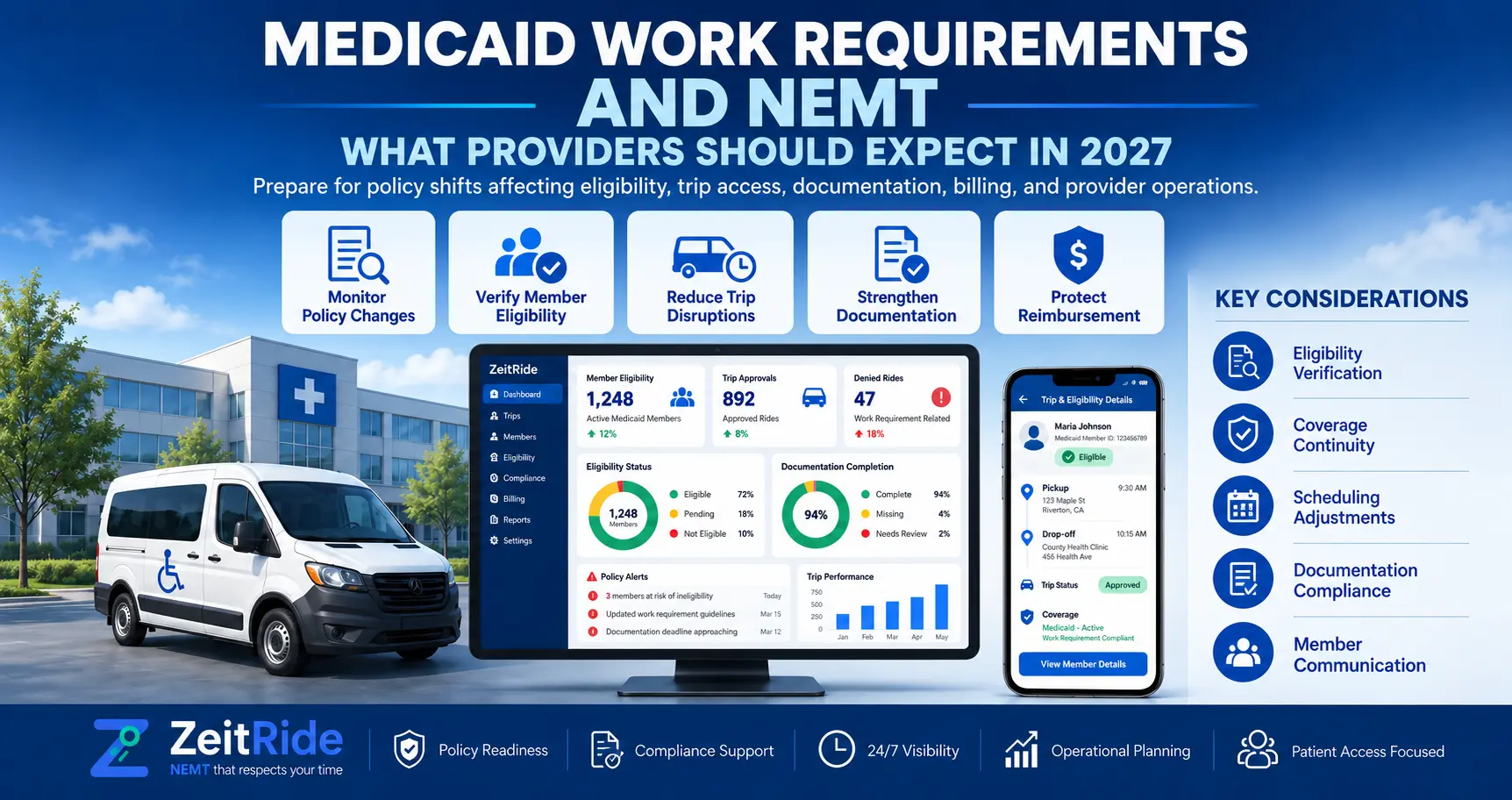
Medicaid Work Requirements and NEMT: What Providers Should Expect in 2027
Medicaid work requirements start January 1, 2027. Which NEMT riders are affected, who is exempt, and how to measure and manage your fleet's exposure.
Quick answer
Starting January 1, 2027, most states must require Medicaid expansion adults aged 19 to 64 to show 80 hours a month of work, school or community service, or qualify for an exemption. NEMT rules do not change, but riders who lose coverage lose their trips. The impact is concentrated in working-age ambulatory riders, since disabled, older, Medicare and most dialysis riders are outside the rule or exempt.
ZeitRide Team
NEMT Operations Expert
The Medicaid work requirements NEMT operators keep hearing about start on January 1, 2027, when most states must begin checking that certain adult enrollees work, study or volunteer 80 hours a month. The rule does not change how NEMT trips are booked or billed. It changes who stays eligible. Expansion adults aged 19 to 64 who cannot show compliance or an exemption can lose coverage, and their trips disappear with it.
For most fleets, the exposure is smaller than the headlines suggest, because the riders who use NEMT most often are largely outside the rule. But the losses will not be evenly spread. Fleets with many working-age behavioral health or primary care riders will feel it first, usually as broker cancellations, ineligible-member rejections and recurring riders who quietly stop showing up on the manifest. This guide covers what the rule requires, which riders are exempt, and how to measure and manage your exposure before January.
What Is the Medicaid Community Engagement Requirement?
The Medicaid community engagement requirement is the official name for the work requirement created by the 2025 federal budget reconciliation law. CMS issued an interim final rule on June 1, 2026, and the CMS fact sheet on the community engagement rule sets out the basics: it applies to non-pregnant adults aged 19 to 64 in the Medicaid adult (expansion) group, or certain section 1115 demonstrations, who are not entitled to or enrolled in Medicare. It covers 43 states and the District of Columbia.
States must generally start by January 1, 2027, and may start earlier. KFF notes that the HHS Secretary can give a state that shows a good-faith effort more time, but no later than December 31, 2028. In other words, the start date in your state may not be the national date, so check your state Medicaid agency's notices rather than assuming.
How the Medicaid 80 hour work requirement is met
An enrollee meets the Medicaid 80 hour work requirement for a month through any one of these routes. States verify compliance at application and at each renewal, and they must try to confirm it from existing data, such as payroll records, before asking the person for paperwork.
| Requirement | What the rule says | Why it matters to an NEMT operator |
|---|---|---|
| Who is subject | Adults 19–64 in the Medicaid expansion group, not pregnant, not on Medicare | Most older, disabled and dual-eligible riders are outside the rule |
| Monthly standard | 80 hours of work, community service or a work program, half-time school, or a mix of these | Riders with steady jobs can often be confirmed through wage data without paperwork |
| Income alternative | Monthly income of at least 80 times the federal minimum wage ($580 in 2026) | Part-time workers can still qualify |
| When it is checked | At application and at renewal; states may check more often | Coverage changes cluster around renewal months |
| If it cannot be verified | Notice of noncompliance and 30 calendar days to respond | Riders may keep booking trips during the notice period, then drop off |
| After disenrollment | The person can reapply at any time | Lost riders can come back, often after missed appointments |
Who Is Exempt From Medicaid Work Requirements?
The answer to who is exempt from Medicaid work requirements matters more to an NEMT provider than the hours rule itself, because many regular riders fall into an exempt group. The CMS fact sheet lists these exemptions:
- Pregnant individuals and people eligible for postpartum coverage
- Medically frail individuals, or people with special medical needs that significantly impair their ability to comply
- Parents, guardians and caretakers of a child aged 13 or under, or of a disabled individual
- People in drug or alcohol rehabilitation or treatment
- Veterans with a total disability rating
- Former foster care youth, and American Indians and Alaska Natives
- People meeting TANF work requirements, or in a SNAP household not subject to SNAP work rules
- Inmates of a public institution
States may also grant short-term hardship exceptions, for example while a person receives inpatient hospital or nursing facility care, lives in a county with a declared disaster or high unemployment, or travels outside the community for extended medical care.
How the medically frail exemption in Medicaid works
The medically frail exemption in Medicaid is the one most NEMT riders will rely on. KFF's summary of the law says it covers people who are blind or disabled, people with physical, intellectual or developmental disabilities, people with a substance use disorder or a disabling mental disorder, and people with serious or complex medical conditions. The CMS rule adds that the condition must significantly impair the person's ability to meet the requirement.
The catch is proof. A rider who is clearly exempt can still lose coverage if the state cannot match the exemption to its data and the rider misses the notice. In the KFF survey of state implementation plans, 32 states said they plan to use Medicaid claims data to identify medical frailty and 29 planned a process for provider confirmation. A rider who travels to treatment three times a week is likely to show up in claims; a rider with an undiagnosed or newly diagnosed condition may not.
How Will Medicaid Work Requirements Affect NEMT Providers?
Start with who actually rides. The CMS report to Congress on Medicaid NEMT found that about 4 to 5 percent of all Medicaid beneficiaries used the benefit in a given year, while 16 percent of people eligible on the basis of disability, and 16 percent of those eligible on the basis of age 65 and over, used it in 2019. People with end-stage renal disease also used NEMT at much higher rates than average. Both high-use eligibility groups, disability and age, sit outside the expansion adult group the rule targets.
That is the central point for Medicaid work requirements NEMT planning: the rule reaches the riders who use NEMT least often, not the dialysis, disability and senior riders who fill many manifests. The table below shows how typical rider groups line up.
| Rider group | Subject to the rule? | Likely NEMT impact |
|---|---|---|
| Riders 65 and older, or on Medicare | No | Little direct effect |
| Riders eligible through disability or SSI | No, not in the expansion group | Little direct effect |
| Dialysis riders under 65 on Medicaid only | Possibly, if in the expansion group; most should qualify as medically frail | Low, but watch for paperwork-driven gaps |
| Behavioral health and substance use treatment riders | Often exempt (treatment or disabling condition) | Medium: exemptions depend on data matching |
| Working-age expansion adults going to primary care, labs, therapy or specialists | Yes | Highest: these trips carry most of the risk |
| Pregnant and postpartum riders | No | Little direct effect |
| Parents of young children | No, while the exemption applies | Little direct effect |
Where the losses will show up first
A coverage loss rarely arrives as a clear message to the transportation provider. It shows up as a trip the broker cancels before the service date, a member the broker portal no longer returns, a claim rejected because the rider was not eligible on the date of service, or a recurring rider who stops booking. Recurring trips are the riskiest, because a standing order can keep generating trips for a member whose coverage has already ended.
Timing matters too. Expansion adults are also moving to six-month renewals in 2027, and in the KFF survey 34 states said they would verify work compliance at each six-month renewal, while Indiana and New Hampshire planned quarterly checks. Expect coverage changes to arrive in waves tied to renewal dates rather than all at once on January 1. Our guide to NEMT eligibility verification covers the pre-trip check that catches these changes before a driver is dispatched.
Medicaid Work Requirements 2027 Timeline for NEMT Operators
Some states did not wait for January. Based on the KFF survey of state plans, here is what the Medicaid work requirements 2027 rollout looks like from an operator's seat.
| Date | What happens | What to do in your fleet |
|---|---|---|
| June 1, 2026 | CMS issues the interim final rule | Read your state agency and broker notices |
| May 1, 2026 | Nebraska begins (planned early start) | Track Nebraska Medicaid trip cancellations now |
| July 1, 2026 | Montana begins (planned); Arkansas soft-launches with no disenrollments until January 2027 | Compare trip counts against the same months last year |
| December 1, 2026 | Iowa begins (planned) | Flag recurring Iowa Medicaid riders for extra checks |
| January 1, 2027 | Most other required states begin | Run eligibility checks before each recurring trip cycle |
| By December 31, 2028 | Latest date for states granted a good-faith extension | Keep monitoring if your state delayed |
Dates come from state plans reported in early 2026 and can move. Treat this as a checklist of what to confirm, not a final schedule.
How Should NEMT Providers Prepare for Medicaid Work Requirements?
You cannot control who keeps coverage, but you can see the change early and keep it from turning into wasted miles and unpaid trips. These six steps work for a five-van fleet as well as a fifty-van one.
- Measure your exposure: split last quarter's completed trips by payer, broker or health plan, and level of service, then estimate how many are ambulatory Medicaid trips for working-age riders.
- List your recurring Medicaid riders under 65 who are not on dialysis or in a disability program, since they are the group most likely to be reviewed.
- Recheck eligibility before each new week of recurring trips, not just when the standing order is first set up.
- Record a reason code for every broker cancellation and claim rejection, so a rise in eligibility-related reasons is visible within weeks.
- Point riders who mention a Medicaid notice to their state agency or health plan, and train dispatchers not to give eligibility advice.
- Reduce dependence on one funding source by building private pay, facility and Medicare Advantage volume where your market supports it.
Most of these steps depend on data many fleets keep in spreadsheets. Keeping funding source, level of service and recurring schedules in rider records in ZeitRide member profiles and pulling trips and cancellations by payer through ZeitRide reporting by funding source turns the exposure check into a report you run in minutes instead of a weekend project.
Will Medicaid NEMT Trip Volume Drop in 2027?
Nobody can give a reliable national number yet. For the House-passed version of the law, CBO estimated that 18.5 million adults would be subject each year and that federal Medicaid coverage would fall by 5.2 million adults by 2034; it has not published updated coverage estimates for the enacted law. How that translates into NEMT trips depends on your rider mix, your state's data matching and how well exempt riders are identified.
A practical way to plan is to sort your fleet into one of three exposure levels and act accordingly.
| Exposure level | Typical fleet profile | Planning response |
|---|---|---|
| Low | Mostly dialysis, wheelchair, 65+ and disability riders | Watch denial reasons; no capacity changes needed |
| Medium | Mixed manifests with a sizable share of ambulatory adult riders | Monthly payer report; tighten recurring-trip checks |
| High | Mostly ambulatory working-age riders through one broker | Hold off on adding vans; build private pay and facility contracts |
If you land in the high group, diversification is the hedge. Private pay takes its own pricing and outreach plan, and ZeitRide private pay billing lets you take card payments for those trips without a separate system.
Plan for Medicaid Work Requirements and NEMT Changes Now
Medicaid work requirements will change NEMT volumes unevenly. Fleets built on dialysis, wheelchair and senior riders should see little direct effect, while fleets that depend on working-age ambulatory Medicaid riders could see trips thin out around renewal dates through 2027. The operators who come through it well will be the ones who know their payer mix, verify recurring trips and spot rising cancellation reasons early.
ZeitRide keeps rider records, broker trips, cancellations, billing and reporting in one system for $49 per vehicle per month; see ZeitRide pricing for what is included. To review your Medicaid exposure and set up payer reporting before January, book a ZeitRide demo.
Frequently Asked Questions
Q: Do Medicaid work requirements apply to NEMT riders?
Only some. The requirement covers Medicaid expansion adults aged 19 to 64 who are not pregnant and not on Medicare. Riders who qualify through age, disability or SSI are not in that group, and many working-age riders are exempt as medically frail, as caregivers or because they are in substance use treatment.
Q: When do Medicaid work requirements start?
Most states must begin by January 1, 2027. Some started earlier: state plans reported to KFF showed Nebraska starting May 1, 2026, Montana July 1, 2026 and Iowa December 1, 2026. A state that shows a good-faith effort can be given more time, but no later than December 31, 2028.
Q: Are dialysis and wheelchair riders exempt from Medicaid work requirements?
Most are not affected. Many are 65 or older, on Medicare, or eligible through disability, which puts them outside the rule. A working-age dialysis rider in the expansion group should qualify as medically frail, but the state must be able to confirm it, so watch for paperwork gaps.
Q: Does Medicaid NEMT cover rides to work or community service?
No. Medicaid NEMT covers transportation to covered medical services, so the new work requirement does not create a new trip type for NEMT providers. Riders who need rides to jobs, classes or volunteer hours have to rely on other transportation programs or pay privately.
Q: What happens to a standing order if the rider loses Medicaid?
The trips are no longer payable from the date coverage ends, even if the standing order remains in the broker or dispatch system. Recheck eligibility before each recurring cycle, cancel trips the broker no longer authorizes, and document the reason so the rider can be reinstated quickly if coverage returns.
Rather see it than read about it?
Bring a real route, a couple of drivers, and your current process. 15 minutes, zero pitch.