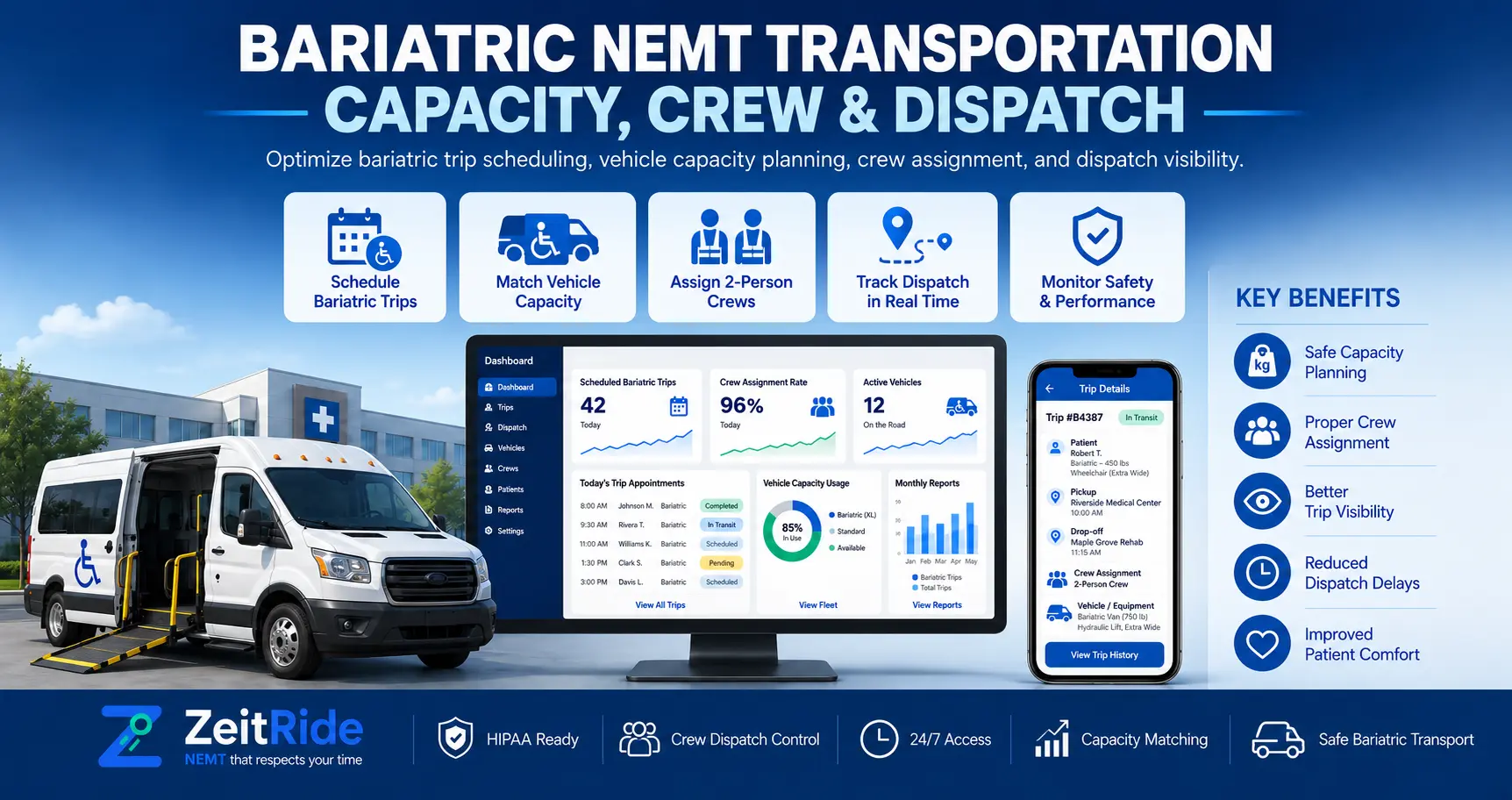
Bariatric NEMT Transportation: Capacity, Crew & Dispatch
A practical guide for NEMT providers to verify bariatric vehicle capacity, plan qualified crews, and dispatch specialized trips with confidence.
Quick answer
Before assigning a bariatric NEMT trip, verify the rider-plus-device load against the actual lift rating, check vehicle fit and securement, and confirm trained staff and pickup access. Resolve missing information and document the final dispatch decision.
ZeitRide Team
NEMT Operations Expert
A dispatch board shows an available driver and an accessible van. The booking looks ready—until the dispatcher learns that the rider uses a heavier power wheelchair and no one has checked the lift's actual rating. The available van may not be the right van.
Bariatric NEMT transportation requires a more precise pre-assignment decision: can the equipment, vehicle, crew, and pickup arrangements safely meet this rider's needs? The goal is not to complicate booking. It is to prevent avoidable dispatch errors while delivering reliable, respectful transportation.
This guide is for US non-emergency medical transportation operators. For general wheelchair assignments, see ZeitRide's wheelchair van dispatch software guide.
What Makes Bariatric NEMT Transportation Different?
Bariatric transportation involves trips requiring additional planning because of a rider's size, mobility equipment, assistance needs, or a combination of these factors. That might involve a higher-rated lift, more interior space, appropriate securement, or additional trained personnel.
There is no single universal weight at which every NEMT trip becomes “bariatric.” The actual question is whether the assigned vehicle and service arrangement meet the documented needs and applicable requirements. It is also important not to confuse non-emergency transportation with medically supervised ambulance service; providers should operate within their authorized scope.
Bariatric NEMT Dispatch: Verify the Trip Before Assignment
Before choosing a driver, collect the details that affect vehicle and crew suitability:
- Occupied device load: Rider weight and wheelchair or mobility-device weight, when relevant to equipment limits.
- Device size and mobility: Type of wheelchair, dimensions, and whether the rider remains seated in it during transport.
- Assistance: Authorized service level, attendants, companions, and any transfer assistance that staff are trained and permitted to provide.
- Location access: Entrance, ramps, stairs, suitable vehicle stopping area, and any obstacles requiring coordination.
- Trip instructions: Appointment time, approved service, payer or broker authorization, and return-trip arrangements.
Confirm missing information with the appropriate coordinator. Do not substitute visual assumptions for capacity facts or place unnecessary diagnoses in driver notes. The NEMT levels of service guide explains assistance categories; this guide focuses on whether the specialized trip is ready to dispatch.
Bariatric Transportation Vehicle Requirements
An accessible label alone does not establish that a van can safely handle an occupied bariatric mobility device. Check five things:
- Lift or ramp rating: Use the capacity shown in the installed equipment's manufacturer documentation.
- Platform and entry clearance: Confirm the device fits the usable platform and can move through the entrance.
- Vehicle limits: Consider manufacturer-rated vehicle loading limits, occupants, and other equipment.
- Securement and restraints: Verify that designated positions and appropriate systems can accommodate the device and occupant.
- Operating condition: Ensure there are no unresolved safety-critical lift, ramp, or securement defects.
The NEMT vehicle inspection checklist covers routine equipment inspection. Bariatric eligibility adds a separate question: is this equipment suitable for this particular occupied device?
Bariatric Wheelchair Lift Capacity: A Worked Example
For an occupied wheelchair, compare the combined rider-and-device weight with the actual lift's rated capacity.
| Example input | Weight |
|---|---|
| Rider | 470 lb |
| Power wheelchair | 240 lb |
| Combined occupied load | 710 lb |
| Van A lift rating | 600 lb |
| Van B lift rating | 800 lb |
Van A must not be assigned for that load: 710 pounds exceeds its 600-pound rating. Van B may be a candidate, but only after confirming the platform, vehicle loading limits, positioning, securement, and remaining safety conditions. These are illustrative figures, not a universal equipment recommendation.
The Federal Transit Administration's lift guidance describes a 600-pound minimum design-load requirement for lifts covered by the relevant DOT accessibility standards. That minimum is not the maximum capacity of every lift, and a design safety factor is not extra permitted operating capacity. For covered operators, FTA wheelchair guidance also explains obligations where equipment is rated above the minimum.
Bariatric Transportation Crew Requirements
There is no nationwide rule requiring exactly two crew members for every bariatric NEMT trip. Staffing depends on the rider's actual assistance needs, equipment, applicable regulations, and state, payer, contract, and company requirements.
Dispatch should verify that the assigned personnel can operate the equipment correctly and provide the authorized assistance. A complex transfer must not become an improvised manual lift by an untrained driver. If a facility must assist, agree on roles before arrival.
For transportation covered by DOT ADA rules, 49 CFR Section 37.173 requires personnel to be trained to proficiency for their duties. Review ZeitRide's NEMT driver requirements guide for wider qualification considerations. Resolve staffing problems through appropriate coordination rather than blanket exclusions based on a rider's weight or disability.
Bariatric Transportation Scheduling and Return Coverage
A vehicle may be suitable yet unavailable for the actual pickup window. Allow realistic time for boarding, securing the device, communicating with the facility, and completing the scheduled journey. Avoid presenting a fixed extra-minute allowance as a nationwide rule.
For each assignment, check whether the crew's shift covers the service, whether the same specialized vehicle is needed for the return, and whether a backup arrangement exists. Will-call returns need a clear contact and a realistic plan for identifying suitable equipment when the rider is ready.
Connected NEMT scheduling software can organize trip times and adjustments, but it cannot replace physical equipment verification.
Bariatric Trip Dispatch Readiness Checklist
Use a simple decision table before releasing a trip to the driver.
| Check | Evidence needed | If missing |
|---|---|---|
| Rider and device | Relevant weight, dimensions, mobility needs | Confirm details |
| Vehicle and lift | Actual ratings, physical fit, working equipment | Find a suitable vehicle |
| Crew | Trained personnel and assistance plan | Arrange qualified coverage |
| Pickup and return | Access instructions, feasible times, return plan | Coordinate or adjust |
| Authorization | Required booking and payer details | Clarify with coordinator |
| Release decision | Mandatory checks complete and recorded | Hold and escalate |
“Hold” means the assignment remains pending while dispatch actively resolves the issue. It is not permission to abandon an authorized passenger or deny service contrary to applicable accessibility obligations.
Example: A Vehicle Is Available, but the Trip Is Not Ready
A dispatcher selects an accessible van for a 710-pound occupied wheelchair. The van's lift is rated for 600 pounds, so the assignment cannot proceed with that equipment. A second vehicle has an 800-pound lift rating, but its available wheelchair position and destination access have not yet been verified.
The supervisor checks those details, confirms appropriate crew coverage, and records the final assignment decision. If the second vehicle cannot meet the requirements, dispatch escalates and coordinates an appropriate alternative with the responsible transportation organization.
The lesson is straightforward: driver availability, seat capacity, and safe bariatric trip eligibility are three different checks.
How ZeitRide Supports Specialized NEMT Dispatch
ZeitRide connects member details, trip booking, driver and vehicle assignment, live dispatch, and field updates. Its documented trip workflow includes mobility types such as Wheelchair XL, attendants, service information, and return legs. This helps dispatchers keep specialized trip instructions attached to the booking.
The platform also supports wheelchair-accessibility matching, live reassignment, driver-app updates, and configurable vehicle inspection workflows. See how its NEMT dispatch software handles changing vehicle and driver assignments.
One distinction matters: ZeitRide's documented dispatch capacity indicators relate to seats and vehicle assignments. They should not be described as automatic wheelchair-lift weight certification. Providers still need reliable equipment ratings and an approved bariatric verification procedure.
See How Specialized Dispatch Works in ZeitRide
Safe bariatric transportation starts with complete trip information, verified equipment, and a clear escalation process. ZeitRide can help keep scheduling and live dispatch connected while your team applies its required equipment and crew checks.
Book a 15-minute ZeitRide demo and bring an anonymized specialized trip example. See the actual workflow and which checks your team must continue to perform.
Frequently Asked Questions
Q: Is 600 pounds the maximum weight for a bariatric NEMT trip?
No. The 600-pound figure is a minimum design-load requirement for certain covered lift equipment, not a universal passenger limit. Confirm the installed equipment's actual rating and the complete vehicle's suitability.
Q: How do dispatchers calculate occupied wheelchair weight?
Add the rider's weight and the mobility device's weight, then check the resulting load against the installed lift's rating. Device dimensions, platform fit, vehicle limits, and safe securement must also be verified.
Q: Do bariatric transports always require two attendants?
No universal nationwide two-attendant rule applies to every trip. Appropriate staffing depends on assistance needs, equipment, training, authorized service, and applicable local or contract requirements.
Q: What if no suitable bariatric vehicle is available?
Do not assign equipment that exceeds its limits. Escalate promptly, contact the responsible broker or coordinator, and arrange an appropriate solution under applicable contracts and accessibility obligations. Document the steps taken.
Q: Can NEMT software verify bariatric weight limits automatically?
Only if that specific capability has been implemented and validated. Scheduling, accessibility flags, and seat-capacity alerts alone do not establish that a lift can safely handle an occupied wheelchair.
Rather see it than read about it?
Bring a real route, a couple of drivers, and your current process. 15 minutes, zero pitch.