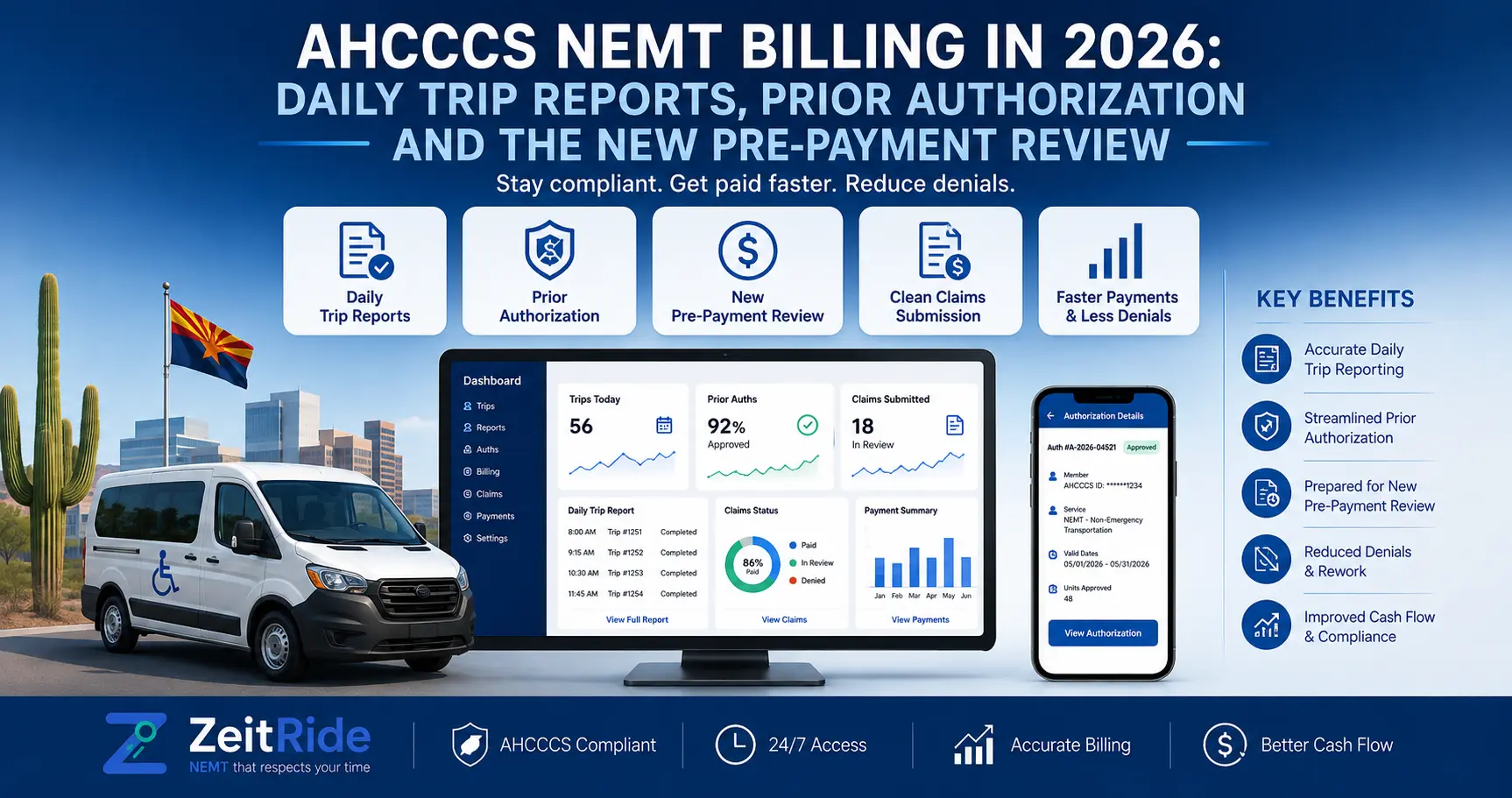
AHCCCS NEMT Billing in 2026: Daily Trip Reports, Prior Authorization and the New Pre-Payment Review
How Arizona NEMT providers bill AHCCCS fee-for-service trips in 2026: Daily Trip Report fields, the 100-mile PA rule, the new rural mileage rate and the AI pre-payment review.
How do I bill AHCCCS for NEMT trips?
Quick answer
Register as AHCCCS provider type 28, then bill fee-for-service trips on a CMS-1500 or 837P with one claim per member per day: base rate, loaded mileage and any authorized wait time, plus the official AHCCCS Daily Trip Report. Trips of 100 miles or more need prior authorization, and since July 2026 fee-for-service NEMT claims go through an AI-assisted pre-payment review.
NEMT Operations Expert
AHCCCS NEMT billing is how a registered transportation provider gets paid by Arizona Medicaid for fee-for-service rides: one claim per member per day, an official Daily Trip Report attached, prior authorization for trips of 100 miles or more, and loaded mileage reported exactly. Since July 2026 those claims also pass through an AI-assisted pre-payment review that started with NEMT.
Most denials don't come from rates or eligibility. They come from the paperwork: a driver who signed with initials, a facility listed without a street address, a rounded mileage figure. This guide walks through each rule your billing desk has to meet in 2026, using AHCCCS's own manuals, so your claims clear the first time.
Who Bills AHCCCS Directly for NEMT?
Arizona serves most Medicaid members through health plans, so most rides are billed to a plan, not to the state. AHCCCS's Division of Fee-for-Service Management (DFSM) pays transportation claims directly only for members who are not in a plan, such as those enrolled in the American Indian Health Program (AIHP), plus trips by IHS and Tribal 638 providers.
| Who you transported | Who you bill | Prior authorization over 100 miles |
|---|---|---|
| Fee-for-service member (for example AIHP) | AHCCCS through DFSM | AHCCCS prior authorization |
| Health plan (acute care) member | That member's health plan | Health plan's rules |
| ALTCS member in a plan | That member's health plan | Member's case manager |
| Any member, trip by an IHS or Tribal 638 provider | AHCCCS | Not required |
| Behavioral health trip under a TRBHA or RBHA | That TRBHA or RBHA | TRBHA or RBHA rules |
Keep the funding source on every trip from the moment it is booked. A van that carries an AIHP member at 8 a.m. and a plan member at 9 a.m. produces two claims to two payers with two rule sets, and mixing them up is a denial before anyone reads the trip report.
AHCCCS Provider Type 28: What You Need Before the First Claim
Non-emergency transportation companies register as AHCCCS provider type 28 in the AHCCCS Provider Enrollment Portal (APEP). AHCCCS screens them at its high-risk level, which means an enrollment fee, a site visit and a fingerprint background check. NPI is not required. The current provider type 28 profile, revised in September 2026, asks for:
- Vehicle insurance and registration for company vehicles
- A signed provider type 28 profile form
- An Arizona Department of Transportation Vehicle for Hire permit
- A tribal business license from each tribe whose lands you serve
- Each driver's full legal name, date of birth, SSN and employment dates
- The AHCCCS NEMT training certificate, course HCNEMT2026 in AZLearns, taken by the owner
The training moved from TraCorp to AZLearns in late summer 2026, so certificates for new enrollments and revalidations now come from AZLearns. Vehicles must display your company logo, which the site visit checks. Drivers need a valid Arizona license plus CPR, First Aid and HIPAA training, and driver changes must be reported in APEP within 30 days.
That last rule is a billing rule in disguise. A claim is denied when the driver on the trip report is not on your most recently uploaded driver list or was not employed on the date of service. NEMT compliance tracking that flags expiring licenses and new hires keeps APEP current. If you are still setting up the company, our guide to starting a transportation business in Arizona covers the steps before registration.
AHCCCS Daily Trip Report Requirements, Field by Field
Every fee-for-service claim needs the AHCCCS Daily Trip Report (Exhibit 14-1); a claim without one is denied. The FFS Provider Billing Manual, Chapter 14, last revised July 31, 2026, accepts only the official form, uploaded as a PDF through the 275 portal or mailed. HTML files are refused, and a PDF must allow text extraction. AHCCCS's Daily Trip Report reminders list the fields that trigger AHCCCS trip report denials most often:
| Field | What AHCCCS expects | Denied when |
|---|---|---|
| Provider block | Name, 6-digit AHCCCS provider ID, address and phone (a stamp is fine) | Any part is missing |
| Driver name | Full first and last name | Initials, first name only or last name only |
| Vehicle | Plate or fleet number, state, make, color and vehicle type | Type written as 'AMB' or 'Ambulatory', or color missing |
| Member ID | AHCCCS ID: capital A plus 8 digits | Missing or wrong format |
| Addresses | Full pickup address; facility name plus street address | Facility name without an address |
| Times and odometer | Pickup and drop-off times with a.m./p.m., actual odometer readings | Readings that don't match the route |
| Reason for visit | Service type, set before the trip | Left blank |
| Signatures | Member (or named representative) and driver, by hand | Typed names, or the driver signing for the member |
| Pages | 'Page 1 of 2', member name, ID and date of birth on page 2 | Missing page numbers or page 2 details |
The July 2026 driver signature rule
The July 31, 2026 revision spells out the driver's part: print a full name and date the first page, then sign and date the second page. A signature can't be initials, a symbol or a stamp. Electronic trip reports are allowed when the driver and member can sign with an electronic pen or fingertip, which is how electronic signatures in a driver app should work.
Multi-rider trips
Each member on a shared ride needs a separate trip report with that member's own pickup and drop-off. Odometer miles must reflect the most direct route for that member, so never add diverted miles to anyone's total. Wait time is paid for one member at most.
How to Build an AHCCCS NEMT Claim
Bill on a CMS-1500 or an 837P, through AHCCCS Online or your clearinghouse. All of a member's transport on one date goes on one claim with one trip report, and AHCCCS denies any line beyond these three:
- Line 1: the base rate, with the number of trips as units (two units for a round trip)
- Line 2: loaded mileage, the statute miles driven with the member on board
- Line 3: wait time (T2007), only when it is authorized and allowed
Report actual mileage. AHCCCS checks the reported miles against the start and end points and audits mileage after payment, and rounded or mismatched miles are denied. Never put two dates of service on one claim line, and keep a separate trip report for each date.
AHCCCS NEMT Prior Authorization, Wait Time and Rural Mileage
Prior authorization at 100 miles
AHCCCS NEMT prior authorization is required for fee-for-service trips of 100 miles or more, whether one way, round trip or several trips that day. Your company must already be registered when you ask, and only the base and mileage codes are authorized. For AIHP members on a reservation, AHCCCS won't issue it unless your tribal business license is on file. Cutting reported miles to stay under 100 is a denial, not a workaround.
Wait time
T2007 is billed in 30-minute units, only for time the driver actually waited at the medical destination because driving back to base wasn't practical. It is not payable for one-way trips, waits under 30 minutes, destinations 10 miles away or less, two vehicles or drivers, or when the odometer moved between drop-off and pickup. Our guide to NEMT wait time billing shows how to log it.
AHCCCS NEMT rates for 2026–2027 and the TN modifier
The TN modifier marks rural trips: transports that start outside the Phoenix and Tucson metro areas. The final FFY 2027 rates notice raised rural non-emergency mileage, S0215 with TN, to $1.63 per mile from October 1, 2026 through September 30, 2027, citing dirt roads, long distances and too few providers. A 60-mile loaded trip from a rural pickup now pays $97.80 in mileage before the base rate. Putting TN on an urban pickup is a denial.
How the AHCCCS Pre-Payment Review Changes NEMT Billing
In July 2026 AHCCCS began scoring fee-for-service claims for fraud, waste and abuse risk before payment, with the Alivia 360 platform. The July 2026 program integrity webinar.pdf) says the first releases, on June 29 and July 20, focus on NEMT and behavioral health claims billed directly to AHCCCS. Plan claims are not part of it.
For providers, the practical effect is that trip report quality now decides how fast you are paid. The webinar lists the problems reviewers see most:
- Handwriting reviewers can't read
- Trip reports not on the official AHCCCS form
- Altered forms, with erased sections or changed required fields
- Missing page numbers, a member's name missing from a page or no vehicle color
Correcting a denied claim
Void the denied claim and submit a replacement that fixes every error from the review. Correct the original trip report rather than writing a new one: cross out the mistake, write the right entry, then add the initials or name of whoever changed it and the date. No white-out. If a report was denied for using a wrong or altered form, it can't be resubmitted; send a new claim with new attachments. Tracking each resubmission against what was paid is easier with remittance reconciliation on the same trip record.
A Billing Workflow That Keeps AHCCCS Claims Clean
Paper trip reports fail on the details because they are filled in at the end of a long shift. The fix is to capture each field when it happens and treat the trip report as an output of the trip, not a separate chore. A workflow that holds up under pre-payment review looks like this:
- Tag the payer at booking: AIHP, plan, ALTCS case manager or TRBHA
- Flag trips near 100 miles at booking and request authorization before the ride
- Assign only drivers who are on your latest APEP driver list
- Capture times, odometer readings, GPS points and hand-drawn signatures in the driver app
- Check every trip report against the field table before it goes into the 275 portal
- Log denials by reason code each month and fix the cause, not just the claim
ZeitRide's NEMT billing software builds billing records from what the driver app recorded on the trip, so your team copies facts onto the official form instead of rebuilding the day from memory. For the wider picture, our article on NEMT claim denials covers the patterns that repeat across states. If you'd like to see a mixed AIHP and health plan day in one dispatch board, book a ZeitRide demo.
Getting AHCCCS NEMT Billing Right in 2026
AHCCCS NEMT billing rewards discipline: the right payer, a registered driver, one claim per member per day, an untouched official trip report, authorization at 100 miles and exact loaded miles. With the July 2026 signature rule, the new rural rate and AI-assisted pre-payment review now in place, the providers who capture trip data cleanly will get paid first.
ZeitRide puts scheduling, dispatch, routing, the driver app, compliance tracking and billing in one platform for $49 per vehicle per month, with no contract. Talk to our team and we'll show you how your trip data lines up with what AHCCCS asks for.
Frequently Asked Questions
Q: Does AHCCCS require prior authorization for NEMT?
Yes, for fee-for-service trips of 100 miles or more, whether one way, round trip or several trips on the same day. You must be registered with AHCCCS before you ask, and only base and mileage codes are authorized. IHS and Tribal 638 providers don't need it, and ALTCS members get approval from their case manager.
Q: Can I use my own trip report form for AHCCCS claims?
No. AHCCCS accepts only its official Daily Trip Report, Exhibit 14-1. Custom versions and HTML files are rejected. Electronic copies are fine if the driver and member can sign with an electronic pen or fingertip, and you upload the report as a PDF that allows text extraction.
Q: How is wait time billed for AHCCCS NEMT?
Wait time uses code T2007 in 30-minute units on the third claim line. It covers only time the driver actually waited at the medical destination when going back to base was not practical. It can't be billed for one-way trips, waits under 30 minutes, trips of 10 miles or less, or when the odometer moved.
Q: When do I use the TN modifier on AHCCCS mileage?
Use TN only when the pickup is outside the Phoenix and Tucson metro areas. Urban pickups billed with TN are denied. From October 1, 2026, rural non-emergency mileage (S0215 with TN) pays $1.63 per mile under the AHCCCS fee-for-service schedule, through September 30, 2027.
Q: How do I fix a denied AHCCCS trip report?
Void the denied claim and submit a replacement that fixes every error from the review. Correct the original trip report: cross out the mistake, write the right entry and add initials and the date, with no white-out. A report denied for using an altered or wrong form needs a new claim and new attachments.
Q: Can drivers sign AHCCCS trip reports electronically?
Yes, if the device lets the driver and member sign by hand with an electronic pen or fingertip. Typed names don't count. Since the July 31, 2026 manual update, the driver prints a full name and dates page one, then signs and dates page two; initials, symbols and stamps are not accepted.
Rather see it than read about it?
Bring a real route, a couple of drivers, and your current process. 15 minutes, zero pitch.