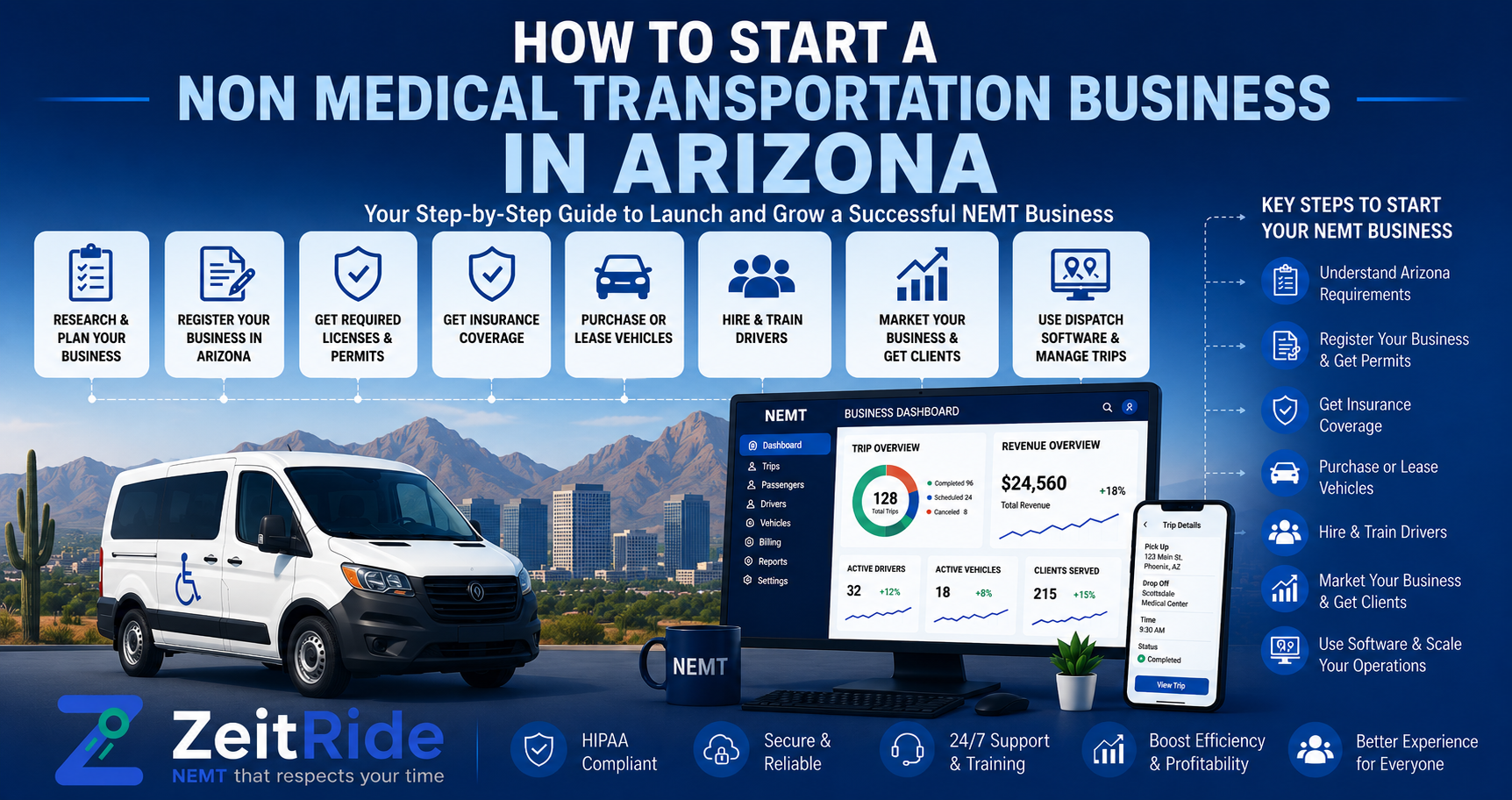
How to start a non medical transportation business in Arizona
Learn how to start a non medical transportation business in Arizona with this step-by-step guide covering AHCCCS enrollment, licensing, insurance, vehicles, software, and startup costs.
Quick answer
To start a non medical transportation business in Arizona, you need to register your business, obtain an EIN, complete AHCCCS provider enrollment, secure commercial insurance, purchase compliant vehicles, hire qualified drivers, and implement NEMT dispatch and billing software.
ZeitRide Team
NEMT Operations Expert
Arizona has roughly 1.4 million AHCCCS-enrolled Medicaid members, and a significant share of them need rides to dialysis in Mesa, chemo in Scottsdale, behavioral health visits in Tucson, and therapy appointments across rural Maricopa and Pinal counties. If you want to start a non medical transportation business in Arizona, you're entering a market with real, recurring demand. But the operators who last are the ones who treat compliance, route efficiency, and software setup as seriously as buying their first van. This guide covers every step.
What a Non Medical Transportation Business Actually Does
A non emergency medical transportation business moves Medicaid-eligible passengers to scheduled, non-emergency medical appointments — dialysis, cancer treatment, physical therapy, behavioral health visits, and routine checkups. You are not an ambulance. You are not on-call for 911 emergencies. You are a scheduled, credentialed, HIPAA-aware transportation provider whose passengers depend on you showing up on time, every time.
In Arizona, NEMT is administered through AHCCCS (Arizona Health Care Cost Containment System), which merged NEMT administration for both physical and behavioral health services under one roof in 2016. This means your credentialing, billing, and trip verification all run through a single system — which simplifies enrollment but demands that you understand the state's documentation requirements before you take your first trip.
The three main service categories in Arizona NEMT:
- Ambulatory transport — passengers who board and exit independently; lowest equipment cost, fastest entry
- Wheelchair-accessible van (WAV) — requires ADA-compliant ramp or lift, four-point securement systems, and verified ADA modifications
- Stretcher van — highest reimbursement rate, highest compliance bar; passengers remain reclined during transport
Most new operators start with ambulatory service, add a WAV within the first year once revenue stabilizes, and consider stretcher service only after establishing a solid Medicaid billing history with AHCCCS.
How to Start a Non Medical Transportation Business in Arizona: Step by Step
Starting a medical non emergency transportation business in Arizona follows a specific sequence. Skip steps or reorder them and you'll face delays, denied enrollment, or uninsurable vehicles.
Step 1 — Form Your Legal Business Entity
Register an LLC or corporation with the Arizona Corporation Commission. An LLC costs $50–$85 to file and separates your personal assets from business liability — critical when you're transporting medically fragile passengers. Get your EIN from IRS.gov immediately after, and open a dedicated business bank account before you spend another dollar.
Step 2 — Complete Your AHCCCS Provider Enrollment
This is the step most new operators underestimate. Arizona AHCCCS NEMT enrollment is not fast. Budget 60 days minimum. Required documentation includes:
- NPI number (obtained free through NPPES)
- Signed and dated Provider 28 Profile Form
- ADOT Vehicle Hire Permit for every vehicle
- AHCCCS NEMT Training Certification
- W-9 tax form (required for Medicaid payment)
- Background check clearance for all drivers
Step 3 — Obtain Your Insurance
You cannot legally transport a single AHCCCS member without valid commercial insurance meeting state minimums. For most Arizona NEMT providers, the minimum stack is:
- Commercial Auto Liability: $1,000,000 CSL
- General Liability: $1,000,000 per occurrence / $2,000,000 aggregate
- Physical damage coverage for all vehicles in your fleet
Step 4 — Purchase and Equip Your Vehicles
A clean, inspected wheelchair-accessible van in the 3–6 year age range typically costs $18,000–$40,000. Required equipment under Arizona and ADA standards:
- Q-straint or equivalent 4-point wheelchair securement system
- ADA-compliant ramp or lift, inspected and operational
- First aid kit and fire extinguisher
- Non-slip flooring
- Vehicle logo or identification required by AHCCCS
Most Medicaid brokers in Arizona also require a GPS tracker and dash camera. This is not optional if you plan to credential with the dominant regional brokers — and it's the right call anyway. A GPS-tracked fleet is an insurable, auditable fleet.
Step 5 — Hire, Train, and Credential Your Drivers
Driver quality is the single most controllable variable in whether your non emergency medical transportation business plan succeeds or stalls. Arizona requires:
- Valid Arizona driver's license with clean MVR (no DUI, no more than 1–2 minor violations in 3 years)
- Federal and state criminal background check
- Sex offender registry check
- CPR and First Aid certification
Build a Driver Policy Manual from week one. Document your pre-trip inspection process, patient loading procedure, incident reporting protocol, and no-show policy. Brokers and auditors will ask for this documentation.
Step 6 — Credential With Arizona's Active NEMT Brokers
AHCCCS works with transportation brokers to dispatch trips to credentialed providers. The key active brokers in Arizona's NEMT market include MTM Health and regional managed care organizations. Getting into their systems is separate from your AHCCCS enrollment and typically takes an additional 2–6 weeks. Start the credentialing process in parallel with your state enrollment — not after.
Step 7 — Set Up Your Dispatch and Billing Software
Running a non emergency medical transportation business on a spreadsheet or a whiteboard is how operators miss trips, submit bad claims, and lose broker contracts inside the first six months. You need purpose-built NEMT dispatch software from day one.
What your software must handle:
- Trip scheduling and real-time dispatch
- AI route optimization to minimize drive time across Phoenix metro and rural corridors
- Driver assignment and GPS verification
- Electronic trip records for AHCCCS billing compliance
- Medicaid claim submission and remittance tracking
- NEMT billing software integration with broker EDI feeds
ZeitRide covers all of this at $49 per vehicle per month — everything included, no per-trip fees, no setup cost, no annual contracts. Most providers go live within 30 minutes. Tony Jackson, owner of Top Choice Medical Transport, said ZeitRide cut his booking time in half — going from 5–6 minutes per trip to booking in two or three minutes.
Your Non Emergency Medical Transportation Business Plan: The Numbers
On the revenue side, AHCCCS reimbursement for ambulatory trips typically runs $18–$45 per one-way trip, with WAV trips fetching $35–$80+. A single ambulatory vehicle running 8–10 trips per day at a blended $30 rate generates roughly $5,400–$6,750 per month in gross revenue. After fuel, insurance, and a driver, experienced operators targeting direct contracts with dialysis centers and senior living communities in Phoenix or Tucson can push net margins into the 25–35% range.
Plan for your growth sequence from the start: Medicaid broker trips build your track record. Direct contracts with Sonoran Desert healthcare facilities, senior communities in Scottsdale and Sun City, and behavioral health centers in South Phoenix deliver higher per-trip margins and predictable recurring volume.
What Operators Get Wrong When Starting a Non Medical Transportation Business
They treat software as an afterthought. The operators who struggle longest are the ones who start on paper dispatch systems and try to retrofit software later. By the time they add 3–5 vehicles, they're manually reconciling billing records, missing remittance, and losing broker trips because they can't confirm pickup windows fast enough.
A platform like ZeitRide's NEMT scheduling software handles broker import from MTM Health, CTS Transit, Provide A Ride, ProCare, and DD Med Trans — meaning your dispatchers aren't manually entering trips from broker portals. Sandra Mills, fleet manager at SafeTrip NEMT, runs three fewer vehicles per day for the same member count after switching to AI-powered route optimization. That's not an abstraction; that's $147/day in vehicle operating costs eliminated.
Who This Guide Is Built For
This breakdown applies directly to three operator profiles entering the Arizona non medical transportation business market:
Fleet owners starting from scratch — You're buying your first 1–3 vehicles, completing AHCCCS enrollment for the first time, and need to understand the full compliance and operational stack before you sign a single contract.
Dispatchers moving into ownership — You've been running someone else's routes for years and understand the workflow. What you need is the business structure, licensing sequence, and software setup that lets you run your own operation without recreating a dispatch system from scratch.
Operations directors scaling an existing fleet — You're already credentialed and running trips, but your current tools can't keep up with growth. You need AI routing, multi-broker import, and billing automation that doesn't require a full-time administrator.
ZeitRide's driver app runs on iOS and Android, works in offline GPS mode for low-signal rural Arizona corridors, and takes most drivers under 15 minutes to learn. Marcus Johnson, owner of Skyline Medical Transport, said it saves roughly a full day's worth of administrative time per week. For a new Arizona provider juggling AHCCCS paperwork, broker credentialing, and driver training simultaneously, that's the kind of time that keeps your operation from falling behind before it gains momentum.
For additional context on how established NEMT operators structure their software and billing, see the best NEMT scheduling software guide and best billing software for non-emergency medical transportation.
Conclusion
Starting a non medical transportation business in Arizona is a legitimate, high-demand business opportunity — but the operators who thrive are the ones who respect the compliance requirements, understand the Arizona AHCCCS enrollment process, and set up the right tools before they take their first trip. Budget 60 days for AHCCCS enrollment, credential with MTM Health and other active Arizona brokers simultaneously, and don't wait to set up dispatch and billing software. ZeitRide runs in 10+ states at $49/vehicle/month — no setup fees, no contracts, first route live within a day. For a closer look at what NEMT software costs across the industry, see how much NEMT software costs. Start your first live Arizona route within a day. $49/vehicle. No contracts. Book your demo.
Q: What licenses do I need to start a non medical transportation business in Arizona?
You need AHCCCS NEMT provider enrollment, an ADOT Vehicle Hire Permit for each vehicle, vehicle registration and insurance meeting state minimums, and AHCCCS NEMT Training Certification. Individual drivers also need PASS Certification and cleared background checks. Processing takes approximately 60 days for AHCCCS enrollment, so start early.
Q: How much does it cost to start a non emergency medical transportation business in Arizona?
A realistic single-vehicle startup runs $25,000–$55,000, covering vehicle purchase, first-year insurance ($4,200–$12,000), the $688 AHCCCS enrollment fee, permits, equipment, and initial operating capital. Ongoing NEMT software costs as little as $49/vehicle/month with ZeitRide — no setup fees, no contracts.
Q: How does Arizona's AHCCCS NEMT system work for new providers?
AHCCCS administers both physical and behavioral health NEMT benefits through a single enrollment system. Once enrolled, your trips are dispatched through contracted transportation brokers, including MTM Health and regional managed care organizations. You bill via CMS 1500 claim forms with mileage measured as statute miles while the passenger is in the vehicle.
Q: Do I need special software to run a non medical transportation business?
Yes — purpose-built NEMT dispatch software is not optional for a compliant, scalable operation. You need trip scheduling, electronic trip verification, GPS tracking, Medicaid billing, and broker EDI integration. ZeitRide covers all of this at $49/vehicle/month, connects directly with MTM Health, Provide A Ride, CTS Transit, ProCare, and DD Med Trans, and goes live within 30 minutes of setup. See the complete NEMT software guide for a full breakdown.
Q: What is the PASS certification and is it required in Arizona?
PASS (Passenger Assistance Safety and Sensitivity) is a three-day driver certification program that teaches safe transport techniques for passengers with disabilities and medical needs. AHCCCS expects it, most Medicaid brokers require it for credentialing, and your insurance carrier may discount premiums for certified drivers. Certification is valid for three years and renewable through in-person or online workshop.
Rather see it than read about it?
Bring a real route, a couple of drivers, and your current process. 15 minutes, zero pitch.