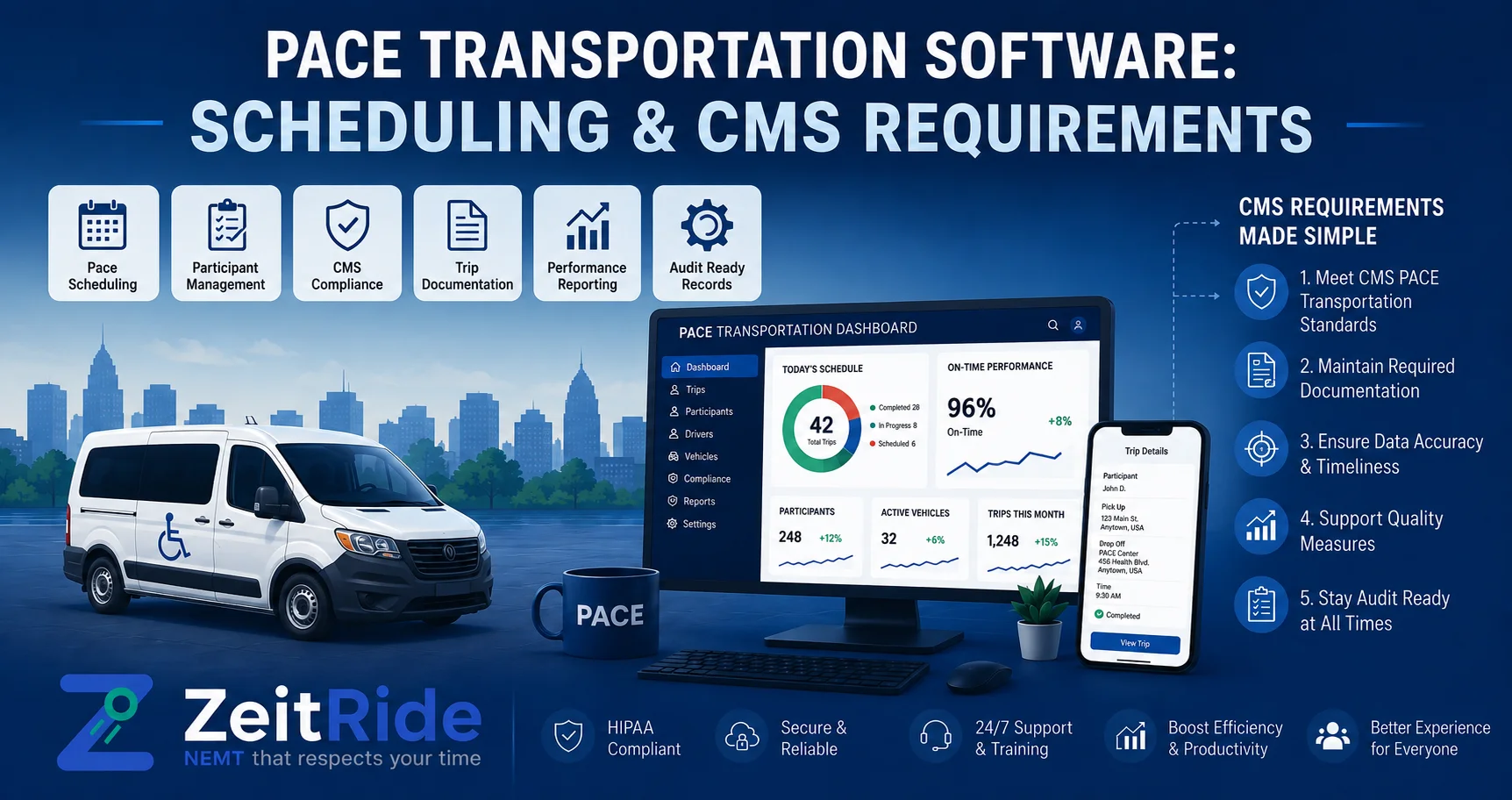
PACE Transportation Software: Scheduling & CMS Requirements
Learn how PACE transportation software helps manage recurring routes, live dispatch, participant needs, and CMS transportation requirements.
Quick answer
PACE transportation software helps PACE programs schedule recurring rides, dispatch vehicles, match participant mobility needs, communicate changes, and maintain transportation records. It can support workflows tied to 42 CFR § 460.76, but software alone does not guarantee compliance.
ZeitRide Team
NEMT Operations Expert
PACE transportation software helps Programs of All-Inclusive Care for the Elderly coordinate recurring center rides, medical appointments, drivers, vehicles, same-day changes, participant transportation needs, and trip records from one operational system.
For a PACE organization, transportation is more than a route-planning problem. Medicare includes transportation to and from the PACE center and medical appointments among PACE services, while federal transportation rules address accessibility, vehicle maintenance, communication, training, and care-plan changes. Medicare's PACE overview explains the broader program, while 42 CFR § 460.76 sets specific federal transportation requirements.
That makes the right software an operational tool for connecting scheduling, dispatch, participant information, drivers, vehicles, and documentation — not simply finding the shortest drive between stops.
What Is PACE Transportation Software?
PACE transportation software is technology used to organize transportation for participants enrolled in Programs of All-Inclusive Care for the Elderly. It can help transportation teams build recurring schedules, assign appropriate vehicles and drivers, dispatch daily routes, communicate changes, monitor trip progress, and maintain operational records.
A useful PACE program transportation software platform should connect those workflows. When scheduling lives in one system, dispatch in another, participant notes in a spreadsheet, and drivers receive changes by phone or text, a single schedule change can require several people to update the same information manually.
PACE-specific transportation does not require a particular software brand under federal law. Instead, the regulations place responsibilities on the PACE organization. The purpose of software is to make those responsibilities easier to manage consistently.
Why PACE Transportation Is Different From a Standard Daily Route
PACE transportation combines recurring transportation with participant-specific care and operational changes.
- Participants attending a PACE center on different days of the week
- Recurring morning pickups and afternoon return trips
- Medical appointments outside the normal center schedule
- Wheelchair, ambulatory, capacity, or other vehicle considerations
- Cancellations, hospitalizations, appointment changes, and same-day additions
- Driver callouts or vehicles becoming unavailable
- Relevant participant instructions changing over time
- Multiple participants traveling toward the same center or appointment area
The result is a schedule that repeats frequently but rarely stays completely static. That is why PACE transportation scheduling should preserve the underlying recurring plan while allowing the transportation team to manage exceptions without rebuilding an entire route.
What Are the Federal PACE Transportation Requirements?
Federal PACE transportation requirements are set out in 42 CFR § 460.76. The rule applies to the PACE organization's transportation responsibilities, including transportation delivered through contractors.
The regulation addresses several important transportation responsibilities, including safe and accessible transportation, maintenance of transportation vehicles, communication between vehicles and the PACE center, transportation-personnel training, and communication of relevant participant care-plan changes.
| Federal Requirement | Operational Meaning | How Software Can Support the Workflow |
|---|---|---|
| Safe, accessible, appropriately equipped transportation | Transportation must meet the needs of the participant population | Store participant mobility needs and vehicle capabilities so schedulers can make appropriate assignments |
| Vehicle maintenance | Owned, rented, leased, and contractor vehicles must be maintained as required | Track vehicles, maintenance dates, inspections, and supporting records |
| Communication with the PACE center | Transportation vehicles must be able to communicate with the PACE center | Connect dispatch and drivers through a mobile app or live operational system |
| Transportation personnel training | Personnel must be trained for participant special needs and emergency situations | Track documentation and make relevant operating instructions accessible to staff |
| Relevant care-plan changes | Relevant changes must be communicated to transportation personnel through the interdisciplinary-team process | Update participant instructions centrally and distribute operational changes to the people running the trip |
CMS guidance also states that transportation is provided as indicated in the participant's plan of care and connects transportation communication to the interdisciplinary team process. See the CMS PACE Chapter 6 service guidance for the agency's transportation discussion.
Software can support these workflows and their documentation, but it does not by itself certify a PACE organization as compliant. Federal, state, contractual, clinical, personnel, vehicle, and operating requirements still have to be evaluated and followed by the organization.
How Should PACE Transportation Scheduling Handle Recurring Routes?
Build the Recurring Pattern Once
Repeated center transportation should not have to be manually re-entered every week. A recurring route should be able to store the participant, pickup location, destination, applicable days, timing, vehicle requirements, route assignment, and other operational instructions. ZeitRide's recurring route automation is designed around this standing-route model so future trips can be generated without rebuilding the same schedule repeatedly.
This matters particularly when one participant attends the center Monday, Wednesday, and Friday while another rides Tuesday and Thursday. The route needs a repeatable structure without assuming every participant follows the same weekly pattern.
Separate the Master Schedule From Daily Exceptions
A well-designed recurring schedule must also allow a dispatcher to change one day's trip without accidentally changing every future occurrence. A participant may be absent for one day, a medical appointment may move, a vehicle may require maintenance, or a driver may call out.
The transportation team should be able to pause, edit, reassign, or override the affected trip while preserving the underlying recurring series. That is an important distinction when evaluating NEMT scheduling software for PACE operations.
Keep Participant Needs Attached to the Trip
A participant's transportation requirements should not depend on a dispatcher remembering a note from last week. Relevant mobility and transportation information should follow the participant into scheduling and vehicle assignment so staff can see it when a trip is created, changed, or dispatched.
Live Dispatch Matters When the PACE Day Changes
A recurring schedule solves the predictable part of transportation. Live dispatch handles everything that becomes unpredictable after the day starts.
Consider a participant whose return time changes after an appointment. The dispatcher may need to see where the assigned vehicle is, whether another driver is closer, what other participants are already on that route, and whether changing the assignment creates a new conflict.
With live NEMT dispatch, the goal is to give the office and field one current version of the trip rather than relying on calls, texts, paper manifests, and separate spreadsheets.
- The participant and current trip status
- Assigned driver and vehicle
- Pickup and destination
- Route position
- Relevant transportation instructions
- Delays, cancellations, or same-day changes
- The next action required
This type of connected workflow can also support the federal requirement that transportation vehicles be able to communicate with the PACE center. The regulation defines the responsibility; transportation technology provides a practical way to support the communication process.
Route Optimization Should Respect Participant Needs
The mathematically shortest route is not automatically the best PACE route. PACE transportation may involve shared center trips, mobility constraints, time windows, vehicle capacity, multiple pickup locations, and participants who should not spend unnecessary time in a vehicle.
That means route optimization has to consider operational constraints rather than distance alone. ZeitRide's AI-assisted NEMT routing connects routing with scheduling and dispatch so route changes can stay aligned with the rest of the operation.
The important buyer question is not simply, "Does the system optimize routes?" It is, "Which participant, vehicle, capacity, timing, and operational constraints does the optimizer actually respect?"
What Should You Test in PACE Transportation Technology?
A software demonstration is most useful when you test real exceptions rather than watching a perfect sample route.
| Workflow to Test | What You Should Ask to See |
|---|---|
| Recurring center transportation | Build one participant's weekly schedule and generate future trips |
| Single-day exception | Cancel or change one trip without damaging the recurring series |
| Mobility requirement | Change a participant's vehicle requirement and show how assignments respond |
| Driver callout | Reassign an active route and push the change to the replacement driver |
| Same-day appointment change | Move a pickup and show how dispatch and the driver's route update |
| Historical record | Show what information remains after a trip or assignment is changed |
| Vehicle issue | Replace a vehicle while preserving the route and participant requirements |
| Driver communication | Send an updated route or instruction through the field workflow |
This approach exposes the difference between a feature that exists on a checklist and PACE transportation technology that can handle the real operating day.
How ZeitRide Supports PACE Transportation Management
ZeitRide combines workflows that matter for recurring PACE transportation, including recurring route schedules, per-member day-of-week assignments, date-specific overrides, live dispatch, AI-assisted stop sequencing, participant and vehicle records, a native driver application, offline GPS, inspections, e-signatures, multi-facility operations, and audit history.
You can see the broader workflow in how ZeitRide works, while the ZeitRide Driver app shows how route information, navigation, trip statuses, forms, inspections, and field updates reach drivers.
The value of connecting these workflows is simple: the recurring schedule, today's dispatch board, the vehicle, the driver, and the field record should reflect the same trip rather than five different versions of it.
For a PACE program, that creates a more practical foundation for recurring transportation and daily exception management while keeping participant needs visible throughout the workflow.
Frequently Asked Questions
Q: What is PACE transportation software?
PACE transportation software helps PACE organizations coordinate participant transportation, including recurring schedules, route planning, vehicle and driver assignments, live dispatch, field communication, and transportation records.
Q: What are the main PACE transportation requirements under CMS rules?
42 CFR § 460.76 addresses safe and accessible transportation, vehicle maintenance, vehicle communication with the PACE center, transportation-personnel training, and communication of relevant care-plan changes to transportation personnel.
Q: Can PACE transportation software manage recurring center routes?
Yes. Software that supports recurring or standing transportation can let staff create a repeating schedule once while changing, pausing, or reassigning individual trips without rebuilding the entire series.
Q: What does PACE transportation management include?
PACE transportation management can include participant scheduling, recurring routes, accessible vehicle assignment, driver coordination, dispatch, same-day exceptions, trip status, vehicle records, maintenance oversight, reporting, and documentation.
Q: Does PACE transportation software make an organization CMS compliant?
No. Software can support communication, scheduling, recordkeeping, vehicle management, and other operational processes, but compliance remains the responsibility of the PACE organization.
Bring One PACE Route. We'll Run It Live.
You do not have to judge transportation software from a generic presentation. Bring one real recurring PACE workflow — participant schedules, route structure, vehicles, and the types of exceptions your transportation team handles. ZeitRide can walk through how that route would be scheduled, dispatched, updated, and delivered to drivers in the platform.
See how ZeitRide handles recurring PACE transportation in a real workflow — book a demo and bring one of your own routes.
Rather see it than read about it?
Bring a real route, a couple of drivers, and your current process. 15 minutes, zero pitch.