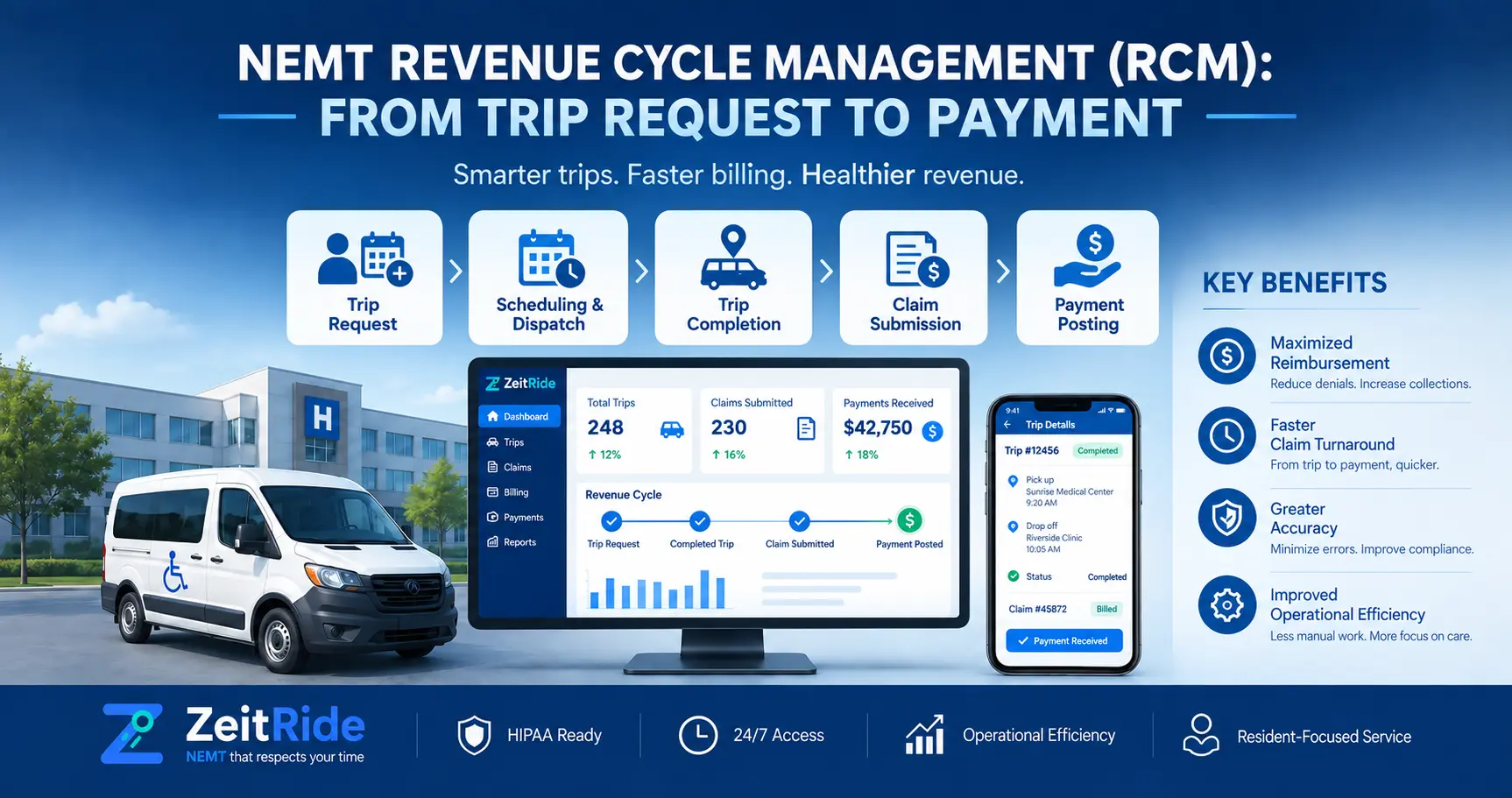
NEMT Revenue Cycle Management (RCM): From Trip Request to Payment
Learn how NEMT revenue cycle management connects eligibility, trip documentation, billing, denials, payments, and reconciliation from request to cash.
Quick answer
NEMT revenue cycle management (RCM) is the end-to-end process of turning a trip request into collected revenue by connecting eligibility, authorization, trip documentation, billing, claim follow-up, payment posting, and reconciliation.
ZeitRide Team
NEMT Operations Expert
An NEMT trip can be completed operationally and still be incomplete financially. The rider reaches the appointment, the driver closes the trip, and dispatch moves on — but the ride may still be missing information required for billing, rejected by a payer, short-paid, or never matched to payment. That is where NEMT revenue cycle management matters. RCM connects the information created before, during, and after transportation so providers can trace a trip from the original request through eligibility, authorization, service delivery, documentation, billing, payment, and reconciliation. Billing is one part of that process. Revenue cycle management covers the entire trip-to-payment lifecycle.
What Is NEMT Revenue Cycle Management?
NEMT revenue cycle management (RCM) is the end-to-end process of converting a valid transportation request into collected and reconciled revenue. It connects trip intake, eligibility, authorization, scheduling, service documentation, billing preparation, claim or invoice submission, rejection and denial management, payment posting, and reconciliation.
A useful NEMT RCM process answers one question at every stage: can you prove that each payable trip was authorized where required, performed correctly, documented correctly, billed correctly, and ultimately paid correctly? This is why revenue cycle management begins before a claim is created. A billing team cannot reliably fix information that was never captured during intake or service delivery.
How Does the NEMT Revenue Cycle Work?
A practical NEMT revenue cycle can be divided into seven connected stages. Each stage creates information that affects whether the trip eventually becomes collected revenue.
1. Trip Intake and Payer Responsibility
The financial lifecycle starts when the transportation request enters the company. Staff should know who is traveling, when transportation is required, the requested service level, origin and destination, and who is expected to pay. That payer may be a Medicaid program, managed care organization, transportation broker, healthcare facility, or private-pay customer. Incorrect payer or member information at intake can create problems throughout the rest of the revenue cycle.
2. Eligibility and Authorization
Eligibility and authorization should not be treated as the same thing. A rider may have active coverage but still require transportation authorization, a broker trip reference, an approved service level, or another program-specific approval. Recurring trips also deserve attention because a previously valid trip does not automatically prove that every future service date remains payable. ZeitRide's NEMT eligibility verification guide explains this process in more depth. The RCM goal is to identify unresolved eligibility or authorization issues before transportation becomes an unpaid service.
3. Scheduling and Trip Setup
Once a trip is accepted, operational information must stay aligned with the financial record. Changes to the destination, mobility requirement, service level, payer information, or broker details should not exist only in dispatch while billing works from older information. A strong revenue cycle keeps important changes attached to one identifiable trip record so operations and finance are working from the same information.
4. Trip Execution and Documentation
The strongest payment record is created while the trip is happening. Depending on the payer, contract, broker, and state requirements, providers may need pickup and drop-off times, origin and destination, mileage, driver and vehicle information, trip status, signatures or attestations, authorization references, GPS-supported trip activity, and exception notes. Not every requirement applies to every program. ZeitRide's NEMT documentation requirements guide provides a deeper look at documentation and audit-readiness.
The core RCM principle is straightforward: capture information when the service occurs rather than trying to rebuild the trip weeks later.
5. Billing Readiness
A trip marked completed should not automatically mean ready to submit. Before entering the NEMT billing workflow, the record should be reviewed for information required by the applicable payer or broker. That includes confirming that the service record is complete, required authorization information is present, payer details are correct, the documented service matches what was delivered, and unresolved exceptions have been reviewed.
For providers working with Medicaid claims, ZeitRide's guide on how to bill Medicaid for NEMT covers coding, modifiers, claims, and broker-versus-direct billing in greater depth. The purpose of RCM is not to duplicate every billing step. It is to make sure a valid trip enters that process correctly.
6. Submission, Rejections, and Denials
Submitting a claim or invoice does not complete the revenue cycle. A record may be accepted, rejected, denied, held for more information, adjusted, or remain unpaid. These outcomes should not all be treated as the same problem. A technical rejection caused by incorrect information requires a different response from a denial caused by missing authorization or insufficient documentation.
ZeitRide's guide to NEMT claim denials explains those issues in more detail. Strong RCM goes beyond fixing one failed claim. It identifies the upstream process that caused the failure and helps prevent the same problem from recurring.
7. Payment and Reconciliation
The revenue cycle does not end when money appears in the bank. Providers still need to determine whether the payment matches the transportation service they expected to be paid for.
- Was every payable completed trip billed?
- Were outbound and return legs both included?
- Was each billed trip represented in payment activity?
- Was the amount received consistent with expectations?
- Are there short-pays or unexplained adjustments?
- Are any payments still unmatched?
ZeitRide's NEMT trip reconciliation guide explains how completed transportation can be compared against billing and payment records. For remittance-specific workflows, NEMT remittance reconciliation covers the narrower process.
Where Does NEMT Revenue Leak?
Revenue leakage often happens through small operational gaps rather than one obvious financial failure. The place where a revenue problem becomes visible is not always the place where it began.
| Stage | Common Problem | Possible Revenue Effect |
|---|---|---|
| Trip intake | Incorrect payer or member information | Wrong billing path or rejected record |
| Eligibility | Coverage not confirmed | Trip may not be payable |
| Authorization | Missing or mismatched approval | Denial or payment dispute |
| Scheduling | Trip changes do not reach billing | Billing record differs from delivered service |
| Documentation | Missing required trip evidence | Billing delay or denial |
| Billing readiness | Completed trip never reaches billing | Unbilled revenue |
| Submission | Incorrect or incomplete billing data | Rejection or delayed processing |
| Payment | Short-pay or unmatched remittance | Revenue leakage remains hidden |
A denial discovered by billing may have started during intake. An unbilled ride may have started with an incorrect completion status. A short-payment may trace back to a service-level or documentation discrepancy. Effective NEMT revenue cycle management connects operations and finance closely enough to trace the problem back to its source.
NEMT Billing Cycle vs. Revenue Cycle Management
The NEMT billing cycle is part of the broader revenue cycle, but the two should not be treated as identical. Billing focuses on turning completed services into claims or invoices. RCM starts earlier and continues until the expected payment is collected, matched, and resolved.
| NEMT Billing Cycle | NEMT Revenue Cycle Management |
|---|---|
| Usually begins with a completed or billing-ready trip | Begins with trip intake |
| Focuses on claims or invoices | Covers the complete financial lifecycle |
| Handles submissions and corrections | Includes upstream error prevention |
| Tracks billing status | Connects operational and financial status |
| Posts payments | Confirms expected payment through reconciliation |
| Fixes individual billing errors | Identifies and corrects the process that created the error |
Billing asks, how do we submit this trip correctly? Revenue cycle management asks, how do we make sure a valid trip becomes the correct payment from beginning to end?
Which NEMT RCM Metrics Matter?
There is no single universal benchmark that fits every NEMT provider. Payer mix, broker relationships, state requirements, trip volume, contract structure, and accounting practices differ. Providers should define their metrics consistently, establish an internal baseline, and monitor trends over time.
| Metric | What It Helps Identify |
|---|---|
| Billing lag | How long completed trips wait before billing |
| Completed-but-unbilled trips | Revenue falling between operations and finance |
| First-pass acceptance | Initial submission quality |
| Denial rate | How often adjudicated claims fail payment |
| Payment variance | Difference between expected and received payment |
| Reconciliation completion | How much payable activity has been matched |
| Outstanding receivables | Where payment remains unresolved |
| Recurring denial causes | Which upstream workflows need correction |
The most useful metric is one that leads to an action. If authorization-related denials rise, investigate the authorization workflow. If completed-but-unbilled trips increase, inspect trip closeout and the operations-to-billing handoff. If payment variances increase, investigate reconciliation and contract expectations.
How Can NEMT Providers Reduce Revenue Leakage?
Revenue protection should happen before, during, and after the trip. Waiting until a claim is denied usually means the underlying problem has already become more expensive to correct.
Before the Trip
- Confirm payer responsibility.
- Verify applicable eligibility.
- Confirm required authorization or broker assignment.
- Identify the correct service level.
- Flag unresolved information before dispatch.
During the Trip
- Keep trip status accurate.
- Capture required timestamps and service information.
- Record required proof of service.
- Document exceptions while details are fresh.
Before and After Billing
- Confirm the completed record is billing-ready.
- Resolve missing information before submission.
- Track rejected and denied records separately.
- Identify recurring root causes.
- Compare expected and actual payment.
- Reconcile payments back to individual trips.
If recurring problems continue to appear at the billing stage, ZeitRide's guide on how to prevent NEMT billing errors explains how providers can reduce manual re-entry, incomplete records, and mismatched trip information.
What Should NEMT Revenue Cycle Management Software Do?
Useful NEMT revenue cycle management software should do more than generate claims. It should help preserve the financial integrity of the trip as it moves from operations into finance.
- Maintain one identifiable trip record from intake through completion.
- Retain payer, broker, facility, and member context.
- Keep important service changes connected to the trip.
- Capture operational trip information required for downstream billing.
- Identify incomplete records before billing.
- Reduce unnecessary re-entry of completed trip data.
- Distinguish submitted, rejected, denied, paid, and unresolved records.
- Connect payment review back to individual trips.
- Surface unpaid trips and payment discrepancies.
- Preserve useful historical and audit records.
Software does not replace payer, broker, or state requirements. Providers still need to confirm the rules that apply to each Medicaid program, managed care organization, transportation broker, facility contract, or other payer.
How ZeitRide Connects Operations and Billing
ZeitRide is designed to keep scheduling, dispatch, driver activity, and billing workflows connected instead of forcing finance teams to reconstruct completed trips from separate systems. Its NEMT billing software workflow uses completed trip information as the foundation for billing-ready records, helping reduce the number of places where trip details can disappear or change between service delivery and payment.
That connection matters because the quality of a financial record depends heavily on the quality of the operational trip record underneath it. The objective is not simply to automate billing. It is to make the trip easier to trace from request through financial resolution.
A Simple NEMT Revenue Cycle Audit
You do not need a complicated consulting project to identify obvious revenue-cycle gaps. Choose a recent group of completed trips and trace each trip from request to payment.
- Was the trip financially valid before service? Check payer responsibility, eligibility, authorization, and trip details.
- Can you prove what happened? Confirm that the completed record contains the documentation required for the workflow.
- Did the trip reach billing correctly? Verify that the payable service became the correct claim, invoice, or broker billing record.
- Did the expected payment arrive? Match the financial outcome back to the original trip.
Then group failures by cause instead of treating every unpaid trip as an unrelated problem. If multiple trips share the same missing field, authorization issue, closeout error, or reconciliation gap, the workflow is likely the real problem.
See One Trip From Request to Payment
Your revenue cycle is easiest to understand when you look at a real trip. Bring one of your current workflows — how the trip arrives, what dispatch does, what the driver records, how billing handles it, and how your team confirms payment. ZeitRide can show you how those stages stay connected without turning the conversation into a generic software presentation.
Ready to see how your own trip-to-payment workflow could work in one connected system? See how ZeitRide works for NEMT operations and bring a real workflow to the conversation.
Frequently Asked Questions
Q: What is NEMT revenue cycle management?
NEMT revenue cycle management is the process of turning a valid transportation request into collected and reconciled revenue by connecting eligibility, authorization, trip execution, documentation, billing, payment follow-up, and reconciliation.
Q: What is the difference between NEMT billing and revenue cycle management?
NEMT billing focuses primarily on preparing and processing claims or invoices. Revenue cycle management is broader and includes the operational and financial steps before billing as well as payment follow-up and reconciliation afterward.
Q: Why do completed NEMT trips go unpaid?
Completed NEMT trips may remain unpaid because of eligibility or authorization problems, missing documentation, incorrect billing information, rejected or denied submissions, missing trip legs, payer adjustments, or payment reconciliation gaps.
Q: What KPIs should NEMT providers track for revenue cycle management?
Useful NEMT RCM metrics include billing lag, completed-but-unbilled trips, first-pass acceptance, denial rate, payment variance, outstanding receivables, recurring denial causes, and reconciliation completion.
Q: Can NEMT revenue cycle management software connect dispatch and billing?
Yes. Connected NEMT software can carry operational trip information into billing preparation, exception tracking, payment review, and reconciliation while reducing unnecessary manual re-entry. Exact payer and integration requirements should still be verified for each operation.
Rather see it than read about it?
Bring a real route, a couple of drivers, and your current process. 15 minutes, zero pitch.