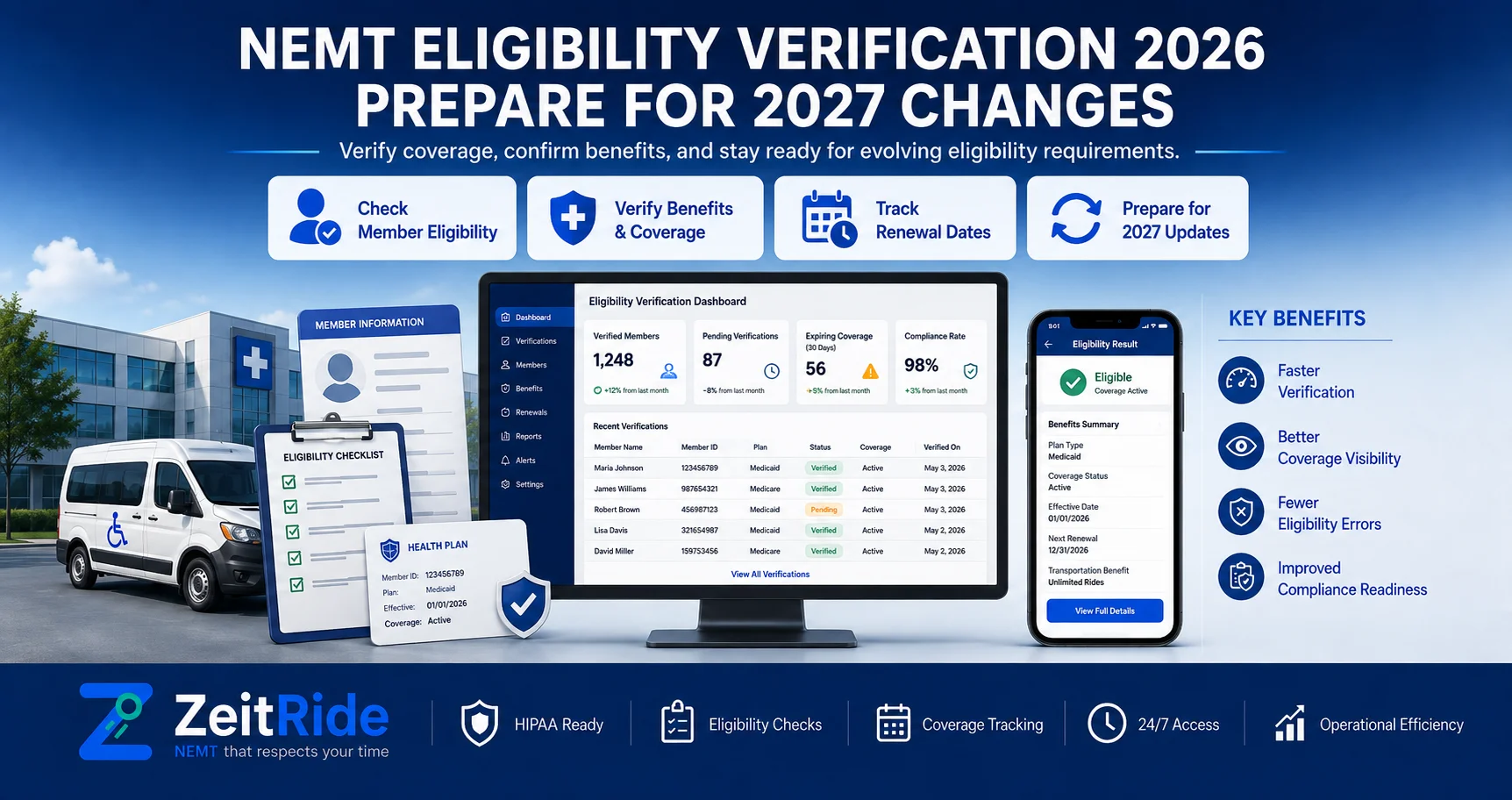
NEMT Eligibility Verification 2026: Prepare for 2027 Changes
Learn how NEMT providers can verify Medicaid eligibility, separate coverage from authorization, manage recurring trips, and prepare for 2027 changes.
Quick answer
NEMT eligibility verification confirms whether a rider has active coverage and the applicable transportation benefit for the service date. Providers should also confirm required authorization, payer or broker responsibility, service level, and any program-specific rules before dispatch.
ZeitRide Team
NEMT Operations Expert
A rider can be familiar, a trip can be recurring, and the route can already be on tomorrow's schedule—but none of that proves the transportation is eligible for payment on the service date. NEMT eligibility verification is the process of confirming the coverage, transportation benefit, authorization, and payer information that apply before transportation is performed.
For Medicaid-focused fleets, this deserves more attention heading into 2027. Federal Medicaid eligibility rules are changing for certain adult populations, while state programs, managed-care organizations, and transportation brokers continue to apply their own operating processes. The practical goal for an NEMT provider is not to become a Medicaid eligibility expert. It is to know what must be verified, who is responsible for verifying it, and what dispatch should do when the answer is unclear.
What Is NEMT Eligibility Verification?
NEMT eligibility verification confirms whether a member has the coverage and transportation eligibility required for a trip on the applicable service date. Depending on the program, the check may involve active Medicaid coverage, the member's benefit plan, NEMT eligibility, an authorization or broker trip reference, approved service level, and other program-specific requirements.
The important point is that eligibility is not one universal yes-or-no field. A person may have active Medicaid coverage but still need a separate transportation authorization, prescription, broker approval, or confirmation that the planned destination and service qualify under the applicable program.
That is why patient eligibility verification for NEMT providers should happen before the vehicle is already on the road.
What's Changing With Medicaid Eligibility in 2027?
Beginning with renewals scheduled on or after January 1, 2027, federal law requires most individuals in the Medicaid adult expansion group who are subject to the new provision to move from annual eligibility renewals to renewals every six months. This change does not apply to every Medicaid eligibility group.
A separate federal community-engagement requirement also begins no later than January 1, 2027 for certain adults, although states may implement it earlier and federal law provides exceptions for specified populations.
For NEMT operators, the lesson is not that every rider's Medicaid coverage will suddenly change in 2027. The operational lesson is that coverage status may need closer attention for some member populations, especially when fleets rely heavily on recurring transportation.
Providers should follow current instructions from the applicable state Medicaid program, managed-care organization, or broker rather than trying to determine a member's legal Medicaid eligibility themselves.
Medicaid Eligibility vs. NEMT Benefit vs. Trip Authorization
These terms are often treated as interchangeable, but they answer different questions.
| Check | Question It Answers | Example |
|---|---|---|
| Medicaid eligibility | Is the person actively enrolled in applicable Medicaid coverage for the service date? | Member has active coverage |
| NEMT benefit eligibility | Does that coverage include the transportation benefit for this situation? | Member qualifies for covered transportation |
| Trip authorization | Has this particular trip or course of transportation been approved where approval is required? | Authorization or broker trip number exists |
| Service-level approval | Is the requested transportation mode supported? | Wheelchair service rather than ambulatory transport |
| Broker or payer assignment | Who is responsible for arranging or paying for the trip? | State, MCO, or transportation broker |
A strong Medicaid eligibility verification for NEMT workflow keeps these questions separate. If staff treat one confirmation as proof of everything else, problems may not surface until dispatch or billing.
Do NEMT Providers Verify Medicaid Eligibility?
Sometimes directly, but not always. The answer depends on the state, payer, managed-care arrangement, broker relationship, and provider contract. In some programs, a transportation broker performs eligibility checks before sending the provider an authorized trip. In other situations, the transportation provider or local coordinating entity has specific verification responsibilities.
State-specific NEMT programs demonstrate why providers should not assume one national workflow. Eligibility-verification responsibilities can differ depending on whether the trip comes through a transportation broker, managed-care organization, Medicaid agency, or another approved arrangement.
So the correct operating question is not simply "do NEMT providers verify Medicaid eligibility?" It is: who owns the eligibility check for this specific trip source, and what evidence does our company need before dispatch?
When Should an NEMT Eligibility Check Happen?
The right timing depends on program requirements, but there are several points where an NEMT eligibility check before trip can prevent downstream confusion.
- When a new Medicaid member first enters your workflow
- Before scheduling when your contract makes the provider responsible for verification
- When a payer, health plan, or broker changes
- When an authorization period expires
- When the service level or destination changes
- When a recurring trip continues into a new eligibility or authorization period
- When staff receive conflicting member, payer, or broker information
- Before billing if program rules require another validation or discrepancy review
The goal is not to repeatedly check the same information without reason. It is to place the verification step early enough that an unresolved issue does not become a driver, dispatch, or claim problem later. ZeitRide's guide on how to prevent NEMT billing errors explains what happens when eligibility or payer problems are discovered only after service is completed.
A Practical NEMT Eligibility Verification Workflow
A useful internal workflow can follow six steps: Identify → Verify → Confirm → Authorize → Record → Recheck.
1. Identify the Payer and Trip Source
Start by identifying whether the trip comes from fee-for-service Medicaid, a managed-care plan, transportation broker, facility arrangement, or another payer structure.
The trip source determines which verification process applies.
2. Verify Active Coverage Where Required
Use the official eligibility system, payer portal, broker workflow, or other approved method required by the applicable program. Do not use an old insurance card or previous trip as evidence of current eligibility.
3. Confirm the Transportation Benefit
Active Medicaid enrollment does not automatically answer every transportation question. Confirm that the applicable plan or benefit supports the requested transportation under the rules governing that trip.
4. Confirm Authorization and Service Level
Where authorization is required, confirm the authorization or broker reference and verify that the approved transportation mode matches the planned service.
The NEMT documentation requirements guide explains why authorization, member, driver, vehicle, completed-service, and billing information should remain connected throughout the trip record.
5. Record What Was Verified
Your team should be able to identify what was checked, when it was checked, and which payer, broker, portal, or approved source provided the information.
The exact documentation requirement varies by program, so follow the applicable contract and state rules rather than inventing a universal format.
6. Recheck When Something Material Changes
A previous verification should not automatically be treated as permanent. Recheck when the eligibility period, payer, authorization, recurring series, service level, or other material trip information changes.
Recurring NEMT Trips Need Special Attention
Recurring trips are where eligibility assumptions become easiest to make.
Consider a dialysis rider transported every Monday, Wednesday, and Friday. After months of consistent service, staff may begin treating the trip as permanent. But the recurring schedule, Medicaid coverage, authorization period, broker assignment, and transportation benefit are separate records that can change on different dates.
Some state Medicaid programs require eligibility verification at specific points in a recurring series. The exact requirement varies by program, but the operational lesson is consistent: recurring status should never be treated as proof of permanent eligibility.
For fleets managing high-volume standing transportation, Medicaid NEMT software should help keep member, payer, trip, dispatch, documentation, and billing information connected instead of leaving those pieces in separate spreadsheets.
NEMT Eligibility Verification Checklist Before Dispatch
When your organization is responsible for the check, use the applicable payer or program workflow to confirm the following before releasing the trip:
- Correct member identity
- Correct Medicaid ID or payer identifier
- Active applicable coverage for the service date
- Applicable transportation benefit or eligibility
- Correct payer, MCO, or transportation broker
- Required authorization or broker trip reference
- Approved service level where applicable
- Valid authorization dates or trip limits
- Correct destination or covered-service information where required
- Any unresolved eligibility or authorization exception
- Verification source and date where documentation is required
Do not turn this list into a universal compliance rule. State Medicaid programs, managed-care organizations, brokers, and contracts can assign these responsibilities differently.
What Should You Do If Eligibility Cannot Be Confirmed?
Do not guess. If eligibility, authorization, or payer responsibility cannot be confirmed, flag the trip and follow the escalation process required by the applicable payer, broker, state program, or contract.
That may mean checking an official eligibility portal, contacting the broker or payer, confirming information with the authorized coordinator, or holding the trip from final release until the issue is resolved.
An unresolved eligibility question should remain visible rather than disappearing into dispatcher notes or someone's inbox.
If a completed trip later produces a denial, use the payer's actual denial reason rather than assuming eligibility was the cause. ZeitRide's NEMT claim denial guide covers that downstream process separately.
How ZeitRide Fits Into the Eligibility Workflow
ZeitRide is not a state Medicaid eligibility system, and provider teams should continue using the official payer, state, MCO, or broker source required for the actual eligibility determination.
Where ZeitRide helps is keeping the operational record around that determination connected. Member and payer information can remain associated with the trip as it moves through scheduling, dispatch, driver execution, documentation, and billing. That reduces the risk of staff verifying one set of information and later rebuilding the trip from a different spreadsheet or disconnected billing record.
For Medicaid providers, the stronger operating model is: Verify in the approved source → keep the relevant trip information connected → dispatch the correct service → document what occurred → bill from the completed record.
This also makes it easier to investigate discrepancies when the member, authorization, payer, or completed trip no longer appears to match.
Prepare Your Eligibility Workflow Before 2027
The 2027 Medicaid changes make this a useful time to review eligibility workflows, but the best process is not built around one federal rule.
It is built around a simple operational principle: do not treat yesterday's eligibility, last month's authorization, or a familiar recurring rider as automatic proof that today's trip is ready to run.
Know which system is authoritative, know who owns the check, make unresolved status visible before dispatch, and keep the verified payer and trip information connected through billing.
If your eligibility checks happen in one portal while scheduling, dispatch, documentation, and billing happen in separate systems, bring that workflow to ZeitRide and see how the operational pieces can stay connected after verification.
Ready to connect Medicaid trip information from scheduling through billing? See ZeitRide's Medicaid-ready NEMT workflow.
Frequently Asked Questions
Q: What is NEMT eligibility verification?
NEMT eligibility verification confirms whether a rider has active applicable coverage and the transportation eligibility required for a trip on the service date.
Q: Do NEMT providers verify Medicaid eligibility?
Responsibility varies by state, payer, managed-care organization, broker, and contract. Some brokers perform eligibility checks before assigning trips, while other arrangements require provider verification.
Q: Is Medicaid eligibility the same as NEMT authorization?
No. Medicaid eligibility confirms applicable coverage, while NEMT authorization confirms approval for transportation where authorization is required.
Q: Do recurring NEMT trips need eligibility rechecks?
They may. Providers should follow the applicable state, payer, broker, and authorization rules instead of assuming a recurring schedule proves permanent eligibility.
Q: What Medicaid eligibility changes begin in 2027?
Most individuals in the affected Medicaid adult expansion group move to six-month renewals beginning with renewals scheduled on or after January 1, 2027. Separate community-engagement requirements also apply to certain adults.
Q: What should an NEMT provider do if eligibility cannot be verified?
Follow the applicable payer, state, MCO, or broker escalation process and confirm the correct eligibility or authorization status rather than relying on a prior trip or assumption.
Rather see it than read about it?
Bring a real route, a couple of drivers, and your current process. 15 minutes, zero pitch.