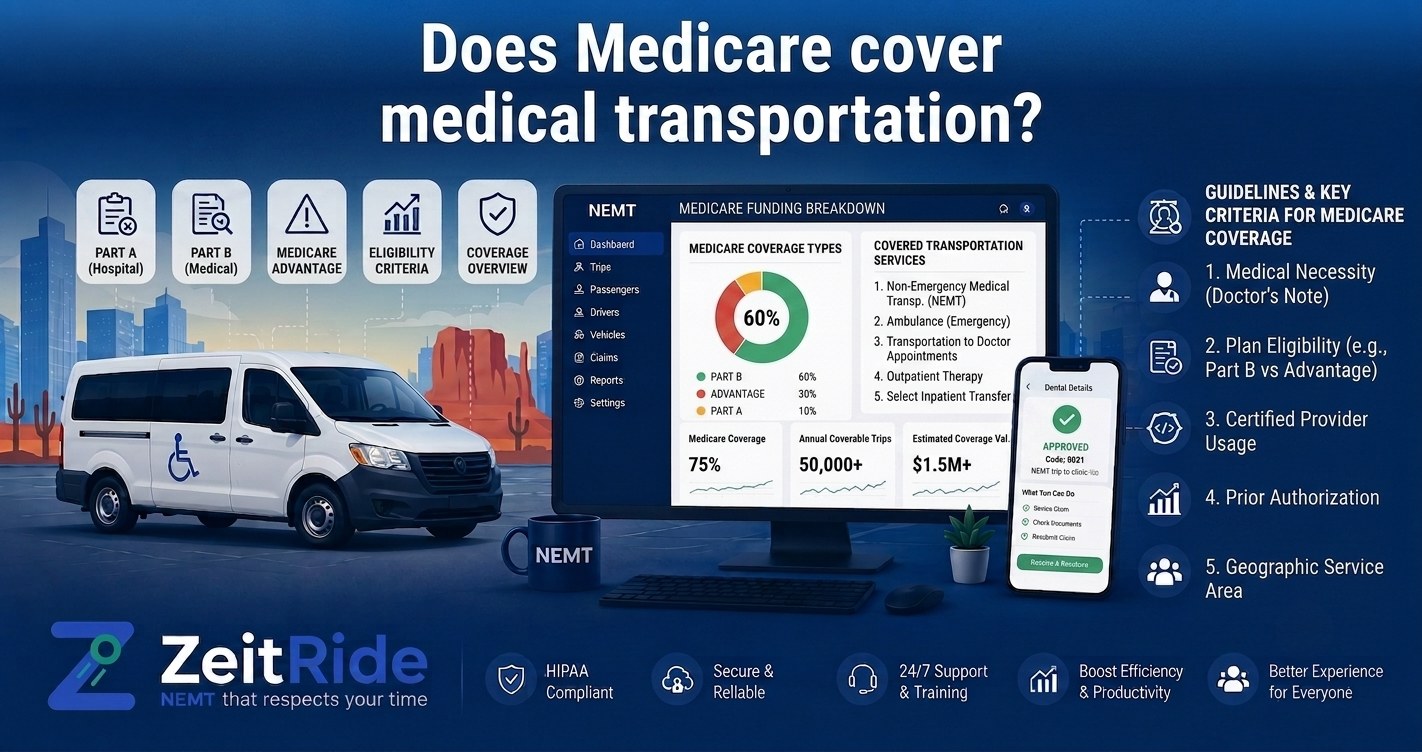
Does Medicare cover medical transportation
Original Medicare rarely covers routine medical transportation. Some Medicare Advantage plans add limited rides as a benefit. Here's what's actually covered.
Quick answer
Original Medicare covers ambulance transport and non-emergency ambulance rides only when a physician certifies medical necessity, such as dialysis transport for end-stage renal disease. It does not cover routine rides to medical appointments.
ZeitRide Team
NEMT Operations Expert
Does Medicare cover medical transportation? Mostly no, and that gap catches a lot of fleets off guard when a rider assumes Medicare will pick up a routine ride to a checkup. Original Medicare covers ambulance transport and a narrow set of medically necessary non-emergency rides, but it doesn't cover the everyday trips most NEMT fleets run. ZeitRide's dispatch software flags payer eligibility before the vehicle leaves the lot, which is exactly the kind of check that keeps a Medicare misunderstanding from turning into an unpaid trip.
What Medicare Medical Transportation Actually Covers
Medicare medical transportation coverage splits cleanly into two categories: what Original Medicare pays for, and what Medicare Advantage plans might add on top. Part B covers ground ambulance transport to the nearest appropriate facility, and it covers non-emergency ambulance transport only when a physician certifies it's medically necessary — the classic example being a dialysis patient with end-stage renal disease who needs regular transport to a treatment center. Outside of that narrow lane, does Medicare provide transportation for a routine ride to a primary care visit? No. Original Medicare simply wasn't built to cover that.
Medicare Advantage changes the picture, but only for plans that choose to offer it. Transportation services for Medicare Advantage members are a supplemental benefit, not a guaranteed one, and coverage varies enormously:
- Some plans cover a fixed number of one-way trips per year to medical appointments
- Some extend to rides for fitness centers or wellness visits
- Special Needs Plans, especially Dual Special Needs Plans for members enrolled in both Medicare and Medicaid, tend to offer the broadest transportation benefits
- Prior authorization is often required once a rider exceeds a set number of trips in a short window
Here's what that means for your fleet: does Medicare cover transportation for the rider sitting in your dispatch queue right now depends entirely on which specific plan they're enrolled in — there's no single answer that applies fleet-wide. See how ZeitRide's dispatch software tags each rider's payer type so your team isn't guessing plan by plan.
How ZeitRide Handles Medicare and Mixed-Payer Trips
Fleets that serve Medicare Advantage riders alongside Medicaid and private-pay members need a system that tracks eligibility per rider, not per fleet. ZeitRide's scheduling software and billing tools work together to keep that distinction clear:
- Rider profiles store payer type, plan details, and any known trip caps, so dispatchers see coverage status before assigning a driver
- Trip manifests and electronic trip records generate automatically, tagged to the correct payer for accurate broker submission
- Broker-specific billing for MTM Health, Provide A Ride, ProCare, and DD Med Trans keeps Medicaid claims moving on a separate, correctly formatted track from any Medicare Advantage trips
- Stripe-based private pay processing handles the trips that fall outside any Medicare or Medicaid coverage entirely
- One flat fee — $49 per vehicle, per month — regardless of how many payer types a fleet bills against
Does Medicare Pay for Transportation — What Operators Get Wrong
Does Medicare pay for transportation the way Medicaid does? No, and the confusion between the two programs causes more denied claims than almost any other billing mistake NEMT operators make. The most common error: assuming a rider with Medicare will be billed the same way as a Medicaid rider. Medicaid is a mandatory federal benefit that every state must provide for eligible beneficiaries. Medicare transportation coverage is the exception, not the rule, and even when it applies, it usually requires documentation a routine Medicaid trip never needs — a physician's written order, a specific diagnosis code, or proof the trip meets a medical necessity standard.
The second mistake is treating all Medicare Advantage plans as interchangeable. Coverage of transportation services for Medicare varies by plan, by region, and by year — a plan that covered 24 one-way trips last year might restructure its benefit design for the next enrollment cycle. Fleets that don't re-verify eligibility at renewal time end up delivering trips that no longer have coverage behind them.
The third mistake is underestimating how often dual-eligible riders show up on a schedule. Someone enrolled in both Medicare and Medicaid may have broader transportation access through Medicaid NEMT even when their Medicare Advantage plan's transportation benefit is thin. Knowing which program to bill first — and which one actually covers the specific trip type — keeps claims from bouncing between payers.
Medicare Coverage Gaps by State
Medicare's limited transportation coverage means Medicaid fills most of the gap, and how that plays out depends heavily on the state. In Pennsylvania and Florida, both large NEMT markets with substantial dual-eligible populations, Medicaid managed care organizations and brokers are usually the primary payer for riders whose Medicare Advantage plan doesn't include transportation or has already exhausted its trip cap for the year. Fleets operating in either state need software that can pivot a rider from a denied or capped Medicare claim to the correct Medicaid billing path without manual rework. See how ZeitRide supports operators in Pennsylvania and Florida.
Bottom Line
Does Medicare cover medical transportation the way most fleets need it to? Rarely — Original Medicare's coverage is narrow, and Medicare Advantage benefits vary too much to assume across your rider base. ZeitRide keeps that variation from slowing down dispatch, with providers seeing a 20% average reduction in miles driven and most fleets running their first live route within a day of setup. Start your first live route within a day. $49/vehicle. No contracts. Book your demo.
Frequently Asked Questions
Q: Does Medicare cover medical transportation for routine doctor visits?
No. Original Medicare does not cover routine transportation to medical appointments. It covers ambulance transport and non-emergency ambulance rides only when a physician certifies medical necessity, such as dialysis transport for end-stage renal disease.
Q: Does Medicare cover transportation through Medicare Advantage plans?
Some Medicare Advantage plans add transportation as a supplemental benefit, but coverage isn't guaranteed and varies by plan. Special Needs Plans typically offer the broadest transportation benefits among Medicare Advantage options.
Q: Does Medicare pay for transportation to dialysis?
Yes, in many cases. Original Medicare Part B may cover non-emergency ambulance transport to dialysis for patients with end-stage renal disease when a physician documents medical necessity.
Q: Does Medicare provide transportation for wheelchair or stretcher trips?
Original Medicare covers wheelchair or stretcher transport only when it meets ambulance-level medical necessity criteria. Routine wheelchair van trips without that documentation typically fall to Medicaid or private pay instead.
Q: What are transportation services for Medicare Advantage members typically limited to?
Most Medicare Advantage transportation benefits cap the number of one-way trips per year and may require prior authorization once a rider exceeds a set trip threshold. Details vary significantly by plan, so fleets should verify coverage per rider rather than assuming fleet-wide eligibility.
Rather see it than read about it?
Bring a real route, a couple of drivers, and your current process. 15 minutes, zero pitch.