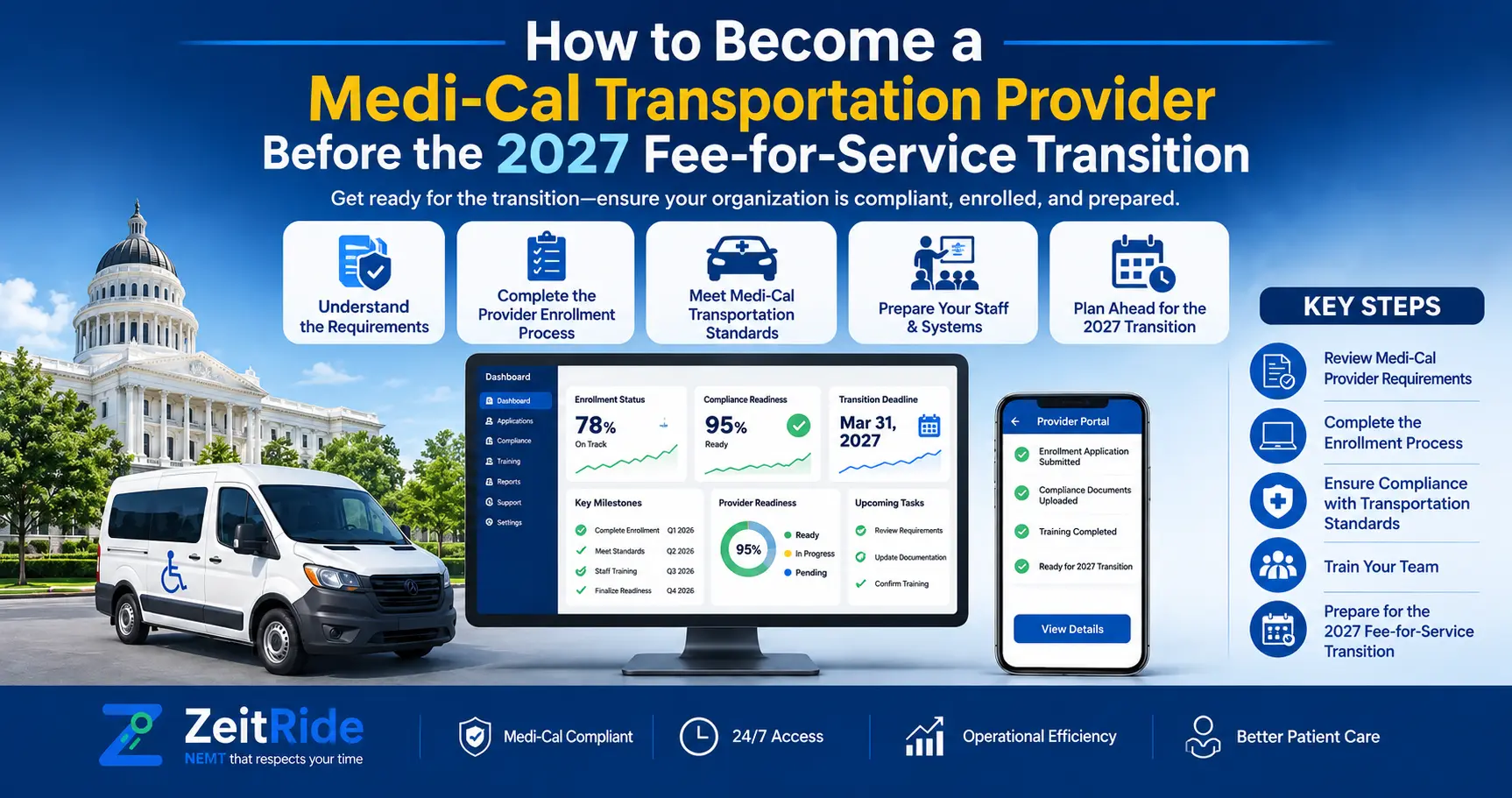
How to Become a Medi-Cal Transportation Provider Before the 2027 Fee-for-Service Transition
Medi-Cal moves UIS members to fee-for-service on January 1, 2027, and their rides must go to FFS-enrolled providers. Here is how to enroll in PAVE, what it costs and how FFS trips work.
How do I become a Medi-Cal transportation provider?
Quick answer
To become a Medi-Cal transportation provider, enroll your business with DHCS through the PAVE portal, pay the application fee ($750 in 2026) and upload business, insurance, vehicle and driver documents for NEMT, NMT or both. From January 1, 2027, members with unsatisfactory immigration status move to fee-for-service, and only FFS-enrolled transportation providers can serve them and bill DHCS.
NEMT Operations Expert
To become a Medi-Cal transportation provider, you enroll your business with the Department of Health Care Services (DHCS) through its online PAVE portal, pay the application fee, and upload your business, insurance, vehicle and driver documents. Only enrolled providers can bill Medi-Cal for NEMT or NMT, and that now matters more than it used to.
On January 1, 2027, Medi-Cal members with unsatisfactory immigration status (UIS) move from managed care plans to fee-for-service (FFS). The DHCS Medi-Cal FFS Provider Toolkit states that transportation providers must be enrolled in Medi-Cal FFS to keep serving these members after that date. If your trips come only through a health plan or its transportation vendor, check your status now. This guide covers the change, PAVE enrollment step by step, what it costs and how long it takes, and how FFS trips run differently.
What Changes in the Medi-Cal Fee-for-Service Transition in 2027?
The Medi-Cal fee-for-service transition in 2027 changes how UIS members get care, not whether they have coverage. DHCS describes the group as undocumented people, some green card holders still in the federal five-year waiting period, and people permanently residing under color of law (PRUCOL). Members who renew on time keep full-scope Medi-Cal, and they keep their transportation benefit too.
What changes is who pays you. The DHCS fee-for-service transition provider FAQ says providers who bill only through managed care and are not enrolled in FFS will not be able to care for UIS members after December 31, 2026, and that claims will be billed directly to DHCS rather than to plans. For transportation providers, three dates matter:
- November 1, 2026: DHCS begins accepting Treatment Authorization Requests (TARs) for affected members, for dates of service on or after January 1, 2027
- December 31, 2026: the last day a plan-only provider can serve these members through managed care
- January 1, 2027: affected members move to FFS, and their rides must go to FFS-enrolled transportation providers
DHCS has not published a separate enrollment deadline for transportation providers, and it does not give a count of affected members on its provider pages. Don't wait for either. If some of your recurring dialysis or behavioral health riders are UIS members, their January trips depend on your FFS enrollment.
Who Needs to Enroll as a Medi-Cal Transportation Provider?
Any company that wants to be paid by Medi-Cal FFS for rides must be an enrolled Medi-Cal transportation provider. Being in a health plan's network, or being screened by a plan or its transportation vendor, is not the same as being enrolled in FFS through PAVE. DHCS asks every provider to log in to PAVE, confirm the FFS enrollment is active, and make sure screening and revalidation are current.
Three groups need to act:
- Plan-contracted operators that were never enrolled in FFS: submit a full application now
- Operators already enrolled for NEMT who also run ambulatory trips: add NMT with a Supplemental Change request
- New companies entering the California market: enroll first, then contract with plans
If you are still forming the company, start with our guide to starting a NEMT business in California. Local licenses and permits, a fictitious business name statement if you use one, and a lease if you rent your premises all have to be ready before you apply in PAVE.
Medi-Cal NEMT vs NMT: Which Enrollment Do You Need?
Medi-Cal splits rides into two benefits, and you enroll for the ones you will provide. NEMT is transportation by ambulance, wheelchair van or litter van for members whose condition rules out ordinary transportation. NMT is transportation by private or public vehicle for members who have no other way to get to a covered appointment. A wheelchair van can be enrolled for both.
| Requirement | NEMT (wheelchair or litter van) | NMT (car, minivan, taxi) |
|---|---|---|
| Who qualifies | Members who can't safely use a car or public transit | Members with no other way to reach a covered service |
| Medical order | Written prescription from a licensed Medi-Cal provider | No prescription; verbal or written member attestation |
| Eligibility check | Confirm eligibility before the trip | Verify eligibility through AEVS before the trip |
| Vehicle documents | DMV commercial registration, commercial insurance, VSSI certificate, special vehicle permit if applicable | DMV commercial registration (usually marked COML) and commercial insurance |
| Driver documents | DMV printout, first aid and CPR, drug and alcohol tests, MCSA-5875 and MCSA-5876 | Driver's license, DMV history printout, MCSA-5875 and 5876 where required |
| Volume rule in FFS | Per prescription and any required authorization | More than eight one-way trips a month needs documentation on or with the claim |
The NMT rules come from the DHCS transportation provider FAQ. DHCS does not require a standard NMT attestation form, but you must keep a record of each attestation. For the equipment side of NEMT vehicles, see our guide to NEMT vehicle requirements.
How to Complete the PAVE Transportation Provider Application
The PAVE transportation provider application is the only route in. DHCS says on its transportation provider application page that applications must be submitted through PAVE, and adding NMT, NMT vehicles or NEMT vehicles to an existing enrollment also goes through PAVE as a Supplemental Change.
Step 1: Get the right NPI
Corporations, LLCs and partnerships need a Type 2 (organization) NPI. Sole proprietors use a Type 1. The wrong NPI type is one of the most common reasons DHCS returns transportation applications, according to its transportation provider enrollment presentation.
Step 2: Create your PAVE profile
Sign up as a PAVE user, verify the six-digit code within 15 minutes, then create a business profile by verifying your NPI. Start a new application and choose Medical Transportation as the provider type. Select non-emergency, wheelchair van and litter van only if your vehicles qualify for them.
Step 3: Upload documents and pay the fee
Answer the questionnaire on business structure, ownership and languages, upload every required document, pay the fee electronically and submit. New NMT-only companies file the full transportation provider package, made up of forms DHCS 6206, 6207 and 6208. Enrolled NEMT providers adding NMT use the Supplemental Changes form, DHCS 6209.
Step 4: Prepare for an onsite visit
DHCS may refer your application for an onsite inspection. For NEMT, inspectors verify ownership, your established place of business and that your vehicles and drivers meet the requirements. Keep the vehicles you listed available, and keep the originals of the documents you uploaded at the address on the application.
Medi-Cal NEMT Provider Enrollment Documents and Costs
Medi-Cal NEMT provider enrollment fails most often on paperwork, not eligibility. Names and addresses must match across every document, and the legal business name must match your IRS letter exactly. The fee for applications submitted from January 1 to December 31, 2026 is $750, according to DHCS's application fees page. CMS sets the fee each year, so an application submitted in January 2027 will be charged the 2027 amount.
| Item | What DHCS asks for | Common mistake |
|---|---|---|
| Tax ID | IRS Letter 147-C or Form SS-4 confirmation if you don't use an SSN | Legal name doesn't match the IRS document |
| Business license | Local business license, tax certificate and permits for every city or county you operate in | Missing a county you pick up in |
| Liability insurance | At least $100,000 per claim and $300,000 annual aggregate | Certificate expires during the review |
| Workers' compensation | Required with one or more employees, or a written explanation | No explanation for owner-only fleets |
| Vehicles | DMV commercial registration and commercial insurance; VSSI certificate and special vehicle permit if applicable | Personal auto registration instead of commercial |
| Drivers | DMV printout, first aid and CPR, drug and alcohol results, MCSA-5875 and 5876, California license | Expired CPR card or medical certificate |
| Fee | $750 for 2026, paid by EFT in PAVE | Assuming an earlier exemption applies without proof |
You can be exempt from the fee if you already paid it to Medicare or another state's Medicaid or CHIP program for the same location, but DHCS has to verify it. Track every expiring item in one place: with NEMT compliance tracking, insurance certificates, CPR cards and medical certificates sit on each driver and vehicle record with alerts before they lapse.
How Long Does Medi-Cal Transportation Enrollment Take?
Longer than the seven weeks left before January 1. DHCS's legal allowance for an initial review is 180 days, though it aims to finish sooner and reviews applications in the order received. If DHCS finds deficiencies, you get 60 days to correct and resubmit. After an onsite visit, DHCS approves, denies or returns the application within 60 days.
The practical takeaway is to submit a complete application this month rather than a fast one. Before you press submit, check for expired documents, addresses that don't match your service address, personal instead of commercial registrations, and requests for NEMT on vehicles that don't qualify. Those are the defects DHCS lists most often.
How FFS Trips, Medi-Cal Transportation TARs and Billing Work
Under managed care, the plan or its transportation vendor arranges the ride, checks eligibility and pays you. In FFS there is no plan in the middle. Requests come from members, their families and medical offices, and DHCS says provider teams can keep using its Requesting Transportation Form to help members arrange rides.
| Step | Managed care plan trip | Medi-Cal FFS trip |
|---|---|---|
| Trip request | Plan or its transportation vendor assigns the trip | Member, representative or medical office contacts you or DHCS directly |
| Eligibility | Checked by the plan or vendor | You verify it before the trip |
| Medical order (NEMT) | Plan's authorization process | Prescription on file from a licensed Medi-Cal provider |
| Authorization | Plan rules | Medi-Cal transportation TAR submitted to DHCS when required |
| Billing | Plan or vendor pays per contract | Claim billed directly to DHCS |
| Support | Plan provider services | Medi-Cal Telephone Service Center, (800) 541-5555 |
A Medi-Cal transportation TAR is a request for DHCS approval of a medically necessary service before you provide it. DHCS has been accepting TARs for affected members since November 1, 2026 for dates of service from January 1, 2027, so standing-order riders can be authorized before their first FFS trip. DHCS also warns that transportation may require new authorizations under FFS, so don't assume a plan approval carries over. Ask each prescribing clinic whether it is enrolled in FFS.
This is where FFS adds work for dispatch. Requests arrive by phone and email instead of through a broker feed, and each one needs an eligibility check, an attestation or prescription on file, and a clean claim. Trip request software turns phone-in and direct requests into scheduled trips without re-typing, while each rider's payer details and mobility needs stay in one profile.
Your Medi-Cal Transportation Provider Checklist for January 1
- Log in to PAVE this week and confirm whether your FFS enrollment is active for every service and vehicle you run
- List riders likely to move to FFS and their recurring appointments in January
- Submit a complete application or Supplemental Change, with matching names and addresses
- Renew any insurance certificate, CPR card or medical certificate that expires before spring
- Ask prescribing clinics whether they are FFS-enrolled and submit TARs early for standing orders
- Set up an FFS payer in your billing workflow and a written NMT attestation record
Separate FFS trips from plan trips from day one. They have different authorization and billing paths, and mixing them is how claims get denied. With NEMT billing software tied to the trip record, the documentation behind each claim comes from what the driver actually completed.
Staying Ready as a Medi-Cal Transportation Provider
The 2027 transition rewards operators who treat enrollment as an operations project, not a form. Get your PAVE enrollment active, keep every document current, and build an intake and billing process that works without a broker. Then your riders keep their January rides, and you keep the revenue.
ZeitRide puts scheduling, dispatch, routing, the driver app, compliance tracking and billing in one platform for $49 per vehicle per month, with no contract. Book a ZeitRide demo and we will show you how to run plan trips and Medi-Cal FFS trips side by side as a Medi-Cal transportation provider.
Frequently Asked Questions
Q: Do I need FFS enrollment if I already serve Medi-Cal plan members?
Yes, if you want to keep serving members moving to fee-for-service. DHCS says providers who bill only through managed care and are not enrolled in FFS cannot care for UIS members after December 31, 2026. Being in a plan network is not the same as FFS enrollment, so check your status in PAVE now.
Q: How long does Medi-Cal transportation provider enrollment take?
DHCS has a legal allowance of 180 days for the initial review, though it aims to finish sooner and works in the order applications arrive. If it finds deficiencies, you have 60 days to correct them. An onsite inspection can add time, so submit a complete application as early as possible.
Q: What is the Medi-Cal provider application fee in 2026?
The fee is $750 for applications submitted between January 1 and December 31, 2026, paid electronically in PAVE. CMS sets it each year, so a 2027 application pays the 2027 amount. You may be exempt if you already paid the fee to Medicare or another state's Medicaid or CHIP program for that location.
Q: Can an NEMT provider add NMT services?
Yes. An enrolled NEMT provider files a Supplemental Change request in PAVE using form DHCS 6209 and states that it is requesting NMT services. If you will use your existing NEMT vehicles and drivers, report that in the Other Information section. New vehicles need DMV commercial registration and proof of commercial insurance.
Q: Does a Medi-Cal NMT provider need a prescription for each ride?
No. NMT does not require a prescription. A Medi-Cal NMT provider must verify the member's eligibility and get a verbal or written attestation that the member has an unmet transportation need and has reasonably exhausted other options. DHCS has no standard form, but you must keep documentation of each attestation.
Q: What happens to my UIS riders on January 1, 2027?
They keep full-scope Medi-Cal and their transportation benefit if they renew on time, but they move from their health plan to fee-for-service. Their rides must then go through FFS-enrolled providers, NEMT needs a prescription and any required TAR, and claims are billed directly to DHCS.
Rather see it than read about it?
Bring a real route, a couple of drivers, and your current process. 15 minutes, zero pitch.