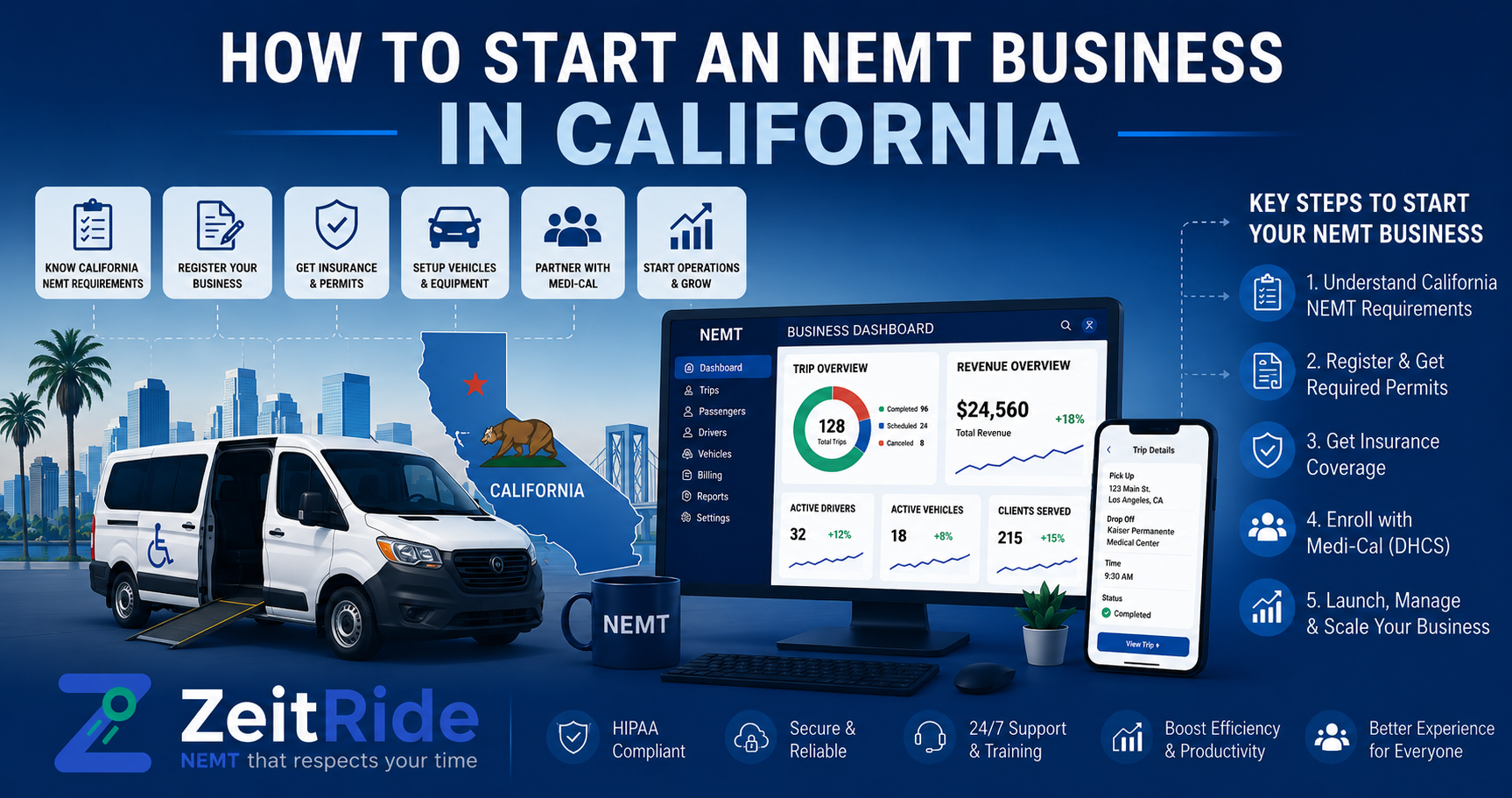
How to start a NEMT business in California
Learn the exact steps to start a NEMT business with proper insurance, licensing, vehicles, broker enrollment, and compliance requirements.
Quick answer
Starting a NEMT business with proper insurance requires forming a legal company, obtaining licenses and credentials, purchasing compliant vehicles, securing commercial auto and liability coverage, and enrolling with Medicaid brokers to operate legally and protect your business.
ZeitRide Team
NEMT Operations Expert
Starting a NEMT business in California is one of the better opportunities in healthcare right now the state has over 14 million Medicaid enrollees, a growing elderly population, and persistent gaps in transportation coverage across counties like Fresno, San Bernardino, and Los Angeles. But if you go in without a clear plan for licensing, insurance, vehicles, and operations software, you'll bleed money long before you dispatch your first trip. This guide walks you through every step, including what most startup guides skip: the real operating costs and how to run your fleet without drowning in paperwork from day one.
What a NEMT Business Actually Is (and Why California Is a Strong Market)
A NEMT business provides scheduled, non-emergency rides for Medicaid members, dialysis patients, seniors, and individuals with mobility challenges who can't independently access medical appointments. You're not an ambulance — you're the person who makes sure a dialysis patient in Stockton gets to their Tuesday appointment and back home.
California's Medi-Cal program funds a significant share of NEMT trips through managed care plans and transportation brokers. County-level demand varies, but the Central Valley, Inland Empire, and rural Northern California regions are chronically underserved. That gap is your market.
The NEMT industry in California is not passive income. It requires real infrastructure: the right vehicles, the right insurance, a NEMT business license, and software that keeps your dispatch and billing from collapsing when you scale past five vehicles.
Step 1: Build Your NEMT Business Plan
Every NEMT business that survives its first year started with a written plan — not because banks require it (though they do), but because it forces you to answer the hard questions before they become expensive surprises.
Your medical transportation company business plan should cover:
- Service area and demand: Which counties? Which member populations — dialysis, oncology, behavioral health? Urban routes or rural long-haul?
- Vehicle count and type: Ambulatory sedans, wheelchair-accessible vans (WAVs), or both? Starting with 2–3 vehicles is typical. A used WAV in good condition runs $15,000–$30,000.
- Revenue model: Medicaid broker contracts, private pay, or both? Broker contracts through entities like MTM Health and Provide A Ride provide volume but require enrollment and credentialing upfront.
- Startup cost estimate: Vehicles, insurance, licensing, and software. Budget $40,000–$80,000 to launch a small fleet properly. The software line item is often underestimated — legacy NEMT platforms charge $5,000–$25,000 in implementation costs before you go live.
- Break-even timeline: Most operators hit profitability within 6–12 months if they enroll with brokers quickly and keep per-vehicle costs under control.
Operator tip: One ZeitRide customer, Sandra Mills of SafeTrip NEMT, is running three fewer vehicles per day while serving the same member volume — because her routing is tighter. Your business plan should account for the cost of bad routing, not just the cost of vehicles.
Step 2: Register Your Business and Get Your NEMT Business License
California doesn't have a single unified "NEMT license" — what you actually need is a stack of registrations that together authorize you to operate legally and bill Medicaid.
Business formation:
- Form an LLC or corporation through the California Secretary of State (sos.ca.gov). Filing fees run $70–$100.
- Apply for a Federal EIN through IRS.gov — free and takes 10 minutes.
- Register for a California Seller's Permit if you'll bill private-pay clients.
NEMT-specific licensing and credentialing:
- Apply for a National Provider Identifier (NPI) through CMS's NPPES registry. You need this before Medicaid billing.
- Enroll in Medi-Cal as a transportation provider through DHCS (California's Department of Health Care Services). This process takes 60–120 days, so start it early.
- Apply to become a credentialed provider with California's Medi-Cal managed care plans — Anthem Blue Cross, Health Net, L.A. Care, and Inland Empire Health Plan are the major ones depending on your region.
- Register with NEMT brokers active in California, including MTM Health and Provide A Ride, to receive trip assignments.
Vehicle and driver requirements:
- All drivers need a valid California driver's license, a clean MVR (motor vehicle record), and a background check. Most brokers also require CPR and First Aid certification.
- Vehicles must pass a California BIT (Basic Inspection of Terminals) inspection if you operate 3+ vehicles commercially.
- Wheelchair-accessible vehicles must meet ADA lift and securement standards.
Starting a NEMT business in California without completing the DHCS and broker enrollment steps is the single most common reason new operators stall. The trips don't come until you're credentialed.
Step 3: Get the Right NEMT Business Insurance
NEMT business insurance is non-negotiable, and California's requirements are stricter than many states. Underestimating this line item is a common mistake in any medical transportation company business plan.
Required coverage types:
- Commercial auto liability: California requires a minimum of $750,000 per occurrence for vehicles transporting passengers for hire, but most Medicaid brokers require $1,000,000–$1,500,000. Get the higher limit — it will be required for credentialing anyway.
- General liability: Covers incidents on-site at pickup and drop-off locations. Minimum $1,000,000 recommended.
- Workers' compensation: Mandatory in California the moment you hire your first employee, including drivers.
- Sexual abuse and molestation (SAM) coverage: Required by most Medicaid broker contracts. This is often overlooked by new operators.
- Umbrella policy: Adds a blanket layer of coverage above your base policies. Brokers increasingly require $2,000,000+ umbrella coverage.
Annual NEMT insurance cost range in California: $8,000–$20,000 per vehicle depending on coverage levels, driver records, and vehicle type. WAVs typically cost more to insure than ambulatory sedans. Work with a broker who specializes in NEMT — general commercial auto brokers often miss SAM coverage and EVV-related compliance endorsements.
Step 4: Build Your Fleet and Hire Drivers
Your fleet is your cost structure. Every vehicle you add increases revenue potential but also increases fixed costs — insurance, maintenance, fuel, and software.
Vehicle selection for a California NEMT fleet:
- Used Toyota Sienna or Chrysler Pacifica WAVs: $15,000–$28,000
- New WAV conversions: $45,000–$65,000
- Standard ambulatory sedans (Toyota Camry, Honda Accord): $12,000–$22,000 used
A well-trained driver in a single van who runs 8–12 efficient trips per day is worth more than two undertrained drivers running sloppy routes. ZeitRide's driver app runs on iOS and Android, has offline GPS for rural California areas with spotty cell coverage, and takes under 15 minutes to learn — which means you're not spending your first week training drivers on the software. See exactly how ZeitRide handles fleet onboarding and dispatch — no pitch, just your workflow on our platform.
Step 5: Set Up Operations Software Before You Launch
This is where most new NEMT operators leave real money on the table. They spend months on licensing and insurance — correctly — and then try to run dispatch on spreadsheets or a generic scheduling tool. That works for three vehicles. It falls apart at seven. What you actually need NEMT software to handle from day one:
- Trip scheduling and recurring route management
- Broker trip import (pulling assignments directly from MTM Health, Provide A Ride, ProCare, and DD Med Trans)
- Real-time dispatch and driver communication
- GPS tracking and offline navigation for drivers
- Medicaid-compliant billing and broker remittance
- EVV (Electronic Visit Verification) — required in California for Medi-Cal-funded trips
- HIPAA-compliant data storage for member records
Legacy platforms like RouteGenie and TripMaster charge per-trip fees or require $5,000–$25,000 in setup costs. That's a real hit to cash flow when you're still building your first month of trip volume. ZeitRide is built for operators starting a NEMT business who want full functionality from day one without the implementation cost. The platform covers dispatch, scheduling, routing, billing, and the driver app — all at $49 per vehicle per month, with no setup fees and no annual contract. Most providers go live within 30 minutes and run their first route the same day. The AI-powered routing alone averages a 20% reduction in miles driven. For a five-vehicle California fleet running urban routes in LA or San Diego, that's a meaningful cut to fuel and labor costs every single week.
You can see the full breakdown at ZeitRide pricing or review all platform features before your demo.
Step 6: Enroll With Brokers and Win Your First Contracts
Your NEMT business doesn't generate revenue until you have trip volume. In California, that means enrolling with Medi-Cal managed care brokers and regional transportation networks.
Primary California NEMT broker channels:
- MTM Health — operates in Southern California and manages Medi-Cal trips for several major health plans
- Provide A Ride — active in California metro markets, requires provider credentialing and portal registration
- ProCare — used by multiple California health plans for NEMT trip management
- DD Med Trans — serves developmental disability transportation clients
Who This Is Built For
Starting a NEMT business in California looks different depending on where you sit: First-time fleet owner: You're building from scratch and need the fastest path to legal, credentialed, and operational. Your focus is getting the NEMT business license stack done in parallel with vehicle acquisition, so you're not waiting on paperwork after your vans are in the driveway. Dispatcher or operations director moving to ownership: You already know how NEMT workflows run. Your challenge is the business side — entity formation, insurance, and broker enrollment. Once that's done, you need dispatch software that mirrors what you're used to, but without the per-seat or per-trip fees. Existing small fleet looking to add California operations: If you're already running in another state, ZeitRide is active in 10+ states, and adding a California operation to the same platform doesn't require a new implementation. See how ZeitRide works across multi-state operations. Tony Jackson, owner of Top Choice Medical Transport, described his experience with ZeitRide: booking a trip takes two to three minutes now, cutting his time roughly in half. That kind of efficiency matters whether you're running your first five vehicles or your fiftieth.
For additional context on what software looks like at scale, the best NEMT software guide for 2026 and the best NEMT scheduling software comparison are good reads before you commit to any platform.
Start Your NEMT Business in California the Right Way
Learning how to start a NEMT business in California comes down to sequencing correctly: entity formation, then NEMT business license stack and insurance, then vehicles and drivers, then software, then broker enrollment. Skip a step or do them out of order and you're either stuck waiting on paperwork or spending money on vehicles you can't dispatch yet. The operators who run the most efficient fleets — like Sandra Mills, who cut three vehicles from her daily operation without losing a single member — are the ones who took the operations side as seriously as the compliance side. ZeitRide is built for that kind of operator: one platform, $49 per vehicle, no setup fees, no per-trip charges, active in 10+ states. Start your first live route within a day. $49/vehicle. No contracts.
Frequently Asked Questions
Q: How do I start a NEMT business in California?
You form a business entity, apply for an NPI, enroll with DHCS as a Medi-Cal transportation provider, get NEMT business insurance, purchase and equip your vehicles, and register with brokers like MTM Health or Provide A Ride. Plan for a 60–120 day credentialing timeline before your first Medi-Cal trip.
Q: How much does it cost to start a NEMT business?
Starting a NEMT business typically requires $40,000–$80,000 in startup capital for a small fleet, covering vehicles, insurance, licensing, and operations software. Legacy software adds $5,000–$25,000 in setup costs; ZeitRide charges $49 per vehicle per month with no setup fee.
Q: What licenses do you need for a NEMT business in California?
You need an NPI, Medi-Cal provider enrollment through DHCS, managed care plan credentialing, and standard business registration (LLC or corporation, EIN). Vehicles must pass California commercial inspection requirements, and drivers need LiveScan background clearance for Medi-Cal work.
Q: What is the best software for starting a NEMT business?
New NEMT operators need software that handles dispatch, scheduling, routing, billing, and broker integration from day one. ZeitRide covers all of these at $49/vehicle/month with no contract, integrates directly with MTM Health, Provide A Ride, and ProCare, and has a driver app with offline GPS that takes under 15 minutes to learn.
Q: How profitable is a NEMT business in California?
NEMT profit margins typically run 20–30% for well-run operations. California's large Medi-Cal population and underserved rural counties create strong demand. Profitability improves significantly with route optimization — operators using ZeitRide's AI routing average 20% fewer miles driven, which directly reduces fuel and labor costs.
Rather see it than read about it?
Bring a real route, a couple of drivers, and your current process. 15 minutes, zero pitch.