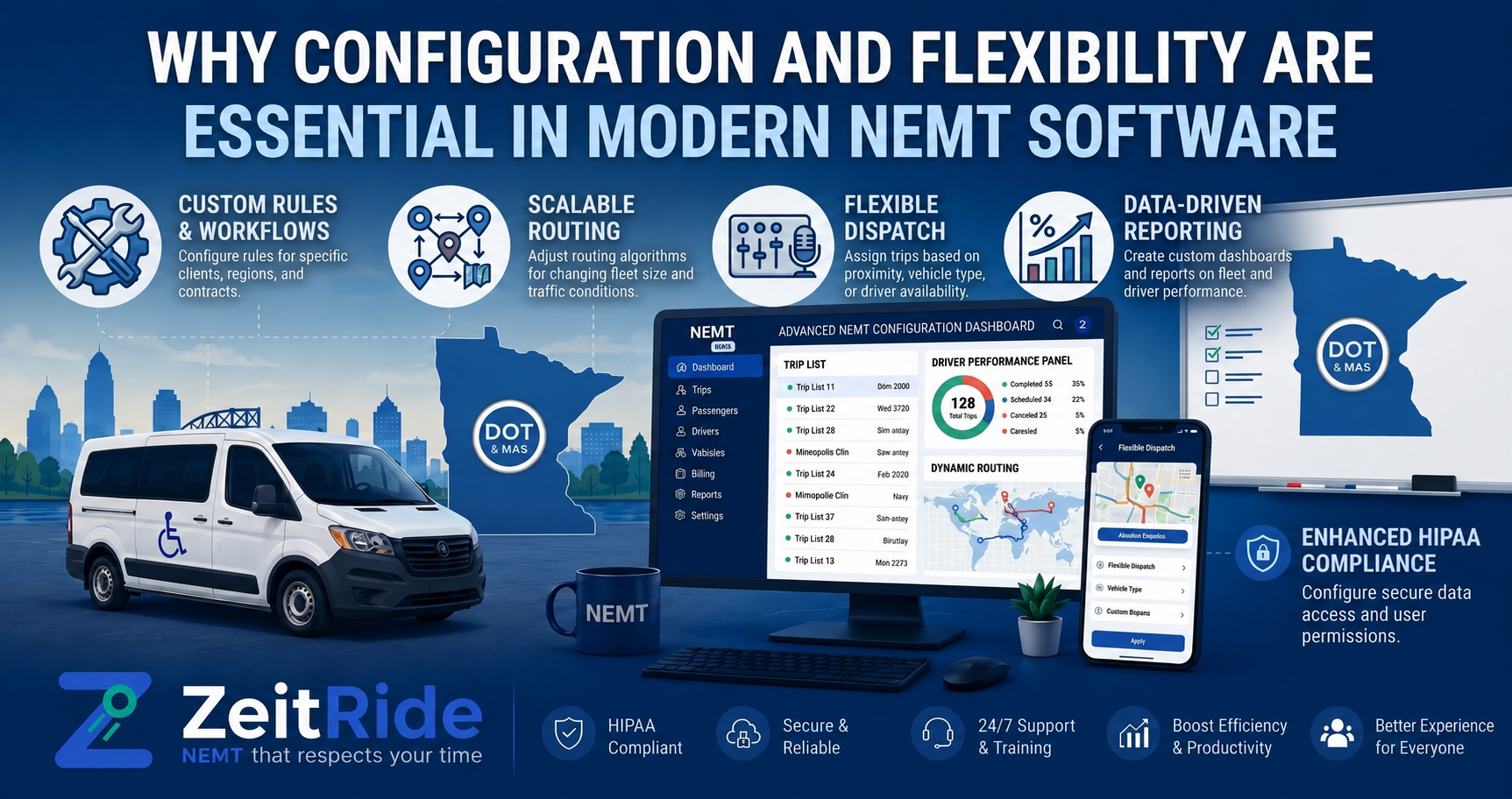
Why Configuration and Flexibility Are Essential in Modern NEMT Software
Configuration and flexibility separate NEMT software that adapts to your fleet from software you have to adapt to. Here's how ZeitRide bends instead.
ZeitRide Team
NEMT Operations Expert
Configuration and flexibility in modern NEMT software come down to one question: can your platform bend to fit how you actually run trips, or do you have to bend to fit the software? Most fleet owners find out the hard way — usually six months into a contract, when a broker changes a billing requirement and the system can't keep up. ZeitRide was built around the opposite assumption: dispatch, scheduling, routing, and billing should flex with your fleet, not lock it into someone else's workflow, all for $49 per vehicle per month with no setup fees.
What "Configurable NEMT Software" Actually Means for Your Fleet
Configurable NEMT software means the platform adapts to your service mix, your broker relationships, and your compliance requirements — not the other way around. A lot of platforms sold as "customizable" really mean you can change a logo or a color scheme. That's not configuration. Real configuration means your dispatcher can toggle between ambulatory, wheelchair, and stretcher trip types without a support ticket. It means recurring dialysis routes and one-off ad-hoc trips live in the same scheduling software without separate modules. It means a broker policy change doesn't require a developer.
Here's the operator reality: fleets running 5 vehicles and fleets running 100+ face the same core problems — trip manifests, EVV requirements, driver payroll, broker remittance — but at wildly different scale. Software built for one size rarely survives a growth spurt or a broker switch. That's the gap most legacy NEMT software never closes. Three things separate genuinely flexible NEMT software from a rigid platform wearing a flexible label:
- It handles Medicaid, facility, and private-pay trips inside one system, not three
- It supports state-specific compliance rules without a custom build
- It lets an operations director change a workflow the same day a broker changes theirs
There's also a difference between flexibility that helps you today and flexibility that's really just complexity in disguise. Some platforms offer dozens of settings menus that require a support call to touch. That's not configuration a dispatcher can use at 6 AM when a driver calls out sick and three trips need to be reassigned. Real configuration means the person doing the work — dispatcher, ops director, or owner — can make the change themselves, in the moment, without opening a ticket. That's the standard ZeitRide is built to meet across dispatch, scheduling, routing, and billing.
How ZeitRide Handles Configuration and Flexibility
ZeitRide's approach starts with the assumption that every fleet's workflow is a little different, and the software shouldn't punish you for that.
- Flat pricing, no add-on modules. $49 per vehicle per month covers dispatch, scheduling, routing, billing, broker integrations, and the driver app. You're not paying extra to unlock the configuration options you actually need.
- Broker integrations that work the way brokers actually operate. ZeitRide connects with MTM Health, CTS Transit, Provide A Ride, ProCare, DD Med Trans, and Tennessee Carriers, so trip imports, manifests, and remittance follow each broker's format instead of forcing a workaround.
- AI-driven route optimization that adjusts to real conditions. ZeitRide's routing engine averages a 20% reduction in miles driven, which matters more once you're running mixed ambulatory and wheelchair routes across a spread-out service area.
- A driver app that doesn't need a training day. The driver app runs on iOS and Android with offline GPS, and drivers are typically comfortable with it in under 15 minutes — no separate onboarding cycle every time you hire.
Configuration and Flexibility: Legacy NEMT Software vs. What Operators Actually Need
Most legacy NEMT platforms — think Bambi, Tobi Cloud, or TripMaster — were built around a fixed set of workflows, then patched over the years with add-ons. That's why switching or scaling on those systems often means a $5,000 to $25,000 implementation project before you run a single trip. ZeitRide's flat-fee model has no setup cost and no annual contract, which changes the calculation entirely: you're not locked into a platform because ripping it out is too expensive.
- They confuse "customizable" with "configurable." Customizable usually means a developer can build something new for a fee. Configurable means the settings already exist and you toggle them yourself.
- They assume flexibility only matters at scale. A single-van operation switching from private-pay to a Medicaid broker contract needs the same configuration options as a 100-vehicle fleet — just applied to fewer trips.
- They underestimate broker churn. States change brokers more often than operators expect. Software tied to one broker's format breaks when that broker changes; software built around configurable broker integrations doesn't.
- They treat the driver app as an afterthought. If the app takes longer than 15 minutes to learn, every new hire becomes a bottleneck — and that's a flexibility problem, not just a training problem.
Who This Is Built For
Configuration and flexibility mean something different depending on your role, and ZeitRide is built to serve all of them inside one system. Fleet owners get flat, predictable pricing at $49 per vehicle per month, with no setup fee eating into margin before the first trip is even billed. Dispatchers get a scheduling interface that handles recurring routes and same-day ad-hoc trips without switching screens or systems. Operations directors get reporting and broker remittance workflows that adjust to policy changes without a rebuild — critical when running across multiple counties or states. Drivers get an app they can actually learn on their first shift, with offline GPS so a dead zone doesn't stall a route. This is also why fleets moving off RouteGenie, Bambi, TripMaster, or Tobi Cloud tend to describe the transition as removing friction rather than adding a new tool. Tony Jackson, Owner of Top Choice Medical Transport, says he can now book a trip in two to three minutes — cutting the time it used to take in half.
Configuration and flexibility in modern NEMT software aren't optional extras — they're what determines whether your system keeps up with broker changes, compliance shifts, and growth, or forces your team to work around it every day. ZeitRide's route optimization alone averages a 20% reduction in miles driven, on top of flat $49/vehicle pricing with no contracts. Start your first live route within a day. $49/vehicle. No contracts. Book your demo.
Frequently Asked Questions
Q: What does configurable NEMT software actually mean?
Configurable NEMT software lets operators adjust trip types, broker workflows, and compliance settings themselves, without a developer. ZeitRide includes this in its $49/vehicle/month plan, covering dispatch, scheduling, routing, and billing in one system.
Q: Why is flexibility more important than a long feature list?
A long feature list doesn't help if none of the features adapt to your specific service mix or broker rules. ZeitRide focuses on configurable workflows across ambulatory, wheelchair, and stretcher trips, so the same platform fits a 5-vehicle fleet or a 100-vehicle operation.
Q: How much does flexible NEMT software cost with ZeitRide?
ZeitRide costs $49 per vehicle per month, covering dispatch, scheduling, routing, billing, broker integrations, and the driver app, with no setup fees or contracts. Most providers are live within 30 minutes and run their first route within a day.
Q: Does ZeitRide support state-specific compliance requirements?
Yes. ZeitRide is HIPAA-aware, Medicaid-ready, and supports EVV requirements that vary by state, with configuration options built for county-level and broker-specific rules in states like Pennsylvania and Florida.
Q: Which broker integrations does ZeitRide support?
ZeitRide integrates with MTM Health, CTS Transit, Provide A Ride, ProCare, DD Med Trans, and Tennessee Carriers, letting trip imports and remittance follow each broker's own process.
Rather see it than read about it?
Bring a real route, a couple of drivers, and your current process. 15 minutes, zero pitch.