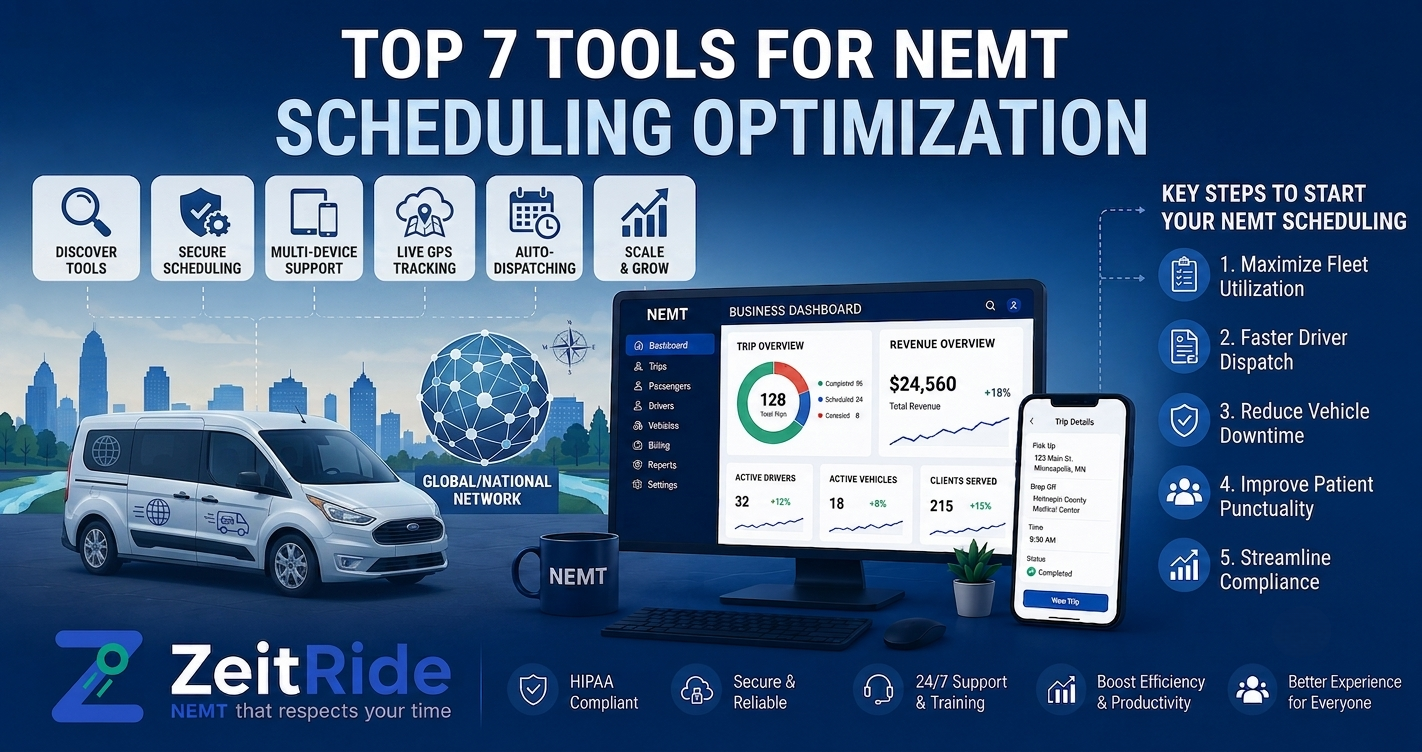
Top 7 tools for NEMT scheduling optimization
Top 7 NEMT scheduling tools that reduce miles, automate billing, improve broker compliance, and streamline dispatch in one platform.
ZeitRide Team
NEMT Operations Expert
Every dispatcher running paratransit trips off a whiteboard or three separate apps knows the real cost of a scheduling gap: a missed pickup, an angry broker, a driver sitting empty on the wrong side of town. NEMT scheduling optimization isn't a buzzword it's the difference between running 12 vehicles at a profit or running 15 vehicles just to break even. Most operators piece together NEMT software from a scheduling tool, a separate routing tool, and a billing tool that don't talk to each other, then wonder why dispatch still feels chaotic. ZeitRide bundles the tools operators actually need into one flat-fee platform at $49 per vehicle per month, and most fleets are live within 30 minutes of signing up.
What NEMT scheduling software actually needs to do
Non-Emergency Medical Transportation runs on tight windows. A dialysis patient can't wait 40 minutes past their appointment, and a broker won't pay for a trip that shows up late without documentation. NEMT software has to schedule recurring routes, slot in same-day ad-hoc trips, match vehicles to mobility needs, and hand off clean records to billing — all without a dispatcher manually re-typing the same trip three times across three systems.
That's the gap most legacy platforms leave open. They handle scheduling in isolation and treat routing, billing, and compliance as separate purchases, which means a dispatcher, a fleet manager, and an operations director are each looking at a different version of the same day. The tools below are the ones that actually move the needle on NEMT scheduling optimization, and ZeitRide ships every one of them under the same $49/vehicle/month plan — no add-ons.
Non-Emergency Medical Transportation providers who run this checklist against their current platform usually find at least two or three gaps. That's normal — most NEMT scheduling software on the market was built to handle one piece of the workflow well and the rest as an afterthought. The list below covers what a fleet needs from dispatcher, driver, and broker, not just from a sales page.
The 7 tools your NEMT scheduling software needs
1. AI-powered route optimization
Manual routing means a dispatcher eyeballing a map and guessing. AI routing reads pickup windows, vehicle capacity, and driver location in real time and rebuilds the route when something changes. ZeitRide's route optimization engine averages a 20% reduction in miles driven compared to manually built routes — that's fuel, wear, and driver hours back in your pocket every week. It runs the recalculation automatically the moment a trip cancels or a pickup window shifts, instead of leaving the dispatcher to redraw the route by hand. See how route optimization works.
2. Direct broker API connections
If your dispatcher is still logging into a broker portal and copy-pasting trip data into your scheduling software, you're paying for a second job you didn't hire for. ZeitRide connects directly to MTM Health, CTS Transit, Provide A Ride, ProCare, DD Med Trans, and Tennessee Carriers, so authorized trips import automatically and status updates flow back out without anyone touching a keyboard.
3. A driver app that drivers actually use
A scheduling tool is only as good as the app your drivers open every morning. ZeitRide's driver app runs on iOS and Android, works offline with GPS caching for rural routes with dead zones, and has a learning curve under 15 minutes — no half-day training session required. Check out the driver app.
4. Automated billing and broker remittance
Scheduling and billing shouldn't live in two different tabs. When a trip closes out in ZeitRide, billing data — trip manifests, mileage, digital signatures — is already attached, ready for broker remittance instead of a separate reconciliation step. Tony Jackson, owner of Top Choice Medical Transport, says booking a trip now takes two or three minutes, cutting his scheduling time roughly in half. See ZeitRide's billing tools.
5. Real-time GPS tracking and geofencing
Dispatchers need to know where every vehicle is without calling drivers one by one. Live GPS tracking shows vehicle position, trip progress, and estimated arrival in one dashboard, and geofencing flags a driver who's off-route before it turns into a missed pickup.
6. Recurring route and ad-hoc trip scheduling in one view
Dialysis, physical therapy, and chemo patients need the same ride three times a week; a same-day discharge trip needs a vehicle in an hour. NEMT scheduling software has to handle both without forcing a dispatcher to rebuild recurring templates from scratch every time a one-off trip gets added.
- Recurring routes auto-populate weeks in advance and adjust automatically when a pickup time shifts
- Ad-hoc trips slot into existing routes based on live vehicle capacity, not guesswork
- Cancellations and no-shows free up a seat instantly instead of leaving a phantom booking on the board
7. Built-in compliance and EVV documentation
Medicaid audits don't wait for a convenient week. ZeitRide is HIPAA-aware and Medicaid-ready, supports Electronic Visit Verification, and encrypts trip data in transit and at rest with a 99.9% uptime target — so trip manifests and electronic trip records are already in order when a broker asks for them.
Legacy scheduling software vs. NEMT scheduling optimization done right
Most legacy platforms charge per trip or per seat, then tack on a $5,000–$25,000 implementation fee before you've scheduled a single ride. Providers like Bambi, Tobi Cloud, RouteGenie, and TripMaster built their pricing around that model. ZeitRide runs month-to-month at a flat $49 per vehicle, with no setup fees and no long-term contract — you can leave anytime, which is exactly why most operators don't.
The bigger difference isn't price, though — it's how the tools connect. Legacy scheduling software treats routing, billing, and driver communication as separate modules that were bolted together over a decade. ZeitRide was built as one system from day one, so a schedule change updates the route, the driver's manifest, and the billing record at the same time. Marcus Johnson, owner of Skyline Medical Transport, puts it simply: switching saved him about a full day's worth of dispatching time every week.
That single-system design is what actual NEMT scheduling optimization looks like in practice — not a longer feature list, but fewer places where a trip can fall through the cracks. A dispatcher working from one screen catches a routing conflict before it becomes a missed pickup, instead of finding out about it from a broker complaint two weeks later.
Who this is built for
Non-Emergency Medical Transportation is a small-margin business, and the people running it wear multiple hats — the same person often books trips, checks broker compliance, and fields a driver's call about a flat tire in the same hour. NEMT scheduling software should shrink that workload, not add a fourth screen to check.
- Fleet owners who need one flat number to budget against instead of per-trip fees that swing with volume
- Dispatchers who need recurring routes, ad-hoc trips, and broker imports in a single screen instead of three
- Operations directors tracking on-time performance, mileage, and broker contract compliance across multiple vehicles
- Drivers who need a manifest that updates in real time and works even where cell coverage doesn't
Bottom line
The seven tools above — AI routing, broker API connections, a real driver app, automated billing, live GPS tracking, combined recurring/ad-hoc scheduling, and built-in compliance — aren't optional extras. They're what separates a fleet running lean from one bleeding hours to spreadsheets. Non-Emergency Medical Transportation operators who consolidate these seven pieces into one NEMT software platform typically see the difference in their first month, not their first year. ZeitRide puts all seven in one platform at $49 per vehicle per month, with providers averaging a 20% reduction in miles driven once they switch.
Frequently asked questions
Q: What is NEMT scheduling optimization?
NEMT scheduling optimization means matching vehicles, drivers, and routes to trip demand with the least wasted mileage and dispatcher time. ZeitRide's route optimization tool does this automatically, averaging a 20% cut in miles driven per fleet.
Q: How much does NEMT scheduling software cost?
ZeitRide charges a flat $49 per vehicle per month with no setup fees and no contract. Legacy NEMT software often adds $5,000–$25,000 in implementation costs on top of per-trip or per-seat charges.
Q: Does NEMT scheduling software integrate with Medicaid brokers?
Yes — ZeitRide connects directly to MTM Health, CTS Transit, Provide A Ride, ProCare, DD Med Trans, and Tennessee Carriers, so authorized trips import automatically instead of requiring manual entry from a broker portal.
Q: Is ZeitRide HIPAA compliant?
ZeitRide is HIPAA-aware and Medicaid-ready, with data encrypted in transit and at rest and support for Electronic Visit Verification, so trip records hold up under Medicaid audit review.
Q: How long does it take to set up NEMT scheduling software?
Most ZeitRide providers are live within 30 minutes of signing up and run their first real route within a day — no multi-week implementation project required.
Rather see it than read about it?
Bring a real route, a couple of drivers, and your current process. 15 minutes, zero pitch.