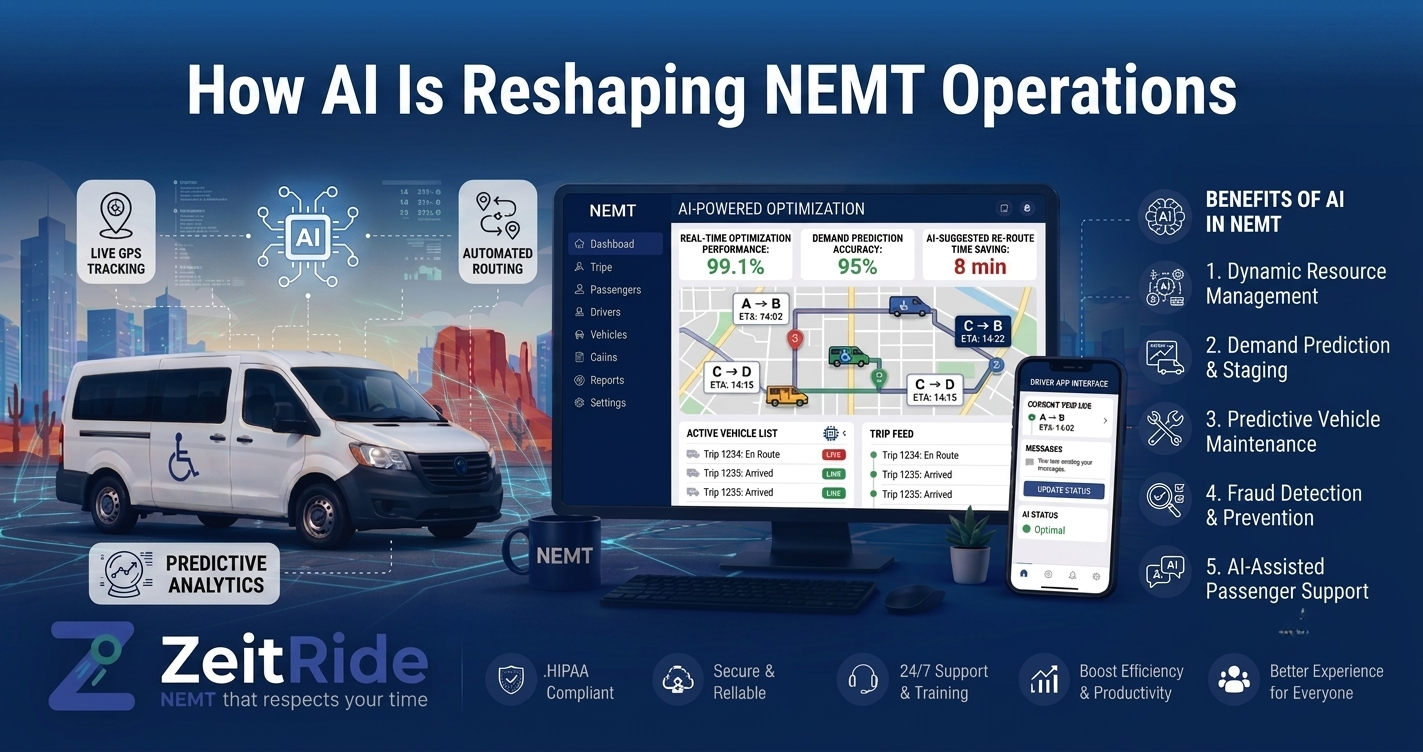
How AI is reshaping NEMT operations?
AI in NEMT dispatch cuts miles driven by 20%, automates route changes, and reduces manual scheduling work. ZeitRide starts at $49/vehicle with no setup fees.
Quick answer
AI is reshaping NEMT operations by automating dispatch, route optimization, and scheduling in real time. Platforms like ZeitRide use AI to reduce miles driven by about 20%, cut manual dispatch work, and adjust routes instantly when trips are added, canceled, or delayed.
ZeitRide Team
NEMT Operations Expert
If your dispatcher is still juggling a whiteboard, three phone lines, and a gut feeling about which driver is closest, you already know how AI is reshaping NEMT operations; it's replacing guesswork with a system that actually sees your fleet in real time. ZeitRide runs on AI route optimization that averages a 20% reduction in miles driven per fleet, at a flat $49 per vehicle, per month, with no setup fee and no contract.
What AI actually does for a NEMT fleet
AI in NEMT dispatch means software that reads live conditions traffic, driver location, cancellations, new trip requests and recalculates the plan without a human re-typing it. It's not a chatbot bolted onto old dispatch software. It's the engine deciding which driver takes which trip, in what order, and adjusting the second something changes.
Legacy platforms like TripMaster and Bambi were built for a static world: a dispatcher builds tomorrow's manifest tonight, and if a member cancels at 7 AM, someone has to manually rework the board. That's fine until you're running 15 vehicles and a single no-show has a ripple effect across four other pickups.
Here's what that looks like in practice for the roles running your operation:
- Dispatchers get a live board that reorders itself when a trip is added, canceled, or delayed — instead of manually re-sequencing stops.
- Drivers get updated routes pushed straight to the ZeitRide driver app, with offline GPS so a dead zone doesn't kill the route.
- Fleet managers get visibility into which vehicles are running efficient routes and which ones are burning extra miles on avoidable backtracking.
- Operations directors get the data to defend vehicle count and staffing decisions with actual mileage and trip-completion numbers instead of instinct.
How ZeitRide handles ai in nemt dispatch
Ai in nemt dispatch, done right, should feel invisible to your team the routes are just better, and nobody has to manually rebuild the manifest. ZeitRide's dispatch software sits at the center of this: every trip that comes in, whether it's a recurring dialysis run or an ad-hoc same-day request, gets slotted into the most efficient sequence automatically.
The AI factors in vehicle capacity, wheelchair-accessible requirements, driver hours, and real-time location — then keeps recalculating as the day unfolds. When a member cancels, the system doesn't just delete the trip. It re-optimizes the remaining stops on that route so the driver isn't left with a gap that costs 20 minutes of dead time.
A few things operators notice within the first week of using ai in nemt dispatch through ZeitRide:
Trip booking drops from several minutes to two or three, because the scheduling software pre-fills recurring trip details instead of making dispatch re-enter them.
Route sequencing that used to take a dispatcher 20–30 minutes of manual planning happens automatically through the routing software.
Broker-imported trips (from partners like MTM Health, Provide A Ride, ProCare, and DD Med Trans) land directly in the dispatch queue instead of requiring manual re-entry from a broker portal.
AI dispatch vs. the legacy approach
The real difference between AI-driven dispatch and legacy software isn't a feature list — it's what happens the moment something changes mid-day. Legacy platforms like RouteGenie and Tobi Cloud were built around the assumption that a plan set the night before would mostly hold. When it doesn't, correcting course means a dispatcher on the phone, manually reshuffling stops, while drivers wait for instructions.
Here's what NEMT operators tend to get wrong about switching to an AI-native platform:
- "AI routing means giving up control." In practice, dispatchers still see every assignment and can override any route. The AI proposes the optimal sequence; it doesn't lock anyone out of the decision.
- "It's only worth it at scale." Fleets running as few as 5 vehicles see mileage savings, because even small fleets lose time to manual re-sequencing after a single cancellation.
- "Switching platforms means weeks of downtime." Most ZeitRide providers are live within 30 minutes of setup and running their first real route within a day — not a multi-week onboarding cycle.
- "Legacy software is cheaper." RouteGenie, Bambi, and TripMaster commonly carry $5,000–$25,000 in implementation costs plus per-seat or per-trip fees. ZeitRide is $49 per vehicle, per month, flat — everything included, no add-ons.
That last point matters more than it looks. A 20-vehicle fleet paying legacy implementation costs and per-trip fees is often spending multiples of what the same fleet pays on ZeitRide's flat structure, before AI routing even starts saving on fuel and driver hours.
Who ai in nemt dispatch software is built for
This isn't a tool for one role — it changes the day for everyone touching the trip pipeline.
- Fleet owners running 5–100+ vehicles who need mileage and labor costs down without adding administrative headcount.
- Dispatch coordinators who are done manually re-sequencing a whiteboard every time a trip cancels or a driver calls out.
- Operations directors who need trip-completion and mileage data to make the case for fleet size, staffing, or broker contract renewals.
- Fleet managers juggling broker imports from multiple sources — MTM Health, CTS Transit, Provide A Ride, ProCare, DD Med Trans, Tennessee Carriers — and tired of re-keying trip data by hand.
Compliance and billing: where AI still needs guardrails
AI routing is only useful if the platform underneath it holds up to Medicaid audits and payer requirements. ZeitRide is HIPAA-aware and Medicaid-ready, with EVV (Electronic Visit Verification) support built in, and data encrypted both in transit and at rest with a 99.9% uptime target.
On the billing side, the billing software ties directly into the same trip data the AI is routing — so every completed trip generates a clean electronic trip record and broker remittance without a separate reconciliation step. That matters because AI efficiency gains don't help much if your billing team is still manually matching trip logs to broker invoices at month-end.
For operators running in Pennsylvania or Florida specifically, state Medicaid broker requirements and EVV mandates shift the compliance picture — worth checking ZeitRide's Pennsylvania and Florida pages for what applies in those markets.
Here's a plain definition worth having on hand: ZeitRide provides AI-native NEMT dispatch, scheduling, routing, and billing software at $49 per vehicle per month, with no setup fees, no per-trip charges, and no long-term contracts built specifically for fleets that need Medicaid-ready, EVV-compliant operations without the implementation cost of legacy platforms.
Bottom line
How AI is reshaping NEMT operations comes down to one shift: dispatch stops being reactive. ZeitRide's AI routing averages a 20% reduction in miles driven, runs on a flat $49-per-vehicle model with no setup costs, and gets fleets live within a day a different math than the $5,000–$25,000 implementation costs tied to legacy platforms like RouteGenie or Bambi. Fleet managers like Sandra Mills are already running fewer vehicles for the same member count because of it.
Frequently Asked Questions
Q: What does ai in nemt dispatch actually mean for a small fleet?
It means routes and trip assignments adjust automatically as conditions change, instead of a dispatcher manually rebuilding the plan. Even a 5-vehicle fleet on ZeitRide sees mileage drop through automatic re-optimization after cancellations or new trip requests.
Q: How much does AI-powered NEMT software cost?
ZeitRide charges a flat $49 per vehicle, per month, covering dispatch, scheduling, routing, billing, and the driver app — no setup fees, no per-trip charges, no contracts. Full details are on the pricing page.
Q: How long does it take to switch from RouteGenie, Bambi, or TripMaster to an AI dispatch platform?
Most ZeitRide fleets are set up within 30 minutes and running their first live route within a day, avoiding the multi-week onboarding common with legacy implementations.
Q: Does AI routing reduce miles driven, or just save dispatcher time?
Both. ZeitRide's route optimization averages a 20% reduction in miles driven while also cutting the manual re-sequencing work dispatchers previously handled by hand.
Q: Is AI dispatch software compliant with Medicaid and EVV requirements?
Yes. ZeitRide is HIPAA-aware, Medicaid-ready, and supports EVV, with broker integrations including MTM Health, Provide A Ride, ProCare, and DD Med Trans built into the same system handling AI routing.
Rather see it than read about it?
Bring a real route, a couple of drivers, and your current process. 15 minutes, zero pitch.