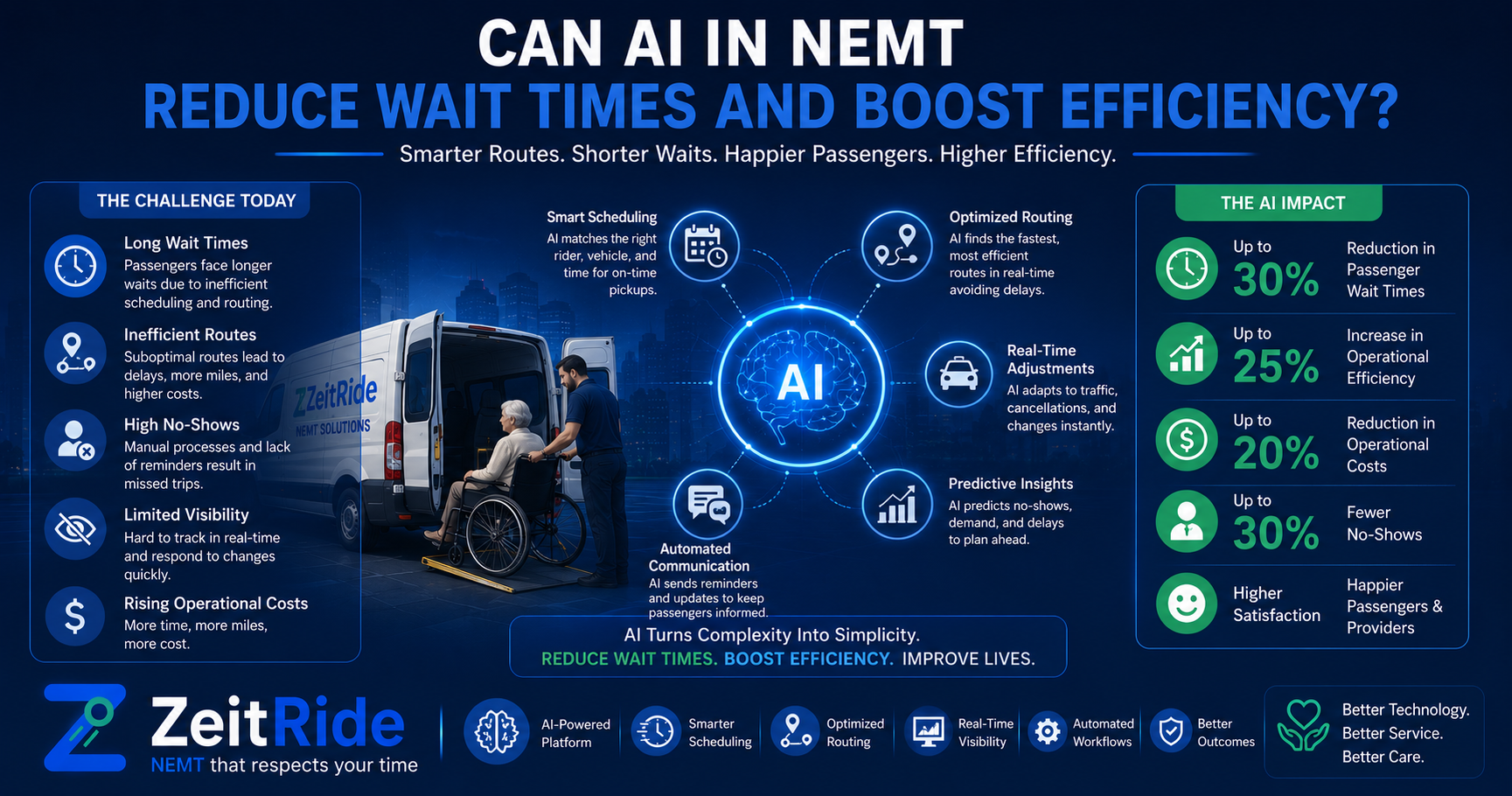
Can AI in NEMT Reduce Wait Times and Boost Efficiency?
AI-driven service-time predictions and dynamic routing can eliminate avoidable wait times and missed return trips, increasing trip throughput without increasing dispatcher workload.
Quick answer
Yes, AI reduces NEMT wait times by optimizing routes continuously as trips change, predicting accurate ETAs based on real-time traffic and appointment data, enabling instant trip reassignments when schedules shift, and automating passenger notifications so facilities plan better. Providers using AI-powered NEMT dispatch report 20–35% reductions in average wait time without adding drivers or dispatchers.
ZeitRide Team
NEMT Operations Expert
Here's a number that should bother every NEMT provider: studies show that up to 3.6 million Americans miss or delay medical appointments each year due to transportation issues and a significant chunk of those failures come down to poor scheduling, late pickups, and overwhelmed dispatchers. So the question isn't just philosophical. Can AI in NEMT reduce wait times and boost efficiency? The answer, backed by real-world results, is a clear yes and in this article, we break down exactly how it works.
Why Traditional NEMT Operations Struggle
Before we dive into AI's impact, it's worth understanding why conventional NEMT dispatch has always been an uphill battle. Manual scheduling creates blind spots. Dispatchers juggle dozens of trips, driver availability, and real-time traffic all at once, all by hand. One missed call can cascade into a chain of late arrivals. The result? Patients wait. Providers scramble. Costs climb. This is precisely the environment where AI in NEMT dispatch doesn't just help it completely changes the game.
How AI in NEMT Reduces Wait Times — Step by Step
1. AI Routing in NEMT: Smarter Paths, Faster Pickups
One of the most immediate wins from deploying AI non-emergency medical transportation software is intelligent route optimization. AI routing in NEMT goes far beyond a standard GPS app. It analyzes live traffic data, driver locations, appointment windows, vehicle types, and patient mobility needs — all simultaneously — to generate the most efficient path for every single trip. The result: • Shorter travel times per trip • Higher on-time arrival rates • Reduced fuel costs per mile • Fewer wasted miles due to poor route planning When you multiply those gains across dozens or hundreds of daily trips, the efficiency improvement is dramatic.
2. AI in NEMT Dispatch: Automation That Thinks Ahead
Old-school dispatch relies on a human being to manually assign drivers to trips — a process that's slow, error-prone, and doesn't scale. AI in NEMT dispatch flips that model. Modern AI dispatch engines automatically match trips to the best available driver based on proximity, vehicle capacity, break schedules, and return-trip requirements. When a driver runs late, the system doesn't wait for a call — it proactively reassigns or adjusts timing in real time. Zeitride's NEMT dispatch software is purpose-built around this AI-first dispatch model, giving your team eyes on every trip at every moment.
3. Predictive Scheduling: Know What's Coming Before It Happens
A huge driver of wait times is last-minute chaos — a no-show driver, a late cancellation, or a surge in ride demand. AI in NEMT solves this through predictive scheduling. By analyzing historical trip data, seasonal patterns, and appointment calendars, the system forecasts demand before it hits. You can pre-position drivers, stagger schedules, and avoid the bottlenecks that cause cascading delays.
This is one of the core features inside Zeitride's NEMT scheduling software — helping providers across the USA stay ahead of demand instead of reacting to it.
Can AI in NEMT Reduce Wait Times? Real-World Impact
Let's be specific about what "boosting efficiency" actually looks like in practice for AI non-emergency medical transportation operations: • Up to 30% reduction in average patient wait time reported by providers using AI-optimized dispatch • 15–25% drop in cost per trip through smarter multi-loading and route batching • Significant reduction in missed trips caused by poor communication or late assignments • Faster billing cycles due to automated trip verification and documentation These aren't hypothetical projections — they're outcomes being reported by NEMT providers who've moved away from manual systems toward intelligent software platforms.
How to Reduce NEMT Wait Times: A Practical Framework
If you're asking how to reduce NEMT wait times in your own operation, the answer is a combination of technology and process. Here's what works: • Adopt AI routing in NEMT to eliminate inefficient manual planning • Automate driver-trip matching through AI in NEMT dispatch systems • Use real-time tracking and ETAs to proactively communicate with patients • Leverage predictive analytics to anticipate high-demand windows • Implement multi-loading logic to group compatible trips without impacting appointment timing
Zeitride's all-in-one platform covers every one of these areas. From NEMT routing software to automated billing, the entire workflow is connected.
Why AI in NEMT Is No Longer Optional
The NEMT industry is under more pressure than ever — rising trip volumes, tighter margins, stricter compliance requirements, and patients who expect reliable, on-time service. Manual operations simply can't keep up. AI in NEMT isn't a luxury for large fleets. It's rapidly becoming the baseline expectation for any provider that wants to stay competitive, maintain broker relationships, and most importantly — actually serve patients well.
Whether you're an independent provider or a multi-region operator, Zeitride's NEMT software is designed to scale with you — from your first 10 trips to your ten-thousandth.
Zeitride: Built for Modern AI Non-Emergency Medical Transportation
Zeitride is a leading NEMT software provider serving transportation companies across the United States. Our platform brings together AI-powered dispatch, intelligent routing, predictive scheduling, real-time tracking, and automated billing — all in one place. We built Zeitride specifically for the realities of modern NEMT: complex multi-trip days, broker compliance requirements, diverse vehicle fleets, and patients who depend on you to get it right, every time. See how Zeitride compares to other NEMT platforms — or explore all Zeitride features to see the full picture.
Ready to Reduce Wait Times and Run a More Efficient Operation?
See exactly what AI in NEMT can do for your business. Schedule a free demo of Zeitride today and discover how providers across the USA are cutting wait times, reducing costs, and scaling with confidence.
Rather see it than read about it?
Bring a real route, a couple of drivers, and your current process. 15 minutes, zero pitch.