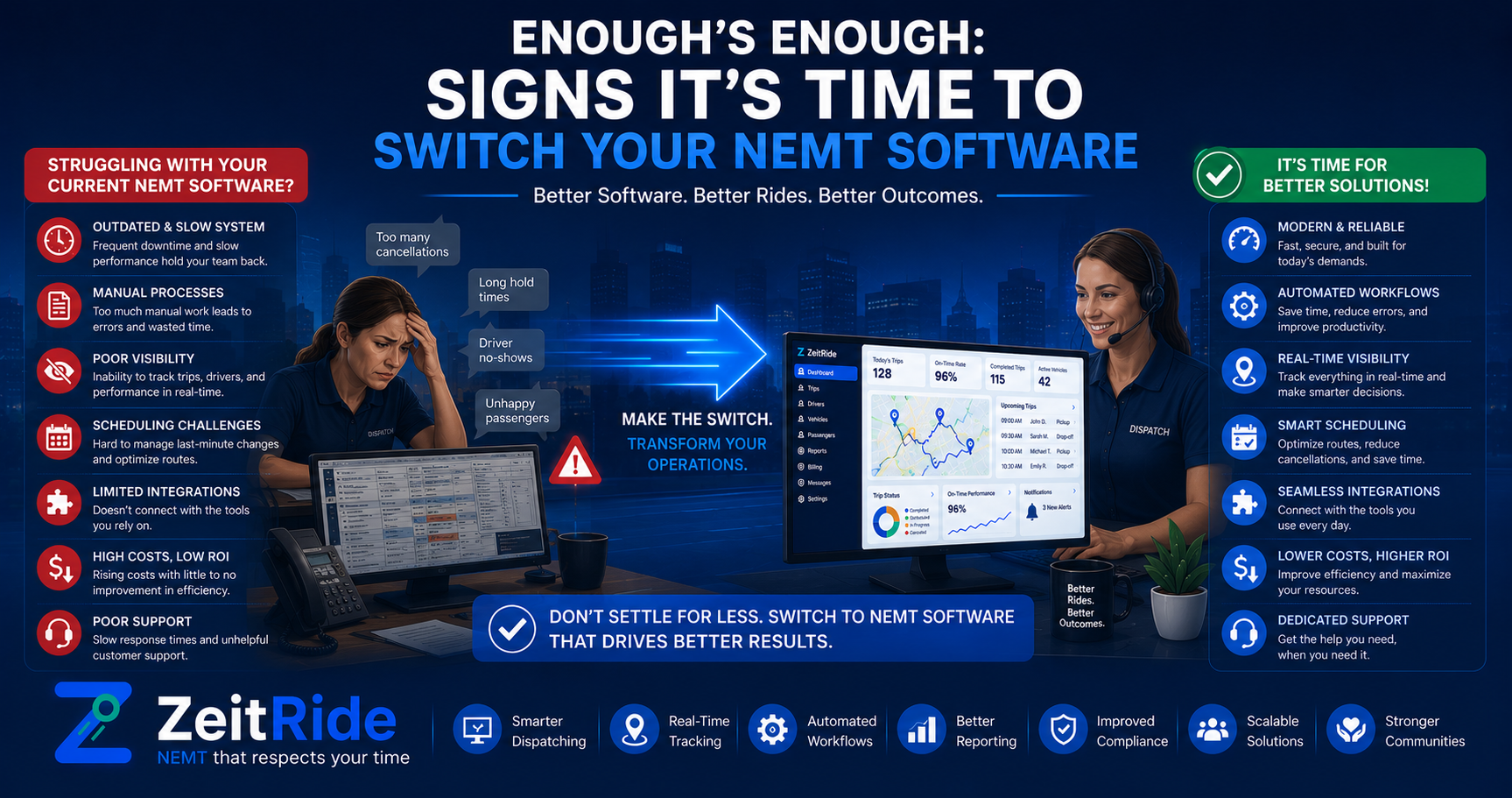
Enough's Enough: Signs It's Time to Switch Your NEMT Software
Is your NEMT software still working for you—or quietly working against you? For many providers, outdated software is the difference between profit and inefficiency. Here are the signs to watch for.
Quick answer
It's time to switch NEMT software when dispatchers are spending more time on workarounds than on actual dispatch, billing errors are frequent and hard to trace, broker trip imports require manual re-entry, the driver app is unreliable or absent, on-time performance is declining without a clear operational cause, and your current vendor's support is slow or unresponsive to issues.
ZeitRide Team
NEMT Operations Expert
When to Switch NEMT Software
Most NEMT providers don't switch software because they're unhappy with a specific feature. They switch because a pattern of small failures has compounded into an operational drag that costs them time, money, and opportunities every week. The signs below are worth taking seriously—not as individual complaints, but as indicators of a platform that has reached the limit of what it can do for your operation.
Sign 1: Your Dispatchers Have Their Own Workarounds
If your dispatchers maintain a separate spreadsheet for trip tracking, use a whiteboard for status updates, or keep a personal shorthand system to compensate for something the software doesn't do—that's not a dispatcher problem. That's a software problem. Workarounds signal that the platform doesn't match how your operation actually runs. Over time, these workarounds become load-bearing: new dispatchers have to learn the workaround instead of learning the software, and when the person who built the workaround leaves, tribal knowledge goes with them.
Sign 2: Billing Errors Are a Regular Occurrence
Billing errors in NEMT fall into two categories: errors that get caught before submission and cause rework, and errors that get submitted and result in denials or recoupments. Both are expensive. If your billing team routinely finds trips that weren't logged correctly, authorizations that didn't get matched, or mileage that doesn't reconcile, the root cause is almost always a data handoff problem between dispatch and billing. Platforms that integrate dispatch and billing eliminate most of these errors at the source.
Sign 3: Broker Trip Imports Require Manual Re-Entry
In 2024, there is no good reason for a dispatcher to be manually re-entering broker trips into scheduling software. Every major NEMT broker offers structured trip data via API or file export. If your platform can't import that data automatically, you're paying a labor cost that your competitors aren't, and you're introducing transcription errors into every imported trip. This is a compatibility problem with your current platform, not a process problem.
Sign 4: The Driver App Is Unreliable or Absent
A driver app that crashes frequently, fails in low-connectivity areas, requires drivers to call dispatch for every status update, or simply doesn't exist is a major operational liability. Drivers who can't confirm pickups electronically create billing documentation gaps. Drivers who call dispatch for directions and status updates increase dispatcher workload and call volume. If your drivers aren't successfully using the app for the full trip lifecycle—pickup confirmation, navigation, e-signatures, drop-off documentation—you're leaving service quality and billing efficiency on the table.
Sign 5: On-Time Performance Is Declining Without a Clear Cause
If your on-time performance is declining but you haven't added routes, changed service areas, or hired new drivers, the most likely culprit is scheduling or dispatch inefficiency. Platforms that don't continuously optimize as trips change accumulate inefficiency throughout the day. What looks like a driver problem or a traffic problem is often a routing or assignment problem that better software would have caught and corrected.
Sign 6: Scaling Up Creates More Problems Than It Solves
Some NEMT platforms work reasonably well at small scale and fall apart as volume increases. If adding 10 vehicles created a proportionally larger increase in dispatcher workload, billing complexity, and error rate—rather than a linear or sublinear increase—your platform probably wasn't designed to scale. Modern platforms handle larger fleets with the same dispatcher team through automation; older platforms require more manual intervention per trip as volume grows.
Sign 7: Vendor Support Is Slow or Unresponsive
When something breaks in NEMT software during morning dispatch, you need a response in minutes—not hours or days. If your current vendor's support ticket system produces responses 48 hours later, if bug reports go unacknowledged, or if feature requests disappear without follow-up, that's a signal about how the vendor prioritizes existing customers vs. new sales. A platform with fast, knowledgeable support is worth paying more for. A platform with slow support that fails during peak hours is a liability regardless of its feature set.
How to Switch NEMT Software Without Disrupting Operations
The switching process matters as much as the platform selection. Ask vendors specifically about: data migration from your current system, training timeline and format, parallel running period (using both systems before full cutover), and what happens to historical trip data after you migrate. Providers who plan the transition carefully—typically 2–4 weeks for most modern platforms—report minimal operational disruption. Providers who rush the switch without a clear migration plan experience the disruption they were trying to avoid.
Final Thought
The right NEMT software should reduce stress, improve efficiency, and help your business grow—not create more manual work and operational bottlenecks. If your team is constantly dealing with dispatch workarounds, billing mistakes, unreliable driver communication, or slow support, those aren’t small inconveniences anymore. They’re signs your current platform is holding your fleet back.
Modern platforms like ZeitRide are designed to help providers streamline dispatching, automate billing workflows, improve broker integrations, and scale operations without increasing administrative chaos. Choosing the right software now can save your business countless hours, reduce costly errors, and create a smoother experience for both drivers and passengers as your fleet grows.
Rather see it than read about it?
Bring a real route, a couple of drivers, and your current process. 15 minutes, zero pitch.