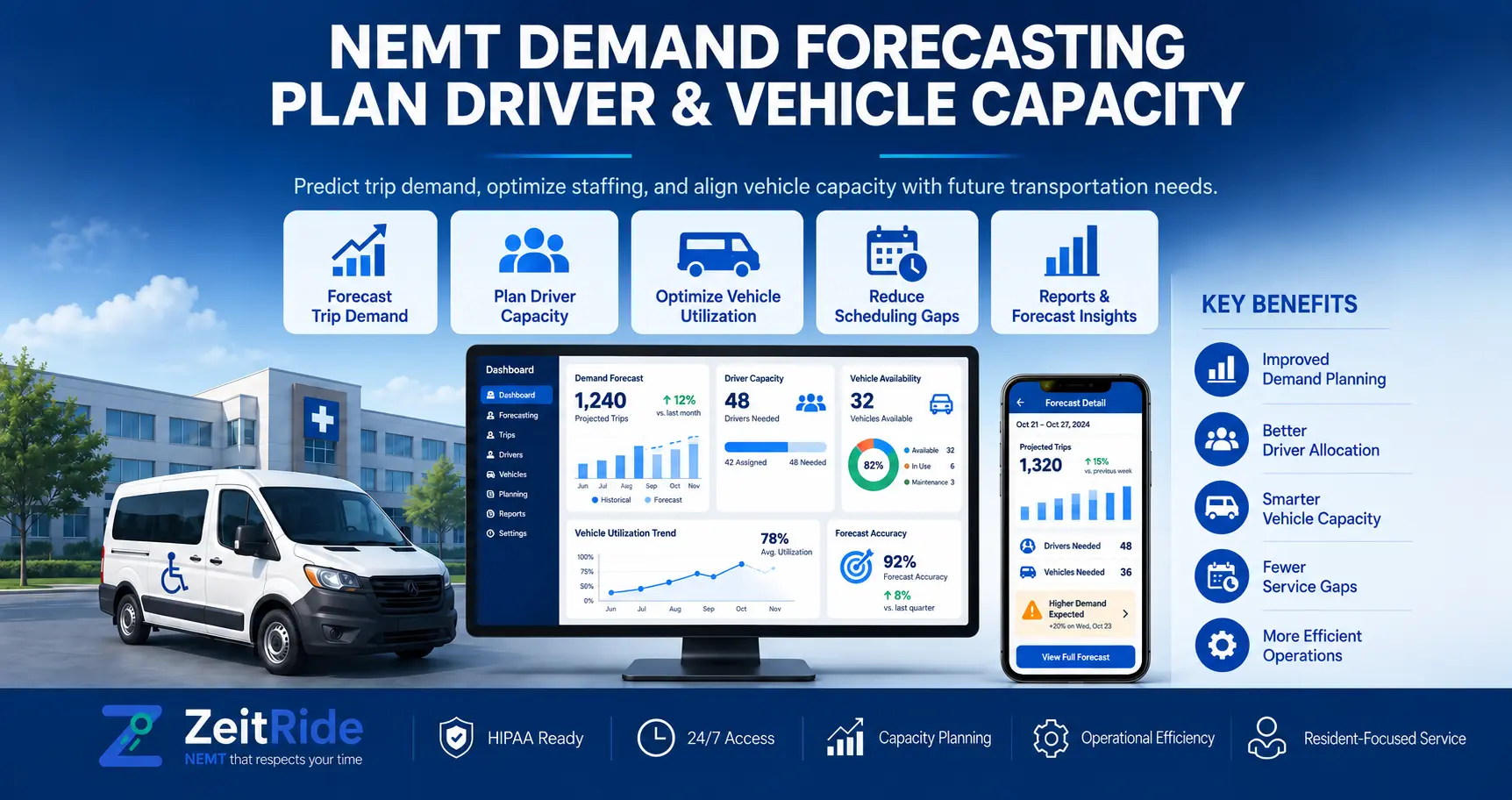
NEMT Demand Forecasting: Plan Driver & Vehicle Capacity
Learn how to forecast NEMT trip demand and turn expected volume into practical driver and vehicle capacity before busy periods hit.
Quick answer
NEMT providers can forecast upcoming demand by combining booked recurring trips with historical trip patterns, same-day demand, cancellations, service levels, and peak-time trends. Convert that forecast into vehicle-hours and driver coverage before building the schedule.
ZeitRide Team
NEMT Operations Expert
Tomorrow's booked trips tell you what is already known. They do not tell you everything that is likely to hit your operation. An NEMT fleet may know its dialysis standing orders but still face predictable one-time appointments, recurring facility demand, same-day requests, cancellations, and concentrated morning or afternoon peaks. If staffing begins only after all of those trips arrive, the operation is already reacting.
NEMT demand forecasting helps providers use their own trip history to estimate future workload before schedules are finalized. The goal is not perfect prediction. It is to create a repeatable forecast that gives operations enough information to prepare drivers, vehicles, and capacity with less guesswork.
What Is NEMT Demand Forecasting?
NEMT demand forecasting is the process of estimating future transportation demand using booked trips, historical trip volume, recurring patterns, service types, time-of-day trends, facilities, brokers, geography, cancellations, and same-day requests.
A useful forecast should answer more than how many trips might occur. It should also help answer when those trips will occur, what vehicles they may require, and how much driver coverage will be needed. That is what turns a forecast into an operating plan.
Why Forecast NEMT Trip Demand?
Without a forecast, many fleets plan tomorrow from today's booking screen. That can create two opposite problems: too little capacity during busy periods or too much unused capacity during quieter periods.
Too Little Capacity
- Unassigned trips
- Overloaded drivers
- Driver overtime
- Rushed dispatch decisions
- Rejected same-day requests
- Weaker on-time performance
Too Much Capacity
- Paid idle time
- Underused vehicles
- Unnecessary driver coverage
- Higher operating cost per completed trip
Forecasting helps operations prepare for the likely workload while still leaving room for uncertainty.
What Data Does NEMT Trip Demand Forecasting Require?
Good NEMT trip demand forecasting begins with clean operational data. Start with the data your fleet already records instead of creating a forecasting model around information you cannot reliably measure.
| Data | What It Helps Predict |
|---|---|
| Requested trips | Total demand entering the operation |
| Completed trips | Actual transportation delivered |
| Day of week | Recurring weekday patterns |
| Time of day | Morning, midday, and afternoon peaks |
| Recurring trips | Already predictable base demand |
| Same-day requests | Short-notice capacity pressure |
| Cancellations and no-shows | Demand that may not become completed work |
| Service level | Vehicle and service-time requirements |
| Facility | Repeating trip generators |
| Broker | Demand patterns by source |
| Geography | Where capacity needs to be positioned |
Start with your existing NEMT fleet reports rather than creating a separate forecasting spreadsheet before you understand the data you already collect. Use comparable periods whenever possible. Monday demand should usually be compared with other Mondays rather than being blended blindly with weekends or materially different operating days.
Separate Known, Predictable, and Unpredictable Demand
A practical forecasting model begins by separating demand into three groups. This prevents already-booked work, historically predictable activity, and genuinely unexpected requests from being treated as though they carry the same level of certainty.
| Demand Type | Meaning | Example |
|---|---|---|
| Known | Transportation already booked | Standing dialysis trips |
| Predictable | Trips are not all booked yet, but history shows a recurring pattern | Facility appointments that regularly appear on Tuesdays |
| Unpredictable | Demand with limited advance visibility | Same-day discharge request |
Known Demand
Known demand is the strongest planning input. Standing orders, recurring facility trips, and already-booked appointments should form the base of the forecast.
Predictable Demand
Historical analysis becomes useful when a weekday, facility, service area, broker, or time block consistently produces additional trips. That pattern should influence capacity planning even before every individual trip is booked.
Unpredictable Demand
Some transportation cannot be reliably predicted. The goal is not to invent future trips. It is to understand how often unexpected demand historically appears and decide how much operational flexibility is reasonable.
How Do You Forecast NEMT Trip Volume?
A simple process can help operators forecast NEMT trip volume without pretending that every future ride can be predicted perfectly.
Step 1: Start With Known Booked Trips
Count recurring and one-time trips already scheduled for the forecast period. This becomes your confirmed demand.
Step 2: Estimate Variable Demand
Review several comparable historical periods. A simple planning calculation is: Expected variable demand = Comparable historical variable trips ÷ Number of comparable periods. Use your own operating history instead of applying an industry-wide average.
Step 3: Estimate Same-Day Demand
Look separately at requests that historically arrive on the day of service. If same-day demand is concentrated around particular weekdays, facilities, brokers, or times of day, preserve that pattern instead of averaging everything together.
Step 4: Account for Cancellations Carefully
If your forecast begins with requested trips, historical cancellations can help estimate how much booked demand normally falls away. If your model already uses completed-trip averages, do not subtract cancellations a second time.
Step 5: Build a Working Forecast
A simplified planning structure is: Forecasted demand = Known trips + Expected variable trips + Expected same-day demand − Expected cancellations. This is a planning model rather than a universal formula, so adapt it to how your operation records requested, scheduled, canceled, and completed trips.
Forecast by Time of Day, Not Just Daily Total
A forecast of 40 trips tomorrow is incomplete. Forty trips distributed fairly evenly across the operating day may require different resources from 40 trips concentrated heavily during morning pickups and afternoon returns.
For NEMT capacity planning, break future demand into practical operating windows such as early morning, morning peak, midday, afternoon return peak, and evening. Capacity pressure is often created by trip concentration rather than the daily total.
Forecast Demand by Service Level
Trip count alone can hide important vehicle requirements. Five ambulatory trips and five wheelchair trips may place different demands on an operation because boarding time, equipment, vehicle compatibility, and trip-cycle time can vary.
Segment forecasted demand by the service levels your fleet actually provides. This helps prevent a situation where the total fleet appears to have available vehicles while the specific vehicle type required by the upcoming workload is already fully committed.
Convert Forecasted Trips Into Vehicle Capacity
Once expected demand is estimated, convert the forecast into workload. A simple NEMT vehicle capacity planning approach is: Forecast vehicle workload = Forecasted trips × Representative trip-cycle minutes.
For example, if a time block contains 12 expected trips and the representative trip cycle for that work is 60 minutes, the forecast represents approximately 720 vehicle-minutes, or 12 vehicle-hours, of workload.
That does not automatically mean 12 vehicles are required. Trips may occur across a wider time window and may fit together differently depending on geography, appointment times, service level, vehicle compatibility, and routing. The NEMT vehicle capacity guide explains trips-per-vehicle and usable operating-time calculations in more detail.
Convert Forecasted Demand Into Driver Coverage
Vehicle availability alone does not create capacity. A usable vehicle also needs an available, qualified driver whose shift can cover the transportation.
- Scheduled driver hours
- Shift start and end times
- Breaks
- Driver qualifications
- Assigned vehicle types
- Recurring commitments
- Known absences
This is where forecasting should hand off to NEMT driver scheduling. Demand forecasting estimates how much coverage may be needed, while driver scheduling determines who can realistically provide that coverage.
Build Low, Base, and High Demand Scenarios
No forecast should pretend uncertainty does not exist. Instead of relying on one rigid trip number, create low, base, and high scenarios using the range found in your own comparable historical periods.
| Scenario | Meaning | Planning Use |
|---|---|---|
| Low | Quieter plausible demand | Minimum expected workload |
| Base | Most reasonable expected demand | Normal schedule |
| High | Busier plausible demand | Contingency capacity |
Do not automatically add the same percentage to every forecast. Use your fleet's historical variation to define what a quiet, normal, and busy comparable period actually looks like.
Compare the Forecast With What Actually Happened
A forecast becomes more useful when the operation learns from its misses. After the forecast period, compare: Forecast → Actual → Variance → Cause → Adjustment.
If Tuesday demand is repeatedly underestimated, investigate the cause. It may be a facility pattern, recurring broker batch, increased same-day demand, seasonal change, new service area, or inconsistent trip classification. Do not only measure whether the forecast was wrong. Understand why it was wrong, then improve the next forecast.
When Does a Capacity Gap Mean You Need More Resources?
A forecast showing more demand than available capacity does not automatically mean it is time to buy another vehicle or permanently add another driver. First identify what type of capacity gap you actually have.
Temporary Peak
Demand exceeds available capacity during only one limited time period. A temporary operational response may make more sense than permanent expansion.
Scheduling Gap
Capacity exists, but available shifts or assignments do not match when forecasted demand occurs.
Utilization Problem
Vehicles and drivers exist, but deadhead, schedule gaps, or inefficient sequencing reduce usable capacity. Review NEMT route optimization before assuming another vehicle is required.
Recurring Capacity Shortage
Efficiently used vehicles and appropriately scheduled drivers still cannot cover recurring, economically useful demand. That is stronger evidence that additional capacity deserves consideration.
How NEMT Predictive Scheduling Fits Into the Workflow
NEMT predictive scheduling should not be confused with simply automating tomorrow's assignments. The useful workflow is: Historical data → Demand forecast → Capacity plan → Driver schedule → Vehicle assignments → Routing → Live dispatch → Actual results.
Forecasting gives the schedule a better starting point. Once the operating day begins, NEMT routing software and dispatch workflows handle real-world constraints such as geography, vehicle compatibility, appointment times, cancellations, call-outs, and changing trip conditions.
The value comes from connecting planning with execution, not from attaching an AI label to an otherwise disconnected forecast.
NEMT Demand Forecasting Checklist
- Count known booked and recurring trips
- Review comparable historical periods
- Separate one-time and recurring demand
- Review same-day request patterns
- Account for cancellations consistently
- Break the forecast down by time of day
- Separate demand by required service level
- Convert expected trips into workload
- Compare workload with available vehicles
- Compare vehicle demand with driver coverage
- Create low, base, and high scenarios
- Review forecast versus actual afterward
- Adjust the next forecast using what you learned
A simple forecast that is reviewed and improved consistently is more useful than a complicated model nobody trusts.
Frequently Asked Questions
Q: What is NEMT demand forecasting?
NEMT demand forecasting estimates future trip volume using booked transportation, historical demand patterns, recurring trips, time of day, service levels, facilities, geography, cancellations, and same-day requests so providers can plan capacity before the operating period begins.
Q: How much historical data should an NEMT fleet use?
Use enough comparable operating history to identify stable patterns, and expand the time window when seasonality, new contracts, or major operational changes matter. There is no universal number of weeks that is correct for every fleet.
Q: How do recurring trips affect an NEMT demand forecast?
Recurring trips create the most predictable base of the forecast because their future transportation is already known or highly repeatable. Variable and same-day demand can then be layered on top.
Q: How do I estimate how many vehicles I need?
Convert forecasted trips into representative vehicle workload, then compare that workload with usable vehicle capacity during the same time period. Account for geography, service level, trip-cycle time, appointment windows, and driver availability.
Q: Does NEMT demand forecasting require AI?
No. Operators can build useful forecasts from clean historical data and consistent calculations. Advanced analytics or AI may identify additional patterns, but a useful forecast still depends on reliable operational data and clear definitions.
Plan Capacity Before Demand Becomes a Dispatch Problem
The purpose of NEMT demand forecasting is not to predict every ride perfectly. It is to give operations a better answer to three questions: What workload should we prepare for? When will it arrive? Do we have enough qualified drivers and vehicles to cover it?
Start with booked trips, add repeatable historical patterns, separate same-day demand, forecast by time and service level, and translate the expected workload into driver and vehicle capacity. Then compare the forecast with what actually happens and improve the next planning cycle.
ZeitRide connects reporting, scheduling, routing, driver, vehicle, and live dispatch workflows around this planning process. Bring a recent block of trip history and one busy operating day to a 15-minute ZeitRide demo and see how your operational data can stay connected from planning through dispatch.
Rather see it than read about it?
Bring a real route, a couple of drivers, and your current process. 15 minutes, zero pitch.