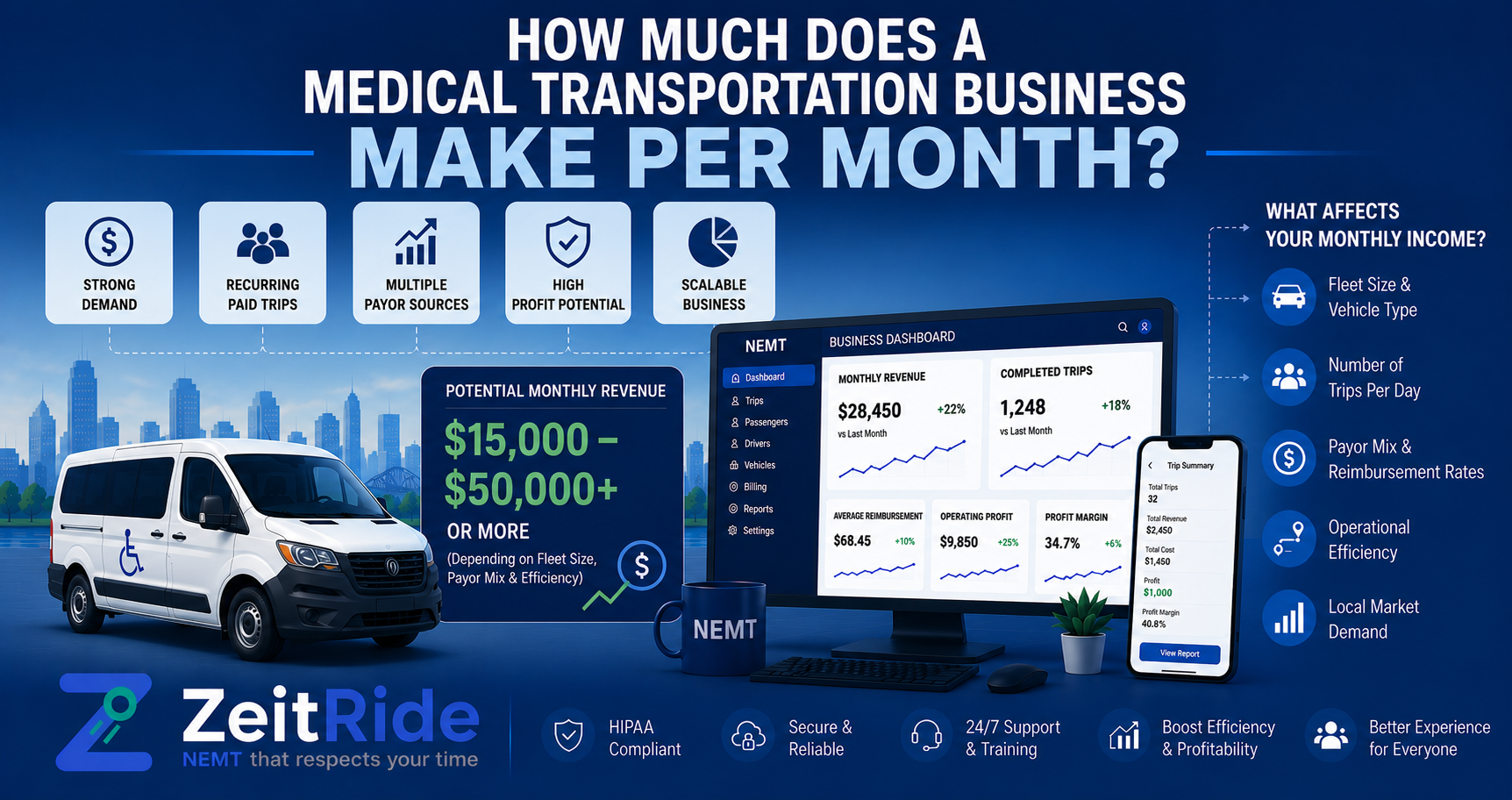
How much does a medical transportation business make per month
Learn how much a medical transportation business makes per month, average NEMT revenue per vehicle, key profit drivers, and ways to increase monthly income.
Quick answer
A medical transportation business typically earns $3,000–$5,000 per vehicle per month in gross revenue, although total income depends on trip mix, reimbursement rates, fleet size, and route efficiency.
ZeitRide Team
NEMT Operations Expert
A fleet owner running six vans can look at the same trip logs as the owner next door and land on a completely different monthly number because how much does a medical transportation business make per month depends less on how many trips get booked and more on how many of those trips actually turn a profit after deadhead miles, no-shows, and driver hours get subtracted out. Most operators find that gap only after a rough month, not before one.
ZeitRide's route optimization engine averages a 20% reduction in miles driven per vehicle, which is usually where that gap starts closing. Book a 15-minute demo bring a real route and we'll run it live in ZeitRide.
What Determines How Much a Medical Transportation Business Makes
The honest answer to how much does a medical transportation business make per month is: it depends on trip mix, fleet utilization, and how much of your revenue gets eaten by empty miles before it reaches your bank account. A single wheelchair van running steady Medicaid and broker trips typically brings in somewhere between $3,000 and $5,000 a month in gross revenue, and a stretcher vehicle in a high-reimbursement area can run higher. That's the top-line number most people quote when someone asks how much do NEMT companies make but it's gross, not profit, and the distance between the two is where most fleets either grow or stall out.
Three factors move that number more than anything else:
- Trip type mix. Ambulatory trips pay the least per ride; wheelchair and stretcher trips pay more but cost more to run and staff.
- Deadhead miles. Unloaded miles driven to reach a pickup or return from a drop-off usually can't be billed, so every mile of them is a direct hit to your medical transportation business's monthly take.
- No-shows and cancellations. A dispatcher juggling paper schedules or a spreadsheet catches these late, if at all and a missed cancellation is a driver, a vehicle, and a time slot burned for nothing.
- Quick stat: Operators who tighten routing and cut deadhead miles typically see the biggest single jump in how much medical transport makes per vehicle, ahead of raising rates or adding trips.
How ZeitRide Changes the Math on NEMT Business Profits
Here's what actually moves the needle on nemt business profits once the trip volume is already there: the software running dispatch, scheduling, and billing either protects the margin on every trip or quietly erodes it. ZeitRide runs your entire operation dispatch, scheduling, routing, billing, broker integrations, and the driver app for one flat $49 per vehicle per month, with no setup fee and no contract.
What that includes in practice:
- AI route optimization that averages a 20% cut in miles driven per vehicle, which is the deadhead-mile problem addressed directly instead of managed around
- Broker import for integrations including MTM Health, CTS Transit, Provide A Ride, ProCare, and DD Med Trans, so trips land on the schedule without a dispatcher retyping them
- A driver app for iOS and Android with offline GPS and a learning curve under 15 minutes, so a new driver isn't slowing down your first week of routes
- HIPAA-aware, Medicaid-ready billing with EVV support, so trip manifests and electronic trip records hold up when a broker or auditor asks for them
Sandra Mills, a fleet manager at SafeTrip NEMT, has described running three fewer vehicles per day while serving the same number of members after switching her dispatch workflow over — which is a direct route-efficiency story, not a pricing story. See exactly how ZeitRide handles routing and dispatch no pitch, just your workflow on our platform.
Why Legacy NEMT Software Quietly Costs You Part of Your Monthly Revenue
Most fleet owners never compare what their current software actually costs against what a flat-fee platform costs, because the legacy invoice looks small until the add-ons show up. Platforms like Bambi, Tobi Cloud, and TripMaster typically layer per-seat fees, per-trip charges, or five-figure implementation costs on top of a base subscription — and those costs come straight out of the same margin you're trying to grow.
| Typical legacy NEMT software | ZeitRide | |
|---|---|---|
| $5,000–$25,000 | $0 | Setup cost |
| Annual, locked in | Month-to-month | Contract |
| Base fee + per-seat + per-trip add-ons | $49/vehicle, everything included | Pricing structure |
What operators tend to get wrong here is treating software cost as a fixed line item instead of a lever on how much a medical transportation business makes per month. A $49/vehicle flat rate on a 10-vehicle fleet is $490 a month, full stop. The same fleet on a legacy platform with per-trip fees can pay several times that once trip volume climbs which means the software cost actually grows faster than your revenue does. See your real numbers side by side compare ZeitRide's pricing against what you're paying now.
Who This Math Actually Matters For
Fleet owners budgeting next year's growth need a realistic per-vehicle revenue number before adding vans, not an industry average pulled from a blog post. Operations directors running 20+ vehicles need to know which trip types and which routes are actually carrying the fleet's profit, since not every trip pays the same after costs. Dispatch coordinators are the ones who feel deadhead miles and no-shows first long before they show up as a soft number at month's end which is exactly why route optimization tools exist at the dispatch level, not the accounting level. Whatever seat you're in, the question "how much does medical transport make" only gets a useful answer once it's broken down by vehicle, trip type, and route — not averaged across the whole fleet.
Running the Numbers for a Small vs. Growing Fleet
A 3-vehicle NEMT operation running steady ambulatory and wheelchair trips typically lands in the $10,000–$14,000 range in monthly gross revenue across the fleet, before fuel, insurance, driver pay, and software. A 10-vehicle fleet with a healthier trip mix — some wheelchair, some stretcher, consistent dialysis and facility contracts — can run well past $40,000 a month gross, with the profitable slice depending almost entirely on how tightly the routes are run and how many broker trips get missed or duplicated on the schedule.
ZeitRide is active in 10+ states, and the pattern holds regardless of region: fleets that switch on route optimization see the miles-driven number drop before they see the trip-volume number climb. Tony Jackson, owner of Top Choice Medical Transport, has said booking a trip now takes two or three minutes instead of the process he was used to — time that goes straight back into taking more trips per shift instead of managing the schedule. If you're running routes in Pennsylvania or Florida, state-specific broker rosters and Medicaid requirements factor into this math too — see the Pennsylvania and Florida NEMT pages for the local detail.
Bottom Line on NEMT Monthly Income
How much does a medical transportation business make per month comes down to trip mix and how much of your gross revenue survives contact with deadhead miles, no-shows, and software fees — not just how many trips get booked. ZeitRide fleets typically see that math shift once route optimization cuts miles driven by an average of 20%, all inside a flat $49-per-vehicle platform with no setup cost and no contract. Start your first live route within a day. $49/vehicle. No contracts. Book your demo.
Frequently Asked Questions
Q: How much does a medical transportation business make per month?
A single-vehicle NEMT operation typically brings in $3,000–$5,000 a month in gross revenue, while a well-run multi-vehicle fleet can generate tens of thousands more depending on trip mix and route efficiency. ZeitRide's route optimization, which averages a 20% cut in miles driven, is usually the fastest way to close the gap between gross revenue and actual take-home.
Q: How much do NEMT companies make on a per-trip basis?
Per-trip payouts usually range from about $20 for a short ambulatory ride up to $300 or more for a high-acuity stretcher trip, depending on distance, equipment, and broker contract. The trip type mix across a fleet's schedule matters more to monthly income than the headline number for any single trip.
Q: How much does medical transport make compared to legacy software costs?
The revenue side barely changes based on software, but the cost side does — legacy platforms like Bambi or TripMaster often add per-seat and per-trip fees on top of a base subscription, while ZeitRide runs $49 per vehicle per month with dispatch, scheduling, routing, and billing included and no setup fee.
Q: What's the biggest factor in NEMT business profits?
Deadhead miles and no-shows typically do more damage to nemt business profits than reimbursement rates do, since unloaded miles usually can't be billed and a late-caught cancellation burns a driver, vehicle, and time slot for nothing. Route optimization and broker-import scheduling are built specifically to catch both before they cost a trip.
Rather see it than read about it?
Bring a real route, a couple of drivers, and your current process. 15 minutes, zero pitch.