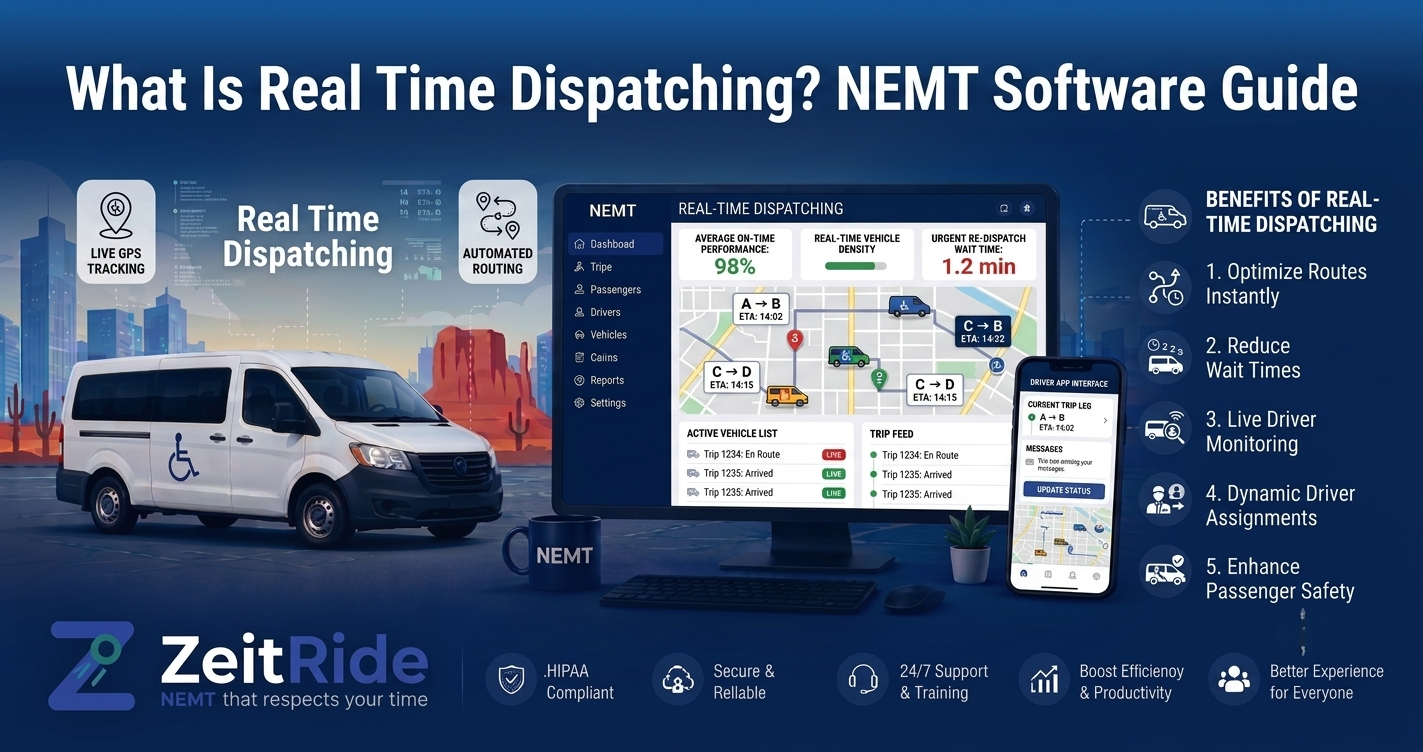
What is real time dispatching?
Learn what real-time dispatching is, how it improves NEMT operations with live GPS, instant trip updates, and smarter driver assignments.
Quick answer
Real-time dispatching is the process of assigning, tracking, and updating trips as they happen using live GPS, driver status, and dispatch software. It helps NEMT fleets respond instantly to delays, cancellations, and new trip requests while improving efficiency and on-time performance.
ZeitRide Team
NEMT Operations Expert
A wheelchair van breaks down at 7:40 AM with a dialysis pickup at 8:00. What is real time dispatching, and why does it matter here? It's the difference between a dispatcher scrambling through a paper board and a system that reassigns the trip to the nearest available driver before the member even notices a delay. ZeitRide runs this kind of reassignment through the same platform that handles scheduling, routing, and billing all for $49 per vehicle, per month, no add-ons.
What Real Time Dispatching Actually Does for Your Fleet
Real time dispatching means assigning, tracking, and adjusting trips as they happen, not the night before. Instead of locking in a manifest at 6 AM and hoping the day goes as planned, a dispatcher working with real time dispatch software sees every vehicle's live location, every driver's status, and every incoming broker request on one screen — and can move trips around as conditions change.
For an NEMT fleet, this isn't a nice-to-have. Appointments get moved, patients cancel same-day, brokers drop in urgent trips, and drivers call out. A dispatcher working off a static plan has to catch every one of those changes manually, often by phone, while a dispatcher working with real time dispatch software gets the change pushed straight to the map and the driver's app.
Three things separate real time dispatching from the old whiteboard-and-radio method:
- Live vehicle location — dispatchers see exactly where every van is, not where it was supposed to be an hour ago
- Instant reassignment — a cancelled trip or a broken-down vehicle gets its trips moved to another driver in seconds, not after a round of phone calls
- Two-way driver communication — trip changes reach the driver's phone directly, with turn-by-turn detail, instead of getting relayed through dispatch
How ZeitRide Handles Real Time Dispatching
ZeitRide was built around the idea that dispatch, scheduling, routing, and billing shouldn't live in four different tools. Here's what real time dispatching looks like inside the platform:
- Live map view of every vehicle, updated continuously through the driver app on iOS and Android — including offline GPS, so tracking doesn't drop when a driver loses signal in a rural stretch
- AI route optimization that recalculates on the fly when a trip is added, cancelled, or delayed — ZeitRide's routing engine averages a 20% reduction in miles driven compared to manually built routes
- One-tap reassignment when a driver calls out or a vehicle needs to come off the road mid-shift
- Broker import for trips coming in from MTM Health, CTS Transit, Provide A Ride, ProCare, DD Med Trans, and Tennessee Carriers, so same-day broker requests drop straight into the live dispatch board instead of an inbox
- Electronic trip records and EVV data captured automatically as trips happen, not reconstructed at the end of the day
See exactly how ZeitRide handles real time dispatching — no pitch, just your workflow on our platform.
Real Time Dispatch Software vs. the Whiteboard-and-Radio Approach
The old approach to NEMT dispatch isn't really a system — it's a manifest printed the night before, a radio, and a dispatcher's memory of which driver is where. That works until something
Legacy dispatch platforms like Bambi, Tobi Cloud, RouteGenie, and TripMaster improved on the whiteboard, but many still charge per trip, per seat, or bolt on real-time tracking as a separate module — often with a $5,000 to $25,000 implementation cost before a single route runs. ZeitRide includes real time dispatch software, scheduling, routing, and billing in the same $49-per-vehicle price, with most providers running their first live route within a day of signing up.
Real Time Dispatching for State-Specific NEMT Operations
Real time dispatching looks a little different depending on where a fleet operates. In Pennsylvania, fleets running rural counties alongside dense Medicaid broker traffic in Philadelphia and Pittsburgh need dispatch software that can reroute a rural trip around a single closed road without derailing three other pickups. In Florida, fleets covering both dense urban routes and long-distance rural transport to regional hospitals lean on real time dispatch software to keep EVV records straight across multiple broker relationships operating in the same coverage area.
In both cases, the software doing the work is the same: live GPS, instant reassignment, and trip records that update automatically — regardless of whether a fleet runs ten vehicles in one county or a hundred across a state. A rural Pennsylvania fleet and a dense Florida urban route face different day-to-day problems, but real-time fleet tracking with dispatch software integration solves both the same way: by giving dispatchers one live picture instead of separate systems for tracking, scheduling, and broker communication.
State-level compliance adds another layer. EVV mandates don't look identical from state to state, and a fleet juggling brokers across county lines needs trip records that satisfy whichever broker or Medicaid program is asking. ZeitRide's routing and billing modules pull from the same live dispatch data, so a trip record generated in a rural Pennsylvania county holds up the same way one generated in urban Florida does — no separate spreadsheet, no manual reconciliation at the end of the month.
What NEMT Operators Get Wrong About Real Time Dispatching
The most common mistake is treating real time dispatching as a feature to add on top of an existing scheduling tool, rather than something built into the core of the platform. Bolting live GPS tracking onto software that wasn't designed for it usually means the tracking data doesn't talk to the scheduling engine, so a dispatcher still has to manually cross-reference two screens to figure out who's free.
The second mistake is assuming real time dispatching only matters for large fleets. A five-vehicle operation loses just as much time chasing down a single vehicle's location by phone as a fifty-vehicle fleet does — it just feels less urgent until a driver calls out on a busy morning.
The third is underestimating what real-time fleet tracking with dispatch software integration does for billing accuracy. When trip records populate automatically from live GPS and dispatch data instead of a driver's memory at the end of a shift, broker remittance disputes drop because the electronic trip record matches what actually happened on the road.
The fourth mistake is assuming a driver app has to be complicated to be useful. Drivers switching from paper manifests or a clunky legacy app worry about a steep learning curve. ZeitRide's driver app is built with a learning curve under 15 minutes, specifically because a dispatcher's real time reassignment only works if the driver on the other end can actually follow the update without a phone call walking them through it.
Bottom Line on Real Time Dispatching
Real time dispatching turns a fleet from reactive to responsive — trips get reassigned in seconds instead of phone calls, and trip records build themselves instead of getting reconstructed after the fact. ZeitRide runs this on the same platform as scheduling, routing, and billing, at $49 per vehicle per month with no setup fees or contracts. Start your first live route within a day. $49 per vehicle. No contracts. Book your demo.
Frequently Asked Questions
Q: What is real time dispatching in NEMT software?
Real time dispatching is the live assignment and adjustment of trips as they happen, using GPS and driver status instead of a plan set the night before. In ZeitRide, this runs through the same $49-per-vehicle platform that also handles scheduling, routing, and billing.
Q: How is real time dispatch software different from regular scheduling software?
Scheduling software plans trips in advance; real time dispatch software adjusts those trips as conditions change during the day. ZeitRide combines both, so a broker trip that comes in mid-morning gets scheduled and dispatched from the same live board.
Q: Does real time dispatching work without cell signal?
Yes — ZeitRide's driver app includes offline GPS, so a vehicle in a rural area with weak signal still tracks and syncs once connectivity returns.
Q: How does real-time fleet tracking with dispatch software integration help with Medicaid compliance?
It creates an electronic trip record automatically as trips happen, which supports EVV requirements and gives operations directors a defensible record during broker or Medicaid audits, instead of reconstructed paperwork.
Rather see it than read about it?
Bring a real route, a couple of drivers, and your current process. 15 minutes, zero pitch.