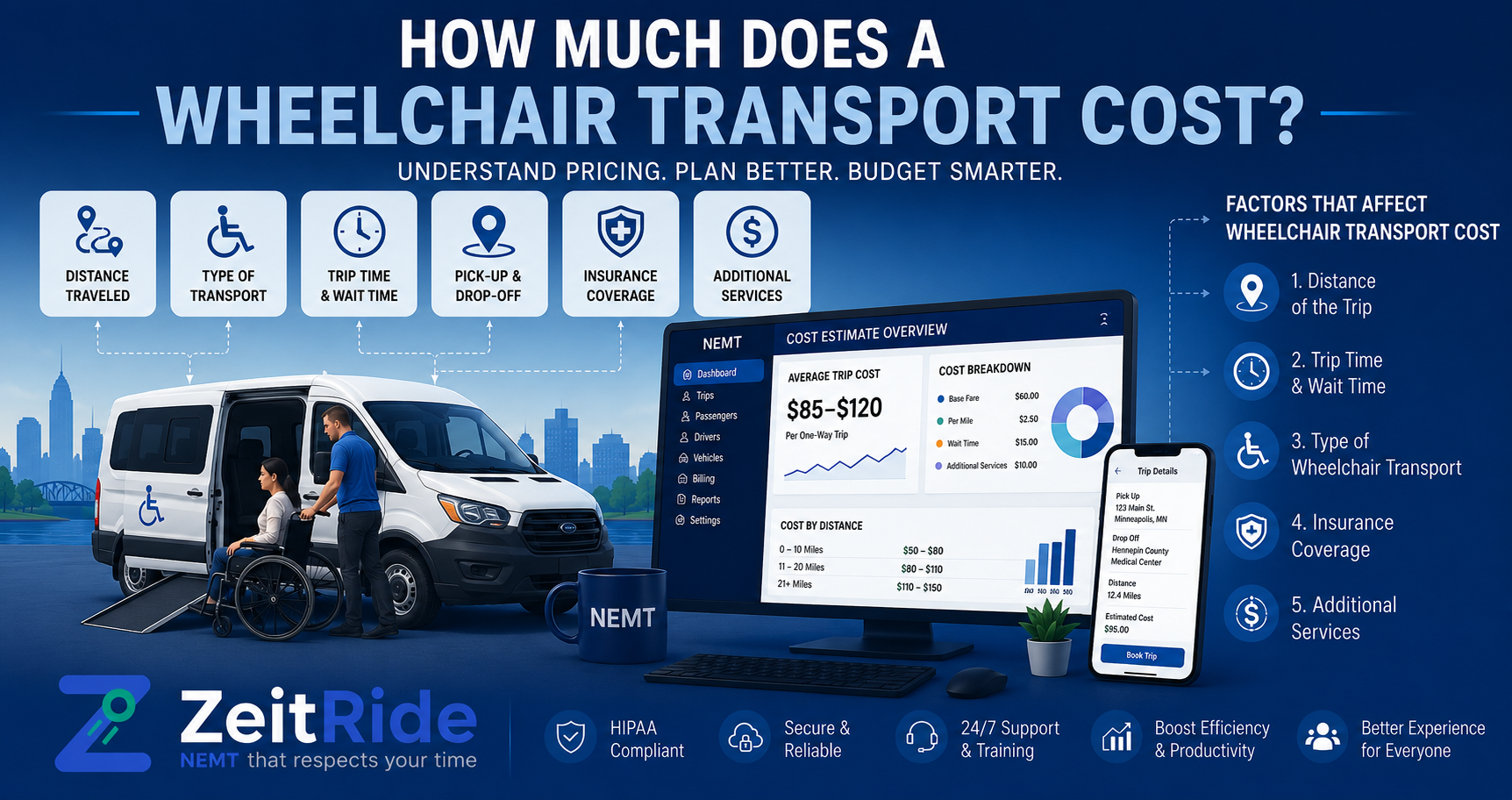
How much does a wheelchair transport cost?
Wheelchair transport typically costs $45–$115 per trip. Learn what affects pricing, Medicaid coverage, mileage fees, and NEMT billing.
Quick answer
Wheelchair transportation typically costs $45–$115 per trip during standard business hours, with higher rates for longer distances, evenings, weekends, holidays, or additional assistance.
ZeitRide Team
NEMT Operations Expert
How much does a wheelchair transport cost? Rates typically run $45–$115 for a standard trip during business hours, climbing higher for weekends, holidays, or longer distances — and if your fleet doesn't have a clear rate structure behind those numbers, pricing turns into a guessing game trip by trip. ZeitRide's billing software applies the correct rate and payer rules to every wheelchair ride automatically, which is exactly what keeps a variable pricing model from becoming a manual headache for your dispatchers.
What Drives the Cost of Wheelchair Transportation
Wheelchair transportation costs more than ambulatory rides because it requires specialized vehicles, trained staff, and equipment like ramps and securement systems that ambulatory service doesn't need. A handful of factors set the final price on any given trip:
- Time of day — standard business-hours rates typically run $45–$65 per trip, while weekend, evening, or holiday trips often run 50–100% higher
- Distance — most providers include a small number of free miles, then charge $3–$5 per mile beyond that, with rates climbing further on weekends or holidays
- Wait time — many wheelchair van service providers charge $15–$30 per 30-minute increment once a driver waits past a grace period
- Level of assistance — an extra attendant, oxygen support, or stair-chair assistance typically adds $5–$25 per trip
- Payer type — Medicaid-covered trips are billed at the state's fee schedule, while private-pay wheelchair rides are billed directly to the rider or family
These numbers vary by market — urban areas generally run higher than rural ones — but the structure is consistent across the industry. ZeitRide provides NEMT billing software that applies these rate variables automatically per trip, so a dispatcher doesn't have to manually calculate mileage overages or holiday surcharges before a rider gets a quote.
How ZeitRide Handles Wheelchair Transportation Pricing
Fleets running wheelchair accessible transportation services alongside ambulatory and stretcher trips need a system that applies the right rate without manual lookup every time. Here's what that looks like inside ZeitRide:
- Rate rules configured per trip type — wheelchair, ambulatory, stretcher — so pricing is consistent across every driver and shift
- Automatic mileage calculation built into routing software that also cuts miles driven by an average of 20% through AI-based route optimization
- Broker-specific billing for Medicaid trips through MTM Health, Provide A Ride, ProCare, and DD Med Trans, formatted correctly for each broker's claim requirements
- Stripe-based private pay processing for wheelchair rides billed directly to riders or families
- Trip manifests and electronic trip records generated automatically, satisfying EVV and HIPAA documentation requirements without extra steps for the driver
What Is a Transport Wheelchair and Why the Terms Get Confused
What is a transport wheelchair? It's a lightweight wheelchair designed to be pushed by an attendant rather than self-propelled by the user — smaller wheels, a simpler frame, and no hand rims, built for short-distance use like moving between a vehicle and a waiting room. It's a piece of equipment, not a service, which is where the confusion with wheelchair transportation usually starts. A transport wheelchair gets a rider from the curb to the door. Wheelchair transportation is the NEMT service that gets them from home to the appointment in the first place, using a vehicle equipped with a ramp or lift and proper securement.
Some wheelchair van service providers keep a transport wheelchair on hand for riders who need one during pickup or drop-off — H&M Transport, for example, offers to bring one at no charge if a rider requests it in advance. That's a small operational detail, but it's the kind of thing that shows up in real search queries from riders trying to understand what they're booking, and it's worth addressing directly so operators aren't caught off guard by the question.
What Fleets Get Wrong About Wheelchair Transport Pricing
The most common mistake fleets make with wheelchair transportation pricing is setting one flat rate and applying it to every trip regardless of time, distance, or payer. That works until a weekend trip loses money because the rate never accounted for after-hours staffing costs, or a Medicaid trip gets billed at a rate the broker won't reimburse. Real wheelchair transportation cost needs to reflect the actual variables — business hours versus after-hours, mileage tiers, and payer-specific fee schedules — or the fleet ends up subsidizing certain trip types without realizing it.
The second mistake is treating Medicaid and private-pay wheelchair rides as if they can share a rate card. Medicaid brokers set fixed reimbursement rates per trip type, and billing above that rate doesn't get a fleet more money — it just creates a rejected claim. Private-pay rides, by contrast, can be priced with more flexibility since there's no fee schedule to match. Mixing the two without a system to separate them leads to either underbilling private-pay riders or submitting Medicaid claims that don't match the broker's schedule.
The third mistake is underestimating wait-time and mileage overage tracking. A dispatcher manually calculating mileage after the fact, rather than at time of booking, means riders and payers get inconsistent quotes — and inconsistent billing is one of the fastest ways to trigger a dispute with a broker or an unhappy private-pay customer.
Wheelchair Transport Rates in Pennsylvania and Florida
Wheelchair transportation costs and Medicaid reimbursement rates differ by state, and Pennsylvania and Florida each have their own broker networks and fee schedules fleets need to track. Both states have significant Medicaid managed care populations relying on wheelchair van service for dialysis, therapy, and routine medical visits, and both require accurate EVV documentation to support broker claims. Fleets operating in either state need billing software that applies the correct state-specific rate without manual cross-referencing. See how ZeitRide supports operators in Pennsylvania and Florida.
Bottom Line
How much does a wheelchair transport cost comes down to time of day, distance, level of assistance, and payer type — and fleets that price those factors consistently avoid the billing disputes that come from guesswork. ZeitRide applies the right rate to every wheelchair trip automatically, with providers seeing a 20% average reduction in miles driven and most fleets running their first live route within a day of setup. Start your first live route within a day. $49/vehicle. No contracts. Book your demo.
Frequently Asked Questions
Q: How much does a wheelchair transport cost on average?
Standard business-hours wheelchair transport typically costs $45–$115 per trip, depending on distance and provider. Weekend, holiday, or after-hours trips often run 50–100% higher, and mileage beyond a provider's included distance adds $3–$5 per mile or more.
Q: What is a transport wheelchair, and is it the same as a wheelchair van?
A transport wheelchair is a lightweight, attendant-pushed wheelchair used for short distances, not a vehicle. Wheelchair transportation, sometimes called wheelchair van service, is the NEMT service that uses a ramp- or lift-equipped vehicle to move riders between locations.
Q: Does Medicaid cover wheelchair transportation costs?
Yes, in most cases. Medicaid typically covers wheelchair transportation when it's deemed medically necessary, billed through a state fee schedule or a broker such as MTM Health, Provide A Ride, ProCare, or DD Med Trans.
Q: Why do wheelchair transportation services cost more than ambulatory rides?
Wheelchair accessible transportation services require specialized vehicles with ramps or lifts, trained staff for safe securement, and additional loading and unloading time. Those factors add cost compared to a standard ambulatory trip.
Rather see it than read about it?
Bring a real route, a couple of drivers, and your current process. 15 minutes, zero pitch.