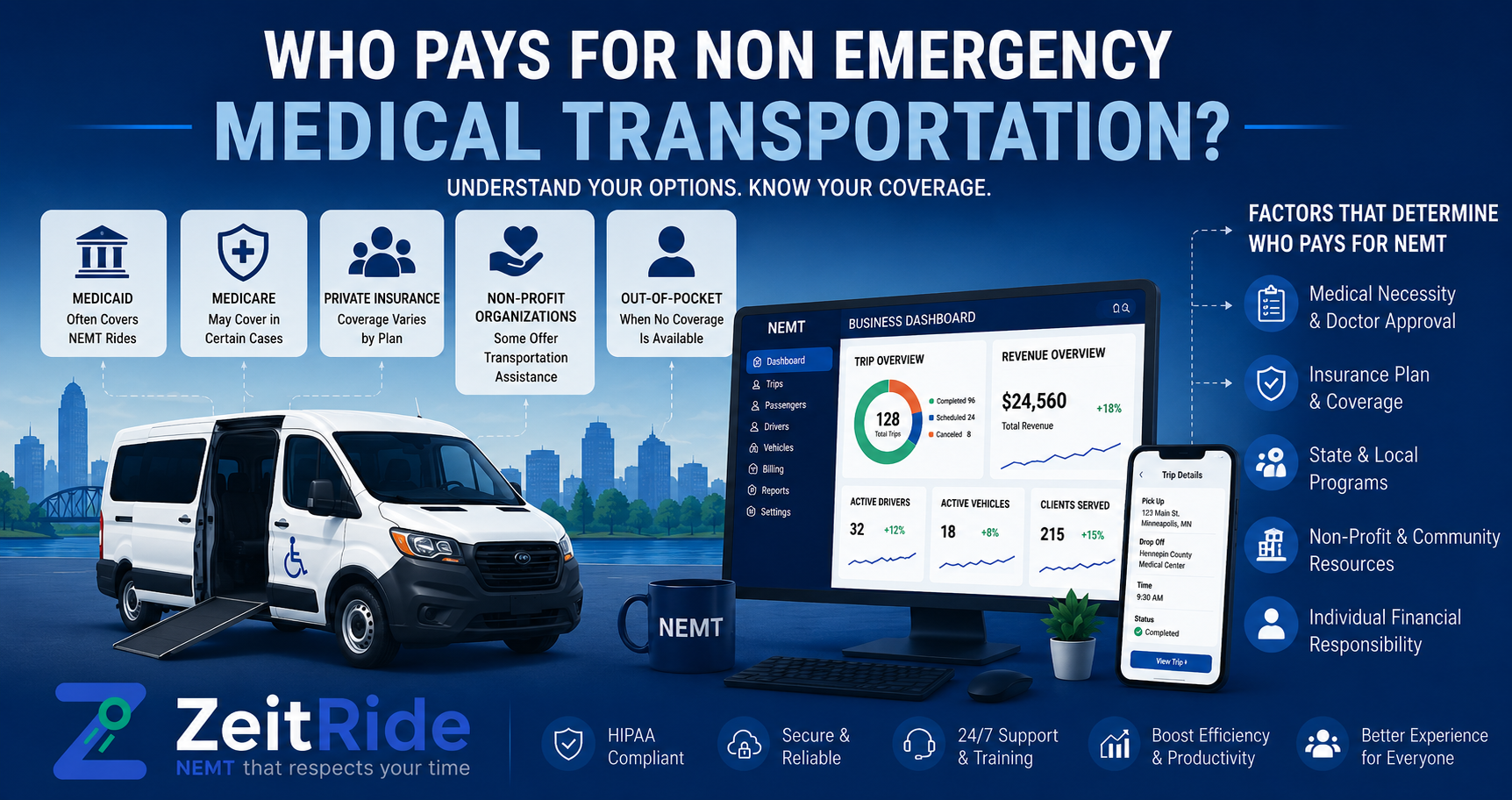
Who pays for non emergency medical transportation
Medicaid and private pay all cover non-emergency medical transportation differently. Here's who pays for what and what it means for your fleet's billing.
Quick answer
Medicaid pays for most non-emergency medical transportation, since federal law requires every state to guarantee it for eligible beneficiaries. Original Medicare covers only non-emergency ambulance transport under strict medical necessity rules, not routine rides.
ZeitRide Team
NEMT Operations Expert
Who pays for non emergency medical transportation depends on who's riding, where they live, and which payer they're enrolled with and if your fleet bills more than one payer type, you already know that answer changes trip to trip. Medicaid covers most of it under federal law. Medicare covers almost none of it. Everyone else falls somewhere in between. ZeitRide runs the billing side of this for fleets in 10+ states, and the providers who get paid fastest are the ones whose software tracks each payer's rules automatically instead of guessing per trip.
What Determines Who Pays for Medical Transport, Non Emergency Trips Specifically
The payer for any non-emergency ride comes down to three things: the rider's coverage, the state's Medicaid delivery model, and whether the trip meets that payer's definition of medical necessity. Medical transport, non-emergency trips aren't billed like ambulance runs — there's no 911 dispatch record backing the claim, so the paperwork has to prove the trip was necessary on its own.
Here's how the major payers break down:
- Medicaid — the largest and most consistent payer. Federal regulation (42 CFR § 431.53) requires every state to guarantee transportation for Medicaid beneficiaries who have no other way to reach a covered medical service. States run this through Fee-for-Service billing, Managed Care organizations, or a dedicated broker like MTM Health, Provide A Ride, ProCare, or DD Med Trans.
- Medicare — narrow coverage. Original Medicare pays for non-emergency ambulance transport only when a physician certifies it's medically necessary and no other transport option is safe. It does not cover routine wheelchair van or ambulatory rides to a checkup.
- Medicare Advantage — some plans add limited non-emergency transportation as a supplemental benefit, usually capped at a set number of one-way trips per year and often requiring a specific broker.
- Private insurance — inconsistent. A handful of plans include NEMT for chronic condition management (dialysis, chemo, physical therapy), but most exclude it entirely.
- Private pay — riders or families cover the trip directly, either because no payer applies or because they want scheduling flexibility a broker-managed trip doesn't allow.
If your dispatch team can't tell at a glance which bucket a rider falls into, every trip becomes a guessing game — and guessing games turn into denied claims. See how ZeitRide's dispatch software flags payer type before the vehicle even leaves the lot.
How ZeitRide Handles Multi-Payer Billing
Fleets running Medicaid, Medicare Advantage, and private-pay trips in the same week need billing that doesn't require three different processes to stay compliant. ZeitRide's billing software is built around one flat structure that adapts to whichever payer is attached to the trip:
- Trip manifests and electronic trip records generate automatically per ride, tagged to the correct payer and broker
- Broker-specific claim formatting for MTM Health, Provide A Ride, ProCare, and DD Med Trans, so nothing bounces for a formatting mismatch
- EVV-compliant timestamps and digital signatures captured at pickup and drop-off, satisfying Medicaid documentation requirements without extra driver steps
- Encrypted, HIPAA-aware storage for every trip record, whether the rider is Medicaid, Medicare Advantage, or private pay
- One flat fee — $49 per vehicle, per month — whether you're billing one payer or five, with no per-trip or per-broker add-on charges
How Much Does Medicaid Pay for Non Emergency Transportation and What Operators Get Wrong
How much does Medicaid pay for non-emergency transportation depends entirely on the state, but 2026 rates generally run $25–$90 for ambulatory trips, $45–$120 for wheelchair transport, and $100–$250+ for stretcher trips, with urban markets typically paying more than rural ones. The most common mistake operators make is assuming Medicaid reimbursement rates are fixed nationally they're not. Each state Medicaid agency sets its own fee schedule, and rates shift year to year based on budget priorities, not just cost of care.
The second mistake: treating every Medicaid trip the same way regardless of the delivery model. A trip billed under Fee-for-Service goes straight to the state. A trip under Managed Care goes through the health plan. A trip under a broker arrangement goes through whichever broker holds that region's contract and each has its own submission window, documentation standard, and appeal process. Miss a broker's filing deadline and the claim is gone, no matter how legitimate the trip was.
The third mistake is underestimating how much Medicare confusion costs a fleet. Original Medicare doesn't pay for routine non-emergency rides only for non-emergency ambulance transport that meets strict medical necessity criteria, and even then it requires a Physician Certification Statement. Providers who bill Medicare like it works the same as Medicaid end up with a pile of denials and no clear reason why.
Does Medicare Cover Non-Emergency Medical Transportation NEMT Straight Answer
Does Medicare cover non-emergency medical transportation NEMT services the way Medicaid does? No. Original Medicare covers non-emergency ambulance transport only in narrow, medically necessary circumstances — not routine wheelchair van or ambulatory rides to a doctor's office. Some Medicare Advantage plans add limited NEMT as a supplemental benefit, but coverage varies by plan, and in 2026 only a minority of individual plans include it at all. Special Needs Plans, particularly Dual Special Needs Plans for people enrolled in both Medicare and Medicaid, tend to offer the strongest transportation benefits.
For fleets, this means Medicare Advantage trips need separate handling from Medicaid trips — different brokers, different trip caps, different prior authorization rules. ZeitRide's routing software applies AI-based route optimization to every trip regardless of payer, averaging a 20% reduction in miles driven — which matters more when Medicare Advantage plans cap the number of trips a rider gets per year and every mile has to count.
Does Medicaid Pay for an Ambulance and How That Differs from NEMT Billing
Does Medicaid pay for an ambulance? Yes, but only for medically necessary transport — emergency ambulance rides are billed and reimbursed separately from routine non-emergency medical transport, and non-emergency ambulance trips require documented medical necessity, such as a bed-confined patient who can't be safely transported by wheelchair van. This is a different billing category from standard NEMT, with its own HCPCS codes and its own prior authorization path. Fleets that also run ambulance-level transport need to track that distinction carefully — mixing ambulance claims with standard wheelchair or ambulatory trip billing is one of the fastest ways to trigger a Medicaid audit.
If your fleet operates in Pennsylvania or Florida, broker relationships and rate schedules differ from state to state, and both markets have their own Medicaid managed care structures worth understanding before you scale. See how ZeitRide supports operators in Pennsylvania and Florida.
Bottom Line
Who pays for non-emergency medical transportation isn't one answer — it's Medicaid, Medicare Advantage, private insurance, and private pay, each with different documentation and billing rules your fleet has to track correctly to get paid. ZeitRide handles that variation automatically, at $49 per vehicle per month, with providers seeing a 20% average reduction in miles driven and most fleets running their first live route within a day of setup. Start your first live route within a day. $49/vehicle. No contracts. Book your demo.
Frequently Asked Questions
Q: Who pays for non emergency medical transportation most often?
Medicaid pays for the majority of non-emergency medical transportation nationwide because federal law requires every state to guarantee it for eligible beneficiaries. Medicare, private insurance, and private pay cover the remaining share, each with narrower or less consistent rules.
Q: How much does Medicaid pay for non emergency transportation in 2026?
Rates vary by state, but typical 2026 ranges run $25–$90 for ambulatory trips and $45–$120 for wheelchair trips. Check your state Medicaid agency's current fee schedule, since rates are adjusted yearly and vary by delivery model.
Q: Does Medicare cover non-emergency medical transportation NEMT services at all?
Original Medicare does not cover routine non-emergency rides, only non-emergency ambulance transport meeting strict medical necessity rules. Some Medicare Advantage plans add limited NEMT as a supplemental benefit, but availability and trip caps vary widely by plan.
Q: Does Medicaid pay for an ambulance the same way it pays for a wheelchair van trip?
No. Ambulance transport, even non-emergency, is billed under separate codes and requires its own documentation of medical necessity. Wheelchair van and ambulatory NEMT trips follow standard Medicaid transportation billing instead.
Rather see it than read about it?
Bring a real route, a couple of drivers, and your current process. 15 minutes, zero pitch.