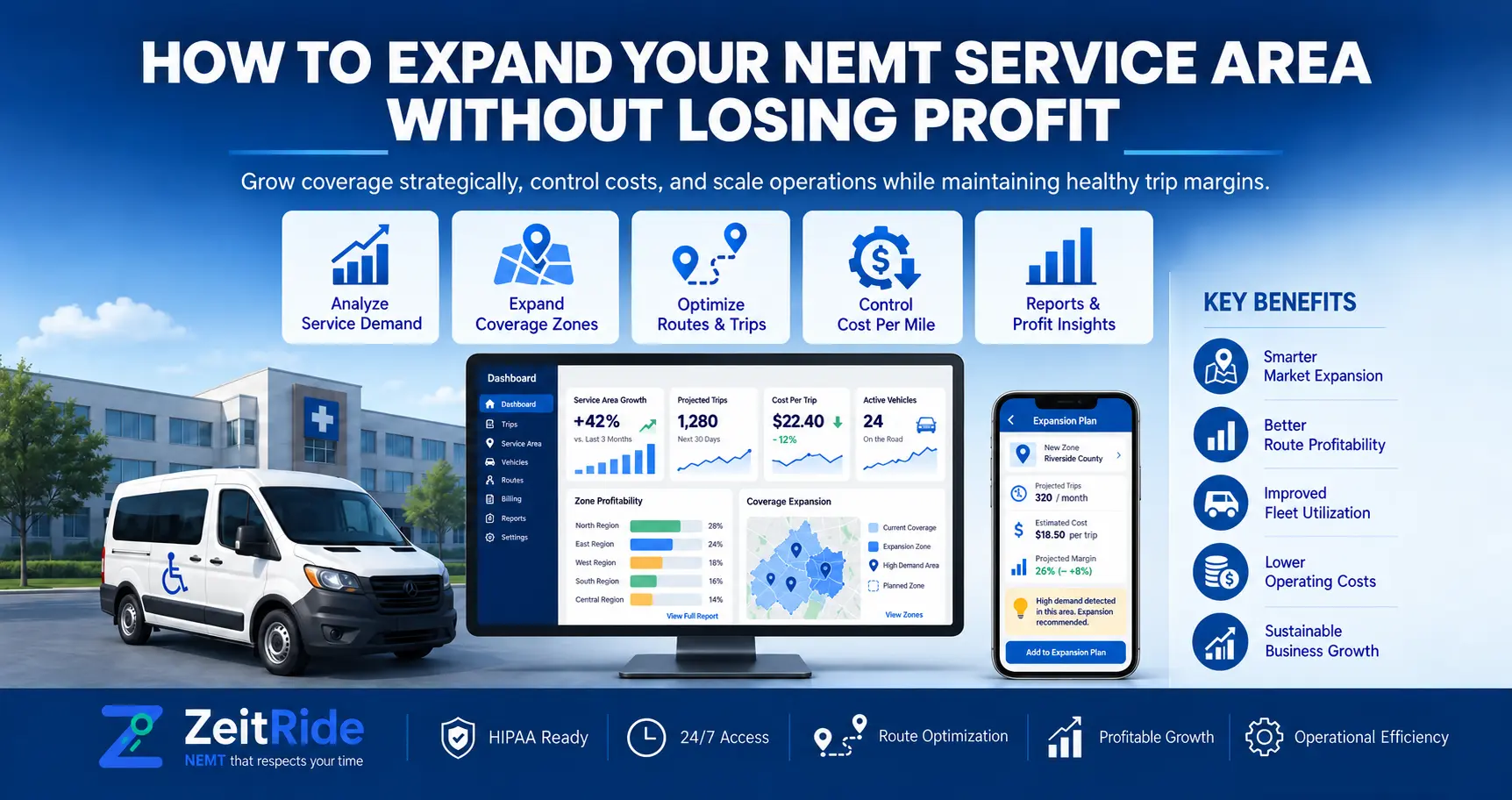
How to Expand Your NEMT Service Area Without Losing Profit
Learn how to expand your NEMT service area by evaluating demand, deadhead, fleet capacity, broker access, and profitability before you grow.
Quick answer
An NEMT provider should expand only after validating trip demand, broker access, fleet and driver capacity, deadhead, and trip economics. Pilot the new area first and compare its performance with the current territory before scaling.
ZeitRide Team
NEMT Operations Expert
Growing into another ZIP code or county can bring more trips, but a larger map does not automatically create a better NEMT business. New territory can also add deadhead, longer driver shifts, weaker route density, vehicle pressure, and more complex dispatch decisions. That is why learning how to expand NEMT service area coverage should start with your operating data—not with how far your vehicles can physically travel.
A strong NEMT service area expansion decision answers a different question: can your fleet serve the new geography repeatedly while maintaining reasonable trip economics, vehicle utilization, and service performance? Before adding territory permanently, establish your current baseline, evaluate real demand, model the additional operating burden, and test the area with a controlled pilot.
What Is NEMT Service Area Expansion?
NEMT service area expansion means adding new geographic territory—such as ZIP codes, cities, counties, or neighboring regions—to the area your transportation company routinely serves. Successful expansion requires more than finding potential passengers. A provider also needs enough trip concentration, appropriate reimbursement, available drivers and vehicles, workable travel times, broker or facility demand, and the ability to maintain existing service standards.
A useful way to think about it is this: a good service area is not simply somewhere your vehicles can reach. It is an area your fleet can serve repeatedly without creating unsustainable operating complexity.
When Should You Expand Your NEMT Service Area?
The right time to expand is usually when evidence of demand and available capacity appear together. Common readiness signals include recurring requests from outside your current territory, brokers asking for additional geographic coverage, facilities referring riders from nearby areas, available vehicle capacity during relevant hours, existing routes already reaching the edge of the proposed area, and stable service performance in your current territory.
Expansion deserves more caution when your present operation is already struggling with late pickups, excessive deadhead, low vehicle utilization, staffing shortages, or unreliable trip coverage. Before adding more geography, review your existing NEMT fleet reports. Expansion should build on an operation that is measurable enough to compare before and after performance.
Establish Your Current Service Area Baseline
You cannot judge a new territory without knowing how your existing one performs. Start by measuring the operating metrics that show whether your current service area is efficient enough to support growth.
- Trips requested and completed
- Trips per vehicle
- Vehicle utilization
- Productive versus empty mileage
- Average driver hours
- On-time performance
- Trip revenue
- Cost per trip
- Broker and facility mix
- Cancellations and no-shows
Analyze these metrics by geography where possible. One side of your existing NEMT service radius may already generate dense recurring transportation, while another direction may require long empty repositioning between unrelated trips. Your current operation becomes the benchmark against which the proposed territory should be tested.
Use an NEMT Service Area Expansion Scorecard
Before committing vehicles or hiring drivers, evaluate each proposed territory using the same decision framework. This makes expansion decisions more consistent and reduces the risk of approving a new area based only on trip volume or one attractive contract.
| Factor | What to Review | Warning Sign |
|---|---|---|
| Trip demand | Actual requests and referral opportunities | Interest but little repeat demand |
| Trip density | How closely trips cluster by geography and time | Widely scattered trips |
| Deadhead | Empty travel required to enter, move within, and leave the area | Long unpaid repositioning |
| Broker access | Whether brokers can assign work in the territory | No clear trip source |
| Facility demand | Hospitals, dialysis centers, SNFs, clinics, and care facilities | Few repeat trip generators |
| Reimbursement | Expected collected revenue compared with added cost | Rates do not support the additional travel |
| Vehicle capacity | Available vehicles at required times | Current fleet is already near capacity |
| Driver coverage | Qualified drivers and available hours | Expansion repeatedly extends shifts |
| Service performance | Effect on pickup windows and current routes | Existing riders become harder to serve |
| Compliance | State, payer, broker, and local requirements | New requirements remain unresolved |
Do not turn the scorecard into a universal numerical benchmark. The economics of an urban fleet, a rural provider, and a wheelchair-heavy operation can be very different. The purpose of the scorecard is to make the decision consistent and evidence-based.
Define the NEMT Service Radius by Economics, Not Distance
A service radius drawn around your office can be misleading. A destination 25 miles away may fit efficiently when it aligns with an existing route, while a closer area can create substantial empty travel because trips are scattered or poorly timed. This is where NEMT route optimization becomes important.
- Loaded miles
- Deadhead miles
- Time between trips
- Return-trip opportunities
- Route compatibility
- Peak-hour travel
- Starting and ending driver locations
The question is not simply, “Can we drive there?” The better question is, “Can we repeatedly serve this area without adding too much nonproductive time and mileage?”
Will the New NEMT Service Area Be Profitable?
NEMT service area profitability should be evaluated using incremental economics. A simple planning model is: Expected territory contribution = Collected trip revenue − Incremental operating costs.
- Driver time
- Fuel
- Deadhead mileage
- Maintenance
- Additional vehicle capacity
- Overtime
- Tolls or parking
- Administrative or dispatch effort
Do not judge a new territory from the advertised broker rate alone. Compare expected revenue with your real operating cost. The NEMT cost per trip calculator can support the underlying trip-cost analysis, while NEMT broker rates should be reviewed separately when reimbursement is the main concern.
Validate Broker and Facility Demand Before Expanding
Potential population is not the same as bookable transportation demand. Before permanently entering another county or ZIP cluster, identify where trips could realistically originate.
- Brokers active in the territory
- Existing contracts and service boundaries
- Dialysis centers
- Hospitals
- Skilled nursing facilities
- Rehabilitation centers
- Behavioral health facilities
- Senior-care organizations
- Recurring private-pay sources
Use U.S. Census Bureau QuickFacts and official Medicaid state profiles to understand the broader market, but validate demographic information with real referral and trip opportunities. If the proposed area requires new payer or facility relationships, review your NEMT contracts strategy before committing additional capacity.
Does Your Current Fleet Have Enough Capacity?
More trip demand does not automatically mean another vehicle should be purchased. First determine whether the existing fleet has unused capacity or whether inefficient allocation is making the operation look full.
- Utilization by vehicle
- Trips per vehicle
- Peak-time availability
- Vehicle type requirements
- Driver availability
- Recurring route commitments
- Existing deadhead
If capacity exists at the wrong time or in the wrong part of the service area, expansion may require operational redesign rather than simply adding assets. Use NEMT routing software to evaluate how geography, trip timing, vehicle availability, and stop order interact as the service area grows.
Pilot New ZIP Codes Before Expanding Permanently
A controlled pilot is one of the safest ways to test an NEMT expansion strategy. Instead of opening an entire county at once, start with a smaller ZIP-code cluster, broker assignment group, facility network, or recurring route pattern.
Track the pilot separately and compare its economics and service performance with your existing territory.
| Metric | Existing Territory | Pilot Territory |
|---|---|---|
| Completed trips | Baseline | Pilot result |
| Revenue per trip | Baseline | Pilot result |
| Cost per trip | Baseline | Pilot result |
| Deadhead | Baseline | Pilot result |
| Driver hours | Baseline | Pilot result |
| Vehicle utilization | Baseline | Pilot result |
| On-time performance | Baseline | Pilot result |
| Exceptions | Baseline | Pilot result |
Do not decide from trip volume alone. High demand can still produce weak economics when vehicles spend too much time traveling empty or when new work disrupts profitable existing routes.
Use a Go, Pilot, or Hold Decision
After collecting enough real operating data, classify the proposed territory into one of three decisions.
Go
Demand, economics, capacity, and service performance support routine expansion.
Pilot
The territory looks promising, but more real trip data is needed before committing permanent capacity.
Hold
Demand may exist, but current reimbursement, deadhead, staffing, capacity, or service-performance risk does not yet support expansion. Hold does not necessarily mean never; it means the operating case has not been proven yet.
How Software Helps Manage a Larger Service Area
Geographic growth increases the number of decisions dispatchers make every day. Trips arrive from more locations, drivers cover more territory, routes overlap differently, and one cancellation or late appointment can affect vehicles much farther apart.
Connected NEMT dispatch software and routing make it easier to view available drivers, vehicle capacity, trip timing, route changes, and geographic workload in the same operational workflow. The goal is not simply more technology; it is better visibility into where demand is growing, which vehicles have capacity, where the fleet is driving empty, and whether expansion is strengthening or weakening the operation.
NEMT Service Area Expansion Checklist
- Identify real trip demand
- Review broker and facility access
- Define the proposed service radius
- Estimate deadhead mileage and time
- Calculate expected trip economics
- Review vehicle capacity
- Confirm driver coverage
- Check applicable requirements
- Test the territory through a controlled pilot
- Compare pilot results with the existing service area
- Review the impact on on-time performance
Expansion should be a measured operating decision—not simply a response to more requests.
Frequently Asked Questions
Q: How do I know if my NEMT business is ready to expand its service area?
Look for repeat demand outside your current territory, available fleet and driver capacity, stable service performance, workable trip economics, and clear broker or facility opportunities. Expansion is safer when these factors appear together.
Q: How large should an NEMT service radius be?
There is no universal ideal radius. The practical boundary depends on trip density, deadhead, reimbursement, traffic, vehicle capacity, driver coverage, and whether the area can be served without weakening existing operations.
Q: How do deadhead miles affect NEMT service area profitability?
Deadhead adds driver time, fuel, mileage, and vehicle wear without a passenger generating trip revenue. A new territory can therefore produce more trips while still weakening margins if empty travel rises too much.
Q: Should an NEMT company expand into another county?
Expand only after confirming actual demand, broker or facility access, compliance requirements, fleet capacity, driver coverage, and workable trip economics. A limited pilot can help test the county before permanent expansion.
Q: Should I add vehicles before expanding my NEMT service area?
Not automatically. First determine whether existing vehicles are truly at capacity or whether routing, scheduling, deadhead, or workload distribution is limiting utilization. Add capacity when the operating data shows it is actually required.
Expand Only When the Data Supports It
The best answer to how to expand NEMT service area coverage is to make geography earn its place in your operation. Measure the current baseline, validate actual demand, understand deadhead and reimbursement, check fleet and driver capacity, run a controlled pilot, and compare the new territory with the operation you already know.
A larger service area is valuable when it creates sustainable, manageable transportation—not merely more miles on the map. ZeitRide connects scheduling, dispatch, routing, driver workflows, and reporting so growing fleets can see how new territory affects daily operations. Book a 15-minute demo and bring one current service area plus one proposed expansion area to see how the workflow could be managed in ZeitRide.
Rather see it than read about it?
Bring a real route, a couple of drivers, and your current process. 15 minutes, zero pitch.